PRKD1 (Protein Kinase D1)
2006-01-01 C Du , M Jaggi , W Zhang , KC Balaji AffiliationDivision of Urology, University of Massachusetts Memorial Medical Center, 55 Lake Avenue North, Worcester, MA 01605, USA
Identity
HGNC
LOCATION
14q12
LOCUSID
ALIAS
CHDED,PKC-MU,PKCM,PKD,PRKCM
FUSION GENES
DNA/RNA
Description
The gene spans over 351 kb and the transcript consists of 18 exons
Transcription
About 3.8 kb in length; Expressed in several organs with highest expression in kidney, heart and lungs.
Proteins
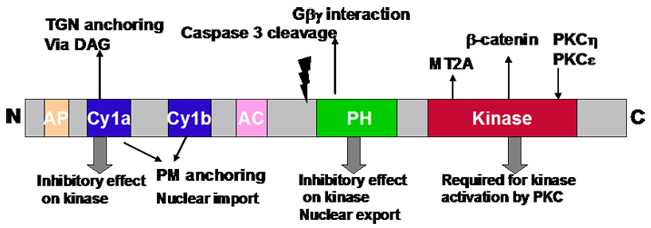
Description
912 amino acids residues, 120 kDa on SDS-PAGE gel; contains an alanine and proline rich (AP), two cysteine-rich domains (CysI and CysII), acidic (AC), pleckstrin homology (PH) and kinase domain (KD). Several domain specific protein interactions and functions have been described (see figure below).
Localisation
In rested cells, the majority of PKD1 are in the cytoplasm. When activated by phorbol ester, PKD1 rapidly moves to plasma membrane and nucleus.
Function
Serine/threonine kinase; protein kinase C downstream effector; intracellular trafficking;
PKD1 has been shown to play a role in proliferation of keratinocytes in skin, B and T lymphocytes and mast cells signaling, possible role in development of central tolerance in thymus gland, proliferation of pancreatic cancer cells, cardiac myocyte contraction, endothelial cell proliferation, osteoblasts differentiation, and prostate cancer cells adhesion and invasion.
PKD1 has been shown to play a role in proliferation of keratinocytes in skin, B and T lymphocytes and mast cells signaling, possible role in development of central tolerance in thymus gland, proliferation of pancreatic cancer cells, cardiac myocyte contraction, endothelial cell proliferation, osteoblasts differentiation, and prostate cancer cells adhesion and invasion.
Homology
Homologues present in mouse and rat.
Implicated in
Entity name
Advanced prostate cancer
Disease
PKD1 phosphorylates E-cadherin in prostate cancer cell lines. E-cadherin phosphorylation is associated with altered cellular aggregation and motility in prostate cancer. Inhibition of PKD1 activity by the selective inhibitor Go6976 in LNCaP cells resulted in decreased cellular aggregation and over expression of PKD1 in C4-2 prostate cancer cells increased cellular aggregation and decreased cellular motility.
Entity name
Cardiac hypertrophy
Disease
Transcriptional regulation of gene expression is tightly coupled to histone deacetylases (HDAC) and histone acetyltransferase (HAT) that modify the access of transcription factors to DNA binding sites. PKD1 has been shown to participate in nuclear export of HDAC5. HDAC5 is phosphorylated by PKD1 in cardiac myocytes, which results in the binding of 14-3-3 protein to the phosphoserine motif on HDAC5, thus leading to nuclear export through a CRM1-dependent mechanism. This results in increased transcriptional activity of hypertrophy mediating genes in myocytes. Cardiac failure is usually preceded by cardiac hypertrophy that is mediated by altered gene expression involved in myocyte contraction, calcium handling and metabolism. PKD1 specific inhibitors may be of benefit in limiting cardiac hypertrophy.
Article Bibliography
| Pubmed ID | Last Year | Title | Authors |
|---|---|---|---|
| 10442635 | 1999 | An invasion-related complex of cortactin, paxillin and PKCmu associates with invadopodia at sites of extracellular matrix degradation. | Bowden ET et al |
| 11777941 | 2002 | Structural requirements for localization and activation of protein kinase C mu (PKC mu) at the Golgi compartment. | Hausser A et al |
| 10092600 | 1999 | Protein kinase C mu is negatively regulated by 14-3-3 signal transduction proteins. | Hausser A et al |
| 15695390 | 2005 | E-cadherin phosphorylation by protein kinase D1/protein kinase C{mu} is associated with altered cellular aggregation and motility in prostate cancer. | Jaggi M et al |
| 8119958 | 1994 | PKCu is a novel, atypical member of the protein kinase C family. | Johannes FJ et al |
| 11943587 | 2002 | Getting to know protein kinase D. | Lint JV et al |
| 10859332 | 2000 | Protein kinase D. A selective target for antigen receptors and a downstream target for protein kinase C in lymphocytes. | Matthews SA et al |
| 11641411 | 2001 | Regulated nucleocytoplasmic transport of protein kinase D in response to G protein-coupled receptor activation. | Rey O et al |
| 15701647 | 2005 | Protein kinase D signaling. | Rozengurt E et al |
| 12829240 | 2003 | Protein kinase D: a family affair. | Rykx A et al |
| 8885868 | 1996 | Protein kinase C mu (PKC mu) associates with the B cell antigen receptor complex and regulates lymphocyte signaling. | Sidorenko SP et al |
| 8078925 | 1994 | Molecular cloning and characterization of protein kinase D: a target for diacylglycerol and phorbol esters with a distinctive catalytic domain. | Valverde AM et al |
| 7836415 | 1995 | Expression and characterization of PKD, a phorbol ester and diacylglycerol-stimulated serine protein kinase. | Van Lint JV et al |
| 10867018 | 2000 | Regulation of protein kinase D by multisite phosphorylation. Identification of phosphorylation sites by mass spectrometry and characterization by site-directed mutagenesis. | Vertommen D et al |
| 12407104 | 2003 | Protein kinase C phosphorylates protein kinase D activation loop Ser744 and Ser748 and releases autoinhibition by the pleckstrin homology domain. | Waldron RT et al |
| 8947045 | 1996 | Protein kinase D (PKD) activation in intact cells through a protein kinase C-dependent signal transduction pathway. | Zugaza JL et al |
Other Information
Locus ID:
NCBI: 5587
MIM: 605435
HGNC: 9407
Ensembl: ENSG00000184304
Variants:
dbSNP: 5587
ClinVar: 5587
TCGA: ENSG00000184304
COSMIC: PRKD1
RNA/Proteins
Expression (GTEx)
Pathways
Protein levels (Protein atlas)
PharmGKB
| Entity ID | Name | Type | Evidence | Association | PK | PD | PMIDs |
|---|---|---|---|---|---|---|---|
| PA128394595 | PLCH1 | Gene | Pathway | associated | |||
| PA134875646 | PLCZ1 | Gene | Pathway | associated | |||
| PA134914471 | PLCH2 | Gene | Pathway | associated | |||
| PA33384 | PLCB1 | Gene | Pathway | associated | |||
| PA33385 | PLCB2 | Gene | Pathway | associated | |||
| PA33386 | PLCB3 | Gene | Pathway | associated | |||
| PA33387 | PLCB4 | Gene | Pathway | associated | |||
| PA33388 | PLCD1 | Gene | Pathway | associated | |||
| PA33389 | PLCD3 | Gene | Pathway | associated | |||
| PA33390 | PLCD4 | Gene | Pathway | associated | |||
| PA33391 | PLCE1 | Gene | Pathway | associated | |||
| PA33392 | PLCG1 | Gene | Pathway | associated | |||
| PA33393 | PLCG2 | Gene | Pathway | associated | |||
| PA33394 | PLCL1 | Gene | Pathway | associated | |||
| PA33395 | PLCL2 | Gene | Pathway | associated |
References
| Pubmed ID | Year | Title | Citations |
|---|---|---|---|
| 37611675 | 2024 | Protein kinase D activity is a risk biomarker in prostate cancer that drives cell invasion by a Snail/ERK dependent mechanism. | 0 |
| 38104800 | 2024 | Protein kinase D (PKD) on the crossroad of lipid absorption, synthesis and utilization. | 0 |
| 37611675 | 2024 | Protein kinase D activity is a risk biomarker in prostate cancer that drives cell invasion by a Snail/ERK dependent mechanism. | 0 |
| 38104800 | 2024 | Protein kinase D (PKD) on the crossroad of lipid absorption, synthesis and utilization. | 0 |
| 36745811 | 2023 | PKD autoinhibition in trans regulates activation loop autophosphorylation in cis. | 3 |
| 36800056 | 2023 | Protein kinase D1 overexpression potentiates epidermal growth factor signaling pathway in MCF-7 cells. | 0 |
| 36899839 | 2023 | IL-33 via PKCμ/PRKD1 Mediated α-Catenin Phosphorylation Regulates Endothelial Cell-Barrier Integrity and Ischemia-Induced Vascular Leakage. | 0 |
| 36745811 | 2023 | PKD autoinhibition in trans regulates activation loop autophosphorylation in cis. | 3 |
| 36800056 | 2023 | Protein kinase D1 overexpression potentiates epidermal growth factor signaling pathway in MCF-7 cells. | 0 |
| 36899839 | 2023 | IL-33 via PKCμ/PRKD1 Mediated α-Catenin Phosphorylation Regulates Endothelial Cell-Barrier Integrity and Ischemia-Induced Vascular Leakage. | 0 |
| 35104164 | 2022 | Phosphorylation-dependent positive feedback on the oxytocin receptor through the kinase PKD1 contributes to long-term social memory. | 2 |
| 35104164 | 2022 | Phosphorylation-dependent positive feedback on the oxytocin receptor through the kinase PKD1 contributes to long-term social memory. | 2 |
| 33812054 | 2021 | Protein kinase D, ubiquitin and proteasome pathways are involved in adenosine receptor-stimulated NR4A expression in myeloid cells. | 0 |
| 33904160 | 2021 | Protein kinase D1 variant associated with human epilepsy and peripheral nerve hypermyelination. | 1 |
| 33812054 | 2021 | Protein kinase D, ubiquitin and proteasome pathways are involved in adenosine receptor-stimulated NR4A expression in myeloid cells. | 0 |
Citation
C Du ; M Jaggi ; W Zhang ; KC Balaji
PRKD1 (Protein Kinase D1)
Atlas Genet Cytogenet Oncol Haematol. 2006-01-01
Online version: http://atlasgeneticsoncology.org/gene/41860/prkd1
