PXN (paxillin)
2011-08-01 Tiffany Pierson , Brendan C Stack Jr AffiliationDepartment of Otolaryngology-Head, Neck Surgery, University of Arkansas for Medical Sciences, AR 72205, USA
DNA/RNA
Description
The PXN gene is 55.314 kb and consists of 12 exons. This gene is a member of the Human CCDS set: CCDS44996, CCDS44997, CCDS44998.
Transcription
The transcript is 3788 base pairs long. 4 isoforms have been identified.
Pseudogene
Not known.
Proteins
Description
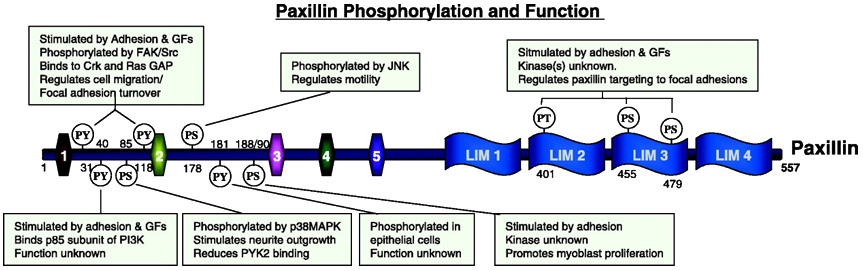
4 isoforms have been identified by alternative splicing. The 1st isoform is the normal variant and is comprised of 591 AA and weighs 68 kDa. The amino terminus region contains 5 LD-motifs, while the carboxy terminus contains 4 LIM-zinc binding domains. The protein also contains a proline rich region and several potential phosphorylation sites.
Expression
Epithelium.
Localisation
Found in the cytoplasm closely apposed to the plasma membrane at sites of focal adhesion to the extracellular matrix.
Function
Focal adhesion protein: This protein is a cytoskeletal component involved in focal actin-membrane attachments to the extracellular matrix. PXN can interact with multiple structural molecules and regulatory proteins to modulate adhesion, motility and survival of the cell by changing actin dynamics. Some PXN binding proteins have oncogenic equivalents, allowing cells to bypass normal adhesion and GF signaling cascades.
Regulation: PXN activity is regulated by various kinases. Adhesion and GFs stimulate these kinases to phosphorylate LD motifs or LIM domains. Molecules such as Vinculin, FAK and SRC phosphorylate tyrosine residues of the N-terminal LD motifs. This results in recruitment of downstream effectors (like CRK) to mediate changes in cell motility or in modulation of gene expression via MAPK pathways. N-terminal serine phosphorylation has also been identified. Phosphorylation of serine and threonine residues of C-terminal LIM domains results in recruitment to focal adhesions. Identification of the C-terminal kinases is currently under investigation.
Regulation: PXN activity is regulated by various kinases. Adhesion and GFs stimulate these kinases to phosphorylate LD motifs or LIM domains. Molecules such as Vinculin, FAK and SRC phosphorylate tyrosine residues of the N-terminal LD motifs. This results in recruitment of downstream effectors (like CRK) to mediate changes in cell motility or in modulation of gene expression via MAPK pathways. N-terminal serine phosphorylation has also been identified. Phosphorylation of serine and threonine residues of C-terminal LIM domains results in recruitment to focal adhesions. Identification of the C-terminal kinases is currently under investigation.
Abbreviations: CRK (CT10 sarcoma oncogene cellular homolog ); FAK (focal adhesion kinase); GF (growth factor); MAPK (mitogen activated protein kinase); SRC (Rous sarcoma oncogene cellular homolog).
Homology
Member of the paxillin family, containing the 4 LIM-zinc binding domains.
Mutations
Germinal
Not known.
Somatic
Several single nucleotide polymorphisms have been identified. Point mutations between the LD1 and LD2 motifs have been associated with lung cancer, the A127T mutation being the most frequent mutation (Jagadeeswaran, et al., 2008).
Implicated in
Entity name
Head and neck cancers
Note
PXN overexpression has been reported in various head and neck cancers (Li et al., 2008; Dai et al., 2010; Shi et al., 2010). Metallopanstimulin-1 expression has been associated with reduced PXN levels and tumor growth rate (Dai et al., 2010).
Entity name
Lung cancer
Note
A significant correlation was found between the presence of the A127T mutation between the LD1 and LD2 regions of PXN with non small cell lung cancer (Jagadeeswaran et al., 2008). A possible mechanism is that mutations between the LD1 and 2 regions confer resistance to calpain mediated proteolysis of PXN (Cortesio et al., 2011). However, two later studies did not find this mutation to exist in lung cancer or any other solid tumor (Pallier et al., 2009; Kim et al., 2011).
Overexpression of PXN in non small cell lung cancer has been reported with less controversy (Jagadeeswaran et al., 2008; Zhao et al., 2010; Mackinnon et al., 2011). The overexpression could possibly be due to rearrangements on chromosome 12 (Wu et al., 2010).
Overexpression of PXN in non small cell lung cancer has been reported with less controversy (Jagadeeswaran et al., 2008; Zhao et al., 2010; Mackinnon et al., 2011). The overexpression could possibly be due to rearrangements on chromosome 12 (Wu et al., 2010).
Entity name
Breast cancer
Note
Metastatic potential was found to be directly related to PXN levels (Cai et al., 2010). The relationship between PXN and Her-2 expression is controversial. A study in 2007 found a direct relationship between the 2 markers (Short et al., 2007) while a 2011 study found no such link (Panousis et al., 2011).
Entity name
Prostate cancer
Note
PXN up regulation was found to promote adhesion and motility of prostate cancer cells (Bokobza et al., 2010).
Article Bibliography
| Pubmed ID | Last Year | Title | Authors |
|---|---|---|---|
| 21042764 | 2010 | Growth and differentiation factor-9 promotes adhesive and motile capacity of prostate cancer cells by up-regulating FAK and Paxillin via Smad dependent pathway. | Bokobza SM et al |
| 15383653 | 2004 | Paxillin: adapting to change. | Brown MC et al |
| 20369478 | 2010 | [Expression of paxillin in breast cancer cell with high and low metastatic potentiality]. | Cai H et al |
| 16552730 | 2006 | Paxillin modulates squamous cancer cell adhesion and is important in pressure-augmented adhesion. | Conway WC et al |
| 21270128 | 2011 | Calpain-mediated proteolysis of paxillin negatively regulates focal adhesion dynamics and cell migration. | Cortesio CL et al |
| 19642098 | 2010 | Extraribosomal function of metallopanstimulin-1: reducing paxillin in head and neck squamous cell carcinoma and inhibiting tumor growth. | Dai Y et al |
| 18650496 | 2008 | Paxillin comes of age. | Deakin NO et al |
| 18172305 | 2008 | Paxillin is a target for somatic mutations in lung cancer: implications for cell growth and invasion. | Jagadeeswaran R et al |
| 21617717 | 2011 | Absence of paxillin gene mutation in lung cancer and other common solid cancers. | Kim MS et al |
| 18380937 | 2008 | Increased expression of paxillin is found in human oesophageal squamous cell carcinoma: a tissue microarray study. | Li BZ et al |
| 21045234 | 2011 | Paxillin expression and amplification in early lung lesions of high-risk patients, lung adenocarcinoma and metastatic disease. | Mackinnon AC et al |
| 19353596 | 2009 | No somatic genetic change in the paxillin gene in nonsmall-cell lung cancer. | Pallier K et al |
| 21614903 | 2011 | The value of TOP2A, EZH2 and paxillin expression as markers of aggressive breast cancer: relationship with other prognostic factors. | Panousis D et al |
| 10795627 | 2000 | Role of the cytoskeletal protein paxillin in oncogenesis. | Sattler M et al |
| 17786945 | 2008 | Paxillin's LD4 motif interacts with bcl-2. | Sheibani N et al |
| 20136697 | 2010 | Paxillin expression levels are correlated with clinical stage and metastasis in salivary adenoid cystic carcinoma. | Shi J et al |
| 17319853 | 2007 | The expression of the cytoskeletal focal adhesion protein paxillin in breast cancer correlates with HER2 overexpression and may help predict response to chemotherapy: a retrospective immunohistochemical study. | Short SM et al |
| 21159652 | 2010 | Paxillin predicts survival and relapse in non-small cell lung cancer by microRNA-218 targeting. | Wu DW et al |
| 20133777 | 2010 | Identification and functional characterization of paxillin as a target of protein tyrosine phosphatase receptor T. | Zhao Y et al |
Other Information
Locus ID:
NCBI: 5829
MIM: 602505
HGNC: 9718
Ensembl: ENSG00000089159
Variants:
dbSNP: 5829
ClinVar: 5829
TCGA: ENSG00000089159
COSMIC: PXN
RNA/Proteins
Expression (GTEx)
Pathways
Protein levels (Protein atlas)
References
| Pubmed ID | Year | Title | Citations |
|---|---|---|---|
| 37949303 | 2024 | Paxillin/HDAC6 regulates microtubule acetylation to promote directional migration of keratinocytes driven by electric fields. | 0 |
| 38254202 | 2024 | Paxillin participates in the sphingosylphosphorylcholine-induced abnormal contraction of vascular smooth muscle by regulating Rho-kinase activation. | 0 |
| 38307570 | 2024 | Effect of Paxillin Expression and Phosphorylation on Colorectal Cancer Prognosis and Metastasis. | 0 |
| 38326036 | 2024 | ICAM-1 Deletion Using CRISPR/Cas9 Protects the Brain from Traumatic Brain Injury-Induced Inflammatory Leukocyte Adhesion and Transmigration Cascades by Attenuating the Paxillin/FAK-Dependent Rho GTPase Pathway. | 0 |
| 38466167 | 2024 | Paxillin phase separation promotes focal adhesion assembly and integrin signaling. | 2 |
| 38718206 | 2024 | Paxillin regulates androgen receptor expression associated with granulosa cell focal adhesions. | 0 |
| 37949303 | 2024 | Paxillin/HDAC6 regulates microtubule acetylation to promote directional migration of keratinocytes driven by electric fields. | 0 |
| 38254202 | 2024 | Paxillin participates in the sphingosylphosphorylcholine-induced abnormal contraction of vascular smooth muscle by regulating Rho-kinase activation. | 0 |
| 38307570 | 2024 | Effect of Paxillin Expression and Phosphorylation on Colorectal Cancer Prognosis and Metastasis. | 0 |
| 38326036 | 2024 | ICAM-1 Deletion Using CRISPR/Cas9 Protects the Brain from Traumatic Brain Injury-Induced Inflammatory Leukocyte Adhesion and Transmigration Cascades by Attenuating the Paxillin/FAK-Dependent Rho GTPase Pathway. | 0 |
| 38466167 | 2024 | Paxillin phase separation promotes focal adhesion assembly and integrin signaling. | 2 |
| 38718206 | 2024 | Paxillin regulates androgen receptor expression associated with granulosa cell focal adhesions. | 0 |
| 36662163 | 2023 | Serum claudin-5, claudin-11, occludin, vinculin, paxillin, and beta-catenin levels in preschool children with autism spectrum disorder. | 5 |
| 37169211 | 2023 | Angiopoietin-like 4 induces head and neck squamous cell carcinoma cell migration through the NRP1/ABL1/PXN pathway. | 1 |
| 37175948 | 2023 | The Role of Paxillin Aberrant Expression in Cancer and Its Potential as a Target for Cancer Therapy. | 3 |
Citation
Tiffany Pierson ; Brendan C Stack Jr
PXN (paxillin)
Atlas Genet Cytogenet Oncol Haematol. 2011-08-01
Online version: http://atlasgeneticsoncology.org/gene/41953/pxn
