TIE1 (tyrosine kinase with immunoglobulin-like and EGF-like domains 1)
2012-03-01 Pipsa Saharinen AffiliationMolecular Cancer Biology Program, Research Programs Unit, Biomedicum Helsinki, Haartmaninkatu 8, P O B 63, FIN-00014 University of Helsinki, Finland
DNA/RNA
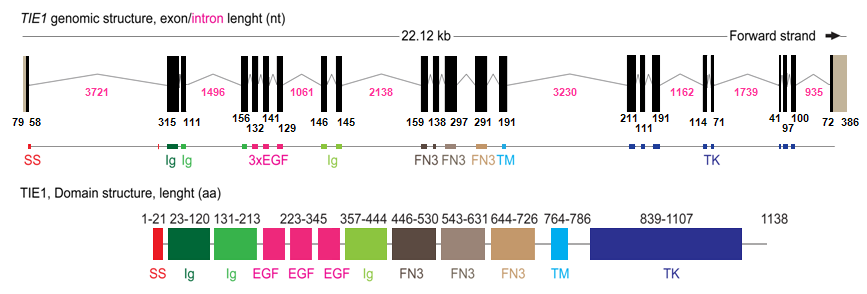
The genomic (top) and the protein domain structures (below) of human TIE1. Black boxes represent exons with intervening intron sequences (lines), light gray boxes represent non-coding sequences of first and last exons. Exon length (black text) and intron length of the longest introns (pink) are indicated in nucleotides. The protein domain coding regions of exons are indicated with colours according to the TIE1 protein domain structure. SS= signal sequence, Ig= immunoglobulin-like domain, EGF= epidermal growth factor-like domain, FN3= fibronectin type-III domain, TM= transmembrane domain, TK= tyrosine kinase domain. Protein domain prediction was performed using (SMART). The crystal structure for Tie2 shows the existence of a third Ig-like domain, immediately after the SS (Barton et al., 2006), and homology modeling of Tie1 predicts a similar fold (Seegar et al., 2010).
Description
The human TIE1 gene spans 22115 bp, encoding for 23 exons in forward strand.
Transcription
Longest mRNA contains 3882 bp. Alternatively spliced forms have been reported, including transcript variant 5 (EU826590.1) coding for a soluble TIE1 ectodomain (Jin et al., 2008).
Proteins
Note
See figure above.
Description
Human TIE1 contains 1138 aa. It belongs to the protein kinase superfamily, protein receptor tyrosine kinase family, TIE subfamily. It contains 3 Ig (immunoglobulin)-like domains (I set type), 3 EGF (epidermal growth factor)-like domains, 3 fibronectin type-III domains, a single transmembrane domain and 1 intracellular split tyrosine kinase domain (Partanen et al., 1992).
Expression
TIE1 is almost exclusively expressed in endothelial cells both in human and in mouse. High expression of TIE1 mRNA is found in adult lung, heart, and placenta, some expression in kidney, whereas muscle, brain, liver and pancreas contain less TIE1 mRNA. Tie1 mRNA is present widely in fetal tissues starting at embryonic day 8,5 (Korhonen et al., 1992). Tie1 mRNA is detected in differentiating angioblasts of the head mesenchyme, in the splanchnopleure and dorsal aorta as well as in migrating endothelial cells of the developing heart, in the heart endocardium and in the endothelial cells forming the lung vasculature (Korhonen et al., 1992).
TIE1 is also expressed on cultured endothelial cells, some haemopoietic progenitor cells, some myeloid leukemia cell lines having erythroid and megakaryoblastoid characteristics (Batard et al., 1996) and in adult acute myelogenous leukemia (Kivivuori et al., 2007). TIE1 expression is increased in angiogenic endothelial cells during wound-healing, in proliferating ovarial capillaries during hormone-induced superovulation and in tumor blood vessels (Korhonen et al., 1992; Kaipainen et al., 1994). Tie1 is downregulated in endothelial cells by shear stress (Chen-Konak et al., 2003), but specifically induced in the mouse vasculature by disturbed flow in vascular bifurcations and branching points along the arteries (Porat et al., 2004).
TIE1 along with ANGPT2 and TEK mRNAs were strongly expressed in cells of Kaposis sarcoma tumor cells, and cutaneous angiosarcomas, in contrast to the focal low-level expression in normal skin biopsies (Brown et al., 2000).
TIE1 is also expressed on cultured endothelial cells, some haemopoietic progenitor cells, some myeloid leukemia cell lines having erythroid and megakaryoblastoid characteristics (Batard et al., 1996) and in adult acute myelogenous leukemia (Kivivuori et al., 2007). TIE1 expression is increased in angiogenic endothelial cells during wound-healing, in proliferating ovarial capillaries during hormone-induced superovulation and in tumor blood vessels (Korhonen et al., 1992; Kaipainen et al., 1994). Tie1 is downregulated in endothelial cells by shear stress (Chen-Konak et al., 2003), but specifically induced in the mouse vasculature by disturbed flow in vascular bifurcations and branching points along the arteries (Porat et al., 2004).
TIE1 along with ANGPT2 and TEK mRNAs were strongly expressed in cells of Kaposis sarcoma tumor cells, and cutaneous angiosarcomas, in contrast to the focal low-level expression in normal skin biopsies (Brown et al., 2000).
Localisation
Cell membrane.
Function
Studies of Tie1 gene targeted mice have revealed that Tie1 is critical for the development of blood (Puri et al., 1995) and lymphatic vasculatures (DAmico et al., 2010; Qu et al., 2010) after midgestation. Tie1 is essential for endothelial cell survival in the developing microvasculature undergoing angiogenic sprouting, and essentially in all blood vessels in adult (Partanen et al., 1996). Tie1-/- embryos die around embryonic day 13,5, depending on the background (Puri et al., 1995; DAmico et al., 2010). The Tie1 deficient or hypomorphic embryos show also signs of edema, due to lymphatic defects involving abnormally patterned lymph sacs and peripheral lymphatic vessels (DAmico et al., 2010; Qu et al., 2010).
The molecular function of TIE1 is not completely understood, as it does not directly bind the angiopoietin growth factors, which are the ligands for TEK (TIE2). However, TIE1 tyrosine phosphorylation is induced by angiopoietin-1 (Saharinen et al., 2005; Yuan et al., 2007), most likely in a complex with TEK (Marron et al., 2000; Saharinen et al., 2005). Angiopoietins activate TEK in a unique manner, which involves the translocation of TEK to endothelial cell-cell contacts, and TIE1 is also present in these complexes (Saharinen et al., 2008). Activation of the TIE1 kinase activity using chimeric TIE1 receptors was found to result in the activation of the Akt pathway (Kontos et al., 2002). The TIE1 ectodomain is proteolytically cleaved, and the cleavage is enhanced by PMA, VEGF and TNF-α (Yabkowitz et al., 1999). The proteolytic processing of TIE1 may regulate TEK activity (Marron et al., 2007).
The deletion of both Tie1 and Tek results in a more severe phenotype than the deletions of either Tie1 or Tek alone (Sato et al., 1995; Puri et al., 1999). The deletion of both Tie1 and Angpt1 resulted in impaired development of the right-hand, but not left-hand side venous system in the mouse embryo (Loughna and Sato, 2001).
TIE1 has been implicated as a proinflammatory gene and its silencing in cultured endothelial cells reduced the expression of proinflammatory genes (Chan and Sukhatme, 2009), while TIE1 overexpression upregulated adhesion molecules including VCAM-1, E-selectin and ICAM-1 (Chan et al., 2008).
The molecular function of TIE1 is not completely understood, as it does not directly bind the angiopoietin growth factors, which are the ligands for TEK (TIE2). However, TIE1 tyrosine phosphorylation is induced by angiopoietin-1 (Saharinen et al., 2005; Yuan et al., 2007), most likely in a complex with TEK (Marron et al., 2000; Saharinen et al., 2005). Angiopoietins activate TEK in a unique manner, which involves the translocation of TEK to endothelial cell-cell contacts, and TIE1 is also present in these complexes (Saharinen et al., 2008). Activation of the TIE1 kinase activity using chimeric TIE1 receptors was found to result in the activation of the Akt pathway (Kontos et al., 2002). The TIE1 ectodomain is proteolytically cleaved, and the cleavage is enhanced by PMA, VEGF and TNF-α (Yabkowitz et al., 1999). The proteolytic processing of TIE1 may regulate TEK activity (Marron et al., 2007).
The deletion of both Tie1 and Tek results in a more severe phenotype than the deletions of either Tie1 or Tek alone (Sato et al., 1995; Puri et al., 1999). The deletion of both Tie1 and Angpt1 resulted in impaired development of the right-hand, but not left-hand side venous system in the mouse embryo (Loughna and Sato, 2001).
TIE1 has been implicated as a proinflammatory gene and its silencing in cultured endothelial cells reduced the expression of proinflammatory genes (Chan and Sukhatme, 2009), while TIE1 overexpression upregulated adhesion molecules including VCAM-1, E-selectin and ICAM-1 (Chan et al., 2008).
Homology
H. sapiens: TIE1; M. musculus: Tie1; R. novergicus: Tie1; D. rerio: tie1; X. tropicalis: tie1.
Mutations
Somatic
Somatic missense mutations and synonymous substitutions in TIE1 have been detected in human cancers, but their significance remains to be found out.
Implicated in
Entity name
Various diseases
Note
TIE1 has not been directly shown to be involved in any human diseases. Most of the information concerning Tie1 function has been retrieved from animal models.
Entity name
Gastric cancer
Note
TIE1 expression has been detected in gastric adenocarcinoma tissues where its expression inversely correlated with patients survival (Lin et al., 1999).
Entity name
Atherosclerosis
Note
Tie1 is upregulated in emerging atherosclerotic plaques and around developing aneurysms (Porat et al., 2004), and Tie1+/- mice bred to the ApoE-deficient background displayed a 35% reduction in atherosclerosis relative to Tie1+/+;Apoe-/- mice (Woo et al., 2011).
Article Bibliography
| Pubmed ID | Last Year | Title | Authors |
|---|---|---|---|
| 16732286 | 2006 | Crystal structures of the Tie2 receptor ectodomain and the angiopoietin-2-Tie2 complex. | Barton WA et al |
| 8630381 | 1996 | The Tie receptor tyrosine kinase is expressed by human hematopoietic progenitor cells and by a subset of megakaryocytic cells. | Batard P et al |
| 20053776 | 2010 | A human monoclonal anti-ANG2 antibody leads to broad antitumor activity in combination with VEGF inhibitors and chemotherapy agents in preclinical models. | Brown JL et al |
| 10854238 | 2000 | Expression of Tie1, Tie2, and angiopoietins 1, 2, and 4 in Kaposi's sarcoma and cutaneous angiosarcoma. | Brown LF et al |
| 19236867 | 2009 | Suppression of Tie-1 in endothelial cells in vitro induces a change in the genome-wide expression profile reflecting an inflammatory function. | Chan B et al |
| 18448073 | 2008 | Receptor tyrosine kinase Tie-1 overexpression in endothelial cells upregulates adhesion molecules. | Chan B et al |
| 14500555 | 2003 | Transcriptional and post-translation regulation of the Tie1 receptor by fluid shear stress changes in vascular endothelial cells. | Chen-Konak L et al |
| 19910638 | 2010 | Loss of endothelial Tie1 receptor impairs lymphatic vessel development-brief report. | D'Amico G et al |
| 19815705 | 2009 | Contrasting actions of selective inhibitors of angiopoietin-1 and angiopoietin-2 on the normalization of tumor blood vessels. | Falcón BL et al |
| 22343031 | 2012 | Effects of angiopoietin-2-blocking antibody on endothelial cell-cell junctions and lung metastasis. | Holopainen T et al |
| 18593464 | 2008 | Novel splice variants derived from the receptor tyrosine kinase superfamily are potential therapeutics for rheumatoid arthritis. | Jin P et al |
| 7987857 | 1994 | Enhanced expression of the tie receptor tyrosine kinase mesenger RNA in the vascular endothelium of metastatic melanomas. | Kaipainen A et al |
| 22184370 | 2012 | Randomized, double-blind, placebo-controlled phase II study of AMG 386 combined with weekly paclitaxel in patients with recurrent ovarian cancer. | Karlan BY et al |
| 16685739 | 2007 | Expression of vascular endothelial growth factor receptor 3 and Tie1 tyrosine kinase receptor on acute leukemia cells. | Kivivuori SM et al |
| 11865050 | 2002 | The endothelial receptor tyrosine kinase Tie1 activates phosphatidylinositol 3-kinase and Akt to inhibit apoptosis. | Kontos CD et al |
| 1384789 | 1992 | Enhanced expression of the tie receptor tyrosine kinase in endothelial cells during neovascularization. | Korhonen J et al |
| 10430078 | 1999 | tie-1 protein tyrosine kinase: a novel independent prognostic marker for gastric cancer. | Lin WC et al |
| 11172728 | 2001 | A combinatorial role of angiopoietin-1 and orphan receptor TIE1 pathways in establishing vascular polarity during angiogenesis. | Loughna S et al |
| 10995770 | 2000 | Evidence for heterotypic interaction between the receptor tyrosine kinases TIE-1 and TIE-2. | Marron MB et al |
| 17728252 | 2007 | Regulated proteolytic processing of Tie1 modulates ligand responsiveness of the receptor-tyrosine kinase Tie2. | Marron MB et al |
| 21481792 | 2011 | Targeting the ANG2/TIE2 axis inhibits tumor growth and metastasis by impairing angiogenesis and disabling rebounds of proangiogenic myeloid cells. | Mazzieri R et al |
| 15542434 | 2004 | Suppression of angiogenesis and tumor growth by selective inhibition of angiopoietin-2. | Oliner J et al |
| 8898215 | 1996 | Cell autonomous functions of the receptor tyrosine kinase TIE in a late phase of angiogenic capillary growth and endothelial cell survival during murine development. | Partanen J et al |
| 15705898 | 2005 | Targeting tumor angiogenesis with adenovirus-delivered anti-Tie-2 intrabody. | Popkov M et al |
| 14670840 | 2004 | Specific induction of tie1 promoter by disturbed flow in atherosclerosis-prone vascular niches and flow-obstructing pathologies. | Porat RM et al |
| 10498691 | 1999 | Interaction of the TEK and TIE receptor tyrosine kinases during cardiovascular development. | Puri MC et al |
| 8846781 | 1995 | The receptor tyrosine kinase TIE is required for integrity and survival of vascular endothelial cells. | Puri MC et al |
| 20223757 | 2010 | Abnormal embryonic lymphatic vessel development in Tie1 hypomorphic mice. | Qu X et al |
| 18425119 | 2008 | Angiopoietins assemble distinct Tie2 signalling complexes in endothelial cell-cell and cell-matrix contacts. | Saharinen P et al |
| 7596437 | 1995 | Distinct roles of the receptor tyrosine kinases Tie-1 and Tie-2 in blood vessel formation. | Sato TN et al |
| 20227369 | 2010 | Tie1-Tie2 interactions mediate functional differences between angiopoietin ligands. | Seegar TC et al |
| 15607960 | 2004 | Kinetics of vascular normalization by VEGFR2 blockade governs brain tumor response to radiation: role of oxygenation, angiopoietin-1, and matrix metalloproteinases. | Winkler F et al |
| 21383501 | 2011 | Tie1 attenuation reduces murine atherosclerosis in a dose-dependent and shear stress-specific manner. | Woo KV et al |
| 10068670 | 1999 | Inflammatory cytokines and vascular endothelial growth factor stimulate the release of soluble tie receptor from human endothelial cells via metalloprotease activation. | Yabkowitz R et al |
| 17504972 | 2007 | Activation of the orphan endothelial receptor Tie1 modifies Tie2-mediated intracellular signaling and cell survival. | Yuan HT et al |
Other Information
Locus ID:
NCBI: 7075
MIM: 600222
HGNC: 11809
Ensembl: ENSG00000066056
Variants:
dbSNP: 7075
ClinVar: 7075
TCGA: ENSG00000066056
COSMIC: TIE1
RNA/Proteins
| Gene ID | Transcript ID | Uniprot |
|---|---|---|
| ENSG00000066056 | ENST00000372476 | P35590 |
| ENSG00000066056 | ENST00000538015 | P35590 |
Expression (GTEx)
References
| Pubmed ID | Year | Title | Citations |
|---|---|---|---|
| 38254961 | 2024 | Cerebrospinal Fluid C1-Esterase Inhibitor and Tie-1 Levels Affect Cognitive Performance: Evidence from Proteome-Wide Mendelian Randomization. | 0 |
| 38617545 | 2024 | TIE1 promotes cervical cancer progression via Basigin-matrix metalloproteinase axis. | 0 |
| 38254961 | 2024 | Cerebrospinal Fluid C1-Esterase Inhibitor and Tie-1 Levels Affect Cognitive Performance: Evidence from Proteome-Wide Mendelian Randomization. | 0 |
| 38617545 | 2024 | TIE1 promotes cervical cancer progression via Basigin-matrix metalloproteinase axis. | 0 |
| 36814284 | 2023 | FLI1 regulates radiotherapy resistance in nasopharyngeal carcinoma through TIE1-mediated PI3K/AKT signaling pathway. | 4 |
| 37096293 | 2023 | Possible biallelic inheritance in TIE1 in a family with congenital lymphedema, intestinal lymphangiectasia and cutis aplasia. | 0 |
| 36814284 | 2023 | FLI1 regulates radiotherapy resistance in nasopharyngeal carcinoma through TIE1-mediated PI3K/AKT signaling pathway. | 4 |
| 37096293 | 2023 | Possible biallelic inheritance in TIE1 in a family with congenital lymphedema, intestinal lymphangiectasia and cutis aplasia. | 0 |
| 34942230 | 2022 | A novel cis-regulatory variant modulating TIE1 expression associated with attention deficit hyperactivity disorder in Han Chinese children. | 4 |
| 34942230 | 2022 | A novel cis-regulatory variant modulating TIE1 expression associated with attention deficit hyperactivity disorder in Han Chinese children. | 4 |
| 33812182 | 2021 | Involvement of small extracellular vesicle-derived TIE-1 in the chemoresistance of ovarian cancer cells. | 3 |
| 33812182 | 2021 | Involvement of small extracellular vesicle-derived TIE-1 in the chemoresistance of ovarian cancer cells. | 3 |
| 32947856 | 2020 | TIE1 as a Candidate Gene for Lymphatic Malformations with or without Lymphedema. | 7 |
| 32947856 | 2020 | TIE1 as a Candidate Gene for Lymphatic Malformations with or without Lymphedema. | 7 |
| 30806032 | 2019 | Metabolic gene NR4A1 as a potential therapeutic target for non-smoking female non-small cell lung cancer patients. | 7 |
Citation
Pipsa Saharinen
TIE1 (tyrosine kinase with immunoglobulin-like and EGF-like domains 1)
Atlas Genet Cytogenet Oncol Haematol. 2012-03-01
Online version: http://atlasgeneticsoncology.org/gene/42560/tie1
