TRAP1 (TNF receptor-associated protein 1)
2010-07-01 Dina Bellizzi , Giuseppe Passarino AffiliationDepartment of Cell Biology, University of Calabria, Rende, 87036, Italy
DNA/RNA
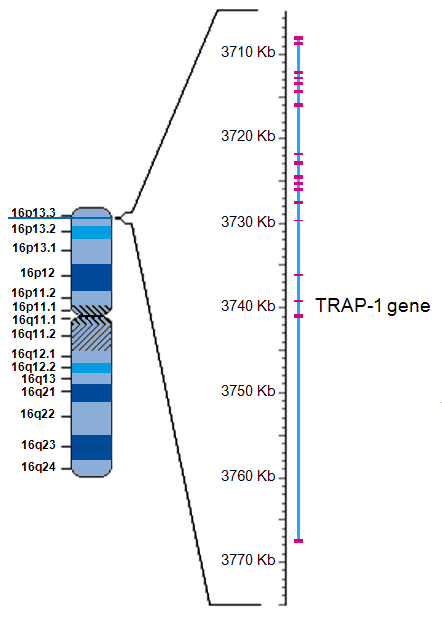
Description
Transcription
Pseudogene
Proteins

Description
- N6-acetyllysine in 87, 332, 382, 424, 466 position;
- phosphotyrosine in 366 position;
- phosphoserine in 401 position;
- phosphothreonine in 494 position.
Expression
Localisation
Function
TRAP1 plays an important role in protecting cells against oxidative stress and apoptosis. To this purpose it has been observed that TRAP1 suppression in mitochondria induces the apoptosis process by means of ROS production. What is more TRAP1 overexpression decreases ROS production and preserves mitochondrial membrane potential during the ischemia-like condition of glucose deprivation and preserves ATP levels and cell viability during oxygen-glucose deprivation. TRAP1 protects cells from granzyme M-mediated apoptosis by preventing the accumulation of ROS. The cleavage of TRAP1 by the granzyme abolishes its antagonistic function to ROS, and leads to ROS accumulation. It has been proposed that mitochondrial homeostasis is differentially regulated in tumor versus normal cells, in part due to elevated expression of TRAP1 in mitochondria. The overexpression of TRAP1 might buffer mitochondrial proteins from direct damage caused by exposure to prolonged oxidative stress. To this regard, it was reported that TRAP1 is a member of a prosurvival mitochondrial pathway highly activated in tumor cells that antagonizes the proapototic activity of cyclophilin D (CypD), a protein involved in the regulation of the mitochondrial permeability transition pore.
TRAP1-overexpression induces a decrease in levels of ROS, Caveolin-1, glutathione peroxidase (GPX), and manganese superoxide dismutase (MnSOD) as well as of the senescence-associated beta-galactosidase in cells treated with deferoxamine (DFO), an iron chelator responsible of mitochondrial dysfunction and senescence-like cellular morphology. It has been shown that TRAP1 is a MYC target, thus it may be considered involved in increased apoptosis in MYC-overexpressing cells and accountable for the elevated susceptibility of such cells to tumor necrosis factor alpha-mediated apoptosis.
Hypoxia conditions induce an up-regulation of protein levels of TRAP1 in osteoarthritic chondrocyte and in cartilage tissue, and in cardiomyocytes, in which TRAP1 plays a protective role by regulating the opening of the mitochondrial permeability transition pore.
TRAP1 is phosphorylated by PINK1, a serine/threonine protein kinase that localizes to mitochondria, and this phosphorylation mediates the PINK1 protective effects against oxidative stress-induced cell death by preventing the release of cytochrome c from mitochondria. PINK1 mutations that cause the Parkinson disease induce a reduced phosporylation of TRAP1 and thus a sensitization of the cells to the lethal effects of reactive oxygen species.
The expression of TRAP1 in heat stress conditions is modulated by the common variability of the mitochondrial DNA. In fact TRAP1 is over-expressed at both mRNA and intra-mitochondrial protein levels in cybrid line harbouring mtDNA of haplogroup H than in the other cybrid lines (lines J, U, X, T).
Homology
- Pan troglodytes: TRAP1 (TNF receptor-associated protein 1)
- Bos taurus: TRAP1 (TNF receptor-associated protein 1)
- Rattus norvegicus: Trap1 (TNF receptor-associated protein 1)
- Mus musculus: Trap1 (TNF receptor-associated protein 1)
Mutations
Note
- schizophrenia: SNP rs2108430, T/C, intron 3;
- bipolar disorders: SNP rs6500552, T/C, intron 1;
- major depression: SNP rs1639150, T/C, intron 1; SNP rs2108430, T/C, intron 3; SNP rs13926, C/G, exon 9 (R307G); SNP rs1136948, C/G, exon 11 (D395E).
Implicated in
Article Bibliography
| Pubmed ID | Last Year | Title | Authors |
|---|---|---|---|
| 18784066 | 2009 | Mitochondrial dysregulation of osteoarthritic human articular chondrocytes analyzed by proteomics: a decrease in mitochondrial superoxide dismutase points to a redox imbalance. | Ruiz-Romero C et al |
| 18815895 | 2009 | Mitochondrial DNA variability modulates mRNA and intra-mitochondrial protein levels of HSP60 and HSP75: experimental evidence from cybrid lines. | Bellizzi D et al |
| 11010808 | 2000 | Immunoelectron microscopy provides evidence that tumor necrosis factor receptor-associated protein 1 (TRAP-1) is a mitochondrial protein which also localizes at specific extramitochondrial sites. | Cechetto JD et al |
| 16269234 | 2005 | The HSP90 family of genes in the human genome: insights into their divergence and evolution. | Chen B et al |
| 8756626 | 1996 | A new member of the hsp90 family of molecular chaperones interacts with the retinoblastoma protein during mitosis and after heat shock. | Chen CF et al |
| 10737792 | 2000 | Expression analysis with oligonucleotide microarrays reveals that MYC regulates genes involved in growth, cell cycle, signaling, and adhesion. | Coller HA et al |
| 18570662 | 2008 | Transcriptional patterns, biomarkers and pathways characterizing nasopharyngeal carcinoma of Southern China. | Fang W et al |
| 10652318 | 2000 | The hsp90-related protein TRAP1 is a mitochondrial protein with distinct functional properties. | Felts SJ et al |
| 17513296 | 2007 | Heat shock protein 75 (TRAP1) antagonizes reactive oxygen species generation and protects cells from granzyme M-mediated apoptosis. | Hua G et al |
| 16927372 | 2007 | Iron chelation study in a normal human hepatocyte cell line suggests that tumor necrosis factor receptor-associated protein 1 (TRAP1) regulates production of reactive oxygen species. | Im CN et al |
| 18999889 | 2008 | Identification of tumor necrosis factor signaling-related proteins during Epstein-Barr virus-induced B cell transformation. | Jeon JP et al |
| 20560583 | 2010 | Clickable NAD analogues for labeling substrate proteins of poly(ADP-ribose) polymerases. | Jiang H et al |
| 17956728 | 2007 | Regulation of tumor cell mitochondrial homeostasis by an organelle-specific Hsp90 chaperone network. | Kang BH et al |
| 19490362 | 2009 | Tumor necrosis factor receptor-associated protein 1 regulates cell adhesion and synaptic morphology via modulation of N-cadherin expression. | Kubota K et al |
| 19942270 | 2010 | Heat shock proteins, cell survival and drug resistance: the mitochondrial chaperone TRAP1, a potential novel target for ovarian cancer therapy. | Landriscina M et al |
| 19948822 | 2010 | Cytoprotective mitochondrial chaperone TRAP-1 as a novel molecular target in localized and metastatic prostate cancer. | Leav I et al |
| 20471161 | 2010 | Tumor necrosis factor receptor-associated protein 1(TRAP1) regulates genes involved in cell cycle and metastases. | Liu D et al |
| 16061661 | 2005 | Altered ErbB receptor signaling and gene expression in cisplatin-resistant ovarian cancer. | Macleod K et al |
| 15292218 | 2004 | Involvement of tumor necrosis factor receptor-associated protein 1 (TRAP1) in apoptosis induced by beta-hydroxyisovalerylshikonin. | Masuda Y et al |
| 17853063 | 2007 | Tumor necrosis factor-associated protein 1 (TRAP-1) protects cells from oxidative stress and apoptosis. | Montesano Gesualdi N et al |
| 17579517 | 2007 | PINK1 protects against oxidative stress by phosphorylating mitochondrial chaperone TRAP1. | Pridgeon JW et al |
| 20387907 | 2010 | Hypoxia conditions differentially modulate human normal and osteoarthritic chondrocyte proteomes. | Ruiz-Romero C et al |
| 18790094 | 2008 | cis-acting sequences and trans-acting factors in the localization of mRNA for mitochondrial ribosomal proteins. | Russo A et al |
| 7876093 | 1995 | Identification of a protein with homology to hsp90 that binds the type 1 tumor necrosis factor receptor. | Song HY et al |
| 18091755 | 2008 | Overexpression of mitochondrial Hsp70/Hsp75 protects astrocytes against ischemic injury in vitro. | Voloboueva LA et al |
| 17624412 | 2007 | Estrogen-regulated gene expression predicts response to endocrine therapy in patients with ovarian cancer. | Walker G et al |
| 20393185 | 2010 | Studies of phosphoproteomic changes induced by nucleophosmin-anaplastic lymphoma kinase (ALK) highlight deregulation of tumor necrosis factor (TNF)/Fas/TNF-related apoptosis-induced ligand signaling pathway in ALK-positive anaplastic large cell lymphoma. | Wu F et al |
| 20236315 | 2010 | Mitochondrial chaperone tumour necrosis factor receptor-associated protein 1 protects cardiomyocytes from hypoxic injury by regulating mitochondrial permeability transition pore opening. | Xiang F et al |
Other Information
Locus ID:
NCBI: 10131
MIM: 606219
HGNC: 16264
Ensembl: ENSG00000126602
Variants:
dbSNP: 10131
ClinVar: 10131
TCGA: ENSG00000126602
COSMIC: TRAP1
RNA/Proteins
Expression (GTEx)
Pathways
Protein levels (Protein atlas)
References
| Pubmed ID | Year | Title | Citations |
|---|---|---|---|
| 36828164 | 2023 | The mitochondrial chaperone TRAP-1 regulates the glutamine metabolism in tumor cells. | 4 |
| 37084412 | 2023 | Histone chaperone SSRP1 is required for apoptosis inhibition and mitochondrial function in HCC via transcriptional promotion of TRAP1. | 0 |
| 37165028 | 2023 | Analysis and functional relevance of the chaperone TRAP-1 interactome in the metabolic regulation and mitochondrial integrity of cancer cells. | 0 |
| 37487647 | 2023 | Cytosolic and mitochondrial translation elongation are coordinated through the molecular chaperone TRAP1 for the synthesis and import of mitochondrial proteins. | 4 |
| 36828164 | 2023 | The mitochondrial chaperone TRAP-1 regulates the glutamine metabolism in tumor cells. | 4 |
| 37084412 | 2023 | Histone chaperone SSRP1 is required for apoptosis inhibition and mitochondrial function in HCC via transcriptional promotion of TRAP1. | 0 |
| 37165028 | 2023 | Analysis and functional relevance of the chaperone TRAP-1 interactome in the metabolic regulation and mitochondrial integrity of cancer cells. | 0 |
| 37487647 | 2023 | Cytosolic and mitochondrial translation elongation are coordinated through the molecular chaperone TRAP1 for the synthesis and import of mitochondrial proteins. | 4 |
| 35543151 | 2022 | TRAP1 regulates the response of colorectal cancer cells to hypoxia and inhibits ribosome biogenesis under conditions of oxygen deprivation. | 4 |
| 35740911 | 2022 | TRAP1 Chaperones the Metabolic Switch in Cancer. | 15 |
| 36113636 | 2022 | Metabolic targeting of NRF2 potentiates the efficacy of the TRAP1 inhibitor G-TPP through reduction of ROS detoxification in colorectal cancer. | 6 |
| 35543151 | 2022 | TRAP1 regulates the response of colorectal cancer cells to hypoxia and inhibits ribosome biogenesis under conditions of oxygen deprivation. | 4 |
| 35740911 | 2022 | TRAP1 Chaperones the Metabolic Switch in Cancer. | 15 |
| 36113636 | 2022 | Metabolic targeting of NRF2 potentiates the efficacy of the TRAP1 inhibitor G-TPP through reduction of ROS detoxification in colorectal cancer. | 6 |
| 33196942 | 2021 | Knockdown of TRAP1 promotes cisplatin-induced apoptosis by promoting the ROS-dependent mitochondrial dysfunction in lung cancer cells. | 8 |
Citation
Dina Bellizzi ; Giuseppe Passarino
TRAP1 (TNF receptor-associated protein 1)
Atlas Genet Cytogenet Oncol Haematol. 2010-07-01
Online version: http://atlasgeneticsoncology.org/gene/42692/trap1
