GNA11 (guanine nucleotide binding protein (G protein), alpha 11 (Gq class))
2011-03-01 Klaus G Griewank , Swapna Vemula , Boris C Bastian AffiliationDepartment of Pathology, Human Oncology, Pathogenesis Program, Memorial Sloan Kettering Cancer Center, New York, NY, USA (KGG, BCB); Department of Pathology, University of California, San Francisco, CA, USA (SV)
Identity
HGNC
LOCATION
19p13.3
LOCUSID
ALIAS
FBH,FBH2,FHH2,GNA-11,HHC2,HYPOC2
FUSION GENES
DNA/RNA
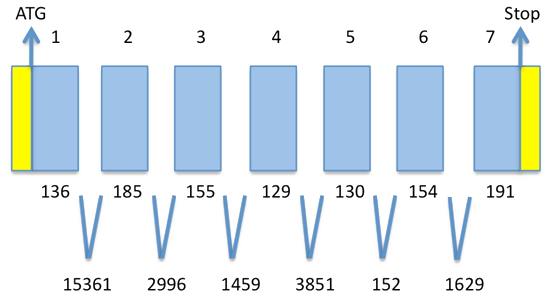
Numbers pertain to amount of nucleotides in exons and introns of human GNA11. Untranscribed sequences are yellow, transcribed ones are blue. The arrows refer to the start and stop codon.
Description
The GNA11 gene is composed of 7 exons spanning a region of 27044 bp.
Transcription
The transcribed mRNA has ORF is 1080 nucleotides.
Pseudogene
Processed pseudogene GNA11 is on chromosome 7, 65970152 to 65971210.
Proteins
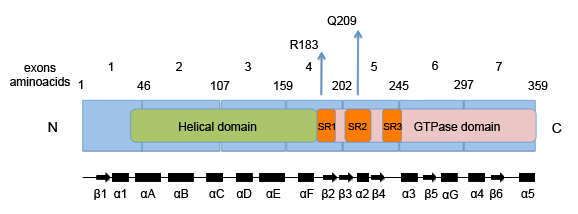
The diagram shows the general functional domains of G alpha 11 in respect to the amino acid residues and the corresponding exons. The alpha helical domain is found in all G alpha family members. Switch regions (SR), the areas that change their conformation based on if GTP or GDP is bound, are shown in orange (SR1: 182-192, SR2: 204-224, SR3: 236-247). The location of the 183 and 209 mutations are shown and affect switch regions 1 and 2 respectively. The GTPase domain is both essential for hydrolyzing bound GTP as well as binding downstream effectors. Adapted from Mizuno and Itoh, 2009.
Description
Aminoacids: 359. Molecular weight: 42123 daltons.
GNA11 is a proto-oncogene that belongs to the Gq family of the G alpha family of G protein coupled receptors. It is highly homologous to GNAQ.
GNA11 is a proto-oncogene that belongs to the Gq family of the G alpha family of G protein coupled receptors. It is highly homologous to GNAQ.
Expression
GNA11 is generally expressed ubiquitously, an exception being platelets, where only GNAQ is expressed.
Localisation
Cytoplasmic. Signaling occurs at the membrane, which requires N-terminal lipid modification (palmitoylation) of the protein.
Function
GNA11 is a G protein alpha unit associating with a beta and a gamma subunit. Upon ligand binding to G protein coupled receptors, GNA11 binds GTP, which leads to activation and disassociation from the beta and gamma subunits. Known downstream signaling partners are phospholipase C (PLC) beta and RhoA. PLC beta upon activation releases inositol triphosphate (IP3) and diacylglycerol (DAG) from membrane phosphatidylinositol-3-phosphate. RhoA activation is mediated through proteins such as p63 RhoGef, Duet and Trio by GNAQ, and may thus also be mediating Rho activation by GNA11. GNA11 activation has been shown to induce MAP Kinase activation, possibly via DAG-mediated activation of protein kinase C isoforms. Many other proteins shown to bind GNAQ and or GNA11 have been reported, many with regulatory functions, thus named GRK (G Protein regulatory kinases) or RGS (regulator of G protein signaling) proteins.
Mutations
Note
The mutations that have been described in melanocytic neoplasia have previously been demonstrated to inhibit the GTPase function and lead to decreased (R183) or completely (Q209) abolished ability to hydrolyze GTP to GDP, locking the protein in the GTP bound, constitutively active state. Experimental in vitro and in vivo data has shown that fitting with the degree of GTPase inhibition Q209 mutations are more potent activators than R183 mutations.
Germinal
No known germinal mutations.
Somatic
Q209 mutations have been described in uveal melanomas (32% primary, 57% metastasis) and blue nevi (6.5%).
R183 mutations have only been described in uveal melanoma (2% primary, 6% metastasis). Overall frequencies and distribution of GNA11 mutations as compared to GNAQ in uveal and cutaneous melanocytic tumors are listed in the table below.
In the table, frequencies of mutations in GNAQ and GNA11 found in different melanocytic proliferations are listed.
R183 mutations have only been described in uveal melanoma (2% primary, 6% metastasis). Overall frequencies and distribution of GNA11 mutations as compared to GNAQ in uveal and cutaneous melanocytic tumors are listed in the table below.
| Categories | n° | GNA11 | GNAQ | Either |
|---|---|---|---|---|
| Blue Nevi | 139 | 7% | 56% | 63% |
| Uveal melanoma, primary | 163 | 34% | 48% | 82% |
| Uveal melanoma, metastasis | 23 | 62% | 28% | 90% |
| Uveal nevus | 1 | 0% | 100% | 100% |
| Conjunctival melanoma | 9 | 0% | 0% | 0% |
| Other nevi | 105 | 0% | 0% | 0% |
| Extra-ocular melanomas | 273 | 0% | 1% | 1% |
| Total | 713 |
Implicated in
Entity name
Blue nevi (6.5%)
Note
The mutations of GNA11 or its paralog GNAQ are expected to be early events in oncogenesis. A mutation in either gene alone is often found in benign proliferations of dermal melanocytes such as blue nevi. Segmental dermal melanocytic hyperplasia of the first trigeminal branch are called Nevi of Ota. In Caucasians Nevus of Ota is a risk factor for uveal melanoma. Similar segmental lesions in the shoulder area are termed Nevus of Ito. These proliferations of dermal melanocytes and blue nevi are benign, but can evolve into melanoma at a low frequency.
Prognosis
Blue nevi as well as segmental melanocytoses are typically harmless, with only a low probability of progressing to melanoma.
Entity name
Uveal melanoma
Note
Primary uveal Melanoma (34%), Uveal melanoma metastases (62%).
Uveal melanoma is an aggressive form of eye cancer. It represents the most common eye cancer and has an incidence of about 2-8 people per million in Caucasians. It can originate in the ciliary body, the iris or most commonly the choroid.
Uveal melanoma is an aggressive form of eye cancer. It represents the most common eye cancer and has an incidence of about 2-8 people per million in Caucasians. It can originate in the ciliary body, the iris or most commonly the choroid.
Prognosis
Uveal melanoma is an aggressive cancer with a 10 year survival rate of approximately 50%. The primary tumor is often only recognized at a stage where it has already metastasized. Metastasis in uveal melanoma occurs predominantly to the liver. The prognosis of uveal melanomas is highly dependent on the presence of additional genetic alterations, loss of chromosome 3 in particular.
Cytogenetics
A frequent chromosomal aberration associated with poor prognosis is the loss of chromosome 3. A gene on this chromosome called BAP1, found to be mutated over 80% of metastasizing uveal melanomas, was recently identified.
Entity name
Other entities
Note
Activating mutations of GNA11 have not been found in other malignancies although a recent publication screened a panel of 922 different tumor samples.
There is a reporting of reduced mRNA and protein levels of GNA11 in breast cancer. This indicates expression levels of GNA11 may be relevant in some settings.
There is a reporting of reduced mRNA and protein levels of GNA11 in breast cancer. This indicates expression levels of GNA11 may be relevant in some settings.
Article Bibliography
| Pubmed ID | Last Year | Title | Authors |
|---|---|---|---|
| 12759536 | 2003 | Reduced expression of GNA11 and silencing of MCT1 in human breast cancers. | Asada K et al |
| 8550609 | 1996 | Functional importance of the amino terminus of Gq alpha. | Hepler JR et al |
| 16182515 | 2006 | Cell signalling diversity of the Gqalpha family of heterotrimeric G proteins. | Hubbard KB et al |
| 16365560 | 2006 | Metastatic uveal melanoma. | Kivelä T et al |
| 19936769 | 2010 | Activating mutations of the GNAQ gene: a frequent event in primary melanocytic neoplasms of the central nervous system. | Küsters-Vandevelde HV et al |
| 19718445 | 2009 | Mutational profile of GNAQQ209 in human tumors. | Lamba S et al |
| 18096806 | 2007 | Structure of Galphaq-p63RhoGEF-RhoA complex reveals a pathway for the activation of RhoA by GPCRs. | Lutz S et al |
| 19212139 | 2009 | Functions and regulatory mechanisms of Gq-signaling pathways. | Mizuno N et al |
| 19369209 | 2009 | Pasteurella multocida toxin activation of heterotrimeric G proteins by deamidation. | Orth JH et al |
| 8622452 | 1996 | Prognostic implications of monosomy 3 in uveal melanoma. | Prescher G et al |
| 15763193 | 2005 | Uveal melanoma: epidemiologic aspects. | Singh AD et al |
| 15339913 | 2004 | A novel Galphaq/11-selective inhibitor. | Takasaki J et al |
| 21083380 | 2010 | Mutations in GNA11 in uveal melanoma. | Van Raamsdonk CD et al |
| 20966218 | 2010 | Kinetic scaffolding mediated by a phospholipase C-beta and Gq signaling complex. | Waldo GL et al |
| 1946421 | 1991 | Characterization of G-protein alpha subunits in the Gq class: expression in murine tissues and in stromal and hematopoietic cell lines. | Wilkie TM et al |
Other Information
Locus ID:
NCBI: 2767
MIM: 139313
HGNC: 4379
Ensembl: ENSG00000088256
Variants:
dbSNP: 2767
ClinVar: 2767
TCGA: ENSG00000088256
COSMIC: GNA11
RNA/Proteins
| Gene ID | Transcript ID | Uniprot |
|---|---|---|
| ENSG00000088256 | ENST00000078429 | P29992 |
| ENSG00000088256 | ENST00000587636 | K7EL62 |
| ENSG00000088256 | ENST00000588401 | A0A087WVZ3 |
Expression (GTEx)
Pathways
Protein levels (Protein atlas)
PharmGKB
| Entity ID | Name | Type | Evidence | Association | PK | PD | PMIDs |
|---|---|---|---|---|---|---|---|
| PA27946 | F2R | Gene | Pathway | associated | 20938371 | ||
| PA27949 | F2RL3 | Gene | Pathway | associated | 20938371 | ||
| PA32868 | P2RY1 | Gene | Pathway | associated | 20938371 | ||
| PA33384 | PLCB1 | Gene | Pathway | associated | 20938371 | ||
| PA33393 | PLCG2 | Gene | Pathway | associated | 20938371 | ||
| PA348 | TBXA2R | Gene | Pathway | associated | 20938371 |
References
| Pubmed ID | Year | Title | Citations |
|---|---|---|---|
| 37750536 | 2024 | Papillary Hemangioma Harbors Somatic GNA11 and GNAQ Mutations. | 1 |
| 37802294 | 2024 | GNAQ/GNA11 Mosaicism Is Associated with Abnormal Serum Calcium Indices and Microvascular Neurocalcification. | 2 |
| 38505749 | 2024 | Double somatic mutations in CTNNB1 and GNA11 in an aldosterone-producing adenoma. | 0 |
| 37750536 | 2024 | Papillary Hemangioma Harbors Somatic GNA11 and GNAQ Mutations. | 1 |
| 37802294 | 2024 | GNAQ/GNA11 Mosaicism Is Associated with Abnormal Serum Calcium Indices and Microvascular Neurocalcification. | 2 |
| 38505749 | 2024 | Double somatic mutations in CTNNB1 and GNA11 in an aldosterone-producing adenoma. | 0 |
| 36970776 | 2023 | GNA11 Variants Identified in Patients with Hypercalcemia or Hypocalcemia. | 2 |
| 36970776 | 2023 | GNA11 Variants Identified in Patients with Hypercalcemia or Hypocalcemia. | 2 |
| 34260077 | 2022 | Mixed vascular naevus syndrome: report of three children with somatic GNA11 mutation and new systemic associations. | 1 |
| 35212356 | 2022 | Genomic Profiling of Metastatic Uveal Melanoma Shows Frequent Coexisting BAP1 or SF3B1 and GNAQ/GNA11 Mutations and Correlation With Prognosis. | 2 |
| 35580369 | 2022 | In uveal melanoma Gα-protein GNA11 mutations convey a shorter disease-specific survival and are more strongly associated with loss of BAP1 and chromosomal alterations than Gα-protein GNAQ mutations. | 12 |
| 35715928 | 2022 | GNA11-mutated Sturge-Weber syndrome has distinct neurological and dermatological features. | 4 |
| 36440997 | 2022 | Early-onset hypertension associated with extensive cutaneous capillary malformations harboring postzygotic variants in GNAQ and GNA11. | 1 |
| 34260077 | 2022 | Mixed vascular naevus syndrome: report of three children with somatic GNA11 mutation and new systemic associations. | 1 |
| 35212356 | 2022 | Genomic Profiling of Metastatic Uveal Melanoma Shows Frequent Coexisting BAP1 or SF3B1 and GNAQ/GNA11 Mutations and Correlation With Prognosis. | 2 |
Citation
Klaus G Griewank ; Swapna Vemula ; Boris C Bastian
GNA11 (guanine nucleotide binding protein (G protein), alpha 11 (Gq class))
Atlas Genet Cytogenet Oncol Haematol. 2011-03-01
Online version: http://atlasgeneticsoncology.org/gene/43272/gna11
