LIPE (lipase E, hormone sensitive type)
2018-02-01 Seher Gök AffiliationScientific and Research Council of TURKEY, Ankara, Turkey; [email protected]
Identity
HGNC
LOCATION
The human LIPE gene is located on 19q13.2 [Link to chromosome band 19q13]
IMAGE

LEGEND
Figure 1. Gene neighbours of LIPE on chromosome 19q13.2 (NCBI Annotation Release 108)
LOCUSID
ALIAS
AOMS4,FPLD6,HSL,LHS,REH
Abstract
Review on LIPE, with data on DNA, on the protein encoded and where the gene is implicated
DNA/RNA
Description
Orientation: Minus strand; 25,920 bases; Exon count: 31 (NCBI Homo sapiens Annotation Release 108) (Table 1).
| Table 1. 31 Exons and their locations for LIPE (from Ensembl) | |||||
| Gene Id | Exon Id | Chromosome | Strand | Exon Start | Exon End |
| ENSG00000079435 | ENSE00001194800 | 19 | - | 42401507 | 42402075 |
| ENSG00000079435 | ENSE00003091115 | 19 | - | 42401816 | 42402075 |
| ENSG00000079435 | ENSE00003004228 | 19 | - | 42402037 | 42402075 |
| ENSG00000079435 | ENSE00003029968 | 19 | - | 42402607 | 42403055 |
| ENSG00000079435 | ENSE00000709262 | 19 | - | 42402607 | 42403031 |
| ENSG00000079435 | ENSE00003099674 | 19 | - | 42402673 | 42403031 |
| ENSG00000079435 | ENSE00000709260 | 19 | - | 42405385 | 42405561 |
| ENSG00000079435 | ENSE00003199240 | 19 | - | 42405385 | 42405837 |
| ENSG00000079435 | ENSE00003007563 | 19 | - | 42406161 | 42406319 |
| ENSG00000079435 | ENSE00000709257 | 19 | - | 42406161 | 42406388 |
| ENSG00000079435 | ENSE00003076590 | 19 | - | 42407174 | 42407226 |
| ENSG00000079435 | ENSE00000709254 | 19 | - | 42407174 | 42407468 |
| ENSG00000079435 | ENSE00003124417 | 19 | - | 42407400 | 42407468 |
| ENSG00000079435 | ENSE00003630092 | 19 | - | 42407606 | 42407791 |
| ENSG00000079435 | ENSE00003654406 | 19 | - | 42407606 | 42407791 |
| ENSG00000079435 | ENSE00003603624 | 19 | - | 42407976 | 42408121 |
| ENSG00000079435 | ENSE00003477031 | 19 | - | 42407976 | 42408121 |
| ENSG00000079435 | ENSE00003202428 | 19 | - | 42408087 | 42408121 |
| ENSG00000079435 | ENSE00003018018 | 19 | - | 42408095 | 42408121 |
| ENSG00000079435 | ENSE00003693446 | 19 | - | 42408232 | 42408322 |
| ENSG00000079435 | ENSE00003608280 | 19 | - | 42408232 | 42408322 |
| ENSG00000079435 | ENSE00003146825 | 19 | - | 42408311 | 42408322 |
| ENSG00000079435 | ENSE00003530964 | 19 | - | 42410307 | 42410842 |
| ENSG00000079435 | ENSE00003532609 | 19 | - | 42410307 | 42410842 |
| ENSG00000079435 | ENSE00003170038 | 19 | - | 42410582 | 42410842 |
| ENSG00000079435 | ENSE00003219943 | 19 | - | 42412274 | 42412347 |
| ENSG00000079435 | ENSE00003155428 | 19 | - | 42412365 | 42412448 |
| ENSG00000079435 | ENSE00003063620 | 19 | - | 42422993 | 42423222 |
| ENSG00000079435 | ENSE00003095994 | 19 | - | 42422993 | 42423203 |
| ENSG00000079435 | ENSE00003221897 | 19 | - | 42423419 | 42424123 |
| ENSG00000079435 | ENSE00001162583 | 19 | - | 42426267 | 42427426 |
Transcription
Human LIPE gene has 9 transcripts (Table 2).
| Table 2. Transcripts of human LIPE gene (Ensembl annotation Release 85) | |||||
| Name | Transcript ID | bp | Translation ID | Protein | Biotype |
| LIPE-201 | ENST00000244289.8 | 3813 | ENSP00000244289 | 1076aa | Protein coding |
| LIPE-205 | ENST00000599783.5 | 1367 | ENSP00000469990 | 260aa | Protein coding |
| LIPE-203 | ENST00000597620.5 | 915 | ENST00000597620 | 305aa | Protein coding |
| LIPE-206 | ENST00000599918.1 | 824 | ENST00000599918 | 275aa | Protein coding |
| LIPE-202 | ENST00000597001.1 | 759 | ENSP00000469268 | 176aa | Protein coding |
| LIPE-204 | ENST00000599211.1 | 738 | ENSP00000472531 | 222aa | Protein coding |
| LIPE-208 | ENST00000601189.1 | 335 | ENSP00000469030 | 80aa | Protein coding |
| LIPE-209 | ENST00000602000.1 | 722 | _ | No protein | Processed transcript |
| LIPE-207 | ENST00000600224.1 | 812 | _ | No Protein | Retained intron |
Pseudogene
LOC106780900 hormone-sensitive lipase pseudogene [Equus caballus (horse)] (NCBI Equus caballus Annotation Release 103)
Proteins
Note
LIPE plays a crucial role in acylglycerol and cholesteryl ester hydrolysis in adipose tissue and exhibits cholesterol hydrolase activity in steroidogenic tissue and macrophages.
Description
LIPE is highly expressed in adipose tissue as well as in heart and skeletal muscle, pancreatic β-cells, placenta, adrenal glands, ovary and testis (Haemmerle et al., 2003). 2 isoforms produced by alternative splicing (Yeamen et, al., 2004; Holst et al., 1996). Isoform 1 : Testicular form also known as canonical sequence, composed of 1,076 amino acids, has 116,598 Da molecular mass.
Two testicular forms of LIPE have been characterized (Stenson et al., 1996 ; Mairal et al., 2002). The 3.9 kb mRNA encodes a 1,076 amino acid protein that contains a unique NH2-terminal region encoded by exon T1. The 3.3 kb mRNA encodes a protein that is identical to the adipocyte LIPE form. However, the mRNA species differ in their 5 ends. Exon usage is mutually exclusive; exon T2 is only transcribed in testis, and exon B is only transcribed in Adipose tissue (Lucas et al., 2003).
Isoform 2 : Adipocyte form, composed of 775 amino acids encoded by 9 exons, has 84,128 Da molecular mass.
Two testicular forms of LIPE have been characterized (Stenson et al., 1996 ; Mairal et al., 2002). The 3.9 kb mRNA encodes a 1,076 amino acid protein that contains a unique NH2-terminal region encoded by exon T1. The 3.3 kb mRNA encodes a protein that is identical to the adipocyte LIPE form. However, the mRNA species differ in their 5 ends. Exon usage is mutually exclusive; exon T2 is only transcribed in testis, and exon B is only transcribed in Adipose tissue (Lucas et al., 2003).
Isoform 2 : Adipocyte form, composed of 775 amino acids encoded by 9 exons, has 84,128 Da molecular mass.

Figure 2. Genomic organization of the LIPE gene coding sequences (red boxes) and untranslated regions (grey boxes). Exons T1 and T2 are used in testis. Exons A and B are used in the colon adenocarcinoma cell line HT29 and adipose tissue, respectively. Exons 1 to 9 are used in all tissues expressing LIPE (adapted from Lucas et al., 2003).
Expression
A 3.3-kb transcript was detected in mammary gland, adrenal gland, adipose tissue and muscle, and both a 3.3 and 3.9 kb transcripts were found in testis (Holst et al. 1996). RNA-seq data from 95 human individuals representing 27 different tissues reveal biased expression in fat and testis (BioProject: PRJEB4337) (Figure 2).
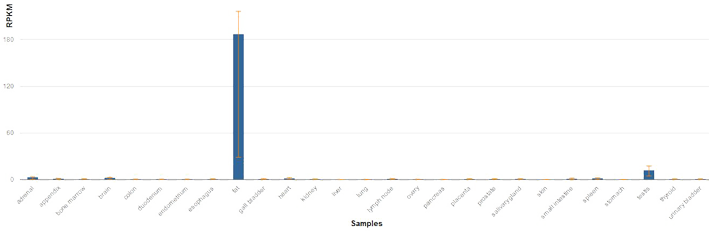
Figure 3. LIPE tissue expression. RNA-seq data from 27 tissues are reported as mean RPKM (Reads Per Kilobase Million), corresponding to mean values of the different individual samples from each tissue type.
Localisation
Found in cell membrane (UniProtKB-SubCell), cytosol (HPA), lipid droplet (UniProtKB-SubCell) and high density caveolae (UniProtKB-SubCell). Translocates to the cytoplasm from the caveolae upon insulin stimulation for lipolysis activation (Egan et al., 1992).
Function
Hormone sensitive lipase is a lipolytic enzyme of the GDXG family catalyzing the rate limiting step of diacylglycerol and monoacylglycerol lipolysis (Stralfors et al., 1978).
In adipose tissue and heart, it primarily hydrolyzes stored triglycerides to free fatty acids, while in steroidogenic tissues, it principally converts cholesteryl esters to free cholesterol for steroid hormone production. LIPE is a multifunctional enzyme catalyzing (GO_REF:0000003);
Diacylglycerol + H2O = monoacylglycerol + a carboxylate.
Triacylglycerol + H2O = diacylglycerol + a carboxylate.
Monoacylglycerol + H2O = glycerol + a carboxylate.
Enzyme is regulated post-transcriptionally. LIPE is rapidly activated by cAMP-dependent phosphorylation under the influence of catecholamines. Dephosphorylation and inactivation via protein phosphatases or inhibition of protein kinases, are controlled by insulin (Yeamen et al., 1994). Ser 659 and Ser 660 have been shown as phosphorylation sites, for in vitro activation of LIPE (Anthonsen et al., 1998).
Also it has protein binding and protein kinase binding function interacting selectively and non-covalently with any protein of protein complex (Aboulaich et al., 2006).
Diacylglycerol + H2O = monoacylglycerol + a carboxylate.
Triacylglycerol + H2O = diacylglycerol + a carboxylate.
Monoacylglycerol + H2O = glycerol + a carboxylate.
Enzyme is regulated post-transcriptionally. LIPE is rapidly activated by cAMP-dependent phosphorylation under the influence of catecholamines. Dephosphorylation and inactivation via protein phosphatases or inhibition of protein kinases, are controlled by insulin (Yeamen et al., 1994). Ser 659 and Ser 660 have been shown as phosphorylation sites, for in vitro activation of LIPE (Anthonsen et al., 1998).
Also it has protein binding and protein kinase binding function interacting selectively and non-covalently with any protein of protein complex (Aboulaich et al., 2006).
Homology
LIPE gene is conserved in chimpanzee, dog, cow, mouse, rat, zebrafish and frog (Table 3).
| Table 3. Pairwise alignment of LIPE gene and protein sequences (in distance from human) | |||
| Gene | Identity % | ||
| Species | Symbol | Protein | DNA |
| H. Sapiens | LIPE | ||
| vs. P.troglodytes | LIPE | 99.0 | 99.3 |
| vs. C.lupus | LIPE | 80.2 | 84.0 |
| vs. B.taurus | LIPE | 85.9 | 86.2 |
| vs. M.musculus | Lipe | 84.3 | 82.0 |
| vs. R.norvegicus | Lipe | 74.9 | 78.1 |
| vs. X.tropicalis | lipe | 62.7 | 62.3 |
| vs. D.reriro | lipeb | 61.7 | 61.5 |
Mutations
Note
198 missense, 12 truncating and 2 inframe mutations of LIPE (cBioPortal).
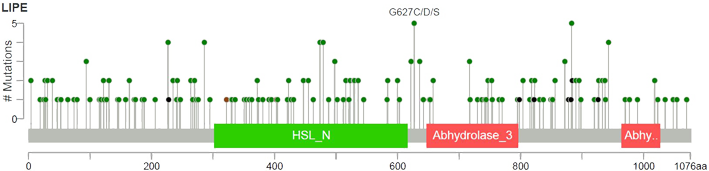
Figure 4. Mutation types observed in LIPE expression in literature and corresponding color codes are as follows: Green: Missense Mutations, Black: Truncating Mutations: Nonsense, Nonstop, Frameshift deletion, Frameshift insertion, Splice site, Brown: Inframe Mutations: Inframe deletion, Inframe insertion, Purple: Other Mutations: All other types of mutations
Somatic
LIPE has 3543 SNPs (Ensembl).
Arg 309 Cyc polymorphism is associated with an increased serum cholesterol levels and type 2 diabetes (Shimada et al. 1996).
LIPE i6(CA)n repeat polymorphism is associated with type 2 diabetes and obesity (Magré et al. 1998). The C-60 G polymorphism is located in the promoter region of the LIPE and it is possible that the substitution of C with G nucleotide result in a decrease in gene expression (Talmud et al. 2001). The C-60 G polymorphism in the promoter of LIPE is associated with body composition and waist circumference (Garenc et al. 2002; Carlsson et al. 2006). In addition, the C-60 G allele male carriers present lower levels of fasting non-esterified fatty acid and higher levels of low density lipoprotein cholesterol (Talmud et al. 2001).
Arg 309 Cyc polymorphism is associated with an increased serum cholesterol levels and type 2 diabetes (Shimada et al. 1996).
LIPE i6(CA)n repeat polymorphism is associated with type 2 diabetes and obesity (Magré et al. 1998). The C-60 G polymorphism is located in the promoter region of the LIPE and it is possible that the substitution of C with G nucleotide result in a decrease in gene expression (Talmud et al. 2001). The C-60 G polymorphism in the promoter of LIPE is associated with body composition and waist circumference (Garenc et al. 2002; Carlsson et al. 2006). In addition, the C-60 G allele male carriers present lower levels of fasting non-esterified fatty acid and higher levels of low density lipoprotein cholesterol (Talmud et al. 2001).
Implicated in
Entity name
Lipodystrophy, Familial Partial, 6 (FPLD6)
Disease
A form of lipodystrophy characterized by abnormal subcutaneous fat distribution. Affected individuals have increased visceral fat, impaired lipolysis, dyslipidemia, hepatic steatosis, systemic insulin resistance, and diabetes. Some patients manifest muscular dystrophy (OMIM:615980).
Cytogenetics
Autosomal recessive. Caused by homozygous mutation in the LIPE gene. Genomewide autozygosity mapping and whole-exome sequencing, identified homozygosity for a 2bp insertion in the LIPE gene (Farhan et al. 2014). The mutation caused a frameshift within the hormone-sensitive lipase domain predicted to result in a premature termination codon with an approximately 50% loss of the original polypeptide.
Entity name
Non-alcoholic Fatty Liver Disease (NAFLD)
Disease
NAFLD, defined as hepatic steatosis with an intrahepatic triglyceride (TG) content?>?5% of the liver volume or weight, develops owing to an imbalance between fatty acid (FA) input and output.
Cytogenetics
In glucose intolerance state, LIPE promoter (CC + GG) contributed the greatest impact on raising serum triglyceride followed by fatty liver and Adipose insulin resistance (Hsiao et al., 2013).
Entity name
Multiple Symmetric Lipomatosis
Disease
Rare condition characterized by the symmetric growth of fatty tumors (lipomas) around the neck, shoulders, upper arms and/or upper trunk. It most often affects men of mediterranean ancestry between the ages of 30 and 70 who have a history of alcohol abuse. The signs and symptoms vary greatly from person to person. Usually, accumulation of fatty tissue increases over time and may lead to a loss of neck mobility and pain. The lipomas can cause physical deformity and peripheral neuropathy, when they compress a nerve.
Cytogenetics
Exome sequencing identified a novel homozygous NC_000019.9:g.42906092C>A variant on chromosome 19, leading to a NM_005357.3:c.3103G>T nucleotide change in coding DNA and corresponding p.(Glu1035*) protein change in LIPE gene as the disease-causing variant (Zolotov et al., 2017).
Entity name
Various Cancers
Note
LIPE gene expression is altered in number of cancers.
Cytogenetics
Search in cBioPortal showed that LIPE is altered in 461 (1.1%) of 40567 sequenced cases / patients (Figure 5).
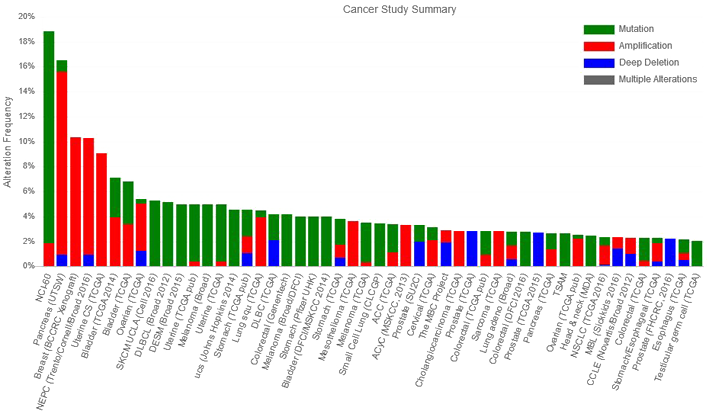
Figure 5. Alteration frequency percentages for indicated cancer types from TCGA (The Cancer Genome Atlas).
Article Bibliography
| Pubmed ID | Last Year | Title | Authors |
|---|---|---|---|
| 17026959 | 2006 | Association and insulin regulated translocation of hormone-sensitive lipase with PTRF. | Aboulaich N et al |
| 9417067 | 1998 | Identification of novel phosphorylation sites in hormone-sensitive lipase that are phosphorylated in response to isoproterenol and govern activation properties in vitro. | Anthonsen MW et al |
| 16534522 | 2006 | The hormone-sensitive lipase C-60G promoter polymorphism is associated with increased waist circumference in normal-weight subjects. | Carlsson E et al |
| 1528859 | 1992 | Mechanism of hormone-stimulated lipolysis in adipocytes: translocation of hormone-sensitive lipase to the lipid storage droplet. | Egan JJ et al |
| 25475467 | 2014 | A novel LIPE nonsense mutation found using exome sequencing in siblings with late-onset familial partial lipodystrophy. | Farhan SM et al |
| 11850754 | 2002 | The hormone-sensitive lipase gene and body composition: the HERITAGE Family Study. | Garenc C et al |
| 12840660 | 2003 | Letting lipids go: hormone-sensitive lipase. | Haemmerle G et al |
| 23688034 | 2013 | Risk interaction of obesity, insulin resistance and hormone-sensitive lipase promoter polymorphisms (LIPE-60 C > G) in the development of fatty liver. | Hsiao PJ et al |
| 12518034 | 2003 | Expression of human hormone-sensitive lipase in white adipose tissue of transgenic mice increases lipase activity but does not enhance in vitro lipolysis. | Lucas S et al |
| 11846402 | 2002 | Characterization of a novel testicular form of human hormone-sensitive lipase. | Mairal A et al |
| 8692022 | 1996 | Detection of an amino acid polymorphism in hormone-sensitive lipase in Japanese subjects. | Shimada F et al |
| 8812477 | 1996 | Molecular cloning, genomic organization, and expression of a testicular isoform of hormone-sensitive lipase. | Holst LS et al |
| 11731226 | 2001 | Variation in the promoter of the human hormone sensitive lipase gene shows gender specific effects on insulin and lipid levels: results from the Ely study. | Talmud PJ et al |
| 7942281 | 1994 | The multifunctional role of hormone-sensitive lipase in lipid metabolism. | Yeaman SJ et al |
| 27862896 | 2017 | Homozygous LIPE mutation in siblings with multiple symmetric lipomatosis, partial lipodystrophy, and myopathy. | Zolotov S et al |
Other Information
Locus ID:
NCBI: 3991
MIM: 151750
HGNC: 6621
Ensembl: ENSG00000079435
Variants:
dbSNP: 3991
ClinVar: 3991
TCGA: ENSG00000079435
COSMIC: LIPE
RNA/Proteins
Expression (GTEx)
Pathways
Protein levels (Protein atlas)
References
| Pubmed ID | Year | Title | Citations |
|---|---|---|---|
| 37149695 | 2023 | Entorhinal cortex epigenome-wide association study highlights four novel loci showing differential methylation in Alzheimer's disease. | 6 |
| 37361522 | 2023 | Habitual nappers and non-nappers differ in circadian rhythms of LIPE expression in abdominal adipose tissue explants. | 0 |
| 37149695 | 2023 | Entorhinal cortex epigenome-wide association study highlights four novel loci showing differential methylation in Alzheimer's disease. | 6 |
| 37361522 | 2023 | Habitual nappers and non-nappers differ in circadian rhythms of LIPE expression in abdominal adipose tissue explants. | 0 |
| 33445064 | 2021 | Dietary fat content and adipose triglyceride lipase and hormone-sensitive lipase gene expressions in adults' subcutaneous and visceral fat tissues. | 2 |
| 33445064 | 2021 | Dietary fat content and adipose triglyceride lipase and hormone-sensitive lipase gene expressions in adults' subcutaneous and visceral fat tissues. | 2 |
| 31150775 | 2019 | Hormone-sensitive lipase is a retinyl ester hydrolase in human and rat quiescent hepatic stellate cells. | 7 |
| 31150775 | 2019 | Hormone-sensitive lipase is a retinyl ester hydrolase in human and rat quiescent hepatic stellate cells. | 7 |
| 27862896 | 2017 | Homozygous LIPE mutation in siblings with multiple symmetric lipomatosis, partial lipodystrophy, and myopathy. | 23 |
| 27862896 | 2017 | Homozygous LIPE mutation in siblings with multiple symmetric lipomatosis, partial lipodystrophy, and myopathy. | 23 |
| 25819461 | 2015 | Primary defects in lipolysis and insulin action in skeletal muscle cells from type 2 diabetic individuals. | 12 |
| 25819461 | 2015 | Primary defects in lipolysis and insulin action in skeletal muscle cells from type 2 diabetic individuals. | 12 |
| 24848981 | 2014 | Null mutation in hormone-sensitive lipase gene and risk of type 2 diabetes. | 91 |
| 25475467 | 2014 | A novel LIPE nonsense mutation found using exome sequencing in siblings with late-onset familial partial lipodystrophy. | 28 |
| 24848981 | 2014 | Null mutation in hormone-sensitive lipase gene and risk of type 2 diabetes. | 91 |
Citation
Seher Gök
LIPE (lipase E, hormone sensitive type)
Atlas Genet Cytogenet Oncol Haematol. 2018-02-01
Online version: http://atlasgeneticsoncology.org/gene/43466/lipe-(lipase-e-hormone-sensitive-type)
