PLD1 (phospholipase D1, phosphatidylcholine-specific)
2010-10-01 Chang Sup Lee , Sung Ho Ryu AffiliationDepartment of Life Science, Division of Molecular, Life Sciences, Division of Integrative Biosciences, Biotechnology, WCU program, Pohang University of Science, Technology, Pohang, 790-784, South Korea
DNA/RNA
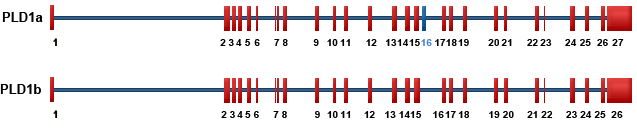
Description
Transcription
Proteins

Description
For example, dynamin and μ2 showed the effects on EGFR-mediated endocytosis via R128/R197 of the PLD1-PX domain and R304 of the PLD1-PH domain, respectively (Lee et al., 2006; Lee et al., 2009b). Also, PLCgamma and munc18 can interact with the P161/P164 of the PLD1-PX domain and the C-terminal region (184~212 residues) of the PLD1-PX domain, respectively (Jang et al., 2003; Lee et al., 2004). These interactions occur in an EGF-dependent manner and contribute to the regulation of PLD activity. Furthermore, PKCalpha can phosphorylate the T147 of the PLD1-PX domain to increase PLD activity (Kim et al., 1999). In addition, to protein interactions, these domains can interact with phospholipids. Recently, it has been reported that phosphoinositide 3,4,5-bisphosphate (PtdIns (3,4,5)P3 interacts with the R179 of the PLD1-PX domain and can stimulate PLD activity (Lee et al., 2005).
Phosphatidic acid-(PA) can also bind to PLD via a secondary lipid-binding pocket residue (R158) in the PLD1-PX domain (Stahelin et al., 2004). In addition, PLD1-PH domain also interacts with phosphoinositide 4,5-bisphosphate (PtdIns (4,5)P2 (Hodgkin et al., 2000). It has been reported that this interaction can regulate PLD activity and localization.
Expression
Localisation
Function
Proliferation
PLD can be activated by a variety of mitogenic signals - epidermal growth factor (EGF), platelet-derived growth factor (PDGF), vascular endothelial growth factor (VEGF), insulin, growth hormones, lysophosphatidic acid (LPA), and spingosine 1-phosphate - all of which can directly bind with G-protein coupled receptors (GPCR) and receptor-tyrosine kinases (RTK). PLD activation via mitogenic signals can induce cell proliferation, cell survival, the suppression of cell cycle arrest, and the prevention of apoptosis (Foster et al., 2003; Lee et al., 2009a; Su et al., 2009). Furthermore, elevated PLD activity has been shown to transform cells (Buchanan et al., 2005).
Vesicle trafficking
It has been reported that PLD is critically involved in vesicle formation and trafficking, such as, in endocytosis, exocytosis, and vesicle formation from the trans-Golgi network (Cazzolli et al., 2006). PLD-derived PA generation can recruit downstream molecules (PtdIns(4)P 5-Kinase) that are involved in vesicle fusion and mediate the inner membrane curvature (Jenkins et al., 2005). Many reports have suggested that PA generation by PLD can contribute to exocytosis (immune cell degranulation, neurotransmitter secretion, and EGF secretion) in various cell lines, such as, mast cells, adipocytes, and neuroendocrine cells. Furthermore, endocytosis (receptor mediated endocytosis and phagocytosis) also depends on PA generation by PLD (Humeau et al., 2001; Hughes et al., 2004; Huang et al., 2005; Peng et al., 2005). Recently, we have been suggested that PLD protein can increase the GTPase activity of dynamin, which is important for endocytosis, and that PLD itself, and not PA, can increase EGFR endocytosis (Lee et al., 2006).
Cytoskeletal reorganization
PA generation by PLD activation has been shown to be a key regulator of cytoskeletal dynamics to induce cell adhesion, spreading, and migration. PLD can be activated by kinases (PKC and PtdIns(4)P 5-Kinase) and small G proteins (Rho, Rac, cdc42, Arf, and Ral) that mediate signaling essentially required for cytoskeletal reorganization (Rudge et al., 2009). Moreover, PLD-derived PA can translocate GTP-Rac to the plasma membrane and induce integrin-mediated cell spreading (Chae et al., 2008).
Differentiation
PLD appears to be involved in the differentiation of various cells. Prolonged PA generation by PLD activation is correlated with the differentiation of keratinocytes (Jung et al., 1999), and the PLD isozyme expression levels are increased during granulocytic differentiation (Di Fulvio et al., 2005). PLD is well known to have an essential role during neuronal cell differentiation (Kanaho et al., 2009). Recently, Yoon et al reported that PLD can induce myoblast differentiation via the secretion of IGF2 in an autocrine manner (Yoon et al., 2008).
Homology
85% sequence identity in Mus musculus.
87% sequence identity in Rattus norvegicus.
47% sequence identity in C. elegans.
56% sequence identity with PLD2 of Homo sapiens.
Implicated in
Recently, PLD1 was shown to activate Rheb, which is upstream of the GTPase of mTor (Sun et al., 2008). Furthermore, PLD has also been implicated in the invasion of tumor cells and in the secretion of matrix metalloproteinases (MMP) (Pai et al., 1994; Wakelam et al., 1997; Knoepp et al., 2008; Park et al., 2009). In particular, the upregulation of PLD1 by PMA was shown to increase the secretion of MMP9 in colon cancer cells (Kang et al., 2008).
Beta-Amyloid precursor protein (beta-APP), which is involved in the pathogenesis of AD, has been shown to interact with PLD1-PH domain and elevated APP levels increased PLD activity in astroglioma cells (Jin et al., 2006; Jin et al., 2007). Also, the presenilins (PS1/PS2), which can mediate the proteolysis of beta-amyloid precursor protein, have been shown to interact with PLD1. Furthermore, the generation of beta-amyloid from beta-APP containing vesicles was found to be decreased by the overexpression of PLD1, which also promoted the budding out of beta-APP containing vesicles (Cai et al., 2006a; Cai et al., 2006b). Although evidence exists that PLD1 is associated with AD, the pathophysiological relationship between PLD1 and AD needs further study.
Article Bibliography
| Pubmed ID | Last Year | Title | Authors |
|---|
Other Information
Locus ID:
NCBI: 5337
MIM: 602382
HGNC: 9067
Ensembl: ENSG00000075651
Variants:
dbSNP: 5337
ClinVar: 5337
TCGA: ENSG00000075651
COSMIC: PLD1
RNA/Proteins
Expression (GTEx)
Pathways
Protein levels (Protein atlas)
References
| Pubmed ID | Year | Title | Citations |
|---|---|---|---|
| 36272918 | 2023 | Phospholipase D and cancer metastasis: A focus on exosomes. | 0 |
| 37381714 | 2023 | Nuclear PLD1 combined with NPM1 induces gemcitabine resistance through tumorigenic IL7R in pancreatic adenocarcinoma. | 1 |
| 37498407 | 2023 | Raf/MEK/ERK Signaling Pathway Is Involved in the Inhibition of Glioma Cell Proliferation and Invasion in the Ketogenic Microenvironment. | 0 |
| 38275747 | 2023 | Lipopolysaccharide Stimulates A549 Cell Migration through p-Tyr 42 RhoA and Phospholipase D1 Activity. | 0 |
| 36272918 | 2023 | Phospholipase D and cancer metastasis: A focus on exosomes. | 0 |
| 37381714 | 2023 | Nuclear PLD1 combined with NPM1 induces gemcitabine resistance through tumorigenic IL7R in pancreatic adenocarcinoma. | 1 |
| 37498407 | 2023 | Raf/MEK/ERK Signaling Pathway Is Involved in the Inhibition of Glioma Cell Proliferation and Invasion in the Ketogenic Microenvironment. | 0 |
| 38275747 | 2023 | Lipopolysaccharide Stimulates A549 Cell Migration through p-Tyr 42 RhoA and Phospholipase D1 Activity. | 0 |
| 34876384 | 2022 | Phospholipase D1-generated phosphatidic acid modulates secretory granule trafficking from biogenesis to compensatory endocytosis in neuroendocrine cells. | 2 |
| 35775110 | 2022 | Phospholipase D1 promotes cervical cancer progression by activating the RAS pathway. | 2 |
| 36362078 | 2022 | Exosome Secretion and Epithelial-Mesenchymal Transition in Ovarian Cancer Are Regulated by Phospholipase D. | 1 |
| 34876384 | 2022 | Phospholipase D1-generated phosphatidic acid modulates secretory granule trafficking from biogenesis to compensatory endocytosis in neuroendocrine cells. | 2 |
| 35775110 | 2022 | Phospholipase D1 promotes cervical cancer progression by activating the RAS pathway. | 2 |
| 36362078 | 2022 | Exosome Secretion and Epithelial-Mesenchymal Transition in Ovarian Cancer Are Regulated by Phospholipase D. | 1 |
| 32869317 | 2021 | Phospholipase D1 is upregulated by vorinostat and confers resistance to vorinostat in glioblastoma. | 6 |
Citation
Chang Sup Lee ; Sung Ho Ryu
PLD1 (phospholipase D1, phosphatidylcholine-specific)
Atlas Genet Cytogenet Oncol Haematol. 2010-10-01
Online version: http://atlasgeneticsoncology.org/gene/43716/pld1
