WIF1 (WNT inhibitory factor 1)
2012-04-01 Irene Vassallo , Monika E Hegi AffiliationLaboratory of Brain Tumor Biology, Genetics, Lausanne University Hospital, Lausanne, Switzerland
Identity
HGNC
LOCATION
12q14.3
IMAGE

LEGEND
Figure 1. WIF1 genomic context.
LOCUSID
ALIAS
WIF-1
FUSION GENES
DNA/RNA
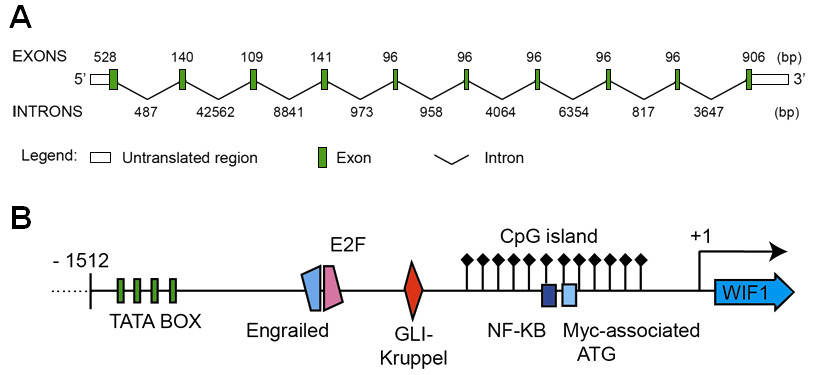
Figure 2. A) WIF1 gene structure. Transcription unit 71007 bp, mRNA 2304 bp. B) Structure of human WIF1 promoter.
Description
The human WIF1 gene is located on the chromosome 12q14.2 from 65444404 bp to 65515346 bp (from pter). It is oriented on the minus strand and comprises 10 exons spanning 71007 bp of genomic DNA. The first and the 10th exons are partially composed by untranslated regions.
Transcription
The mRNA produced is 2304 bp long. The promoter region of WIF1 has been cloned and studied by Reguart et al. and its structure is shown in Figure 2B (Reguart et al., 2004). Regulatory elements in the WIF1 promoter comprise a TATA box and binding sites of the transcription factors: Engrailed, E2F, GLI-Kruppel, NF-κB, and MYC, as visualized in Figure 2B. The CpG island located upstream of the WIF1 transcriptional start site is prone to aberrant methylation in various tumor types. Hypermethylation of this region has been found to be responsible for WIF1 downregulation, suggestive of tumor suppressor properties in different cancer types.
Pseudogene
No pseudogene known so far.
Proteins

Figure 3. WIF1 protein domains.
Description
WIF1 is a protein of 379 aminoacids, composed of a signal peptide for extracellular secretion, a WIF domain, five EGF repeats and a hydrophilic C terminus (Figure 3).
The WIF domain is responsible for the binding with some of the WNT ligands (3a, 4, 5a, 7a, 9a, 11) and to olfactomedin 1, a protein involved in neuronal differentiation (Hsieh et al., 1999).
The WIF domain is responsible for the binding with some of the WNT ligands (3a, 4, 5a, 7a, 9a, 11) and to olfactomedin 1, a protein involved in neuronal differentiation (Hsieh et al., 1999).
Expression
In development WIF1 starts to be produced during somitogenesis and maintains its expression in adults mainly in the lung, heart, and at the cartilage-mesenchyme interface (data derived from Xenopus, zebrafish and mouse).
Localisation
WIF1 is an extracellular secreted protein.
Function
WIF1 is a secreted WNT inhibitor that works by sequestering soluble Wnt proteins. It prevents the interaction between WNT morphogens and their specific receptors (Figure 4). WIF1 has been shown to bind to agonists of both, the canonical and the non-canonical WNT pathway. In contrast to other inhibitors like DKKs that can inhibit only the β-catenin dependent pathway, WIF1 can block the activation of both the canonical and the non-canonical WNT signaling pathway (Kawano and Kypta, 2003). Recently has been shown by Malinauskas et al. that WIF1 has a modular mechanism of inhibition. The WIF domain is responsible for the binding of WNT1 with WNT ligands and the five EGF-like domains seems to be partially involved in the extracellular localization of WIF1. The essential formation of gradients of WNT morphogens during development is mediated by interaction of the EGF-like domains and some glycosaminoglycans, namely heparin and heparan sulfate (Malinauskas et al., 2011).
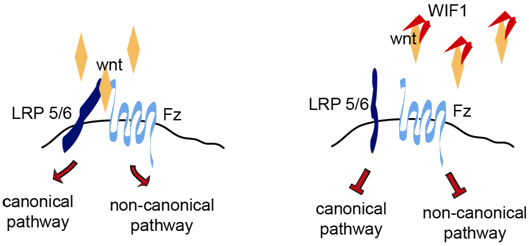
Figure 4. WIF1 inhibition mechanism.
Homology
The WIF1 gene is conserved in
- P. troglodytes (WIF1)
- C. lupus (WIF1)
- M. musculus (WIF1)
- R. norvegicus (WIF1)
- G. gallus (WIF1)
- D. rerio (WIF1)
- D. melanogaster (shf)
- P. troglodytes (WIF1)
- C. lupus (WIF1)
- M. musculus (WIF1)
- R. norvegicus (WIF1)
- G. gallus (WIF1)
- D. rerio (WIF1)
- D. melanogaster (shf)
Mutations
Note
WIF1 is rarely mutated in human cancer.
Somatic
According to COSMIC (Catalogue of Somatic Mutations in Cancer) only 6 samples over 1103 sequenced human cancer specimens show mutations that lead to amminoacid missense substitution.
Genomic deletions of the region where WIF1 is located have instead been reported for 10% of glioblastoma samples (Lambiv et al., 2011).
Genomic deletions of the region where WIF1 is located have instead been reported for 10% of glioblastoma samples (Lambiv et al., 2011).
Implicated in
Entity name
Cervical cancer
Note
WIF1 is downregulated by promoter hypermethylation in 87.5% of primary cervical cancer. Peritumoral WIF1 gene transfer induces apoptosis and inhibits growth and invasion (Ramachandran et al., 2011).
Entity name
Glioblastoma
Note
WIF1 silencing is mediated by both deletion (7/69, 10%) and promoter hypermethylation (29/110, 26%). WIF1 re-expression abolishes tumorigenicity of glioblastoma cell lines potentially by inducing senescence (Lambiv et al., 2011).
Entity name
Primary non-small-cell lung carcinoma (NSCLC)
Note
WIF1 is frequently downregulated and this downregulation is correlated with WIF1 promoter hypermethylation (Mazieres et al., 2004).
Entity name
Note
Hypermethylation of the WIF1 promoter is found in the majority of osteosarcoma cell lines tested and it correlates with WIF1 mRNA downregulation (Rubin et al., 2010).
Entity name
Hepatocellular carcinoma (HCC)
Note
WIF1 is frequently downregulated through promoter hypermethylation (Deng et al., 2010).
Entity name
Mesothelioma
Note
WIF-1 promoter methylation was reported from 73.9% of mesothelioma tissues and in 100% of tested mesothelioma cell lines (Kohno et al., 2010).
Entity name
Renal cell carcinoma (RCC)
Note
WIF-1 is downregulated by promoter methylation and when re-expressed induces apoptosis in RCC cells (Kawakami et al., 2009).
Entity name
Bladder cancer
Note
Entity name
Esophageal adenocarcinoma (EAC)
Note
Epigenetic alteration of WIF1 is an early event in the carcinogenesis of EAC. Its suggested to be involved in the progression from Barretts esophagus (BE) to EAC thus WIF1 hypermethylation is proposed to be used as a diagnostic and predictive marker for increased EAC risk in BE patients. (Clément et al., 2008).
Entity name
Gastrointestinal cancers
Note
WIF-1 expression has been reported to be downregulated in 80.0% of esophageal, 74.2% of gastric, 82.0% of colorectal, and 75% of pancreatic cancer tissues. WIF1 silencing, mediated by hypermethylation, is proposed to be an early event in colorectal carcinogenesis (Taniguchi et al., 2005).
Entity name
Breast cancer
Note
67% of the investigated invasive breast adenocarcinoma (Stages II or III) shows aberrant WIF1 promoter methylation (Ai et al., 2006).
Entity name
Salivary gland pleomorphic adenoma
Note
WIF1 is rearranged resulting in a HMGA2/WIF1 fusion transcript. In consequence of this fusion WIF1 that in normal salivary gland tissue is highly expressed becomes downregulated. On the contrary, HMGA2 that in normal tissue is not expressed is strongly upregulated (Queimado et al., 2007).
Article Bibliography
| Pubmed ID | Last Year | Title | Authors |
|---|---|---|---|
| 16501252 | 2006 | Inactivation of Wnt inhibitory factor-1 (WIF1) expression by epigenetic silencing is a common event in breast cancer. | Ai L et al |
| 18005197 | 2008 | Epigenetic alteration of the Wnt inhibitory factor-1 promoter occurs early in the carcinogenesis of Barrett's esophagus. | Clément G et al |
| 20119713 | 2010 | Epigenetic silencing of WIF-1 in hepatocellular carcinomas. | Deng Y et al |
| 10201374 | 1999 | A new secreted protein that binds to Wnt proteins and inhibits their activities. | Hsieh JC et al |
| 19887605 | 2009 | Functional significance of Wnt inhibitory factor-1 gene in kidney cancer. | Kawakami K et al |
| 12775774 | 2003 | Secreted antagonists of the Wnt signalling pathway. | Kawano Y et al |
| 20596629 | 2010 | Aberrant promoter methylation of WIF-1 and SFRP1, 2, 4 genes in mesothelioma. | Kohno H et al |
| 21642372 | 2011 | The Wnt inhibitory factor 1 (WIF1) is targeted in glioblastoma and has a tumor suppressing function potentially by induction of senescence. | Lambiv WL et al |
| 21743455 | 2011 | Modular mechanism of Wnt signaling inhibition by Wnt inhibitory factor 1. | Malinauskas T et al |
| 15256437 | 2004 | Wnt inhibitory factor-1 is silenced by promoter hypermethylation in human lung cancer. | Mazieres J et al |
| 17171686 | 2007 | WIF1, an inhibitor of the Wnt pathway, is rearranged in salivary gland tumors. | Queimado L et al |
| 22002305 | 2012 | Wnt inhibitory factor 1 induces apoptosis and inhibits cervical cancer growth, invasion and angiogenesis in vivo. | Ramachandran I et al |
| 15351726 | 2004 | Cloning and characterization of the promoter of human Wnt inhibitory factor-1. | Reguart N et al |
| 20197388 | 2010 | Wnt inhibitory factor 1 decreases tumorigenesis and metastasis in osteosarcoma. | Rubin EM et al |
| 19174556 | 2009 | WIF1, a Wnt pathway inhibitor, regulates SKP2 and c-myc expression leading to G1 arrest and growth inhibition of human invasive urinary bladder cancer cells. | Tang Y et al |
| 16007117 | 2005 | Frequent epigenetic inactivation of Wnt inhibitory factor-1 in human gastrointestinal cancers. | Taniguchi H et al |
| 16428476 | 2006 | Epigenetic inactivation of Wnt inhibitory factor-1 plays an important role in bladder cancer through aberrant canonical Wnt/beta-catenin signaling pathway. | Urakami S et al |
Other Information
Locus ID:
NCBI: 11197
MIM: 605186
HGNC: 18081
Ensembl: ENSG00000156076
Variants:
dbSNP: 11197
ClinVar: 11197
TCGA: ENSG00000156076
COSMIC: WIF1
RNA/Proteins
| Gene ID | Transcript ID | Uniprot |
|---|---|---|
| ENSG00000156076 | ENST00000286574 | Q9Y5W5 |
| ENSG00000156076 | ENST00000543094 | H0YFK7 |
| ENSG00000156076 | ENST00000546001 | F5H8A3 |
Expression (GTEx)
Pathways
PharmGKB
| Entity ID | Name | Type | Evidence | Association | PK | PD | PMIDs |
|---|---|---|---|---|---|---|---|
| PA164713176 | Platinum compounds | Chemical | ClinicalAnnotation | associated | PD | 24980784 | |
| PA443622 | Carcinoma, Non-Small-Cell Lung | Disease | ClinicalAnnotation | associated | PD | 24980784 |
References
| Pubmed ID | Year | Title | Citations |
|---|---|---|---|
| 37849332 | 2024 | Expanding the histological spectrum of salivary gland neoplasms with HMGA2::WIF1 fusion emphasising their malignant potential: a report of eight cases. | 0 |
| 38604345 | 2024 | Upregulated miR-374a-5p drives psoriasis pathogenesis through WIF1 downregulation and Wnt5a/NF-κB activation. | 0 |
| 37849332 | 2024 | Expanding the histological spectrum of salivary gland neoplasms with HMGA2::WIF1 fusion emphasising their malignant potential: a report of eight cases. | 0 |
| 38604345 | 2024 | Upregulated miR-374a-5p drives psoriasis pathogenesis through WIF1 downregulation and Wnt5a/NF-κB activation. | 0 |
| 37306343 | 2023 | WIF1 was downregulated in cervical cancer due to promoter methylation. | 1 |
| 37306343 | 2023 | WIF1 was downregulated in cervical cancer due to promoter methylation. | 1 |
| 34324456 | 2022 | HMGA2-WIF1 Rearrangements Characterize a Distinctive Subset of Salivary Pleomorphic Adenomas With Prominent Trabecular (Canalicular Adenoma-like) Morphology. | 8 |
| 34324456 | 2022 | HMGA2-WIF1 Rearrangements Characterize a Distinctive Subset of Salivary Pleomorphic Adenomas With Prominent Trabecular (Canalicular Adenoma-like) Morphology. | 8 |
| 33477402 | 2021 | Gene Methylation and Silencing of WIF1 Is a Frequent Genetic Abnormality in Mantle Cell Lymphoma. | 0 |
| 33629313 | 2021 | SPRR2C, DEFB4A, WIF1, CRY2, and KRT19 are correlated with the development of atopic eczema. | 0 |
| 33813201 | 2021 | LINC00176 facilitates CD4(+)T cell adhesion in systemic lupus erythematosus via the WNT5a signaling pathway by regulating WIF1. | 4 |
| 33928818 | 2021 | Prognostic Role of RASSF1A, SOX17 and Wif-1 Promoter Methylation Status in Cell-Free DNA of Advanced Gastric Cancer Patients. | 10 |
| 33992091 | 2021 | Association of ZNF331 and WIF1 methylation in peripheral blood leukocytes with the risk and prognosis of gastric cancer. | 5 |
| 34037837 | 2021 | The status of WIF1 methylation in cell-free DNA is associated with the insusceptibility for gefitinib in the treatment of lung cancer. | 2 |
| 34042263 | 2021 | The complex role of Wnt ligands in type 2 diabetes mellitus and related complications. | 21 |
Citation
Irene Vassallo ; Monika E Hegi
WIF1 (WNT inhibitory factor 1)
Atlas Genet Cytogenet Oncol Haematol. 2012-04-01
Online version: http://atlasgeneticsoncology.org/gene/44085/wif1
