PEG10 (paternally expressed 10)
2011-02-01 Andreas Lux AffiliationInstitute of Molecular, Cell Biology, Mannheim University of Applied Sciences, Mannheim, Germany
Identity
DNA/RNA

Description
Transcription
Transcript processing. Northern blot analyses have shown that for humans depending on the tissue PEG10 transcripts of different size exist. One between 6 and 7 kb, corresponding to the major 6.6 kb PEG10 transcript, as well as minor sized transcripts (Ono et al., 2001; Smallwood et al., 2003; Lux et al., 2005). The major 6.6 kb PEG10 transcript is polyadenylated and at the distal end of exon 2 there are two canonical polyadenylation sequences, AATAAA. In a recent study, minor sized alternatively polyadenylated transcripts were isolated but none of these transcripts contained the typical polyadenylation signal motif at their 3-end nor any known alternative polyadenylation signal sequence motifs (Lux et al., 2010). If PEG10 transcripts are truly subjected to alternative polyadenylation then future studies have to address the question whether this influences PEG10 expression, mRNA stability, mRNA localisation or translation and if it might be related to pathological processes. Because PEG10 is most likely derived from a retrotransposon it is interesting to note that non-conserved poly(A) sites are associated with transposable elements to a much greater extent than conserved ones (Lee et al., 2008).
Proteins
Description
Translation. In order to perform the -1 frameshift, the reading frame 1 (RF1) - reading frame 2 (RF2) overlap sequence contains a seven nucleotide "slippery" sequence with typical consecutive homopolymeric triplets. The underlined PEG10 "slippery" heptanucleotide sequence G GGA AAC TC follows the general pattern of X XXY YYZ where the A- and P-site tRNAs detach from the zero frame codons XXY YYZ and re-pair after shifting back one nucleotide to XXX YYY and restart translation with the codon after the YYY triplet. Thus, the deduced amino acid sequence of the frameshift site after frameshift translation is GNL. The heptanucleotide "slippery" sequence is completely conserved in all species and the sequence of the downstream pseudoknot is completely conserved in the mammalian species. except for one nucleotide change in the rodent sequence. A detailed analysis of the PEG10 frameshift sequence was done by Manktelow and colleagues (2005).
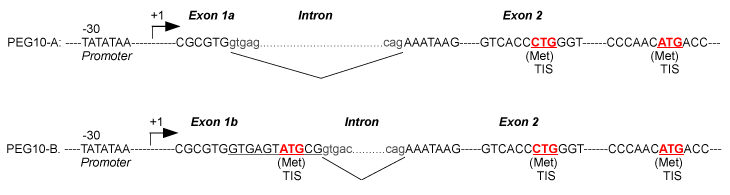
Due to alternative splicing two transcript variants exist, PEG10-A and PEG10-B, leading to several protein isoforms. These isoforms are first, the result of different translation initiation sites in reading frame 1 (RF1) (Lux et al., 2010). Second, due to the fact, whether the reading frames 1 and 2 (RF2) are translated into an RF1 protein or into an RF1/2 protein by succesfull -1 frameshift translation, and third, in the RF1/2 translation products, shortly after the frameshift site, there is a retroviral typical functional aspartic protease motif usually for Gag-Pol protein processing leading to proteolytic cleavage products (Clark et al., 2007). It was demonstrated that upstream of the originaly predicted ATG translation initiation site (TIS) a second in frame non-ATG exists. For clarification, the non-ATG translation site will be named TIS-1a and the previous ATG start site TIS-2. This non-ATG start codon, a CTG, is 102 nucleotides upstream of the ATG start codon. The alternative splice event that leads to transcript PEG10-B introduces an additional in frame ATG start codon even further upstream of the previous two, which will be named TIS-1b. Their might be an additional TIS further downstream of TIS-2 (Lux et al., 2010). Transcript PEG10-A codes for PEG10-RF1 (using TIS-2), PEG10-RF1a (using TIS-1a), PEG10-RF1/2 and PEG10-RF1a/2. While in theory, transcript PEG10-B can lead to all six isoforms, PEG10-RF1, PEG10-RF1a, PEG10-RF1b (using TIS-1b), PEG10-RF1/2, PEG10-RF1a/2 and PEG10-RF1b/2. Figure 1 shows in a more schematic way the different TIS for transcripts PEG10-A and PEG10-B. The deduced amino acid sequences of the different isoforms are listed in figure 2.
Investigation of PEG10 translation in mouse placenta during gestation and human placenta showed that in vivo both reading frames are translated as an RF1 protein and an RF1/2 fusion protein (Clark et al., 2007). The mouse RF1/2 protein is about 40 kDa larger than the corresponding human protein due to an in frame insertion of approximately 600 nucleotides into the RF2 sequence. Interestingly, the size of RF1 and RF1/2 proteins and the translational frame shift efficiency varies during gestation. From 9.5 dpc when PEG10 expression in mice is first detectable, the 150 kDa frameshift protein is dominant. By using an RF1-specific antibody the frameshift efficiency was estimated and showed an apparent decrease from 68% at 9.5 dpc to 43% by 21.5 dpc. At 15.5 dpc an additional protein of 105 kDa was detected at about equal amounts as the 150 kDa protein. At late gestation, 21.5 dpc, it was present in greater amounts than the 150 kDa PEG10-RF1/2 protein. Mass spectrometry analysis identified the 105 kDa protein as a PEG10 product consisting primarily of PEG10 RF2 but containing peptides from both reading frames. PEG10 protein analysis for amniotic membrane showed a similar profile to that of placenta. Starting with a low expression at 9.5 dpc and then an increased and continued expression throughout gestation. The RF1/2 fusion protein again was the dominant band. Surprisingly, at 10.5 dpc a transient RF1 protein of increased mass of about 50 kDa was detected that disappeared at later time points and only the slightly smaller 47-kDa band identical in size to that in placenta was present again. Furthermore, in this report three RF1 protein populations were detected for HepG2 cells ranging from 47 to 55 kDa. Whether these different PEG10 protein masses are the result of post-translational modifications or due to the use of different TIS or a mixture of both is not clear and awaits further investigations.
In addition, western blot analysis with an RF1-specific antibody of adult mouse heart, spleen and brain tissue extracts showed a weak, single protein band but of different mass, around 50 kDa, for each tissue (Clark et al., 2007). No RF1/2 proteins were detected. The authors concluded based on their further analysis that these proteins do not represent Peg10 proteins.
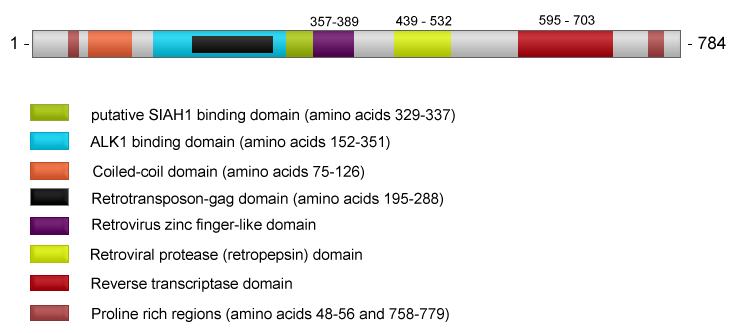
Protein domains/motifs. By bioinformatic analyses using different programmes like the Simple Modular Architecture Research Tool (SMART), the SUPERFAMILY Sequence Search (SCOP domains) and the Eukaryotic Linear Motif (ELM) resource for functional site prediction, several domains and motifs were predicted. Some are exemplarily shown schematicaly in figure 3 for the 784 amino acid long PEG10-RF1b/2 protein. The Zink-finger domain was consistently identified although the size of the domain varies from amino acid 357-389 or a core region from 370-386 for a ZNF-C2HC (CX2CX4HX4C) consensus sequence, which is highly conserved in Gag proteins in most retroviruses and some retrotransposons. There are two proline rich regions, one at the N-terminus and one at the C-terminus. Proline-rich regions are recognized as presenting binding motifs to, for example, Src homology 2 (SH2) and SH3 domains. The ELM programme predicted the C-terminal proline stretch to be a possible binding site for SH3 domain containing proteins. As already reported, PEG10 contains a retroviral typical aspartyl protease consensus sequence, AMIDSGA. In order to test whether this motif is catalytic active the aspartate was mutated to an alanine (Clark et al., 2007). This change disrupted the protease activity and proved that the aspartyl protease is responsible for the cleavage of the full length PEG10 frameshift protein in to the RF1 and RF2 parts. Taken the protease activity into account the previously estimated PEG10 frameshift efficiency of 15-30% (Shigemoto et al., 2001; Lux et al., 2005) was reestimated to be 60% (Clark et al., 2007).
Interacting proteins. Aside from the protease motif, for none of the other domains it is known whether they are functional nor if they bind to other proteins. The only known binding partners for PEG10 are currently the SIAH1 and SIAH2 proteins (Okabe et al., 2003) and the TGF-beta type I receptor ALK1 (Lux et al., 2005). All three proteins were identified by a yeast two-hybrid screen with the PEG10-RF1 protein and the interactions were confirmed by co-immunoprecipitation experiments. The exact SIAH1/SIAH2 binding region was not determined, but the ELM programme predicted a potential SIAH1 binding site (figure 3, PEG10-RF1b amino acids 329-337). Co-immunoprecipitation experiments by overexpressing PEG10-RF1 and several other type I and II receptors of the TGF-beta superfamily in COS-1 cells showed that PEG10 does also interact with other members of this receptor group (Lux et al., 2005). Nevertheless, when specifically investigated in the two-hybrid assay under stringent conditions none of these receptors reacted with PEG10-RF1 to activate the reporter system. Thus, the most specific interaction appears to be with ALK1.
Expression
Peg10 expression was observed in relation to adipocyte differentiation in mice. Peg10 was identified as one of the genes expressed early in adipogenesis (Hishida et al., 2007). Expression of Peg10 was elevated after the addition of differentiation inducers in adipocyte differentiable 3T3-L1 cells, but not in the non-adipogenic cell line NIH-3T3. The knockdown of Peg10 by RNA interference inhibited the differentiation of 3T3-L1 cells. Moreover, Peg10 siRNA treatment impaired mitotic clonal expansion (MCE), necessary for adipocyte differentiation, and the crucial expression of C/EBPbeta and C/EBPdelta at the immediate early stage of the differentiation process was inhibited by the knock-down. These results indicate that Peg10 plays an important role at the immediate early stage of adipocyte differentiation.
Aside from bone and cartilage tissue differentiation and adipocyte cell differentiation PEG10 might also be involved in neuronal cell differentiation. In a preliminary experiment with the neuroblastoma cell line SH-SY5Y increasing PEG10 expression was reported over a period of 14 days after treatment with all-trans retinoic acid for differentiation (Lux et al., 2010).
Localisation
Function
Nevertheless, PEG10-RF1 appears to enhance cell proliferation and blocks apoptosis. Evidence for PEG10s role in cell proliferation were reported by Tsou et al. (2003). Induced PEG10 expression was found during G2/M phase of regenerating mouse liver and elevated expression of PEG10 was found in HCC. The authors state that both, HCC and regenerating mouse livers, represent the two proliferative states of the otherwise quiescent liver tissue. In addition, ectopic expression of PEG10 in 293T cells enhanced cell cycle progression. Complementary data were presented by Okabe and colleagues (2003). The hepatoma cell line, SNU423 that has no endogenous PEG10, was stable transfected with an expression construct for PEG10-RF1 to test the effect of PEG10 on cell growth. The PEG10 stable transfectant cells revealed significant growth promotion compared with the parental or mock cells. Under conditions of serum starvation (0.1% FBS), the mock cells rapidly underwent growth arrest, but stable PEG10-expressing cells continued to proliferate. In the same report, in a yeast two-hybrid screen, the apoptosis inducing protein SIAH1 was identified as a PEG10-RF1 interactor. Overexpression of SIAH1 increased cell death in different hepatoma cell lines, whereas co-expression of PEG10-RF1 in tested SNU423 revealed a partial but significant protection from apoptosis. Anti-apoptotic activity of PEG10 was also reported by Yoshibayashi et al. (2007). The finding that PEG10 enhances cell proliferation was further confirmed by PEG10-specific siRNA knock-down experiments in a series of carcinoma cell lines, i.e. Panc1, HepG2, and Hep3B, which led to a significantly reduced cell proliferation (Li et al., 2006; Yoshibayashi et al., 2007).
Anti-apoptotic activity by PEG10 were not only seen for HCC/hepatoma but also reported for B-cell acute and chronic lymphocytic leukemia, B-ALL and B-CLL. It was observed that B-ALL and B-CLL CD19+CD34+ B cells expressed elevated levels of PEG10, regulated by the chemokines CXCL13 and CCL19 and that these cells were resistant to TNF-alpha induced apoptosis. Treatment of the cells with PEG10 antisense constructs reversed this effect (Hu et al., 2004; Chunsong et al., 2006; Wang et al., 2007). Kainz and colleagues (2007) reported that PEG10 overexpression is associated with high-risk B-CLL. Expression levels in CD19+ B-CLL cells were up to 100-fold higher than in B-cells from healthy donors and expression levels in B-CLL patient samples remained stable over time even after chemotherapy. The intensity of intracellular staining of PEG10 protein corresponded to mRNA levels. Further analysis of PEG10s anti-apoptotic potential showed that short term knock-down (2 days after transfection) of PEG10 in B-CLL cells was not associated with changes in cell survival but long term inhibition (4 days after transfection of PEG10) led to a significant effect on the induction of apoptosis and late apoptosis/necrosis in B-CLL cells.
As described above, during gestation PEG10 is highly expressed in the placenta. Mouse placenta is positive for Peg10 transcripts as well as for proteins from reading frame 1 and reading frame 1/2 (Clark et al., 2007). Peg10 knock-out experiments in mice demonstrated that Peg10 and therefore the Peg10 proteins have an important role during placenta development. Heterozygous knock-outs for the patternal allele died at 10.5 dpc. Their placentas were severely depleted and the labyrinth layer was not developed and the spongiotrophoblast cells were missing (Ono et al., 2006). As discussed by the authors, parthenogenetic embryos die before 9.5 d.p.c. and show early embryonic lethality with poorly developed extraembryonic tissues. Morphological defects of the most developed parthenotes are very similar to those of Peg10-Pat KO embryos; they lack the diploid trophoblast cells of the labyrinth layer and the spongiotrophoblast. However, the majority of parthenotes show more severe phenotypes; suggesting that other genes could also contribute to the parthenogenetic phenotypes. Nevertheless, the result for mouse Peg10 suggests that one of the Peg10 isoforms could be critical for parthenogenetic development in mice and therefore also in man.
Homology
Implicated in
Widespread DNA copy number alterations are well recognized in HCC and concurrent genomic gains within the chromosome region 7q21 has been implicated in the progression of HCC. In a study by Ip et al. (2007), it was suggested that PEG10 may be a potential biomarker in the progressive development of HCC. Quantitative PCR and qRT-PCR showed the chromosomal gain of 7q21 as well as over expression of PEG10 in HCC cell lines and primary tumors. In addition, qRT-PCR demonstrated a significant progressive trend of increasing PEG10 expression from the putative pre-malignant adjacent livers to early resectable HCC tumors, and to late inoperable HCCs. The authors concluded that genomic gain represents one of the major mechanisms in the induction of PEG10 over expression. This conclusion is further supported by independent data from Tsuji et al. (2010). Increased PEG10 expression might also serve as a biomarker for nephropathy in peripheral blow cells of type 2 diabetes (T2DN) (Guttula et al., 2010).
Article Bibliography
| Pubmed ID | Last Year | Title | Authors |
|---|---|---|---|
| 15716091 | 2005 | Transposable elements as a source of genetic innovation: expression and evolution of a family of retrotransposon-derived neogenes in mammals. | Brandt J et al |
| 16093683 | 2005 | A family of neofunctionalized Ty3/gypsy retrotransposon genes in mammalian genomes. | Brandt J et al |
| 17082584 | 2006 | CXC chemokine ligand 13 and CC chemokine ligand 19 cooperatively render resistance to apoptosis in B cell lineage acute and chronic lymphocytic leukemia CD23+CD5+ B cells. | Chunsong H et al |
| 17942406 | 2007 | Mammalian gene PEG10 expresses two reading frames by high efficiency -1 frameshifting in embryonic-associated tissues. | Clark MB et al |
| 16778176 | 2006 | Multiple imprinted and stemness genes provide a link between normal and tumor progenitor cells of the developing human kidney. | Dekel B et al |
| 3007011 | 1985 | The regulation of gene expression in murine teratocarcinoma cells. | Gorman CM et al |
| 20431808 | 2010 | Cluster analysis and phylogenetic relationship in biomarker identification of type 2 diabetes and nephropathy. | Guttula SV et al |
| 17707377 | 2007 | peg10, an imprinted gene, plays a crucial role in adipocyte differentiation. | Hishida T et al |
| 16225771 | 2004 | PEG10 activation by co-stimulation of CXCR5 and CCR7 essentially contributes to resistance to apoptosis in CD19+CD34+ B cells from patients with B cell lineage acute and chronic lymphocytic leukemia. | Hu C et al |
| 17126992 | 2007 | Identification of PEG10 as a progression related biomarker for hepatocellular carcinoma. | Ip WK et al |
| 17369855 | 2007 | Androgen activates PEG10 to promote carcinogenesis in hepatic cancer cells. | Jie X et al |
| 17621626 | 2007 | Overexpression of the paternally expressed gene 10 (PEG10) from the imprinted locus on chromosome 7q21 in high-risk B-cell chronic lymphocytic leukemia. | Kainz B et al |
| 18757892 | 2008 | Phylogenetic analysis of mRNA polyadenylation sites reveals a role of transposable elements in evolution of the 3'-end of genes. | Lee JY et al |
| 16423995 | 2006 | PEG10 is a c-MYC target gene in cancer cells. | Li CM et al |
| 15611116 | 2005 | Human retroviral gag- and gag-pol-like proteins interact with the transforming growth factor-beta receptor activin receptor-like kinase 1. | Lux A et al |
| 20084274 | 2010 | Genetic and molecular analyses of PEG10 reveal new aspects of genomic organization, transcription and translation. | Lux H et al |
| 15767280 | 2005 | Characterization of the frameshift signal of Edr, a mammalian example of programmed -1 ribosomal frameshifting. | Manktelow E et al |
| 11159908 | 2001 | E2Fs regulate the expression of genes involved in differentiation, development, proliferation, and apoptosis. | Müller H et al |
| 12810624 | 2003 | Involvement of PEG10 in human hepatocellular carcinogenesis through interaction with SIAH1. | Okabe H et al |
| 11318613 | 2001 | A retrotransposon-derived gene, PEG10, is a novel imprinted gene located on human chromosome 7q21. | Ono R et al |
| 16341224 | 2006 | Deletion of Peg10, an imprinted gene acquired from a retrotransposon, causes early embryonic lethality. | Ono R et al |
| 11574691 | 2001 | Identification and characterisation of a developmentally regulated mammalian gene that utilises -1 programmed ribosomal frameshifting. | Shigemoto K et al |
| 12620933 | 2003 | Temporal regulation of the expression of syncytin (HERV-W), maternally imprinted PEG10, and SGCE in human placenta. | Smallwood A et al |
| 17432937 | 2007 | Retrotransposon silencing by DNA methylation can drive mammalian genomic imprinting. | Suzuki S et al |
| 14576465 | 2003 | Overexpression of a novel imprinted gene, PEG10, in human hepatocellular carcinoma and in regenerating mouse livers. | Tsou AP et al |
| 20362226 | 2010 | PEG10 is a probable target for the amplification at 7q21 detected in hepatocellular carcinoma. | Tsuji K et al |
| 11158386 | 2001 | Ty3/Gypsy retrotransposon fossils in mammalian genomes: did they evolve into new cellular functions? | Volff J et al |
| 18625225 | 2008 | PEG10 directly regulated by E2Fs might have a role in the development of hepatocellular carcinoma. | Wang C et al |
| 18425371 | 2008 | 1p31, 7q21 and 18q21 chromosomal aberrations and candidate genes in acquired vinblastine resistance of human cervical carcinoma KB cells. | Wang J et al |
| 17709502 | 2007 | CCL19 and CXCL13 synergistically regulate interaction between B cell acute lymphocytic leukemia CD23+CD5+ B Cells and CD8+ T cells. | Wang X et al |
| 17273732 | 2007 | SIAH1 causes growth arrest and apoptosis in hepatoma cells through beta-catenin degradation-dependent and -independent mechanisms. | Yoshibayashi H et al |
| 15057899 | 2004 | Coordinate expression of regulatory genes differentiates embryonic and perinatal forms of biliary atresia. | Zhang DY et al |
Other Information
Locus ID:
NCBI: 23089
MIM: 609810
HGNC: 14005
Ensembl: ENSG00000242265
Variants:
dbSNP: 23089
ClinVar: 23089
TCGA: ENSG00000242265
COSMIC: PEG10
RNA/Proteins
Expression (GTEx)
Protein levels (Protein atlas)
References
| Pubmed ID | Year | Title | Citations |
|---|---|---|---|
| 36951542 | 2023 | UBQLN2 restrains the domesticated retrotransposon PEG10 to maintain neuronal health in ALS. | 7 |
| 37464405 | 2023 | Paternal Expressed Gene 10 (PEG10) is decreased in early-onset preeclampsia. | 0 |
| 37932427 | 2023 | GPC3 and PEG10 peptides associated with placental gp96 elicit specific T cell immunity against hepatocellular carcinoma. | 0 |
| 36951542 | 2023 | UBQLN2 restrains the domesticated retrotransposon PEG10 to maintain neuronal health in ALS. | 7 |
| 37464405 | 2023 | Paternal Expressed Gene 10 (PEG10) is decreased in early-onset preeclampsia. | 0 |
| 37932427 | 2023 | GPC3 and PEG10 peptides associated with placental gp96 elicit specific T cell immunity against hepatocellular carcinoma. | 0 |
| 34357660 | 2022 | Structural evidence that MOAP1 and PEG10 are derived from retrovirus/retrotransposon Gag proteins. | 1 |
| 34582557 | 2022 | PEG10 amplification at 7q21.3 potentiates large-cell transformation in cutaneous T-cell lymphoma. | 7 |
| 34633608 | 2022 | Circ_0075804 promotes the malignant behaviors of retinoblastoma cells by binding to miR-138-5p to induce PEG10 expression. | 5 |
| 34876700 | 2022 | Transcriptional regulator CTR9 promotes hepatocellular carcinoma progression and metastasis via increasing PEG10 transcriptional activity. | 3 |
| 34934172 | 2022 | Folate deficiency disturbs PEG10 methylation modifications in human spina bifida. | 3 |
| 35739280 | 2022 | CRISPR activation screen identifies TGFβ-associated PEG10 as a crucial tumor suppressor in Ewing sarcoma. | 0 |
| 36385135 | 2022 | LncRNA NALT1 promotes colorectal cancer progression via targeting PEG10 by sponging microRNA-574-5p. | 8 |
| 34357660 | 2022 | Structural evidence that MOAP1 and PEG10 are derived from retrovirus/retrotransposon Gag proteins. | 1 |
| 34582557 | 2022 | PEG10 amplification at 7q21.3 potentiates large-cell transformation in cutaneous T-cell lymphoma. | 7 |
Citation
Andreas Lux
PEG10 (paternally expressed 10)
Atlas Genet Cytogenet Oncol Haematol. 2011-02-01
Online version: http://atlasgeneticsoncology.org/gene/44104/peg10
