NPY1R (neuropeptide Y receptor Y1)
2010-06-01 Massimiliano Ruscica , Elena Dozio , Luca Passafaro , Paolo Magni AffiliationDipartimento di Endocrinologia, Fisiopatologia e Biologia Applicata, Universita degli Studi di Milano, Italy (MR, LP, PM); Dipartimento di Morfologia Umana e Scienze Biomediche Citta Studi, Universita degli Studi di Milano, Italy (ED)
DNA/RNA
Note

Description
The human NPY1R gene is divided into three exons: exon 1 (115 bp), exon 2 (850 bp), and exon 3 (1749 bp). In particular, the NPY1R gene contains three alternative exon 1 sequences (80, 110, and 106 bp) located 6.4, 18.4, and 23.9 kb upstream of exon 2. Exon 1A is located 6.4 kb upstream of exon 2; exon 1B was found a further 12 kb upstream exon 1A, and exon 1C another 5.5 kb upstream of exon 1B. These alternative 5 exons allow the regulation of tissue-specific expression of the receptor. The first 57 nucleotides of the 5UTR of the human NPY1R mRNA are separated by a 6-kb intron from the second exon. The second intron 97 bp, containing an in-frame stop codon, is located at nucleotide 908 in the protein coding region after the fifth transmembrane domain between exon 2 and 3. Moreover, as shown by Nakamura, mouse NPY1R gene contains an alternate exon 4 located over 15 kb downstream of exon 3.
Transcription
Proteins
Note
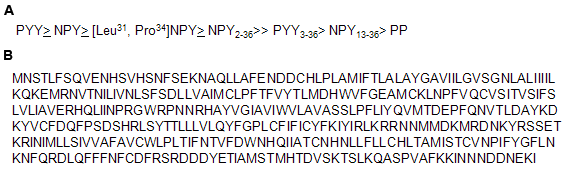
Description
Expression
Nervous system
The NPY Y1R is widely distributed in the central nervous system. A study conducted on four normal human brains revealed that high levels of Y1R receptor mRNA were expressed in cortical areas and in the claustrum, while moderate levels were present in the nucleus accumbens, caudate nucleus, putamen, amygdaloid nuclei and arcuate and paraventricular nuclei of the hypothalamus. Moreover, a study conducted on prefrontal cortex of subjects affected by bipolar disorder, major depression, or schizophrenia revealed a progressive age-related decline in the expression of Y1R mRNA associated with a lack of coexpression with NPY neurons. Interestingly, there was no significant effect of suicide as a cause of death on Y1R mRNA expression levels. In fact, subjects with suicide as a cause of death tended to have higher Y1R mRNA expression levels, but these individuals were among the youngest ones (45 years old) in the population studied.
Periphery
Peripherally, Y1Rs are expressed mainly in arteries and veins, where they are associated with vasoconstriction and potentiation of other vasoconstrictors of neurogenic origin. Although limited, there is evidence of prejunctional Y1R inhibition of neurotransmitter release. Nonetheless, NPY Y1R is primarily located postjunctionally on vascular smooth muscle cells.
1) Colon
In vitro receptor autoradiography ([125I]PYY) performed on normal human colonic tissue obtained from nine patients showed that Y1R is distributed only in vessels. No measurable levels of subtype Y1 was identified in smooth muscle, mucosa, muscularis mucosae, as well as in lymphoid follicles, myoenteric and submucosal plexus.
2) Heart
A study conducted on 20-week old fetal human hearts showed that Y1R is present on right ventricular endocardial endothelial cells. In particular, it is highly expressed at the level of the nucleus specifically at the perinucleoplasm and nuclear membrane levels, while lower levels were detected in the cytoplasm and the plasma membrane.
3) Dental pulp
NPY Y1R proteins were present in solubilized membrane preparations of both healthy and inflamed human gingival tissue by Western blotting. Major immunoreactive bands were detected at approximately 55 kDa due to a glycosylated form of the native receptor protein. By using the SwissProt glycosylation prediction packages NetNGlyc and NetOGly, authors confirmed that the human Y1R has potential N- and O-glycosylation sites. The expression of Y1R protein in both healthy and inflamed gingival tissue suggests that NPY could act via the Y1R to exert its tonic effects. Moreover, Y1R was expressed in human dental pulp with evidence of increased expression in carious compared with noncarious teeth. Y1R were localized to nerve fibres and inflammatory cells in the dental pulp of carious teeth.
4) Achilles tendons
Y1R is expressed in the tenocytes in the Achilles tendon. Specifically, Y1R is present within the smooth muscle of the blood vessel walls, but not in the endothelial layer of calcaneal tendons.
5) Skin
In human tissues, RT-PCR and immunocytochemistry studies suggested that Y1R is the primary receptor in human cutaneous circulation, supporting the findings that local non-noradrenergic mechanisms are entirely Y1R-based. Skin blood flow in humans is controlled through two branches of the sympathetic nervous system: a vasoconstrictor system and an active vasodilator system of uncertain neurotransmitter. In this context, NPY showed a vasoconstrictor effect in human subcutaneous arteries that had been dissected out of the abdominal regions from patients who underwent nonvascular disease surgeries (e.g., hernia). NPY decreased cutaneous blood flow via Y1R, with evidence for the additional involvement of postjunctional Y2R. This ability of NPY and Y1R to affect skin vascular conductance varies in accordance with relative innervations at specific sites.
Localisation
Function
Y1R has been involved in several NPY-induced responses, such as activation of neuroendocrine axes, vasoconstriction, anxiolysis, as well as the stimulation of food intake. Moreover, Y1R mediates emotional behavior, stress response, and ethanol consumption.
The prototype of NPY Y1R-mediated responses is vasoconstriction. Specifically, the physiological role of the Y1R subtype was demonstrated in mice lacking Y1R expression, which show no blood pressure response to NPY, but a normal response to norepinephrine. Y1R knockout mice have normal blood pressure, suggesting that the Y1R does not play a crucial role in maintaining blood pressure homeostasis in unstimulated conditions. However, Y1R has been also involved in other NPY-induced responses, such as stimulation of food intake and activation of neuroendocrine axes. In particular, Y1R and Y5R, both expressed in hypothalamic regions involved in the control of feeding, represent the most likely candidates for mediating the appetite stimulatory capacity of NPY. Mice lacking Y1R showed an increased body weight due to a low-energy expenditure rather than high-energy intake. In fact, these mice had a decreased metabolic rate secondary to decreased locomotor activity and movement associated thermogenesis.
Homology
Mutations
Note
Okahisa et al. described that genetic variants of rs7687423 of the NPY1R gene may alter the subjective effects of methamphetamine and result in susceptibility to dependence. Because NPY1R mRNA changes were observed in peripheral tissues and the brain in schizophrenia patients, these findings may also indicate that the NPY1R gene is involved in vulnerability to methamphetamine-induced psychosis because almost all of the analyzed subjects with methamphetamine dependence had comorbid methamphetamine psychosis.
Implicated in
Article Bibliography
| Pubmed ID | Last Year | Title | Authors |
|---|---|---|---|
| 16585197 | 2006 | Estrogen up-regulates neuropeptide Y Y1 receptor expression in a human breast cancer cell line. | Amlal H et al |
| 8975716 | 1996 | Characterization of the human type 2 neuropeptide Y receptor gene (NPY2R) and localization to the chromosome 4q region containing the type 1 neuropeptide Y receptor gene. | Ammar DA et al |
| 12769744 | 2003 | Neuropeptide Y (NPY) family of hormones: progress in the development of receptor selective agonists and antagonists. | Balasubramaniam A et al |
| 7592987 | 1995 | Multiple promoters regulate tissue-specific expression of the human NPY-Y1 receptor gene. | Ball HJ et al |
| 19364758 | 2009 | Presence of the neuropeptide Y1 receptor in tenocytes and blood vessel walls in the human Achilles tendon. | Bjur D et al |
| 9223221 | 1997 | Y-receptor subtypes--how many more? | Blomqvist AG et al |
| 11377922 | 2001 | Neuropeptide Y Y(1) and Y(2) receptor mRNA expression in the prefrontal cortex of psychiatric subjects. Relationship of Y(2) subtype to suicidal behavior. | Caberlotto L et al |
| 10759209 | 2000 | Molecular characterization of the ligand-receptor interaction of the neuropeptide Y family. | Cabrele C et al |
| 12524448 | 2003 | Homodimerization of neuropeptide y receptors investigated by fluorescence resonance energy transfer in living cells. | Dinger MC et al |
| 18699789 | 2008 | Neuropeptide Y Y1 receptor in human dental pulp cells of noncarious and carious teeth. | El Karim IA et al |
| 1468559 | 1992 | The murine NPY-1 receptor gene. Structure and delineation of tissue-specific expression. | Eva C et al |
| 1317737 | 1992 | Characterization of vascular neuropeptide Y receptors. | Grundemar L et al |
| 8329116 | 1993 | Molecular cloning, characterization, and localization of the human homolog to the reported bovine NPY Y3 receptor: lack of NPY binding and activation. | Herzog H et al |
| 19571208 | 2009 | Neuropeptide Y and neurovascular control in skeletal muscle and skin. | Hodges GJ et al |
| 8804050 | 1996 | Expression of the neuropeptide Y Y1 receptor mRNA in the human brain: an in situ hybridization study. | Jacques D et al |
| 15767333 | 2005 | Contemporary lung cancer trends among U.S. women. | Jemal A et al |
| 15753367 | 2005 | Differential effects of neuropeptide Y on the growth and vascularization of neural crest-derived tumors. | Kitlinska J et al |
| 15623622 | 2004 | High expression of neuropeptide y receptors in tumors of the human adrenal gland and extra-adrenal paraganglia. | Körner M et al |
| 1317848 | 1992 | Cloning and functional expression of a human neuropeptide Y/peptide YY receptor of the Y1 type. | Larhammar D et al |
| 19010457 | 2009 | Neuropeptide Y (NPY) and NPY Y1 receptor in periodontal health and disease. | Lundy FT et al |
| 8530415 | 1995 | Identification of two isoforms of mouse neuropeptide Y-Y1 receptor generated by alternative splicing. Isolation, genomic structure, and functional expression of the receptors. | Nakamura M et al |
| 19566775 | 2009 | Association between neuropeptide Y gene and its receptor Y1 gene and methamphetamine dependence. | Okahisa Y et al |
| 15337379 | 2004 | Importance of NPY Y1 receptor-mediated pathways: assessment using NPY Y1 receptor knockouts. | Pedrazzini T et al |
| 12812992 | 2003 | Agonist- and antagonist-induced sequestration/internalization of neuropeptide Y Y1 receptors in HEK293 cells. | Pheng LH et al |
| 15090072 | 2004 | A case of autism with an interstitial deletion on 4q leading to hemizygosity for genes encoding for glutamine and glycine neurotransmitter receptor sub-units (AMPA 2, GLRA3, GLRB) and neuropeptide receptors NPY1R, NPY5R. | Ramanathan S et al |
| 11683516 | 2001 | Localization and characterization of neuropeptide receptors in human colon. | Rettenbacher M et al |
| 11389101 | 2001 | Y(1)-mediated effect of neuropeptide Y in cancer: breast carcinomas as targets. | Reubi JC et al |
| 17979777 | 2007 | Relevance of the neuropeptide Y system in the biology of cancer progression. | Ruscica M et al |
| 2427930 | 1985 | RNA-mediated gene duplication: the rat preproinsulin I gene is a functional retroposon. | Soares MB et al |
| 3010387 | 1986 | Evidence for different pre-and post-junctional receptors for neuropeptide Y and related peptides. | Wahlestedt C et al |
Other Information
Locus ID:
NCBI: 4886
MIM: 162641
HGNC: 7956
Ensembl: ENSG00000164128
Variants:
dbSNP: 4886
ClinVar: 4886
TCGA: ENSG00000164128
COSMIC: NPY1R
RNA/Proteins
Expression (GTEx)
Pathways
PharmGKB
| Entity ID | Name | Type | Evidence | Association | PK | PD | PMIDs |
|---|---|---|---|---|---|---|---|
| PA255 | NPY | Gene | Pathway | associated | |||
| PA34090 | PYY | Gene | Pathway | associated |
References
| Pubmed ID | Year | Title | Citations |
|---|---|---|---|
| 34773642 | 2022 | Differential regulation of NPY and SP receptor expression in STRO-1+ve PDLSCs by inflammatory cytokines. | 4 |
| 35093384 | 2022 | Expression of hypoxia inducible factor-dependent neuropeptide Y receptors Y1 and Y5 sensitizes hypoxic cells to NPY stimulation. | 2 |
| 35121782 | 2022 | NPY1R exerts inhibitory action on estradiol-stimulated growth and predicts endocrine sensitivity and better survival in ER-positive breast cancer. | 4 |
| 35165283 | 2022 | Structural basis of neuropeptide Y signaling through Y1 receptor. | 16 |
| 35401881 | 2022 | Integrative Analysis of Exosomal miR-452 and miR-4713 Downregulating NPY1R for the Prevention of Childhood Obesity. | 5 |
| 34773642 | 2022 | Differential regulation of NPY and SP receptor expression in STRO-1+ve PDLSCs by inflammatory cytokines. | 4 |
| 35093384 | 2022 | Expression of hypoxia inducible factor-dependent neuropeptide Y receptors Y1 and Y5 sensitizes hypoxic cells to NPY stimulation. | 2 |
| 35121782 | 2022 | NPY1R exerts inhibitory action on estradiol-stimulated growth and predicts endocrine sensitivity and better survival in ER-positive breast cancer. | 4 |
| 35165283 | 2022 | Structural basis of neuropeptide Y signaling through Y1 receptor. | 16 |
| 35401881 | 2022 | Integrative Analysis of Exosomal miR-452 and miR-4713 Downregulating NPY1R for the Prevention of Childhood Obesity. | 5 |
| 33086223 | 2021 | Clinical Significance of Immunohistochemical Expression of Neuropeptide Y1 Receptor in Patients With Breast Cancer in Egypt. | 3 |
| 33782920 | 2021 | Theoretical study of the interactions between peptide tyrosine tyrosine [PYY (1-36)], a newly identified modulator in type 2 diabetes pathophysiology, with receptors NPY1R and NPY4R. | 4 |
| 33086223 | 2021 | Clinical Significance of Immunohistochemical Expression of Neuropeptide Y1 Receptor in Patients With Breast Cancer in Egypt. | 3 |
| 33782920 | 2021 | Theoretical study of the interactions between peptide tyrosine tyrosine [PYY (1-36)], a newly identified modulator in type 2 diabetes pathophysiology, with receptors NPY1R and NPY4R. | 4 |
| 32757697 | 2020 | Further evidence for the association of GAL, GALR1 and NPY1R variants with opioid dependence. | 1 |
Citation
Massimiliano Ruscica ; Elena Dozio ; Luca Passafaro ; Paolo Magni
NPY1R (neuropeptide Y receptor Y1)
Atlas Genet Cytogenet Oncol Haematol. 2010-06-01
Online version: http://atlasgeneticsoncology.org/gene/44260/npy1r
