ACHE (acetylcholinesterase)
2012-05-01 Hermona Soreq , David S Greenberg AffiliationDepartment of Biological Chemistry, the Edmond, Lily Safra Center of Neuroscience, The Hebrew University of Jerusalem, 91904 Jerusalem, Israel
Identity
HGNC
LOCATION
7q22.1
LOCUSID
ALIAS
ACEE,ARACHE,N-ACHE,YT
FUSION GENES
DNA/RNA
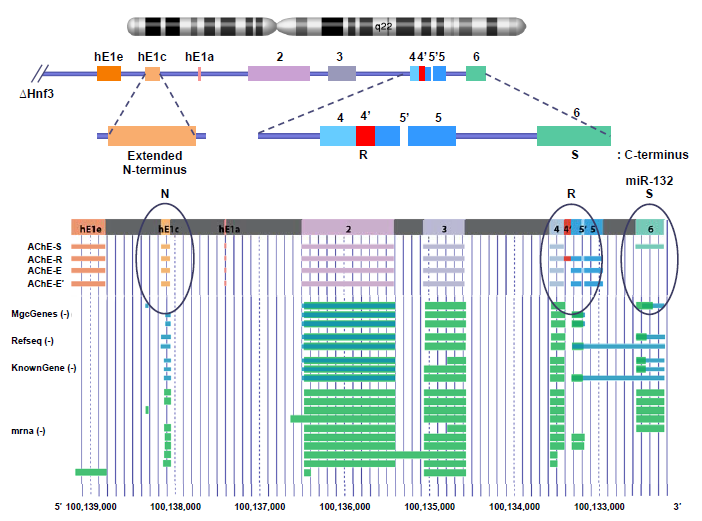
The human AChE gene is located at q22 of the long arm of chromosome 7. The AChE mRNA has multiple isoforms which arise from both alternative promoter usage in the 5 of the gene and alternative splicing of exons 4, 5 and 6.
Description
The ACHE gene spans about 6 kilobases on chromosome 7q22.
Transcription
The gene gives rise to multiple alternatively spliced transcripts. These include AChE-Synaptic (AChE-S), AChE-Erythrocyte (AChE-E) and AChE-Read through (AChE-R). AChE-S is the major neuronal transcript. Alternative 3 splicing gives rise to AChE-E, a dimeric glycophosphatidylinositol (GPI)-anchored isoform expressed primarily in erythrocytes. The third variant AChE-R is produced by the inclusion of the normally spliced out intron 4 and is reported to be elevated during stress. In addition, the existence of multiple promoters leads to the production of several variants with extended N-terminal sequences which are transcribed from the alternative promoters although their expression patterns have not yet been well characterized (Soreq and Seidman, 2001; Meshorer and Soreq, 2006).
Pseudogene
None.
Proteins
Description
Acetylcholinesterase (AChE) is a 57 kDa protein. AChE can be monomeric (AChE-R), dimeric (AChE-E) or tetrameric (AChE-S). Tetrameric AChE-S can further interact with collagen Q (ColQ), enabling anchorage to neuromuscular junctions (NMJs), and a proline-rich membrane anchor protein (PRiMA) is responsible for the synaptic docking of AChE-S in the brain. AChE-R is a soluble monomer with a unique naturally unfolded C-terminal peptide. Because AChE-E and AChE-R are incapable of anchorage to the NMJ or to synaptic membranes through ColQ or PRiMA, only the AChE-S form of the enzyme is regarded as truly "synaptic" (Massoulié et al., 1993; Taylor et al., 1993; Silman and Sussman, 2008).
Expression
Functional heterogeneity in AChE activity is regulated at the transcriptional, post-transcriptional and post-translational levels, leading to complex expression patterns that reflect tissue and cell-type specificity, differentiation state, physiological condition and response to external stimuli. Recent studies have also looked at regulation of AChE expression by microRNA (Hanin and Soreq, 2011).
Localisation
Intracellular, extracellular, plasma, cerebrospinal fluid.
Function
Acetylcholinesterase is a type B hydrolase that rapidly and selectively hydrolyzes the neurotransmitter acetylcholine (ACh) at cholinergic synapses, as well as at neuromuscular junctions (Soreq and Seidman, 2001). In addition to its catalytic function of the hydrolysis of acetylcholine, AChE has been shown to be involved in many non-cholinergic functions, such as cell growth, stem cell differentiation (Sperling et al., 2008; Falugi and Aluigi, 2012), neuritogenesis, cell adhesion (Paraoanu and Layer, 2008), synaptogenesis, activation of dopaminergic neurons, tumorigenesis, amyloid fibril assembly (Inestrosa et al., 1996; Alvarez et al., 1997), haematopoiesis and thrombopoiesis (Greenfield, 1996; Layer, 1996; Small et al., 1996). The role of acetylcholinesterase in modulating the regulation of cholinergic function is still being investigated (Shaked et al., 2009; Schliebs and Arendt, 2011). The role of AChE inhibitors in many neurodegenerative and neurodevelopmental pathologies is also being studied (Hargreaves, 2012; Li et al., 2012).
Homology
AChE is widely conserved in the animal kingdom and is found in mammals, Drosophila, C. elegans and Torpedo californica, among others.
Mutations
Note
No natural disease-causing mutations have been reported but a number of single nucleotide polymorphisms (SNPs) are known which may affect transcriptional activity and immune properties.
Implicated in
Entity name
Primary ovarian carcinomas
Note
Significant amplification and mutagenesis of both the ache and the highly homologous BChE gene were identified in malignant tumors. The frequent co-amplification in ovarian carcinomas of ACHE implicates cholinesterases in neoplastic growth and/or proliferation (Zakut et al., 1990).
Entity name
Glioblastoma multiforme
Note
AChE mRNA accumulates in primary human astrocytomas in a manner associated with these tumors grade of aggressiveness (Perry et al., 2002). CREB regulation allows AChE-R-induced, PKA-mediated proliferation of glioblastoma tumors (Perry et al., 2004).
Entity name
Leukemia
Note
AChE-S may be a regulator of hematopoiesis, affecting cell fate decisions downstream to the GEMM progenitor cells (Perry et al., 2007). Deletion of the acetylcholinesterase locus at 7q22 is associated with myelodysplastic syndromes (MDS) and acute myeloid leukaemia (AML) (Stephenson et al., 1996).
Entity name
Breast cancer
Note
In a recent study, amplifications and deletions in the AChE and BChE genes were investigated in sporadic breast tumors using real-time polymerase chain reaction and the relative quantification method and the majority of the tumor tissues showed a notable number of both deletions and amplifications of both the AChE and BChE genes (Bernardi et al., 2010).
Entity name
Alzheimers disease
Note
The loss of cholinergic neurons has long been believed to be an important aspect of Alzheimers pathology (Oddo and LaFerla, 2006; Schliebs and Arendt, 2011) and increasing the level of acetylcholine by the use of cholinesterase inhibitors is one of the few pharmacological interventions available for the treatment of Alzheimers disease (Birks, 2006; Shanks et al., 2009). AChE has been identified in the amyloid plaques found in Alzheimers disease and the isoforms of AChE have different effects on the extent of plaque development (Berson et al., 2008).
Entity name
Inflammation
Note
Being a major regulator of acetylcholine levels, AChE may relieve the cholinergic blockade of inflammation (Shaked et al., 2009). Correspondingly, increasing levels of the AChE-targeted microRNA-132, and presumably other AChE-targeted microRNAs can potentiate this blockade (Hanin and Soreq, 2011).
Article Bibliography
| Pubmed ID | Last Year | Title | Authors |
|---|---|---|---|
| 9325095 | 1997 | Acetylcholinesterase promotes the aggregation of amyloid-beta-peptide fragments by forming a complex with the growing fibrils. | Alvarez A et al |
| 20193849 | 2010 | Amplification and deletion of the ACHE and BCHE cholinesterase genes in sporadic breast cancer. | Bernardi CC et al |
| 18056160 | 2008 | Changes in readthrough acetylcholinesterase expression modulate amyloid-beta pathology. | Berson A et al |
| 16437532 | 2006 | Cholinesterase inhibitors for Alzheimer's disease. | Birks J et al |
| 22529777 | 2012 | Early appearance and possible functions of non-neuromuscular cholinesterase activities. | Falugi C et al |
| 8792328 | 1996 | Non-classical actions of cholinesterases: role in cellular differentiation, tumorigenesis and Alzheimer's disease. | Greenfield S et al |
| 22007158 | 2011 | Cholinesterase-Targeting microRNAs Identified in silico Affect Specific Biological Processes. | Hanin G et al |
| 22411244 | 2012 | Neurodegenerations induced by organophosphorous compounds. | Hargreaves AJ et al |
| 8608006 | 1996 | Acetylcholinesterase accelerates assembly of amyloid-beta-peptides into Alzheimer's fibrils: possible role of the peripheral site of the enzyme. | Inestrosa NC et al |
| 8792329 | 1996 | Non-classical actions of cholinesterases: role in cellular differentiation, tumorigenesis and Alzheimer's disease. | Layer PG et al |
| 22401178 | 2012 | Evaluation of epidemiology and animal data for risk assessment: chlorpyrifos developmental neurobehavioral outcomes. | Li AA et al |
| 8248501 | 1993 | Structure and functions of acetylcholinesterase and butyrylcholinesterase. | Massoulié J et al |
| 16516310 | 2006 | Virtues and woes of AChE alternative splicing in stress-related neuropathologies. | Meshorer E et al |
| 16448808 | 2006 | The role of nicotinic acetylcholine receptors in Alzheimer's disease. | Oddo S et al |
| 18205832 | 2008 | Acetylcholinesterase in cell adhesion, neurite growth and network formation. | Paraoanu LE et al |
| 17476278 | 2007 | Acetylcholinesterase/C terminal binding protein interactions modify Ikaros functions, causing T lymphopenia. | Perry C et al |
| 15153340 | 2004 | CREB regulates AChE-R-induced proliferation of human glioblastoma cells. | Perry C et al |
| 21145918 | 2011 | The cholinergic system in aging and neuronal degeneration. | Schliebs R et al |
| 20005135 | 2009 | MicroRNA-132 potentiates cholinergic anti-inflammatory signaling by targeting acetylcholinesterase. | Shaked I et al |
| 19678754 | 2009 | Cholinesterase inhibition: is there evidence for disease-modifying effects? | Shanks M et al |
| 18586019 | 2008 | Acetylcholinesterase: how is structure related to function? | Silman I et al |
| 8792327 | 1996 | Non-classical actions of cholinesterases: role in cellular differentiation, tumorigenesis and Alzheimer's disease. | Small DH et al |
| 11283752 | 2001 | Acetylcholinesterase--new roles for an old actor. | Soreq H et al |
| 18588865 | 2008 | Characterisation of cholinesterase expression during murine embryonic stem cell differentiation. | Sperling LE et al |
| 8637218 | 1996 | Deletion of the acetylcholinesterase locus at 7q22 associated with myelodysplastic syndromes (MDS) and acute myeloid leukaemia (AML). | Stephenson J et al |
| 8343976 | 1993 | Structure and regulation of expression of the acetylcholinesterase gene. | Taylor P et al |
| 2394839 | 1990 | Acetylcholinesterase and butyrylcholinesterase genes coamplify in primary ovarian carcinomas. | Zakut H et al |
Other Information
Locus ID:
NCBI: 43
MIM: 100740
HGNC: 108
Ensembl: ENSG00000087085
Variants:
dbSNP: 43
ClinVar: 43
TCGA: ENSG00000087085
COSMIC: ACHE
RNA/Proteins
Expression (GTEx)
Pathways
PharmGKB
| Entity ID | Name | Type | Evidence | Association | PK | PD | PMIDs |
|---|---|---|---|---|---|---|---|
| PA443319 | Alzheimer Disease | Disease | ClinicalAnnotation | associated | PD | 18780301 | |
| PA451262 | rivastigmine | Chemical | ClinicalAnnotation | associated | PD | 18780301 |
References
| Pubmed ID | Year | Title | Citations |
|---|---|---|---|
| 38454407 | 2024 | PLA2G4A and ACHE modulate lipid profiles via glycerophospholipid metabolism in platinum-resistant gastric cancer. | 0 |
| 38768263 | 2024 | Preferential Door for Ligand Binding and Unbinding Pathways in Inhibited Human Acetylcholinesterase. | 0 |
| 38454407 | 2024 | PLA2G4A and ACHE modulate lipid profiles via glycerophospholipid metabolism in platinum-resistant gastric cancer. | 0 |
| 38768263 | 2024 | Preferential Door for Ligand Binding and Unbinding Pathways in Inhibited Human Acetylcholinesterase. | 0 |
| 36928077 | 2023 | Identification of two early blood biomarkers ACHE and CLEC12A for improved risk stratification of critically ill COVID-19 patients. | 1 |
| 37027384 | 2023 | Acetylcholinesterase, pro-inflammatory cytokines, and association of ACHE SNP rs 17228602 with male infertility. | 2 |
| 37544578 | 2023 | Association of NOTCH4 and ACHE gene polymorphism in Alzheimer's disease of Gujarat cohort. | 0 |
| 37813167 | 2023 | Choline-acetyltransferase (ChAT) and acetylcholinesterase (AChE) in the human infant dorsal motor nucleus of the Vagus (DMNV), and alterations according to sudden infant death syndrome (SIDS) category. | 0 |
| 36928077 | 2023 | Identification of two early blood biomarkers ACHE and CLEC12A for improved risk stratification of critically ill COVID-19 patients. | 1 |
| 37027384 | 2023 | Acetylcholinesterase, pro-inflammatory cytokines, and association of ACHE SNP rs 17228602 with male infertility. | 2 |
| 37544578 | 2023 | Association of NOTCH4 and ACHE gene polymorphism in Alzheimer's disease of Gujarat cohort. | 0 |
| 37813167 | 2023 | Choline-acetyltransferase (ChAT) and acetylcholinesterase (AChE) in the human infant dorsal motor nucleus of the Vagus (DMNV), and alterations according to sudden infant death syndrome (SIDS) category. | 0 |
| 31726885 | 2022 | AChE mRNA expression as a possible novel biomarker for the diagnosis of coronary artery disease and Alzheimer's disease, and its association with oxidative stress. | 7 |
| 35967390 | 2022 | Impaired sweating in patients with cholinergic urticaria is linked to low expression of acetylcholine receptor CHRM3 and acetylcholine esterase in sweat glands. | 4 |
| 31726885 | 2022 | AChE mRNA expression as a possible novel biomarker for the diagnosis of coronary artery disease and Alzheimer's disease, and its association with oxidative stress. | 7 |
Citation
Hermona Soreq ; David S Greenberg
ACHE (acetylcholinesterase)
Atlas Genet Cytogenet Oncol Haematol. 2012-05-01
Online version: http://atlasgeneticsoncology.org/gene/44317/ache
