GPER1 (G protein-coupled estrogen receptor 1)
2009-03-01 Eric R Prossnitz AffiliationCancer Research, Treatment Center, University of New Mexico Health Sciences Center, Albuquerque, NM 87131, USA
Identity
HGNC
LOCATION
7p22.3
IMAGE

LEGEND
Diagram from Entrez Gene.
LOCUSID
ALIAS
GPER,GPR30,CEPR,CMKRL2,DRY12,FEG-1,GPCR-Br,LERGU,LERGU2,LyGPR,mER
DNA/RNA
Note
GPR30 is an estrogen-responsive GPCR (7-transmembrane G protein-coupled receptor).

Alternate transcriptional splice variants (involving the 5 UTR region of the gene) have been characterized. Diagram from Entrez Gene.
Description
The open reading frame of GPR30 is encoded by a single exon (1125 bp) located at chromosome 7p22.3.
Transcription
GPR30 mRNA is about 3.0 kb in human with an 1125 bp open reading frame.
Proteins
Description
The gene encodes a 7-transmembrane G protein-coupled receptor (GPCR) of 375 amino acids.
Expression
GPR30 is widely express throughout the body.
Localisation
Predominantly in the Endoplasmic Reticulum.
Function
Rapid and transcriptional responses to estrogen.
GPR30 is a 7-transmembrane G protein-coupled receptor (GPCR) that has been shown to be an estrogen responsive receptor, expressed predominantly in the endoplasmic reticulum. Signaling occurs via heterotrimeric G protein activation resulting in matrix-metalloproteinase activation, release of heparin-binding EGF and transactivation of EGFR with subsequent MAPK and Akt activation. Calcium mobilization has also been reported in multiple cell types including neurons. This protein plays a role in the rapid non-genomic signaling events often seen following stimulation with estrogen. Transcriptional activation has also been reported secondary to kinase activation. Actions of GPR30 can occur in parallel to those mediated by ERalpha and ERbeta in cells where multiple receptor are expressed, or in the absence of ERalpha and ERbeta. Note that GPR30 does not appear to mediate transcription via classical estrogen-response elements.
GPR30 is a 7-transmembrane G protein-coupled receptor (GPCR) that has been shown to be an estrogen responsive receptor, expressed predominantly in the endoplasmic reticulum. Signaling occurs via heterotrimeric G protein activation resulting in matrix-metalloproteinase activation, release of heparin-binding EGF and transactivation of EGFR with subsequent MAPK and Akt activation. Calcium mobilization has also been reported in multiple cell types including neurons. This protein plays a role in the rapid non-genomic signaling events often seen following stimulation with estrogen. Transcriptional activation has also been reported secondary to kinase activation. Actions of GPR30 can occur in parallel to those mediated by ERalpha and ERbeta in cells where multiple receptor are expressed, or in the absence of ERalpha and ERbeta. Note that GPR30 does not appear to mediate transcription via classical estrogen-response elements.
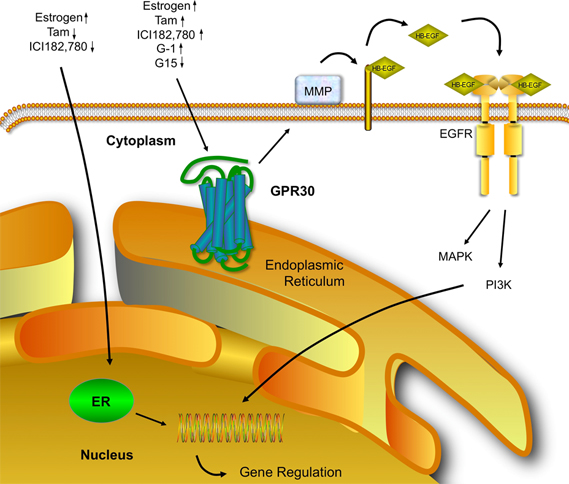
Cellular activation by GPR30 and classical estrogen receptors (ERs). Receptor agonists and antagonists (indicated by upward and downward arrows, respectively) are shown for the indicated receptor (Tam, tamoxifen; G-1, GPR30-selective agonist; G15, GPR30-selective antagonist). Nuclear estrogen receptors classically mediate gene regulation although they can also mediate rapid signaling through kinases (not shown). GPR30 is found predominantly in the endoplasmic reticulum and mediates cell activation at least in part through the transactivation of EGFR leading to the stimulation of MAPK, PI3K and other rapid cellular processes, which can result in transcriptional activation.
Homology
High homology between species. Low homology to other GPCRs.
Mutations
Note
None
Implicated in
Entity name
Cancer
Prognosis
Expression levels correlated with HER-2/neu, tumor size and the presence of metastatic disease in breast cancer. Expression correlated with survival and high-risk disease in endometrial cancer. GPR30 mediates estrogen-dependent responses in breast, endometrial and ovarian cancer cell lines including proliferation and migration.
Entity name
Other
Note
GPR30 has been implicated to play a role in estrogen-induced thymic atrophy, estrogen-mediated amelioration of autoimmune encephalomyelitis, depression, pain, vascular function and oocyte maturation.
Article Bibliography
| Pubmed ID | Last Year | Title | Authors |
|---|---|---|---|
| 16520733 | 2006 | Virtual and biomolecular screening converge on a selective agonist for GPR30. | Bologa CG et al |
| 9367686 | 1997 | Identification of a gene (GPR30) with homology to the G-protein-coupled receptor superfamily associated with estrogen receptor expression in breast cancer. | Carmeci C et al |
| 17085646 | 2006 | Distribution of GPR30, a seven membrane-spanning estrogen receptor, in primary breast cancer and its association with clinicopathologic determinants of tumor progression. | Filardo EJ et al |
| 19179659 | 2009 | Regulatory role of G protein-coupled estrogen receptor for vascular function and obesity. | Haas E et al |
| 9479505 | 1998 | Discovery of three novel G-protein-coupled receptor genes. | O'Dowd BF et al |
| 8920907 | 1996 | Cloning of human cDNA encoding a novel heptahelix receptor expressed in Burkitt's lymphoma and widely distributed in brain and peripheral tissues. | Owman C et al |
| 18271749 | 2008 | Estrogen signaling through the transmembrane G protein-coupled receptor GPR30. | Prossnitz ER et al |
| 15705806 | 2005 | A transmembrane intracellular estrogen receptor mediates rapid cell signaling. | Revankar CM et al |
| 17403429 | 2007 | GPR30: a novel indicator of poor survival for endometrial carcinoma. | Smith HO et al |
| 9398636 | 1997 | Cloning of cDNAs encoding G protein-coupled receptor expressed in human endothelial cells exposed to fluid shear stress. | Takada Y et al |
| 15539556 | 2005 | Identity of an estrogen membrane receptor coupled to a G protein in human breast cancer cells. | Thomas P et al |
| 18063692 | 2008 | GPR30 contributes to estrogen-induced thymic atrophy. | Wang C et al |
Other Information
Locus ID:
NCBI: 2852
MIM: 601805
HGNC: 4485
Ensembl: ENSG00000164850
Variants:
dbSNP: 2852
ClinVar: 2852
TCGA: ENSG00000164850
COSMIC: GPER1
RNA/Proteins
Expression (GTEx)
Pathways
Protein levels (Protein atlas)
References
| Pubmed ID | Year | Title | Citations |
|---|---|---|---|
| 38141748 | 2024 | The detection of Gper1 as an important gene promoting jawbone regeneration in the context of estrogen deficiency. | 0 |
| 38148599 | 2024 | Regulatory mechanism of GPER in the invasion and migration of ectopic endometrial stromal cells in endometriosis. | 0 |
| 38211639 | 2024 | G protein-coupled estrogen receptor (GPER)/GPR30 forms a complex with the β(1)-adrenergic receptor, a membrane-associated guanylate kinase (MAGUK) scaffold protein, and protein kinase A anchoring protein (AKAP) 5 in MCF7 breast cancer cells. | 0 |
| 38315451 | 2024 | G-protein-coupled estrogen receptor 1 promotes peritoneal metastasis of gastric cancer through nicotinamide adenine dinucleotide kinase 1-mediated redox modulation. | 0 |
| 38741146 | 2024 | Estetrol/GPER/SERPINB2 transduction signaling inhibits the motility of triple-negative breast cancer cells. | 0 |
| 38141748 | 2024 | The detection of Gper1 as an important gene promoting jawbone regeneration in the context of estrogen deficiency. | 0 |
| 38148599 | 2024 | Regulatory mechanism of GPER in the invasion and migration of ectopic endometrial stromal cells in endometriosis. | 0 |
| 38211639 | 2024 | G protein-coupled estrogen receptor (GPER)/GPR30 forms a complex with the β(1)-adrenergic receptor, a membrane-associated guanylate kinase (MAGUK) scaffold protein, and protein kinase A anchoring protein (AKAP) 5 in MCF7 breast cancer cells. | 0 |
| 38315451 | 2024 | G-protein-coupled estrogen receptor 1 promotes peritoneal metastasis of gastric cancer through nicotinamide adenine dinucleotide kinase 1-mediated redox modulation. | 0 |
| 38741146 | 2024 | Estetrol/GPER/SERPINB2 transduction signaling inhibits the motility of triple-negative breast cancer cells. | 0 |
| 36307605 | 2023 | Involvement of the G-Protein-Coupled Estrogen Receptor-1 (GPER) Signaling Pathway in Neurodegenerative Disorders: A Review. | 6 |
| 36384894 | 2023 | GPER1 links estrogens to centrosome amplification and chromosomal instability in human colon cells. | 3 |
| 36693877 | 2023 | Identification of a human estrogen receptor α tetrapeptidic fragment with dual antiproliferative and anti-nociceptive action. | 3 |
| 36709642 | 2023 | The immunohistochemical expression of GPER and classical sex hormone receptors differs in adenomyosis and eutopic endometrium. | 0 |
| 36769338 | 2023 | The Co-Expression of Estrogen Receptors ERα, ERβ, and GPER in Endometrial Cancer. | 2 |
Citation
Eric R Prossnitz
GPER1 (G protein-coupled estrogen receptor 1)
Atlas Genet Cytogenet Oncol Haematol. 2009-03-01
Online version: http://atlasgeneticsoncology.org/gene/44344/gper1
