DNA/RNA

Figure 1. DEFB1 gene. The diagram shows pre-propeptide coding sequence (black rectangles) and unstranslated regions (blue rectangles). Signal peptide coding sequence is comprised of 60 bases. Mature peptide coding sequence spans 144 bases (www.ensembl.org). The pro-peptide segment is in exon 1 and not in exon 2 as in the rest of beta-defensins known to date (Pazgier et al., 2006).
Description
DEFB1 is a gene composed of 2 exons and a ~7 kb intron. DEFB1 spans 7488 bp, two exons and one intron of 6962 bp (Liu et al., 1997).
Transcription
The transcript is of 207 nt (www.kegg.org). No variants are produced by alternative splicing, the entire mature peptide coding sequence is in exon 1, however several hBD-1 amino-terminal processed forms are found in urine (Valore et al., 1998), probably cleaved by chymotrypsin (Zucht et al., 1998) or matrix metalloproteinase 7 (matrylisin) (Wilson et al., 2009) each showing different microbicidal potencies (Valore et al., 1998). The functions and tissue of origin of these processed forms are unknown (Prado-Montes de Oca, 2010).
Pseudogene
None reported. DEFB1 is considered as a unique copy gene, although rare duplicons in some individuals have been reported (Linzmeier et al., 2005).
Proteins
Note
Human beta-defensins are produced mainly by various epithelia and secreted in mature forms by the producing cells. The hBD-1 shows three disulfide bridges (with the pro-peptide nomenclature) are formed at cysteines 37-66 (1-5), 44-59 (2-4) and 49-67 (3-6). The disulfide bridge pattern on cysteines 1-5, 2-4 and 3-6 is a hallmark of beta-defensins (Prado-Montes de Oca, 2010).
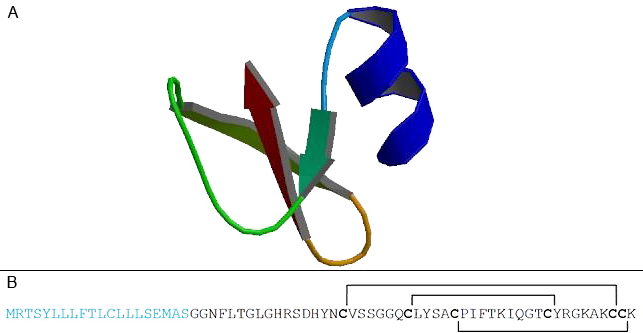
Figure 2. (A) Model of hBD-1 peptide (according to PDB:1IJU, www.pdb.org). (B) Sequence of hBD-1 pro-peptide. Signal peptide sequence (blue), mature peptide (black) with cysteine residues (bold) and disulfide bridges (brackets) are shown.
Description
The prepropeptide has 68 aa and the mature peptide is of 48 amino acids. As quaternary structure hBD-1 shows in vitro dimerization by weak intermolecular salt bridges, but if dimers are formed in vivo or if they perform any different function is unknown (Prado Montes de Oca, 2010).
Expression
The highest concentrations of hBD-1 are found in the kidney (epithelial layes of the loops of Henle, distal tubules, collecting tubes) and female reproductive tract (layers of vagina, ectocervix, endocervix, uterus, fallopian tubes), especially in pregnant women. It is also expressed in astrocytes, mammary gland, cornea, small intestine, gingival tissue, epithelial cells of testis, mature dendritic cells (for a more complete information of DEFB1-expressing cells see www.ebi.ac.uk/microarray-as/atlas and www.ncbi.nlm.nih.gov/geo/).
Localisation
The hBD-1 peptide resides in the cytoplasm of normal cells and in the nucleus of several cancer cells (Bick et al., 2007; Wenghoefer et al., 2008). In normal skin, hBD-1 is localized to the perinuclear region of keratinocytes and in burned skin in dermal glandular structures and hair shafts (Poindexter et al., 2006).
Function
hBD-1 functions as an antimicrobial peptide against viruses as HIV, Av1CF2, Gram-positive and Gram-negative bacteria, Mycobacterium tuberculosis. It functions as a chemoattractant to immature dendritic cells and T cells acts as a tumor suppressor inducing caspase-mediated apoptosis. In addition it could be involved as transcription factor in epithelia reorganization (Prado Montes de Oca, 2010).
Homology
Homolog genes to human beta-defensin 1 are found in Mus musculus (mouse) (Morrison et al., 1998), Pan troglodytes (chimpanzee) (Prado-Montes de Oca et al., 2009), Macaca mulatta (Rhesus monkey), Canis familiaris (dog), Rattus norvegicus (rat), Sus scrofa (pig, named beta defensin 2), Bos taurus (cow, named protein similar to beta defensin) among other species (www.kegg.org; www.ensembl.org).
Mutations
Note
There are 214 annotated polymorphisms in DEFB1, most of them are SNPs (bdSNP build 130, www.genome.ucsc.edu). Insertions and deletions are less frequently found (López Campos and Prado Montes de Oca, in process). There are reports of 10 SNPs in DEFB1 with disease association. The most relevant SNPs are those located on 5 unstranslated region namely -52A (higher HIV load and higher risk of perinatal HIV infection, gastritis, asthma), -44C (atopic dermatitis, chronic obstructive pulmonar disease, Crohns disease, cancer, lepromatous leprosy) and -20 A/G (infections in cystic fibrosis) (gene RIF at www.ncbi.nlm.nih.gov; Prado-Montes de Oca, 2010). The variant -44C correlates with lower constitutive expression and -44G correlates with lower IFN-gamma-dependent induction. This could explain the extremely rare heterozygote advantage in this region (Figuera et al., 2005; Prado Montes de Oca, 2010).
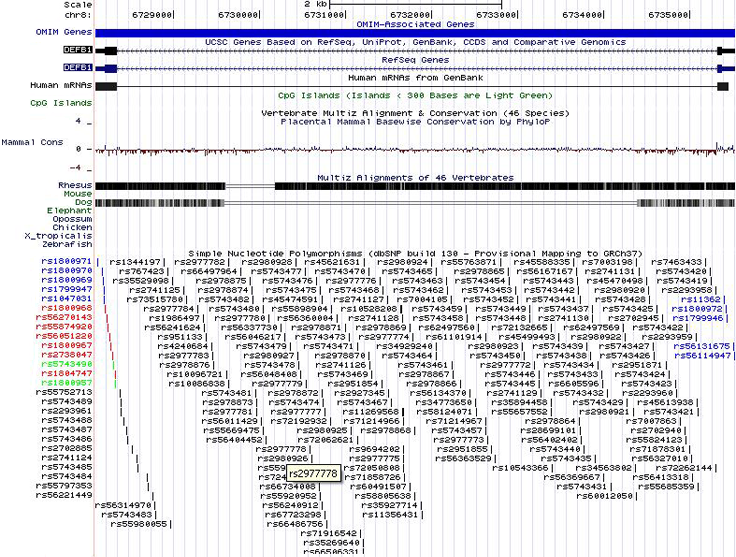
Figure 3. The 214 polymorphisms annotated in both strands of DEFB1 gene according to UCSC Genome Browser (www.genome.ucsc.edu, hg19, Feb 2009). Most polymorphisms are located in intron (black), fewer are located in UTRs (blue) and exons. Those polymorphisms located in exons could be either synonymous (green) or non-synonymous (red).
Implicated in
Entity name
The 8p23.1 duplication syndrome
Note
Associate with variable phenotype that may include one or more of the following: developmental delay, mild dysmorphism and heart defects (Barber et al., 2010).
Cytogenetics
The 8p23.1 duplication syndrome and copy number variation of the 8p23.1 defensin gene cluster are cytogenetically indistinguishable but distinct at the molecular level (Barber et al., 2010).
Entity name
Copy number variation of the 8p23.1 defensin gene cluster
Note
From 1 to 12 copies of 8p23.1 defensin gene cluster are normally found per diploid genome (Hollox et al., 2003). The null allele is very rare (allele frequency 0.2%) (Hollox et al., 2008). Predisposition to Crohns disease and sporadic prostate cancer is higher at low copy number (Huse et al., 2008) and to psoriasis at high copy number (Hollox, 2008).
Entity name
Oral squamous cell carcinoma (OSCC)
Note
DEFB1 basal expression is 50-fold lower in OSCC, and inducibility is significantly reduced (Wenghoefer et al., 2008). Genotypes in DEFB1 gene tend to loss of heterozygosity in OSCC (Joly et al., 2009).
Entity name
Malignant melanoma
Note
It was found weak evidence that genotype -44 GG in DEFB1 increases risk for malignant melanoma in a Spanish population (OR= 2.78, CI 95%= 0.88-8.82, p=0.08) (Fernandez et al., 2009).
Entity name
Prostate and renal cancers
Note
DEFB1 has been proposed as a tumor suppressor because it promotes cancer cells apoptosis and is absent in most tumor samples (Sun et al., 2006; Bullard et al., 2008). There is a marked down-regulation of DEFB1 in 82% of prostate cancers and 90% of renal cell carcinomas (Donald et al., 2003) and this DEFB1 downregulation is associated with malignancy (Wenghoefer et al., 2008; Pantelis et al., 2009). Furthermore, oncogene PAX2 binds to DEFB1 promoter and suppresses its expression independent of p53 (Bose et al., 2009). Parvalbumin and DEFB1 expression could be useful to differentiate papillary renal cell carcinoma (RCC) from conventional RCC (Young et al., 2003).
Entity name
Leukoplakia
Note
DEFB1 is downregulated 2.5 fold in leukoplakia but their role in the disease, if any, is unknown (Wenghoefer et al., 2008).
Entity name
Several allergic and infectious diseases
Note
For allergic and infectious diseases where DEFB1 is implicated see Prado Montes de Oca, 2010.
Article Bibliography
| Pubmed ID | Last Year | Title | Authors |
|---|---|---|---|
| 20167067 | 2010 | 8p23.1 duplication syndrome differentiated from copy number variation of the defensin cluster at prenatal diagnosis in four new families. | Barber JC et al |
| 18091980 | 2007 | Nuclear localization of HBD-1 in human keratinocytes. | Bick RJ et al |
| 19118900 | 2009 | PAX2 oncogene negatively regulates the expression of the host defense peptide human beta defensin-1 in prostate cancer. | Bose SK et al |
| 17868871 | 2008 | Functional analysis of the host defense peptide Human Beta Defensin-1: new insight into its potential role in cancer. | Bullard RS et al |
| 12695553 | 2003 | Cancer-specific loss of beta-defensin 1 in renal and prostatic carcinomas. | Donald CD et al |
| 19741426 | 2009 | Human beta-defensins (HBD1 and HBD3) and malignant melanoma susceptibility. | Fernandez LP et al |
| 12916016 | 2003 | Extensive normal copy number variation of a beta-defensin antimicrobial-gene cluster. | Hollox EJ et al |
| 18974263 | 2008 | Defensins and the dynamic genome: what we can learn from structural variation at human chromosome band 8p23.1. | Hollox EJ et al |
| 19287149 | 2008 | Copy number variation of beta-defensins and relevance to disease. | Hollox EJ et al |
| 18515986 | 2008 | Genetic variants of the copy number polymorphic beta-defensin locus are associated with sporadic prostate cancer. | Huse K et al |
| 19702947 | 2009 | Loss of human beta-defensin 1, 2, and 3 expression in oral squamous cell carcinoma. | Joly S et al |
| 19712472 | 2009 | Association of a genetic polymorphism (-44 C/G SNP) in the human DEFB1 gene with expression and inducibility of multiple beta-defensins in gingival keratinocytes. | Kalus AA et al |
| 16039093 | 2005 | Human defensin gene copy number polymorphisms: comprehensive analysis of independent variation in alpha- and beta-defensin regions at 8p22-p23. | Linzmeier RM et al |
| 9268634 | 1997 | The human beta-defensin-1 and alpha-defensins are encoded by adjacent genes: two peptide families with differing disulfide topology share a common ancestry. | Liu L et al |
| 9585433 | 1998 | Mouse beta defensin-1 is a functional homolog of human beta defensin-1. | Morrison GM et al |
| 18805729 | 2009 | Down regulation and nuclear localization of human beta-defensin-1 in pleomorphic adenomas of salivary glands. | Pantelis A et al |
| 17071614 | 2007 | Studies of the biological properties of human beta-defensin 1. | Pazgier M et al |
| 16621313 | 2006 | Localization of antimicrobial peptides in normal and burned skin. | Poindexter BJ et al |
| 20100591 | 2010 | Human beta-defensin 1: a restless warrior against allergies, infections and cancer. | Prado-Montes de Oca E et al |
| 16951166 | 2006 | Human beta-defensin-1, a potential chromosome 8p tumor suppressor: control of transcription and induction of apoptosis in renal cell carcinoma. | Sun CQ et al |
| 9541493 | 1998 | Human beta-defensin-1: an antimicrobial peptide of urogenital tissues. | Valore EV et al |
| 18346877 | 2008 | Decreased gene expression of human beta-defensin-1 in the development of squamous cell carcinoma of the oral cavity. | Wenghoefer M et al |
| 19181662 | 2009 | Differential Processing of {alpha}- and {beta}-Defensin Precursors by Matrix Metalloproteinase-7 (MMP-7). | Wilson CL et al |
| 12548166 | 2003 | Beta defensin-1, parvalbumin, and vimentin: a panel of diagnostic immunohistochemical markers for renal tumors derived from gene expression profiling studies using cDNA microarrays. | Young AN et al |
| 9682027 | 1998 | Human beta-defensin-1: A urinary peptide present in variant molecular forms and its putative functional implication. | Zucht HD et al |
Other Information
Locus ID:
NCBI: 1672
MIM: 602056
HGNC: 2766
Ensembl: ENSG00000164825
Variants:
dbSNP: 1672
ClinVar: 1672
TCGA: ENSG00000164825
COSMIC: DEFB1
RNA/Proteins
| Gene ID | Transcript ID | Uniprot |
|---|---|---|
| ENSG00000164825 | ENST00000297439 | P60022 |
Expression (GTEx)
Pathways
References
| Pubmed ID | Year | Title | Citations |
|---|---|---|---|
| 37697693 | 2024 | Effects of Schumann resonance on the proliferation and migration of normal human epidermal keratinocytes and the expression of DEFB1 and SIRT1. | 0 |
| 38246944 | 2024 | Salivary Th17 cytokine, human β-defensin 1-3, and salivary scavenger and agglutinin levels in Crohn's disease. | 0 |
| 38285273 | 2024 | Relationship between biofilm-forming microorganisms (BFM: Staphylococcus aureus and Pseudomonas aeruginosa) and DEFB1 gene variants on β-defensin levels in periprosthetic joint infection (PJI). | 0 |
| 37697693 | 2024 | Effects of Schumann resonance on the proliferation and migration of normal human epidermal keratinocytes and the expression of DEFB1 and SIRT1. | 0 |
| 38246944 | 2024 | Salivary Th17 cytokine, human β-defensin 1-3, and salivary scavenger and agglutinin levels in Crohn's disease. | 0 |
| 38285273 | 2024 | Relationship between biofilm-forming microorganisms (BFM: Staphylococcus aureus and Pseudomonas aeruginosa) and DEFB1 gene variants on β-defensin levels in periprosthetic joint infection (PJI). | 0 |
| 36535830 | 2023 | Human beta-defensin 1 circulating level and gene polymorphism in non-segmental vitiligo Egyptian patients. | 0 |
| 36597064 | 2023 | Associations of PART1 and DEFB1 polymorphisms with Dental Caries in twelve-year-old children in Southern China: a cross-sectional study. | 1 |
| 36535830 | 2023 | Human beta-defensin 1 circulating level and gene polymorphism in non-segmental vitiligo Egyptian patients. | 0 |
| 36597064 | 2023 | Associations of PART1 and DEFB1 polymorphisms with Dental Caries in twelve-year-old children in Southern China: a cross-sectional study. | 1 |
| 33345418 | 2022 | An association analysis for genetic factors for dental caries susceptibility in a cohort of Chinese children. | 6 |
| 34251960 | 2022 | β-defensin 1 Gene Polymorphisms are Associated with Kidney Disease in Northwestern Mexicans with Type 2 Diabetes. | 1 |
| 35452998 | 2022 | In-silico analysis of non-synonymous single nucleotide polymorphisms in human β-defensin type 1 gene reveals their impact on protein-ligand binding sites. | 2 |
| 33345418 | 2022 | An association analysis for genetic factors for dental caries susceptibility in a cohort of Chinese children. | 6 |
| 34251960 | 2022 | β-defensin 1 Gene Polymorphisms are Associated with Kidney Disease in Northwestern Mexicans with Type 2 Diabetes. | 1 |
Citation
Ernesto Prado Montes de Oca
DEFB1 (defensin, beta 1)
Atlas Genet Cytogenet Oncol Haematol. 2010-05-01
Online version: http://atlasgeneticsoncology.org/gene/44352/defb1
