APLNR (apelin receptor)
2009-08-01 Yves Audigier AffiliationUnite INSERM U-858, I2MR, equipe 13, CHU Rangueil, Bat. L3, BP 84225, 1 avenue Jean-Poulhes, 31432-Toulouse Cedex 4, France
Identity
HGNC
LOCATION
11q12.1
LOCUSID
ALIAS
AGTRL1,APJ,APJR,HG11
FUSION GENES
DNA/RNA
Description
1 exon.
Transcription
3.8 kb mRNA; 1140 bp open reading frame.
Proteins
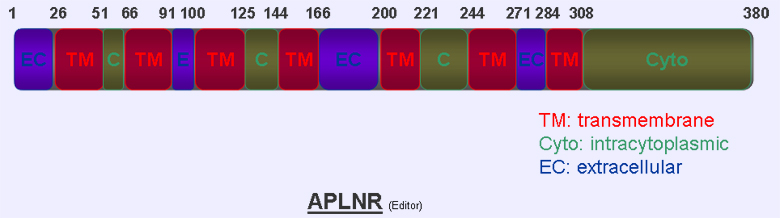
Description
380 amino acids.
Expression
Blood vessels, hypothalamus, heart, stomach, colon, endocrine pancreas, bone, skeletic muscle, spleen.
Localisation
Plasma membrane.
Function
The apelin receptor APJ belongs to the family of G protein-coupled receptors (ODowd et al., 1993; Devic et al., 1996; Devic et al., 1999; Scott et al., 2007) and is coupled to a Gi/o protein (Masri et al., 2006). Its activation leads to the regulation of various intracellular effectors with the following consequences: adenylylcyclase inhibition (Masri et al., 2006; Habata et al., 1999), increase of intracellular calcium (Choe et al., 2000) and activation of extracellular signal-regulated kinases (ERKs), PI-3K, Akt or p70S6 kinase (S6K1) (Masri et al., 2006; Masri et al., 2004 ).
Expression of apelin receptors by the endothelial cell (Devic et al., 1996; Devic et al., 1999) is associated with two effects :
1) NO release leading to vessel vasodilatation (Tatemoto et al., 2001) and peripheral hypotension (Lee et al., 2000);
2) cell proliferation and migration (Masri et al., 2004; Kasai et al., 2004) linked to angiogenesis (Cox et al., 2006).
The expression in the central nervous system is high in hypothalamus (De Mota et al., 2000; OCarroll et al., 2000) where receptor activation leads to the decrease of vasopressin release (De Mota et al., 2004). Activation of apelin receptors expressed by cardiomyocytes results in a strong inotropic effect (Szokodi et al., 2002). In stomach, apelin receptors are expressed by enterochromaffin-like cells where their stimulation decreases gastrin-induced acid secretion (Lambrecht et al., 2006). Apelin receptors may regulate epithelial proliferation in the colon (Han et al., 2007). Expression of apelin receptors both in endocrine pancreas and skeletic muscle contributes to the regulation of insulin plasma levels and glucose uptake (Sorhede Winzell et al., 2005; Dray et al., 2008). Apelin signalling also increases osteoblast proliferation (Xie et al., 2007) and cytokine expression by T lymphocytes (Habata et al., 1999).
Expression of apelin receptors by the endothelial cell (Devic et al., 1996; Devic et al., 1999) is associated with two effects :
1) NO release leading to vessel vasodilatation (Tatemoto et al., 2001) and peripheral hypotension (Lee et al., 2000);
2) cell proliferation and migration (Masri et al., 2004; Kasai et al., 2004) linked to angiogenesis (Cox et al., 2006).
The expression in the central nervous system is high in hypothalamus (De Mota et al., 2000; OCarroll et al., 2000) where receptor activation leads to the decrease of vasopressin release (De Mota et al., 2004). Activation of apelin receptors expressed by cardiomyocytes results in a strong inotropic effect (Szokodi et al., 2002). In stomach, apelin receptors are expressed by enterochromaffin-like cells where their stimulation decreases gastrin-induced acid secretion (Lambrecht et al., 2006). Apelin receptors may regulate epithelial proliferation in the colon (Han et al., 2007). Expression of apelin receptors both in endocrine pancreas and skeletic muscle contributes to the regulation of insulin plasma levels and glucose uptake (Sorhede Winzell et al., 2005; Dray et al., 2008). Apelin signalling also increases osteoblast proliferation (Xie et al., 2007) and cytokine expression by T lymphocytes (Habata et al., 1999).
Mutations
Note
No mutation has been presently described.
Implicated in
Entity name
Malignant glioma
Note
On a quantitative point of view, APLNR gene expression is highly upregulated in microvascular proliferations of malignant gliomas (Kalin et al., 2007)
Entity name
Various diseases
Note
On a qualitative point of view, two single nucleotide polymorphisms (SNP) have been reported. A functional SNP in an Sp1-binding site of APLNR gene is associated with susceptibility to brain infarction (Hata et al., 2007). The 212A variant of the APJ receptor gene is associated with slower heart failure progression in idiopathic dilated cardiomyopathy (Sarzani et al., 2007).
Article Bibliography
| Pubmed ID | Last Year | Title | Authors |
|---|---|---|---|
| 10871767 | 2000 | Functional expression of the seven-transmembrane HIV-1 co-receptor APJ in neural cells. | Choe W et al |
| 16750822 | 2006 | Apelin, the ligand for the endothelial G-protein-coupled receptor, APJ, is a potent angiogenic factor required for normal vascular development of the frog embryo. | Cox CM et al |
| 11146423 | 2000 | Cloning, pharmacological characterization and brain distribution of the rat apelin receptor. | De Mota N et al |
| 15231996 | 2004 | Apelin, a potent diuretic neuropeptide counteracting vasopressin actions through inhibition of vasopressin neuron activity and vasopressin release. | De Mota N et al |
| 8951791 | 1996 | Expression of a new G protein-coupled receptor X-msr is associated with an endothelial lineage in Xenopus laevis. | Devic E et al |
| 10473142 | 1999 | Amino acid sequence and embryonic expression of msr/apj, the mouse homolog of Xenopus X-msr and human APJ. | Devic E et al |
| 19046574 | 2008 | Apelin stimulates glucose utilization in normal and obese insulin-resistant mice. | Dray C et al |
| 10525157 | 1999 | Apelin, the natural ligand of the orphan receptor APJ, is abundantly secreted in the colostrum. | Habata Y et al |
| 17391779 | 2007 | Increased colonic apelin production in rodents with experimental colitis and in humans with IBD. | Han S et al |
| 17309882 | 2007 | Functional SNP in an Sp1-binding site of AGTRL1 gene is associated with susceptibility to brain infarction. | Hata J et al |
| 17412318 | 2007 | Paracrine and autocrine mechanisms of apelin signaling govern embryonic and tumor angiogenesis. | Kälin RE et al |
| 15530405 | 2004 | Apelin is a novel angiogenic factor in retinal endothelial cells. | Kasai A et al |
| 16403840 | 2006 | Transcriptomes of purified gastric ECL and parietal cells: identification of a novel pathway regulating acid secretion. | Lambrecht NW et al |
| 10617103 | 2000 | Characterization of apelin, the ligand for the APJ receptor. | Lee DK et al |
| 16679320 | 2006 | The apelin receptor is coupled to Gi1 or Gi2 protein and is differentially desensitized by apelin fragments. | Masri B et al |
| 11004481 | 2000 | Distribution of mRNA encoding B78/apj, the rat homologue of the human APJ receptor, and its endogenous ligand apelin in brain and peripheral tissues. | O'Carroll AM et al |
| 8294032 | 1993 | A human gene that shows identity with the gene encoding the angiotensin receptor is located on chromosome 11. | O'Dowd BF et al |
| 17826642 | 2007 | The 212A variant of the APJ receptor gene for the endogenous inotrope apelin is associated with slower heart failure progression in idiopathic dilated cardiomyopathy. | Sarzani R et al |
| 17336906 | 2007 | The g protein-coupled receptor agtrl1b regulates early development of myocardial progenitors. | Scott IC et al |
| 15970338 | 2005 | The apj receptor is expressed in pancreatic islets and its ligand, apelin, inhibits insulin secretion in mice. | Sörhede Winzell M et al |
| 12215493 | 2002 | Apelin, the novel endogenous ligand of the orphan receptor APJ, regulates cardiac contractility. | Szokodi I et al |
| 11384769 | 2001 | The novel peptide apelin lowers blood pressure via a nitric oxide-dependent mechanism. | Tatemoto K et al |
| 16563531 | 2006 | Apelin and its receptor are expressed in human osteoblasts. | Xie H et al |
Other Information
Locus ID:
NCBI: 187
MIM: 600052
HGNC: 339
Ensembl: ENSG00000134817
Variants:
dbSNP: 187
ClinVar: 187
TCGA: ENSG00000134817
COSMIC: APLNR
RNA/Proteins
| Gene ID | Transcript ID | Uniprot |
|---|---|---|
| ENSG00000134817 | ENST00000257254 | P35414 |
| ENSG00000134817 | ENST00000606794 | P35414 |
| ENSG00000134817 | ENST00000611099 | P35414 |
Expression (GTEx)
Pathways
Protein levels (Protein atlas)
References
| Pubmed ID | Year | Title | Citations |
|---|---|---|---|
| 38508477 | 2024 | The regulatory role of the apelin/APJ axis in scarring: Identification of upstream and downstream mechanisms. | 0 |
| 38508477 | 2024 | The regulatory role of the apelin/APJ axis in scarring: Identification of upstream and downstream mechanisms. | 0 |
| 36239923 | 2023 | Inducible apelin receptor knockdown reduces differentiation efficiency and contractility of hESC-derived cardiomyocytes. | 3 |
| 36669444 | 2023 | Reduced Apela/APJ system expression in patients with pulmonary artery hypertension secondary to chronic obstructive pulmonary disease. | 1 |
| 37062502 | 2023 | Apelin/ELABELA-APJ system in cardiac hypertrophy: Regulatory mechanisms and therapeutic potential. | 0 |
| 37167781 | 2023 | DNMT1 mediates proliferation, migration and invasion of extravillous trophoblasts by regulating the methylation level of APLNR. | 2 |
| 37364634 | 2023 | Heterodimerization of apelin and opioid receptor-like 1 receptors mediates apelin-13-induced G protein biased signaling. | 0 |
| 37562237 | 2023 | Therapeutic potential of apelin and Elabela in cardiovascular disease. | 1 |
| 37716179 | 2023 | The regulatory effects of the apelin/APJ system on depression: A prospective therapeutic target. | 0 |
| 36239923 | 2023 | Inducible apelin receptor knockdown reduces differentiation efficiency and contractility of hESC-derived cardiomyocytes. | 3 |
| 36669444 | 2023 | Reduced Apela/APJ system expression in patients with pulmonary artery hypertension secondary to chronic obstructive pulmonary disease. | 1 |
| 37062502 | 2023 | Apelin/ELABELA-APJ system in cardiac hypertrophy: Regulatory mechanisms and therapeutic potential. | 0 |
| 37167781 | 2023 | DNMT1 mediates proliferation, migration and invasion of extravillous trophoblasts by regulating the methylation level of APLNR. | 2 |
| 37364634 | 2023 | Heterodimerization of apelin and opioid receptor-like 1 receptors mediates apelin-13-induced G protein biased signaling. | 0 |
| 37562237 | 2023 | Therapeutic potential of apelin and Elabela in cardiovascular disease. | 1 |
Citation
Yves Audigier
APLNR (apelin receptor)
Atlas Genet Cytogenet Oncol Haematol. 2009-08-01
Online version: http://atlasgeneticsoncology.org/gene/44364/aplnr
