TRIAP1 (TP53 regulated inhibitor of apoptosis 1)
2011-02-01 Veruska Alves , Roberta Felix , Andre Vettore , Gisele Colleoni AffiliationUniversidade Federal de Sao Paulo - UNIFESP, Laboratory of Cancer Molecular Biology, Sao Paulo, Brazil
Identity
HGNC
LOCATION
12q24.31
LOCUSID
ALIAS
HSPC132,MDM35,P53CSV,WF-1
FUSION GENES
DNA/RNA
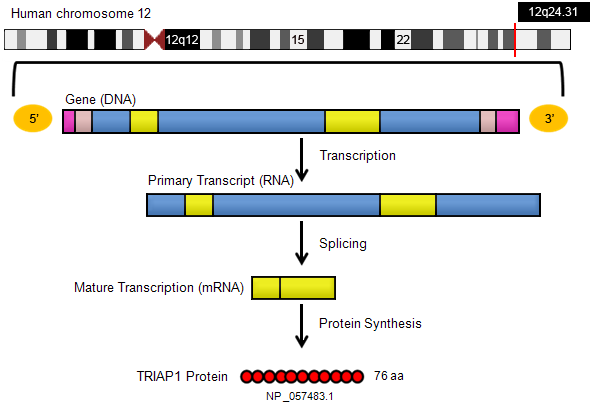
Figure 1.
Description
2452 bases, starts at 119366147 and ends at 119368598 bp from promoter with minus strand orientation.
Transcription
This gene contains 2 introns which transcription gives 3 different mRNAs, 2 alternatively spliced variants and 1 unspliced form that encodes good proteins (see figure 1).
Proteins
Note
The P53CSV protein is involved in programmed cell death. It contains a p53-binding site and it is induced when cells are at low genotoxic stress. It is probably involved in cell survival by interaction between Apaf-1 (apoptosis protease activating factor 1) and heat shock protein 70 (Hsp70) with subsequent inhibition of caspase-9 activation.
Description
This protein contains 76 amino acids and has 8786 (Da) of weight.

Figure 2.
Localisation
The protein is localized in cytoplasm and perinuclear region.
Function
P53CSV is a novel p53-target gene. This gene can modulate apoptotic pathways by interaction with heat shock protein 70 (HSP70), preventing the induction of apoptosis. When cells are submitted to low levels of genotoxic stress, it is an important player in P53-mediated cell survivor pathway (Park and Nakamura, 2005; Felix et al., 2009).
P53CSV can inhibit apoptosis through interaction with APAF1 and HSP70 complex.
P53CSV can inhibit apoptosis through interaction with APAF1 and HSP70 complex.
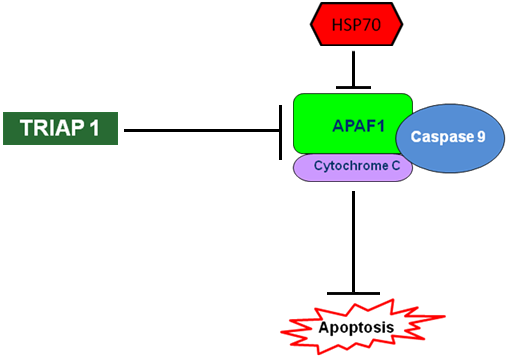
Figure 3. Hypothetical illustration about TRIAP1 (P53CSV) involvement in the p53-dependent cell survival pathway. The TRIAP1 mediates cell survival at low level of genotoxic stress by inhibiting activation of the complex APAF-1/caspase-9/cytochrome C preventing the apoptosis induction.
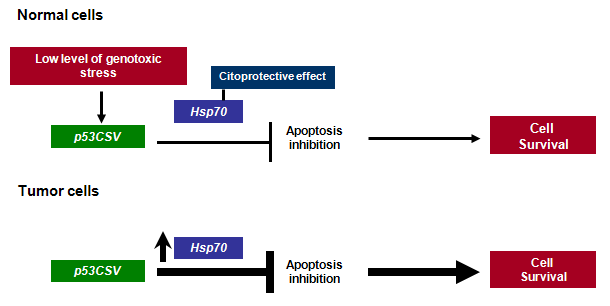
Figure 4. Hypothetical P53CSV mechanism of action in interaction with heat shock protein 70 in normal and tumor cells (Felix et al., 2009).
Mutations
Note
There are two identified alterations until now. One of them is located at position 270 of mRNA and the allele G (guanine) is switched to the allele C (cytosine) at position 77 of the amino acid sequence protein. The other one is a synonymous alteration localized at position 160 of mRNA involving the protein residue Leucine. The allele C (cytosine) is switched to the allele T (thymine) at position 40 of the amino acid sequence protein (NCBI).
Implicated in
Entity name
Note
Felix et al. (2009), described that P53CSV gene was upregulated in multiple myeloma SAGE (serial analysis of gene expression) library when compared to normal/reactive plasma cells. They suggested that the interaction between P53CSV/Hsp70 should be evaluated as a potential target for multiple myeloma patients. Real time quantitative PCR analyses confirmed upregulation of P53CSV in 90% of multiple myeloma plasma samples cells.
Entity name
Inflammatory stress
Note
Staib et al. (2005) reported P53CSV expression in colon carcinoma cells in the course of inflammatory responses associated with four microenvironmental components: nitric oxide, hydrogen peroxide, DNA replication arrest, and hypoxia.
Entity name
Solid cancers
Note
Yu Kun et al. (2008), using a genome-wide computational strategy identified genes exhibiting precise transcriptional control in solid tumors and evaluated if they linked to multiple cancer-related pathways such as metastatic and invasive potential. siRNA knockdown of five genes supports the existence of precisely controlled genes in solid tumors, including P53CSV.
Article Bibliography
| Pubmed ID | Last Year | Title | Authors |
|---|---|---|---|
| 19171422 | 2009 | SAGE analysis highlights the importance of p53csv, ddx5, mapkapk2 and ranbp2 to multiple myeloma tumorigenesis. | Felix RS et al |
| 15735003 | 2005 | p53CSV, a novel p53-inducible gene involved in the p53-dependent cell-survival pathway. | Park WR et al |
| 16288013 | 2005 | The p53 tumor suppressor network is a key responder to microenvironmental components of chronic inflammatory stress. | Staib F et al |
| 18636107 | 2008 | A precisely regulated gene expression cassette potently modulates metastasis and survival in multiple solid cancers. | Yu K et al |
Other Information
Locus ID:
NCBI: 51499
MIM: 614943
HGNC: 26937
Ensembl: ENSG00000170855
Variants:
dbSNP: 51499
ClinVar: 51499
TCGA: ENSG00000170855
COSMIC: TRIAP1
RNA/Proteins
| Gene ID | Transcript ID | Uniprot |
|---|---|---|
| ENSG00000170855 | ENST00000546954 | O43715 |
Expression (GTEx)
Pathways
Protein levels (Protein atlas)
References
| Pubmed ID | Year | Title | Citations |
|---|---|---|---|
| 36917609 | 2023 | Triap1 upregulation promotes escape from mitotic-slippage-induced G1 arrest. | 1 |
| 36917609 | 2023 | Triap1 upregulation promotes escape from mitotic-slippage-induced G1 arrest. | 1 |
| 33123835 | 2021 | Regulation of Apoptosis and Inflammatory Response in Interleukin-1β-Induced Nucleus Pulposus Cells by miR-125b-5p Via Targeting TRIAP1. | 10 |
| 33981772 | 2021 | Circular RNA circPVT1 Contributes to Doxorubicin (DXR) Resistance of Osteosarcoma Cells by Regulating TRIAP1 via miR-137. | 14 |
| 33123835 | 2021 | Regulation of Apoptosis and Inflammatory Response in Interleukin-1β-Induced Nucleus Pulposus Cells by miR-125b-5p Via Targeting TRIAP1. | 10 |
| 33981772 | 2021 | Circular RNA circPVT1 Contributes to Doxorubicin (DXR) Resistance of Osteosarcoma Cells by Regulating TRIAP1 via miR-137. | 14 |
| 32096592 | 2020 | TRIAP1 knockdown sensitizes non-small cell lung cancer to ionizing radiation by disrupting redox homeostasis. | 9 |
| 32096592 | 2020 | TRIAP1 knockdown sensitizes non-small cell lung cancer to ionizing radiation by disrupting redox homeostasis. | 9 |
| 31433581 | 2019 | miR-1301/TRIAP1 Axis Participates in Epirubicin-Mediated Anti-Proliferation and Pro-Apoptosis in Osteosarcoma. | 7 |
| 31433581 | 2019 | miR-1301/TRIAP1 Axis Participates in Epirubicin-Mediated Anti-Proliferation and Pro-Apoptosis in Osteosarcoma. | 7 |
| 27032384 | 2016 | TP53 Regulated Inhibitor of Apoptosis 1 (TRIAP1) stable silencing increases late apoptosis by upregulation of caspase 9 and APAF1 in RPMI8226 multiple myeloma cell line. | 15 |
| 27428374 | 2016 | Overexpression of Mitochondria Mediator Gene TRIAP1 by miR-320b Loss Is Associated with Progression in Nasopharyngeal Carcinoma. | 39 |
| 27032384 | 2016 | TP53 Regulated Inhibitor of Apoptosis 1 (TRIAP1) stable silencing increases late apoptosis by upregulation of caspase 9 and APAF1 in RPMI8226 multiple myeloma cell line. | 15 |
| 27428374 | 2016 | Overexpression of Mitochondria Mediator Gene TRIAP1 by miR-320b Loss Is Associated with Progression in Nasopharyngeal Carcinoma. | 39 |
| 25998939 | 2015 | Apoptosis inhibitor TRIAP1 is a novel effector of drug resistance. | 19 |
Citation
Veruska Alves ; Roberta Felix ; Andre Vettore ; Gisele Colleoni
TRIAP1 (TP53 regulated inhibitor of apoptosis 1)
Atlas Genet Cytogenet Oncol Haematol. 2011-02-01
Online version: http://atlasgeneticsoncology.org/gene/44577/triap1
