SIAH1 (siah E3 ubiquitin protein ligase 1)
2013-02-01 Yoshito Nagano , Shu-Ichi Matsuzawa AffiliationHiroshima University Graduate School of Biomedical, Health Sciences, Hiroshima 734-8551, Japan (YN), Sanford-Burnham Medical Research Institute, La Jolla, CA, 92037, USA (SIM)
Identity
HGNC
LOCATION
16q12.1
IMAGE

LEGEND
Map of chromosome 16 with region 16q12.1 highlighted as the location of the gene SIAH1.
LOCUSID
ALIAS
BURHAS,SIAH1A
FUSION GENES
DNA/RNA
Note
The human Siah1 gene is composed of 2 exons, separated by an intron of roughly 14,5 kb.
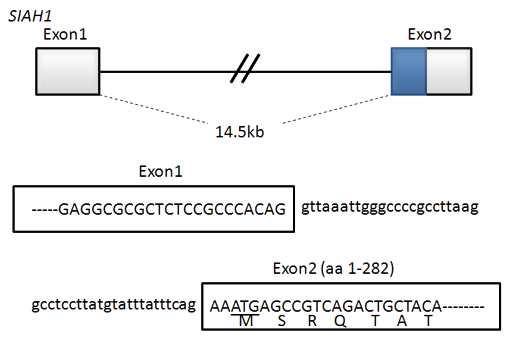
Genomic structure and exon-intron boundaries for SIAH1. The relevant DNA sequences at exon-intron boundaries are indicated, and respective amino acid sequences are indicated below in single-letter code. The entire open reading frame of SIAH1 is in exon 2, and its initiating methionine is underlined.
Pseudogene
One pseudogene has been reported.
Proteins
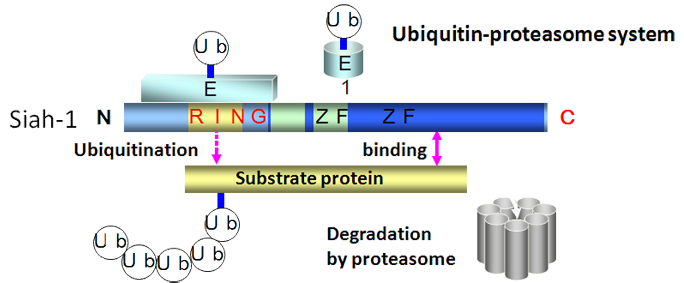
Schema of Siah1 structure. Siah1 has RING domain at the N-terminus and the substrate binding domain (SBD) at the C-terminus. Some substrate proteins are recognized by this substrate binding domain directly, and receive ubiquitin-conjugation.
Expression
Siah1 mRNA is widely expressed in the human tissues. It is expressed at higher level in placenta, skeletal muscle and testis.
Localisation
Siah1 protein can be localized in both cytoplasm and nucleus.
Function
Siah1 is the mammalian homolog of Drosophia seven in absentia (SINA) protein (Carthew and Rubin, 1990). Siah1 protein plays a key role in biological processes such as the cell cycle, programmed cell death, and oncogenesis (Nemani et al., 1996). The Siah family of RING-domain proteins are components of ubiquitin ligase complexes, targeting proteins for proteasomal degradation. Numerous substrates targeted for degradation by Siah proteins have been reported; Synphilin-1 (Nagano et al., 2003), DCC (Hu et al., 1997), N-CoR (Zhang et al., 1998), BOB1/OBF1 (Boehm et al., 2001, Tiedt et al., 2001), c-Myb (Tanikawa et al., 2000), Kid (Germani et al., 2000) and CtIP (Germani et al., 2003). Siah1 expression is upregulated by p53, revealing a link between genotoxic injury and destruction of β-catenin and reduced T-cell factor/lymphoid enhancer factor (Tcf/Lef) activity (Liu et al., 2001; Jansen et al., 2009). Recent paper showed Siah1 expression facilitates ubiquitination and degradation of the tumor suppressor HIPK2 that is a key regulator of the apoptotic programme induced by DNA damage (Winter et al., 2008).
It has been shown that the nuclear translocation and accumulation of GAPDH play important roles in early events leading to cell death initiation and execution (Sirover, 1999), resulting in the various degenerative diseases. Siah1 functions as a potential carrier/shuttle proteins for the induction of GAPDH nuclear translocation because of its nuclear location signal (NLS) domain in Siah1 (Hara et al., 2005).
Siah1a knockout mice are growth-retarded, exhibit early lethality, and display spermatogenetic defects. They also exhibit high numbers of osteoclasts with low numbers of osteoblasts, resulting in severe osteopenia (Frew et al., 2004).
It has been shown that the nuclear translocation and accumulation of GAPDH play important roles in early events leading to cell death initiation and execution (Sirover, 1999), resulting in the various degenerative diseases. Siah1 functions as a potential carrier/shuttle proteins for the induction of GAPDH nuclear translocation because of its nuclear location signal (NLS) domain in Siah1 (Hara et al., 2005).
Siah1a knockout mice are growth-retarded, exhibit early lethality, and display spermatogenetic defects. They also exhibit high numbers of osteoclasts with low numbers of osteoblasts, resulting in severe osteopenia (Frew et al., 2004).
Homology
Human: Siah2.
Mouse: Siah1a, Siah1b, Siah2.
Mouse: Siah1a, Siah1b, Siah2.
Mutations
Note
There is limited evidence for mutation, with only one report of a low frequency of inactivating mutations in gastric cancer (Kim et al., 2004).
Implicated in
Entity name
Breast cancer
Note
Wen et al. showed that Siah1 overexpression induced cell apoptosis by up-regulating the level of Bim through the activation of the JNK signaling pathway, and the suppression of Siah1 expression increased cell invasion via the activation of the ERK signaling pathway in breast cancer cells (Wen et al., 2010a; Wen et al., 2010b).
He et al. showed that overexpression of Siah1 enhanced radiation-induced apoptosis in breast cancer cells (He et al., 2010).
Those data suggest that Siah1 can be a novel therapeutic target for tumor cell death.
He et al. showed that overexpression of Siah1 enhanced radiation-induced apoptosis in breast cancer cells (He et al., 2010).
Those data suggest that Siah1 can be a novel therapeutic target for tumor cell death.
Entity name
Leukemia
Note
Krämer et al. showed that the leukemia fusion protein PML-RARα (promyelocytic leukemia-retinoic acid receptor α which causes acute promyelocytic leukemias, is degraded by ubiquitin-proteasome system and that their turnover critically depends on the E2-conjugase UbcH8 and Siah1. They also showed that HDAC inhibitor enhanced the degradation of leukemia fusion proteins via UbcH8-Siah1 axis and could be a new therapeutic strategy for leukemia (Krämer et al., 2008).
Entity name
Gastric cancer
Note
Kim et al. found two missense mutations in the SIAH1 gene in gastric cancer. The two mutants revealed that impairment of β-catenin degradation pathway, increase of cyclin D1 expression, and inhibition of apoptosis in culture cells, suggesting that mutations of Siah1 gene may play an important role in the development and progression in a subset of gastric cancer through β-catenin stabilization and apoptosis block (Kim et al., 2004).
Entity name
Hepatocellular carcinoma
Note
Matsuo et al. showed that the expression level of SIAH1 was markedly downregulated in hepatocellular carcinoma (HCC), especially in advanced stages (Matsuo et al., 2003). Okabe et al. showed that the paternally expressed gene 10 (PEG10) was an important factor in HCC progression as a substrate for Siah1 and could be a novel molecular target for treatment (Okabe et al., 2003).
Entity name
Parkinsons disease
Note
Nagano et al. showed for the first time that Siah1 ubiquitinated α-synuclein-interacting protein, Synphilin-1, leading to degradation. These proteins are located in Lewy body, the pathological hallmark of Parkinsons disease (Nagano et al., 2003). Recent papers showed that Siah1 facilitated mono- or di-ubiquitination of α-synuclein, leading to Lewy body formation (Lee et al., 2008; Rott et al., 2008). But no mutation in Siah1 has been identified in Parkinsons disease patients (Franck et al., 2006).
Article Bibliography
| Pubmed ID | Last Year | Title | Authors |
|---|---|---|---|
| 11483518 | 2001 | Regulation of BOB.1/OBF.1 stability by SIAH. | Boehm J et al |
| 2146028 | 1990 | seven in absentia, a gene required for specification of R7 cell fate in the Drosophila eye. | Carthew RW et al |
| 16752048 | 2006 | Mutation analysis of the seven in absentia homolog 1 (SIAH1) gene in Parkinson's disease. | Franck T et al |
| 15123657 | 2004 | Osteopenia in Siah1a mutant mice. | Frew IJ et al |
| 11146551 | 2000 | SIAH-1 interacts with alpha-tubulin and degrades the kinesin Kid by the proteasome pathway during mitosis. | Germani A et al |
| 14654780 | 2003 | SIAH-1 interacts with CtIP and promotes its degradation by the proteasome pathway. | Germani A et al |
| 15951807 | 2005 | S-nitrosylated GAPDH initiates apoptotic cell death by nuclear translocation following Siah1 binding. | Hara MR et al |
| 20682032 | 2010 | Siah1 proteins enhance radiosensitivity of human breast cancer cells. | He HT et al |
| 9334332 | 1997 | Mammalian homologs of seven in absentia regulate DCC via the ubiquitin-proteasome pathway. | Hu G et al |
| 18629630 | 2009 | Downregulation of SIAH2, an ubiquitin E3 ligase, is associated with resistance to endocrine therapy in breast cancer. | Jansen MP et al |
| 15467739 | 2004 | Inactivating mutations of the Siah-1 gene in gastric cancer. | Kim CJ et al |
| 18073335 | 2008 | Mechanism for ubiquitylation of the leukemia fusion proteins AML1-ETO and PML-RARalpha. | Krämer OH et al |
| 18065497 | 2008 | Ubiquitination of alpha-synuclein by Siah-1 promotes alpha-synuclein aggregation and apoptotic cell death. | Lee JT et al |
| 11389840 | 2001 | Siah-1 mediates a novel beta-catenin degradation pathway linking p53 to the adenomatous polyposis coli protein. | Liu J et al |
| 12557228 | 2003 | SIAH1 inactivation correlates with tumor progression in hepatocellular carcinomas. | Matsuo K et al |
| 14506261 | 2003 | Siah-1 facilitates ubiquitination and degradation of synphilin-1. | Nagano Y et al |
| 8799150 | 1996 | Activation of the human homologue of the Drosophila sina gene in apoptosis and tumor suppression. | Nemani M et al |
| 12810624 | 2003 | Involvement of PEG10 in human hepatocellular carcinogenesis through interaction with SIAH1. | Okabe H et al |
| 18070888 | 2008 | Monoubiquitylation of alpha-synuclein by seven in absentia homolog (SIAH) promotes its aggregation in dopaminergic cells. | Rott R et al |
| 10407139 | 1999 | New insights into an old protein: the functional diversity of mammalian glyceraldehyde-3-phosphate dehydrogenase. | Sirover MA et al |
| 10747903 | 2000 | p53 suppresses the c-Myb-induced activation of heat shock transcription factor 3. | Tanikawa J et al |
| 11483517 | 2001 | The RING finger protein Siah-1 regulates the level of the transcriptional coactivator OBF-1. | Tiedt R et al |
| 19775288 | 2010 | SIAH1 induced apoptosis by activation of the JNK pathway and inhibited invasion by inactivation of the ERK pathway in breast cancer cells. | Wen YY et al |
| 18536714 | 2008 | Control of HIPK2 stability by ubiquitin ligase Siah-1 and checkpoint kinases ATM and ATR. | Winter M et al |
| 9637679 | 1998 | Proteasomal regulation of nuclear receptor corepressor-mediated repression. | Zhang J et al |
Other Information
Locus ID:
NCBI: 6477
MIM: 602212
HGNC: 10857
Ensembl: ENSG00000196470
Variants:
dbSNP: 6477
ClinVar: 6477
TCGA: ENSG00000196470
COSMIC: SIAH1
RNA/Proteins
Expression (GTEx)
Pathways
Protein levels (Protein atlas)
References
| Pubmed ID | Year | Title | Citations |
|---|---|---|---|
| 38842203 | 2024 | SIAH1 Promotes the Pyroptosis of Cardiomyocytes in Diabetic Cardiomyopathy via Regulating IκB-α/NF-κВ Signaling. | 0 |
| 38842203 | 2024 | SIAH1 Promotes the Pyroptosis of Cardiomyocytes in Diabetic Cardiomyopathy via Regulating IκB-α/NF-κВ Signaling. | 0 |
| 34958110 | 2022 | Siah1 in cancer and nervous system diseases (Review). | 8 |
| 35261172 | 2022 | Reactive oxygen species-induced SIAH1 promotes granulosa cells' senescence in premature ovarian failure. | 7 |
| 35580525 | 2022 | SIAH1 promotes senescence and apoptosis of nucleus pulposus cells to exacerbate disc degeneration through ubiquitinating XIAP. | 3 |
| 35723276 | 2022 | FRK inhibits glioblastoma progression via phosphorylating YAP and inducing its ubiquitylation and degradation by Siah1. | 3 |
| 35961388 | 2022 | Siah1 promotes the proliferation of NSCLC cells through ubiquitinating and stabilizing Notch1. | 3 |
| 34958110 | 2022 | Siah1 in cancer and nervous system diseases (Review). | 8 |
| 35261172 | 2022 | Reactive oxygen species-induced SIAH1 promotes granulosa cells' senescence in premature ovarian failure. | 7 |
| 35580525 | 2022 | SIAH1 promotes senescence and apoptosis of nucleus pulposus cells to exacerbate disc degeneration through ubiquitinating XIAP. | 3 |
| 35723276 | 2022 | FRK inhibits glioblastoma progression via phosphorylating YAP and inducing its ubiquitylation and degradation by Siah1. | 3 |
| 35961388 | 2022 | Siah1 promotes the proliferation of NSCLC cells through ubiquitinating and stabilizing Notch1. | 3 |
| 32430360 | 2021 | De novo variants in SIAH1, encoding an E3 ubiquitin ligase, are associated with developmental delay, hypotonia and dysmorphic features. | 4 |
| 34355355 | 2021 | miR-129-5p Ameliorates Ischemic Brain Injury by Binding to SIAH1 and Activating the mTOR Signaling Pathway. | 4 |
| 34555669 | 2021 | Proteasomal activator 28 gamma stabilizes hepatitis B virus X protein by competitively inhibiting the Siah-1-mediated proteasomal degradation. | 3 |
Citation
Yoshito Nagano ; Shu-Ichi Matsuzawa
SIAH1 (siah E3 ubiquitin protein ligase 1)
Atlas Genet Cytogenet Oncol Haematol. 2013-02-01
Online version: http://atlasgeneticsoncology.org/gene/457/siah1
