GPC5 (glypican 5)
2010-11-01 Khin Thway , Joanna Selfe , Janet Shipley AffiliationMolecular Cytogenetics, Section of Molecular Carcinogenesis, the Institute of Cancer Research, 15 Cotswold Road, Sutton, Surrey, SM2 5NG, United Kingdom
DNA/RNA
Note
The gene spans 1.47 Mb of DNA, comprising 8 exons.
Transcription
2.904 kb mRNA. 1718 bp open reading frame.
Proteins
Description
572 amino acids; 64 kDa protein (core protein). GPC5 is a heparan sulfate proteoglycan (HSPG), that is bound to the cell surface by a glycosyl-phosphatidylinositol (GPI) anchor.
Expression
GPC5 is expressed mainly in fetal tissues, including brain, lung and liver. In the adult, expression is primarily in brain tissue.
Localisation
Attached to the cell membrane by a GPI anchor.
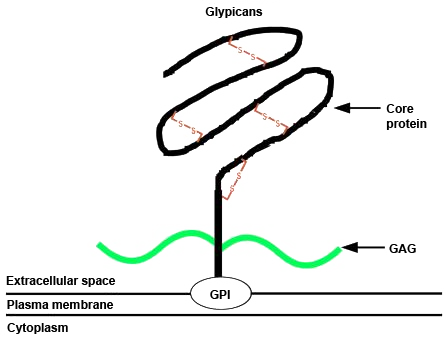
Schematic of glypican protein structure at the cell surface. The protein is held in the plasma membrane by a GPI anchor at the carboxyl terminus. Numerous glycosoaminoglycan (GAG) attachment sites close to the membrane surface allow heparin and chondroitin sulphate chains to be attached to the core protein (shown in green). The amino terminal end of the protein is a globular structure held together by a conserved set of cysteine residues forming disulphide bridges. (Picture reproduced from Filmus and Selleck, 2001).
Function
The precise functions of GPC5 have yet to be fully established. HSPGs are common constituents of cell surfaces and the extracellular matrix (ECM), with essential functions in cell growth and development (Burgess and Macaig, 1989; Andres et al., 1992). Glypicans appear to be expressed predominantly during development, with expression levels changing in a stage- and tissue-specific manner, suggesting their involvement in morphogenesis (Sing and Filmus, 2002). As they can bind numerous ligands and be associated with a variety of receptors, they act as co-receptors for a number of heparin-binding growth factors, modulating their activity. The heparan sulfate modifications of glypicans can mediate interactions with growth factors or ECM proteins, but ligands and ECM proteins can also bind through motifs in the core proteins (Mythreye and Blobe, 2009). Glypicans can be secreted from the cell surface, such soluble forms can also bind growth factors. Evidence to date suggests that glypicans can regulate Wnt, hedgehog, fibroblast growth factor and bone morphogenetic protein pathways. The effect on these pathways may be stimulatory or inhibitory depending on cellular context (Gallet et al., 2008; Capurro et al., 2008; Kreuger et al., 2004; Yan and Lin, 2007; Grisaru et al., 2001; Yan et al., 2010).
GPC5 expression has been shown in the developing central nervous system, limbs and kidneys of mice, and its expression in mammalian fetal tissues suggests roles in growth and differentiation during development (Veugelers et al., 1997; Saunders et al., 1997; Luxardi et al., 2007). Its almost exclusive expression in adult brain tissue suggests a possible role in controlling neurotropic factors and maintaining neural function.
GPC5 expression has been shown in the developing central nervous system, limbs and kidneys of mice, and its expression in mammalian fetal tissues suggests roles in growth and differentiation during development (Veugelers et al., 1997; Saunders et al., 1997; Luxardi et al., 2007). Its almost exclusive expression in adult brain tissue suggests a possible role in controlling neurotropic factors and maintaining neural function.
Homology
GPC5 is a member of the glypican family of HSPGs, of which six members (GPC1, GPC2, GPC3, GPC4, GPC5, GPC6) have been identified in mammals. GPC3 is the most homologous member to GPC5 in humans. There is approximately 20-60% sequence homology between family members, including conservation of a pattern of 14 cysteine residues. Homolog glypican-like genes are also present in Drosophila (dally and dally-like).
Implicated in
Entity name
Tumourigenesis
Note
Amplification of 13q31-32 has been shown in poor prognosis liposarcomas, breast cancers and neurologic tumours (Reardon et al., 2000; Ojopi et al., 2001; Ullmann et al., 2001; Schmidt et al., 2005). Amplification of 13q31-32 has also been shown in approximately 20% of alveolar rhabdomyosarcoma, as well as gain of GPC5 copies in both alveolar and embryonal rhabdomyosarcoma (Gordon et al., 2000). GPC5 is overexpressed in the majority of rhabdomyosarcomas compared with normal skeletal muscle and has been shown to modulate responses to FGF2 in rhabdomyosarcoma cells (Williamson et al., 2007). GPC5 may also potentiate hedgehog signalling in these cells as it can bind to both Hedgehog and the Patched receptor (Li et al., 2010a). A recent genome wide association study has linked polymorphisms in GPC5 to risk of lung cancer in never-smokers (Li et al., 2010b). The high-risk allele was coincident with lower expression of GPC5, suggesting that the role of GPC5 is likely to be tumour type-specific in an analogous manner to GPC3, the closest family member to GPC5.
Entity name
Developmental disorders
Note
Studies on the role of GPC5 in disease are still relatively limited. In humans, deletions of the 13q31-32 region are associated with the 13q deletion syndrome, a developmental disorder with a wide phenotypic spectrum including mental and growth retardation, congenital defects and craniofacial dysmorphy, and GPC5 is suggested as a candidate gene for digital malformations in this syndrome (Quelin et al., 2009). Correspondingly, GPC5 is also a candidate gene for postaxial polydactyly type A2, which is associated with duplication of 13q31-32 (van der Zwaag et al., 2010).
Entity name
Multiple sclerosis
Note
Several genome wide association studies have identified GPC5 as having a potential role in Multiple Sclerosis (MS) (Baranzini et al., 2009; Lorentzen et al., 2010). Several different GPC5 polymorphisms were also highlighted in an independent study designed to determine which genes are associated with efficacy of interferon beta therapy in MS (Byun et al., 2008), this finding has subsequently been confirmed in a separate study (Cenit et al., 2009). HSPGs are found in dense networks in active MS plaques, where they may sequester pro-inflammatory cytokines.
Article Bibliography
| Pubmed ID | Last Year | Title | Authors |
|---|
Other Information
Locus ID:
NCBI: 2262
MIM: 602446
HGNC: 4453
Ensembl: ENSG00000179399
Variants:
dbSNP: 2262
ClinVar: 2262
TCGA: ENSG00000179399
COSMIC: GPC5
RNA/Proteins
| Gene ID | Transcript ID | Uniprot |
|---|---|---|
| ENSG00000179399 | ENST00000377067 | P78333 |
| ENSG00000179399 | ENST00000618283 | A0A087WX13 |
| ENSG00000179399 | ENST00000618596 | A0A087WX91 |
Expression (GTEx)
Pathways
Protein levels (Protein atlas)
References
| Pubmed ID | Year | Title | Citations |
|---|---|---|---|
| 33512817 | 2021 | Glypican-1, -3, -5 (GPC1, GPC3, GPC5) and Hedgehog Pathway Expression in Oral Squamous Cell Carcinoma. | 1 |
| 33606708 | 2021 | Subcellular localization of glypican-5 is associated with dynamic motility of the human mesenchymal stem cell line U3DT. | 0 |
| 34079082 | 2021 | GPC5 suppresses lung cancer progression and metastasis via intracellular CTDSP1/AhR/ARNT signaling axis and extracellular exosome secretion. | 7 |
| 33512817 | 2021 | Glypican-1, -3, -5 (GPC1, GPC3, GPC5) and Hedgehog Pathway Expression in Oral Squamous Cell Carcinoma. | 1 |
| 33606708 | 2021 | Subcellular localization of glypican-5 is associated with dynamic motility of the human mesenchymal stem cell line U3DT. | 0 |
| 34079082 | 2021 | GPC5 suppresses lung cancer progression and metastasis via intracellular CTDSP1/AhR/ARNT signaling axis and extracellular exosome secretion. | 7 |
| 30557546 | 2019 | Long non-coding RNA Hotair promotes gastric cancer progression via miR-217-GPC5 axis. | 23 |
| 30951720 | 2019 | MicroRNA-301b promotes the proliferation and invasion of glioma cells through enhancing activation of Wnt/β-catenin signaling via targeting Glypican-5. | 4 |
| 30557546 | 2019 | Long non-coding RNA Hotair promotes gastric cancer progression via miR-217-GPC5 axis. | 23 |
| 30951720 | 2019 | MicroRNA-301b promotes the proliferation and invasion of glioma cells through enhancing activation of Wnt/β-catenin signaling via targeting Glypican-5. | 4 |
| 28893348 | 2018 | Overexpression of Glypican 5 (GPC5) Inhibits Prostate Cancer Cell Proliferation and Invasion via Suppressing Sp1-Mediated EMT and Activation of Wnt/β-Catenin Signaling. | 18 |
| 29407175 | 2018 | High expression of microRNA-4295 contributes to cell proliferation and invasion of pancreatic ductal adenocarcinoma by the down-regulation of Glypican-5. | 10 |
| 28893348 | 2018 | Overexpression of Glypican 5 (GPC5) Inhibits Prostate Cancer Cell Proliferation and Invasion via Suppressing Sp1-Mediated EMT and Activation of Wnt/β-Catenin Signaling. | 18 |
| 29407175 | 2018 | High expression of microRNA-4295 contributes to cell proliferation and invasion of pancreatic ductal adenocarcinoma by the down-regulation of Glypican-5. | 10 |
| 26631038 | 2016 | Prognostic significance of GPC5 expression in patients with prostate cancer. | 12 |
Citation
Khin Thway ; Joanna Selfe ; Janet Shipley
GPC5 (glypican 5)
Atlas Genet Cytogenet Oncol Haematol. 2010-11-01
Online version: http://atlasgeneticsoncology.org/gene/45705/gpc5
