PIK3CD (phosphoinositide-3-kinase, catalytic, delta polypeptide)
2011-02-01 Emily Burns , Bart Vanhaesebroeck AffiliationCentre of Cell Signalling, Barts Cancer Institute, Queen Mary University of London, London, EC1M 6BQ, UK
Identity

DNA/RNA
Description
Transcription
Proteins

Description
The PI3K enzymes are heterodimeric molecules which consist of a catalytic p110 subunit, and a constitutively bound p85 regulatory unit of which there are five isoforms encoded by three genes (PIK3R1, PIK3R2 and PIK3R3) (Vanhaesebroeck and Waterfield, 1999; Geering et al., 2007).
The regulatory subunit has a dual function of recruiting the p110 catalytic subunit to an activated upstream tyrosine kinase receptor, and inhibiting catalytic activity in the absence of this stimulatory interaction (Yu et al., 1998). Unlike p110alpha, p110delta does not phoshorylate its associated p85 regulatory subunit and instead auto-phosphorylates (Vanhaesebroeck et al., 1997; Vanhaesebroeck et al., 1999a).
Expression
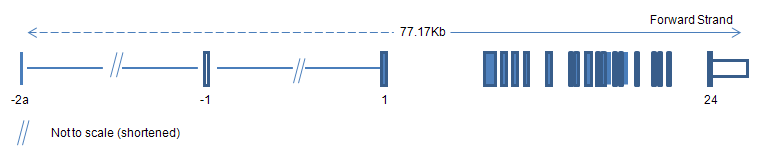
A transcription factor binding cluster located immediately upstream of the untranslated exon -2a in the human gene, has been identified and found to have enhanced promotor activity in leukocytes. This promoter region may therefore facilitate the enhanced expression of p110delta in leukocytes (Kok et al., 2009).
Localisation
Function
Active p110delta initiates signalling cascades by phosphorylating phosphoinositide (PI) lipids such as PIP2 producing pools of PIP3 in the periplasmic region (Vanhaesebroeck et al., 1997). A wide range of effector proteins recognise and interact with the PI species produced, and the resulting alteration in location and activities of these effectors initiates a number of signalling cascades. The classical effector of PI3K signalling is the serine/threonin kinase AKT (aka protein kinase B), which contains a pleckstrin homology (PH) domain that interacts with PIP3 (Franke et al., 1997). The affinity of Akt for PIP3 facilitates activation of Akts protein kinase activity, resulting in activity-modifying phosphorylation of a range of downstream Akt targets.
Roles of p110delta in immune function. The role of p110delta in vivo has been studied in a p110delta null mouse (Clayton et al., 2002; Jou et al., 2002) and in a p110delta kinase-dead mouse known as p110deltaD910A/D910A (Okkenhaug et al., 2002). Phenotypic analysis of the p110deltaD910A/D910A mouse revealed an important role for p110delta in immunity; the mice have notable defects in their T and B cell responses, as well as several other immunological abnormalities (Okkenhaug et al., 2002). In vitro and ex vivo studies suggest that p110delta is the predominant PI3K class IA isoform regulating the phenotype and responses of many leukocyte cell types (Vanhaesebroeck et al., 1999b; Puri et al., 2004; Papakonstanti et al., 2008). In mast cells derived from the p110delta kinase-dead mice, ninety percent of the total PI3K lipid kinase activity was dependent on p110delta (Ali et al., 2004). p110delta has been found to be a key player in the induction of amongst other things, proliferation, chemotaxis, and cytokine/chemokine release in response to both physiological stimuli and pathological stimuli, in many leukocytes (Okkenhaug and Vanhaesebroeck, 2003; Dos Santos et al., 2007; Papakonstanti et al., 2008; Dil et al., 2009; Low et al., 2010).
Homology
Mutations
Note
Implicated in
Despite the dominance of p110delta in the regulation of proliferation in leukocytes and the abberant activity of its major downstream target Akt, no mutations or amplifications of p110delta have been observed in these or other haematological malignancies.
A series of clinical trials are now underway to assess the effects of selective inhibition of p110delta on refractory haematological malignancies, and preliminary results are promising (Furman, 2010).
Article Bibliography
| Pubmed ID | Last Year | Title | Authors |
|---|---|---|---|
| 15496927 | 2004 | Essential role for the p110delta phosphoinositide 3-kinase in the allergic response. | Ali K et al |
| 16702948 | 2006 | A selective inhibitor of the p110delta isoform of PI 3-kinase inhibits AML cell proliferation and survival and increases the cytotoxic effects of VP16. | Billottet C et al |
| 12235209 | 2002 | A crucial role for the p110delta subunit of phosphatidylinositol 3-kinase in B cell development and activation. | Clayton E et al |
| 11162674 | 2001 | Structural organization of the mouse phosphatidylinositol 3-kinase p110d gene. | Clayton E et al |
| 19362372 | 2009 | Role of phosphoinositide 3-kinase p110 delta in TLR4- and TLR9-mediated B cell cytokine production and differentiation. | Dil N et al |
| 17405917 | 2007 | Gene expression profiling of LPS-stimulated murine macrophages and role of the NF-kappaB and PI3K/mTOR signaling pathways. | Dos Santos S et al |
| 17846664 | 2007 | Control of axonal growth and regeneration of sensory neurons by the p110delta PI 3-kinase. | Eickholt BJ et al |
| 16847462 | 2006 | The evolution of phosphatidylinositol 3-kinases as regulators of growth and metabolism. | Engelman JA et al |
| 16625210 | 2006 | Critical role for the p110alpha phosphoinositide-3-OH kinase in growth and metabolic regulation. | Foukas LC et al |
| 9005852 | 1997 | Direct regulation of the Akt proto-oncogene product by phosphatidylinositol-3,4-bisphosphate. | Franke TF et al |
| 20864914 | 2010 | New agents in early clinical trials for CLL therapy. | Furman RR et al |
| 17470792 | 2007 | Class IA phosphoinositide 3-kinases are obligate p85-p110 heterodimers. | Geering B et al |
| 20522708 | 2010 | Phosphatidylinositol 3-kinase-δ inhibitor CAL-101 shows promising preclinical activity in chronic lymphocytic leukemia by antagonizing intrinsic and extrinsic cellular survival signals. | Herman SE et al |
| 20505158 | 2010 | PI3K/p110{delta} is a novel therapeutic target in multiple myeloma. | Ikeda H et al |
| 17626838 | 2007 | Inactivation of PI3Kgamma and PI3Kdelta distorts T-cell development and causes multiple organ inflammation. | Ji H et al |
| 12446777 | 2002 | Essential, nonredundant role for the phosphoinositide 3-kinase p110delta in signaling by the B-cell receptor complex. | Jou ST et al |
| 19357769 | 2009 | Regulation of p110delta PI 3-kinase gene expression. | Kok K et al |
| 20959606 | 2011 | CAL-101, a p110delta selective phosphatidylinositol-3-kinase inhibitor for the treatment of B-cell malignancies, inhibits PI3K signaling and cellular viability. | Lannutti BJ et al |
| 16507763 | 2006 | Inhibition of phosphoinositide 3-kinase delta attenuates allergic airway inflammation and hyperresponsiveness in murine asthma model. | Lee KS et al |
| 20837769 | 2010 | Phosphoinositide 3-kinase δ regulates membrane fission of Golgi carriers for selective cytokine secretion. | Low PC et al |
| 17614878 | 2007 | Phosphoinositide 3-kinase signalling in lung disease: leucocytes and beyond. | Medina-Tato DA et al |
| 12750723 | 2003 | Constitutive phosphorylation of Akt/PKB protein in acute myeloid leukemia: its significance as a prognostic variable. | Min YH et al |
| 12669022 | 2003 | PI3K in lymphocyte development, differentiation and activation. | Okkenhaug K et al |
| 19033389 | 2008 | Distinct roles of class IA PI3K isoforms in primary and immortalised macrophages. | Papakonstanti EA et al |
| 18811876 | 2008 | Phosphoinositide 3-kinase delta inhibitor as a novel therapeutic agent in asthma. | Park SJ et al |
| 14751923 | 2004 | Mechanisms and implications of phosphoinositide 3-kinase delta in promoting neutrophil trafficking into inflamed tissue. | Puri KD et al |
| 17290298 | 2007 | PI3K delta and PI3K gamma: partners in crime in inflammation in rheumatoid arthritis and beyond? | Rommel C et al |
| 12670921 | 2003 | Regulation of breast cancer cell chemotaxis by the phosphoinositide 3-kinase p110delta. | Sawyer C et al |
| 9455486 | 1997 | Identification and chromosome assignment of a human gene encoding a novel phosphatidylinositol-3 kinase. | Seki N et al |
| 20637203 | 2010 | Altered macrophage function contributes to colitis in mice defective in the phosphoinositide-3 kinase subunit p110δ. | Uno JK et al |
| 10579926 | 1999 | Signaling by distinct classes of phosphoinositide 3-kinases. | Vanhaesebroeck B et al |
| 9488453 | 1998 | Regulation of the p85/p110 phosphatidylinositol 3'-kinase: stabilization and inhibition of the p110alpha catalytic subunit by the p85 regulatory subunit. | Yu J et al |
Other Information
Locus ID:
NCBI: 5293
MIM: 602839
HGNC: 8977
Ensembl: ENSG00000171608
Variants:
dbSNP: 5293
ClinVar: 5293
TCGA: ENSG00000171608
COSMIC: PIK3CD
RNA/Proteins
Expression (GTEx)
Pathways
Protein levels (Protein atlas)
PharmGKB
| Entity ID | Name | Type | Evidence | Association | PK | PD | PMIDs |
|---|---|---|---|---|---|---|---|
| PA24684 | AKT1 | Gene | Pathway | associated | 28362716 | ||
| PA27844 | ERBB2 | Gene | Pathway | associated | |||
| PA27846 | ERBB3 | Gene | Pathway | associated | |||
| PA27847 | ERBB4 | Gene | Pathway | associated | |||
| PA28180 | FLT1 | Gene | Pathway | associated | 28362716 | ||
| PA28183 | FLT4 | Gene | Pathway | associated | 28362716 | ||
| PA30086 | KDR | Gene | Pathway | associated | 28362716 | ||
| PA7360 | EGFR | Gene | Pathway | associated |
References
| Pubmed ID | Year | Title | Citations |
|---|---|---|---|
| 37277581 | 2024 | Upregulation of SEMP1 Contributes to Improving the Biological Functions of Trophoblast via the PI3K/AKT Pathway in Preeclampsia. | 0 |
| 37642368 | 2024 | STMN1 promotes cell malignancy and bortezomib resistance of multiple myeloma cell lines via PI3K/AKT signaling. | 0 |
| 37728571 | 2024 | Spinster homolog 2 reduces malignancies of glioblastoma via PTEN/PI3K/AKT pathway. | 0 |
| 37909722 | 2024 | KIRREL promotes the proliferation of gastric cancer cells and angiogenesis through the PI3K/AKT/mTOR pathway. | 0 |
| 38172081 | 2024 | IRS1 promotes thyroid cancer metastasis through EMT and PI3K/AKT pathways. | 0 |
| 38172354 | 2024 | FOXM1 transcriptional regulation of RacGAP1 activates the PI3K/AKT signaling pathway to promote the proliferation, migration, and invasion of cervical cancer cells. | 1 |
| 38287413 | 2024 | Activated phosphoinositide 3-kinase δ syndrome caused by PIK3CD mutations: expanding the phenotype. | 0 |
| 38307209 | 2024 | PI3Kδ Mediates Fibrosis by Patient-Derived Vitreous. | 0 |
| 38363382 | 2024 | The novel miR-873-5p-YWHAE-PI3K/AKT axis is involved in non-small cell lung cancer progression and chemoresistance by mediating autophagy. | 0 |
| 38421448 | 2024 | FAM76B regulates PI3K/Akt/NF-κB-mediated M1 macrophage polarization by influencing the stability of PIK3CD mRNA. | 0 |
| 38811189 | 2024 | circZNF532 promotes endothelial-to-mesenchymal transition in diabetic retinopathy by recruiting TAF15 to stabilize PIK3CD. | 0 |
| 37277581 | 2024 | Upregulation of SEMP1 Contributes to Improving the Biological Functions of Trophoblast via the PI3K/AKT Pathway in Preeclampsia. | 0 |
| 37642368 | 2024 | STMN1 promotes cell malignancy and bortezomib resistance of multiple myeloma cell lines via PI3K/AKT signaling. | 0 |
| 37728571 | 2024 | Spinster homolog 2 reduces malignancies of glioblastoma via PTEN/PI3K/AKT pathway. | 0 |
| 37909722 | 2024 | KIRREL promotes the proliferation of gastric cancer cells and angiogenesis through the PI3K/AKT/mTOR pathway. | 0 |
Citation
Emily Burns ; Bart Vanhaesebroeck
PIK3CD (phosphoinositide-3-kinase, catalytic, delta polypeptide)
Atlas Genet Cytogenet Oncol Haematol. 2011-02-01
Online version: http://atlasgeneticsoncology.org/gene/46261/pik3cd
