SRSF1 (serine/arginine-rich splicing factor 1)
2011-11-01 Ruben Pio AffiliationDepartment of Biochemistry, Division of Oncology (CIMA), University of Navarra, Pamplona, Spain
Identity
HGNC
LOCATION
17q22
LOCUSID
ALIAS
ASF,SF2,SF2p33,SFRS1,SRp30a
FUSION GENES
DNA/RNA
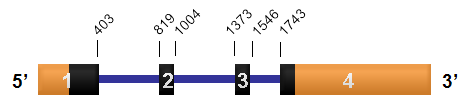
Genomic structure of the SRSF1 gene. The black area indicates the coding sequence.
Description
The SRSF1 locus spans 6424 bp on the minus (-) strand of the long arm of chromosome 17 and is composed of 4 exons.
Transcription
ASF-1 (SF2) contains 4 exons (248 aa). Two additional cDNAs generated by alternative 3 splice-site use or by intron retention have been described and are designated ASF-2 (292 aa) and ASF-3 (201 aa), respectively. However, ASF/SF2 is the only isoform expressed at detectable levels.
Pseudogene
No known pseudogenes.
Proteins
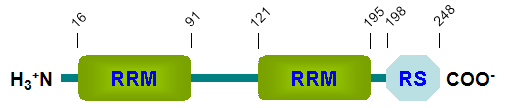
Schematic diagram of SF2/ASF protein. SF2/ASF has a modular structure with two RNA recognition motifs (RRM) that provide RNA-binding specificity and one arginine/serine-rich domain (RS), involved in protein-protein interactions that facilitate recruitment of the spliceosome. The RS domain acts also as a nuclear localization signal, controlling the subcellular localization of SF2/ASF. The protein can be phosphorilated in Ser residues in the C-terminal RS domain.
Description
248 amino acids, 28 kDa.
Expression
SF2/ASF is constitutively expressed in all cell types. However, there are differences in expression levels between cell types and organs. Moreover, in some pathological conditions the expression levels are altered.
Localisation
SF2/ASF is a shuttling protein with a high mobility between the nucleus and the cytoplasm. In the nucleus, SF2/ASF is concentrated in speckles and when transcription is activated it accumulates at the sites of transcription.
Function
SF2/ASF modulates both constitutive and alternative pre-mRNA splicing. The function of SF2/ASF in splicing depends on the pre-mRNA sequence and the cellular context. Cis-acting sequences and trans-acting factors modulate SF2/ASF activity. For example, SF2/ASF antagonizes the activity of hnRNP A/B proteins in splice site selection. An excess of hnRNP A1 favors distal 5 splice sites, whereas SF2/ASF promotes the use of proximal 5 splice sites.
SF2/ASF is also involved in transcription, mRNA export, nonsense-mediated mRNA decay, and translation.
SF2/ASF is also involved in transcription, mRNA export, nonsense-mediated mRNA decay, and translation.
Homology
SF2/ASF shares a high homology with other members of the SR family. SR proteins are conserved across vertebrates and invertebrates. They contain one or two copies of an RNA recognition motif (RRM) at the amino-terminus, spaced by a series of glycine residues that may form a flexible hinge, and a carboxy-terminal highly charged SR domain.
Mutations
Note
No mutations have been reported. Gene amplification has been found in some tumor types.
Implicated in
Entity name
Various cancers
Note
SF2/ASF acts as an oncogene.
SF2/ASF is upregulated in various human tumors, including lung, colon, kidney, liver, pancreas, ovary, cervix, and breast. Upregulation is sometimes associated with gene amplification. Overexpression of SF2/ASF is sufficient to transform immortal rodent fibroblasts.
mTORC1 activation may be essential for SF2/ASF-mediated transformation.
SF2/ASF-bound mRNAs recruit the mTOR kinase, resulting in the phosphorylation and release of 4E-BP, leading to translation initiation. Clinical tumors with SF2/ASF up-regulation may be especially sensitive to mTOR inhibitors.
SF2/ASF is upregulated in various human tumors, including lung, colon, kidney, liver, pancreas, ovary, cervix, and breast. Upregulation is sometimes associated with gene amplification. Overexpression of SF2/ASF is sufficient to transform immortal rodent fibroblasts.
mTORC1 activation may be essential for SF2/ASF-mediated transformation.
SF2/ASF-bound mRNAs recruit the mTOR kinase, resulting in the phosphorylation and release of 4E-BP, leading to translation initiation. Clinical tumors with SF2/ASF up-regulation may be especially sensitive to mTOR inhibitors.
Entity name
Non-small cell lung cancer (NSCLC)
Note
SF2/ASF and survivin expression are involved in non-small cell lung cancer progression.
SF2/ASF is overexpressed in lung cancer cell lines and human NSCLC specimens. SF2/ASF controls the expression of survivin through the activation of the mTOR pathway.
SF2/ASF is overexpressed in lung cancer cell lines and human NSCLC specimens. SF2/ASF controls the expression of survivin through the activation of the mTOR pathway.
Entity name
Prostate cancer
Note
Cyclin D1b oncogene is induced by SF2/ASF.
SF2/ASF associates with cyclin D1b mRNA, an alternative splicing of the CCND1 transcript with enhanced oncogenic functions. SF2/ASF expression correlates with cyclin D1b in human prostate cancer.
SF2/ASF associates with cyclin D1b mRNA, an alternative splicing of the CCND1 transcript with enhanced oncogenic functions. SF2/ASF expression correlates with cyclin D1b in human prostate cancer.
Entity name
Cystic fibrosis
Note
Aberrant regulation of CFTR exon 9 alternative splicing by splicing factors may be associated with cystic fibrosis.
SF2/ASF binds to an intronic splicing silencer of exon 9 of CFTR and promotes exon exclusion.
SF2/ASF binds to an intronic splicing silencer of exon 9 of CFTR and promotes exon exclusion.
Entity name
Cardiac remodeling
Note
SF2/ASF has a role in cardiac remodeling.
ASF/SF2 is a key regulator of alternative splicing events during postnatal heart remodeling.
ASF/SF2 is a key regulator of alternative splicing events during postnatal heart remodeling.
Entity name
Retroviral splicing
Note
SF2/ASF regulates retroviral splicing.
SF2/ASF has been implicated in the regulation of retroviral splicing in Rous sarcoma virus, HIV-1 and HPV-16.
SF2/ASF has been implicated in the regulation of retroviral splicing in Rous sarcoma virus, HIV-1 and HPV-16.
Entity name
Cell motility
Note
SF2/ASF activates epithelial to mesenchymal transition.
DeltaRon, a splicing isoform of the tyrosine kinase receptor Ron, increases motility. DeltaRon is generated by the skipping of exon 11. SF2/ASF, by controlling the production of DeltaRon, activates epithelial to mesenchymal transition, leading to cell locomotion.
DeltaRon, a splicing isoform of the tyrosine kinase receptor Ron, increases motility. DeltaRon is generated by the skipping of exon 11. SF2/ASF, by controlling the production of DeltaRon, activates epithelial to mesenchymal transition, leading to cell locomotion.
Article Bibliography
| Pubmed ID | Last Year | Title | Authors |
|---|
Other Information
Locus ID:
NCBI: 6426
MIM: 600812
HGNC: 10780
Ensembl: ENSG00000136450
Variants:
dbSNP: 6426
ClinVar: 6426
TCGA: ENSG00000136450
COSMIC: SRSF1
RNA/Proteins
Expression (GTEx)
Pathways
Protein levels (Protein atlas)
References
| Pubmed ID | Year | Title | Citations |
|---|---|---|---|
| 38294104 | 2024 | TIM22 and TIM29 inhibit HBV replication by up-regulating SRSF1 expression. | 1 |
| 38369277 | 2024 | RNA Binding Proteins that Mediate LPS-induced Alternative Splicing of the MyD88 Innate Immune Regulator. | 0 |
| 38567732 | 2024 | Unearthing a novel function of SRSF1 in binding and unfolding of RNA G-quadruplexes. | 0 |
| 38581057 | 2024 | Circ_0001786 facilitates gefitinib resistance and malignant progression in non-small cell lung cancer via miR-34b-5p/SRSF1. | 1 |
| 38735973 | 2024 | High expression of SRSF1 facilitates osteosarcoma progression and unveils its potential mechanisms. | 0 |
| 38743621 | 2024 | SRSF1 interactome determined by proximity labeling reveals direct interaction with spliceosomal RNA helicase DDX23. | 1 |
| 39023093 | 2024 | The U1-70K and SRSF1 interaction is modulated by phosphorylation during the early stages of spliceosome assembly. | 1 |
| 38294104 | 2024 | TIM22 and TIM29 inhibit HBV replication by up-regulating SRSF1 expression. | 1 |
| 38369277 | 2024 | RNA Binding Proteins that Mediate LPS-induced Alternative Splicing of the MyD88 Innate Immune Regulator. | 0 |
| 38567732 | 2024 | Unearthing a novel function of SRSF1 in binding and unfolding of RNA G-quadruplexes. | 0 |
| 38581057 | 2024 | Circ_0001786 facilitates gefitinib resistance and malignant progression in non-small cell lung cancer via miR-34b-5p/SRSF1. | 1 |
| 38735973 | 2024 | High expression of SRSF1 facilitates osteosarcoma progression and unveils its potential mechanisms. | 0 |
| 38743621 | 2024 | SRSF1 interactome determined by proximity labeling reveals direct interaction with spliceosomal RNA helicase DDX23. | 1 |
| 39023093 | 2024 | The U1-70K and SRSF1 interaction is modulated by phosphorylation during the early stages of spliceosome assembly. | 1 |
| 36508830 | 2023 | CircCDR1as mediates PM(2.5)-induced lung cancer progression by binding to SRSF1. | 2 |
Citation
Ruben Pio
SRSF1 (serine/arginine-rich splicing factor 1)
Atlas Genet Cytogenet Oncol Haematol. 2011-11-01
Online version: http://atlasgeneticsoncology.org/gene/47631/srsf1
