CLDN9 (claudin 9)
2012-12-01 Erika Patricia Rendon-Huerta , Ana C Torres-Martínez , Luis Montaño AffiliationDepartamento de Bioquimica, Facultad de Medicina, UNAM, 04510, Mexico City, Mexico
DNA/RNA
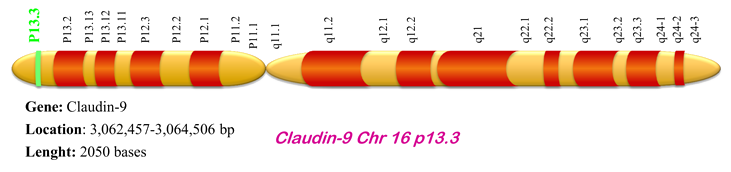
Description
2050 base-pairs DNA linear, starts at 30624573 and ends at 3064506 bp from pter with plus strand orientation. This gene contains 1 exon.
Transcription
The transcription produces 1 spliced mRNA variant (NM_020982), 2139 bp.
Pseudogene
Not found.
Proteins
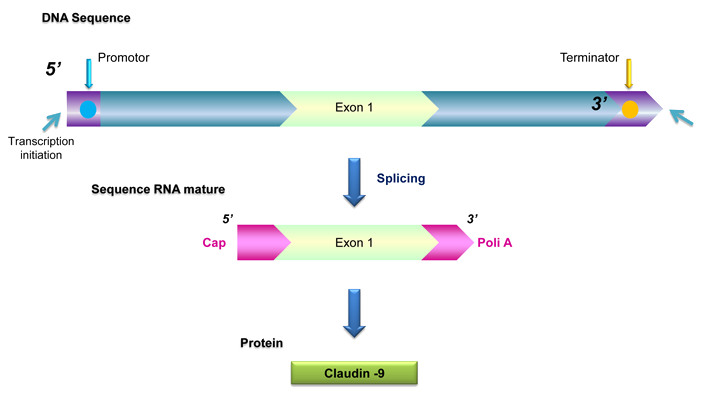
Description
The transcription of this gene gives 1 spliced mRNA that encodes 1 protein isoform with 217 aa and 22848 Da of molecular weight.

Expression
Pituitary gland (71,08%), lung (14,44%), intestine (6,87%), eye (6,56%), and brain (1,05%).
Localisation
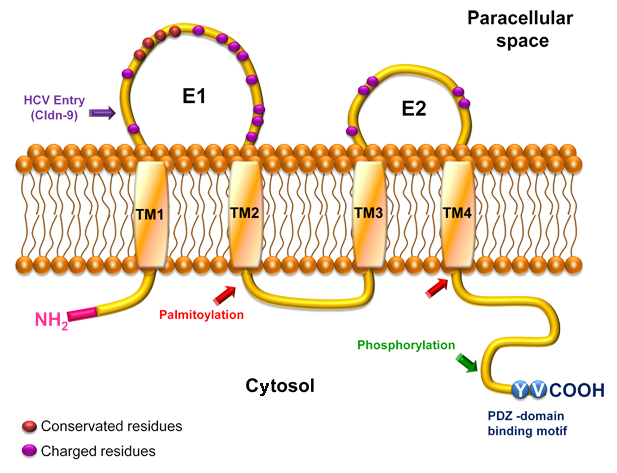
This is a multi-pass membrane protein localized in the tight junction, cell membrane, cytoplasm and nucleus.
Function
Claudin-9 belongs to the claudin family. Claudins constitute integral membrane proteins responsible for solute and electrolyte permeability of the tight junction that serve as a physical barrier to prevent solutes and water from passing freely through the paracellular space between epithelial or endothelial cell sheets. Tight junctions also play a critical role in maintaining cell polarity and signal transductions. Claudin-9 creates charge specific channels in the paracellular space, plays a major role in tight junction-specific obliteration of the intercellular space, through calcium-independent cell-adhesion activity, is required to preserve sensory cells in the hearing organ because claudin-9-defective tight junctions fail to shield the basolateral side of hair cells from the K+-rich endolymph. Its ion barrier function is essential in the cochlea, but appears to be dispensable in other organs. Is one of the entry cofactors for hepatitis C virus; it enables HCV entry into target cells just as efficiently as CLDN1.
Homology
The CLDN9 gene is conserved in chimpanzee, dog, cow, mouse, rat, dog, opossum, lizard and zebrafish.
Implicated in
Entity name
Gastric adenocarcinoma
Note
Abnormal claudin expression has been documented in several malignancies. Strong claudin-9 expression was associated with higher mortality rate (66%) in the diffuse- vs the intestinal-type (25%) gastric adenocarcinoma after a 2-year follow-up (Rendón-Huerta et al., 2010). Claudin-9 expression is closely related to gastric carcinogenesis, and their detection is a useful prognostic marker in gastric adenocarcinoma.
Claudin-9 overexpression in AGS cells enhanced their invasive potential (1,6-fold), cell migration and proliferation rate (13,3%); it also increased claudin-1 and zonula occludens-1 levels (Zavala et al., 2011). Increased expression of claudin-9 is sufficient to enhance tumorigenic properties of a gastric adenocarcinoma cell line.
Claudin-9 overexpression in AGS cells enhanced their invasive potential (1,6-fold), cell migration and proliferation rate (13,3%); it also increased claudin-1 and zonula occludens-1 levels (Zavala et al., 2011). Increased expression of claudin-9 is sufficient to enhance tumorigenic properties of a gastric adenocarcinoma cell line.
Entity name
Hepatitis C virus infection
Note
Claudin-9 mediates the entry of HCV into target cells. CLDN9 is expressed in the liver, the primary site of HCV replication, and peripheral blood mononuclear cells, an additional site of HCV replication. Sequence comparison and mutagenesis studies, showed that residues N38 and V45 in the first extracellular loop of CLDN9 are necessary for HCV entry (Zheng et al., 2007).
Claudin-9 expressed in CD81+ (tetraspanin) cells also enables the entry of HCV pseudoparticles. Claudin -1 and -9 function equally well as entry cofactors in endothelial cells but claudin-1 is more efficient in hepatoma cells (Meertens et al., 2008). This suggests that additional cellular factors modulate the ability of claudins to function as HCV entry cofactors.
Claudin-9 expressed in CD81+ (tetraspanin) cells also enables the entry of HCV pseudoparticles. Claudin -1 and -9 function equally well as entry cofactors in endothelial cells but claudin-1 is more efficient in hepatoma cells (Meertens et al., 2008). This suggests that additional cellular factors modulate the ability of claudins to function as HCV entry cofactors.
Entity name
Hearing
Note
Claudin-9 is required for the preservation of sensory cells in the hearing organ because its absence in a specific subdomain underneath more apical tight-junction strands formed by other claudins, fails to shield the basolateral side of hair cells from the K+-rich endolymph (Nakano et al., 2009). Claudin-9 mutant mice have shown that even the deeper (subapical) tight-junction strands have biologically important ion barrier function.
Entity name
Cornea
Note
Epigenetic regulators such as TSA, 5-aza, and DMSO significantly enhance the expression of claudin-9 in corneal cells, changing transcriptional signals by demethylating CpG islands (Nishikiori et al., 2008); additionally, the epigenetic regulators increase transendothelial electrical resistance and suppress fluxes of corneal cells, thus enhancing the corneal barrier function, in murine experimental corneal trauma.
Entity name
Neonatal development
Note
Claudins are the gatekeepers of the paracellular pathway, and claudin isoform expression determines the permeability characteristics of the paracellular pathway. Claudin-9 is not expressed or barely detectable in the adult mouse but it is expressed in the neonatal mouse kidney. Claudin-9 mRNA is present in 1-day-old proximal convoluted tubules (Abuazza et al., 2006). Expression of claudin-9 results in an increased transepithelial resistance, decreased chloride permeability, and decreased P(Na)/P(Cl) and P(HCO3)/P(Cl) (Sas et al. 2008). Claudin-9 may play a role in the maturational changes in kidney paracellular permeability.
Entity name
Pathway signalling
Note
Transmembrane proteins of the claudin family are critical determinants of TJ permeability but little is known about the signaling pathways that control their expression. In mammary epithelial cells SP600125 (an inhibitor of Jun N-terminal kinase) increased claudin-9 expression whereas PD169316 (a p38 MAPK inhibitor) did not modify claudin-9 expression (Carrozzino et al., 2009). Claudin-9 expression is associated with cellular stress.
Article Bibliography
| Pubmed ID | Last Year | Title | Authors |
|---|---|---|---|
| 16774906 | 2006 | Claudins 6, 9, and 13 are developmentally expressed renal tight junction proteins. | Abuazza G et al |
| 19605737 | 2009 | Inhibition of basal p38 or JNK activity enhances epithelial barrier function through differential modulation of claudin expression. | Carrozzino F et al |
| 18234789 | 2008 | The tight junction proteins claudin-1, -6, and -9 are entry cofactors for hepatitis C virus. | Meertens L et al |
| 19696885 | 2009 | A claudin-9-based ion permeability barrier is essential for hearing. | Nakano Y et al |
| 18661270 | 2008 | Prevention of murine experimental corneal trauma by epigenetic events regulating claudin 6 and claudin 9. | Nishikiori N et al |
| 19960275 | 2010 | Distribution and expression pattern of claudins 6, 7, and 9 in diffuse- and intestinal-type gastric adenocarcinomas. | Rendón-Huerta E et al |
| 18784328 | 2008 | Effect of claudins 6 and 9 on paracellular permeability in MDCK II cells. | Sas D et al |
| 20874001 | 2011 | Claudin-6, 7, or 9 overexpression in the human gastric adenocarcinoma cell line AGS increases its invasiveness, migration, and proliferation rate. | Zavala-Zendejas VE et al |
| 17804490 | 2007 | Claudin-6 and claudin-9 function as additional coreceptors for hepatitis C virus. | Zheng A et al |
Other Information
Locus ID:
NCBI: 9080
MIM: 615799
HGNC: 2051
Ensembl: ENSG00000213937
Variants:
dbSNP: 9080
ClinVar: 9080
TCGA: ENSG00000213937
COSMIC: CLDN9
RNA/Proteins
| Gene ID | Transcript ID | Uniprot |
|---|---|---|
| ENSG00000213937 | ENST00000445369 | O95484 |
Expression (GTEx)
Pathways
References
| Pubmed ID | Year | Title | Citations |
|---|---|---|---|
| 37719361 | 2023 | Pharmacological Activity of Matrine in Inhibiting Colon Cancer Cells VM Formation, Proliferation, and Invasion by Downregulating Claudin-9 Mediated EMT Process and MAPK Signaling Pathway. | 1 |
| 37719361 | 2023 | Pharmacological Activity of Matrine in Inhibiting Colon Cancer Cells VM Formation, Proliferation, and Invasion by Downregulating Claudin-9 Mediated EMT Process and MAPK Signaling Pathway. | 1 |
| 36129146 | 2022 | Claudin‑9 is a novel prognostic biomarker for endometrial cancer. | 5 |
| 36129146 | 2022 | Claudin‑9 is a novel prognostic biomarker for endometrial cancer. | 5 |
| 31175426 | 2019 | A truncating CLDN9 variant is associated with autosomal recessive nonsyndromic hearing loss. | 11 |
| 31175426 | 2019 | A truncating CLDN9 variant is associated with autosomal recessive nonsyndromic hearing loss. | 11 |
| 29031421 | 2018 | TLR2 activation induced by H. pylori LPS promotes the differential expression of claudin-4, -6, -7 and -9 via either STAT3 and ERK1/2 in AGS cells. | 19 |
| 29031421 | 2018 | TLR2 activation induced by H. pylori LPS promotes the differential expression of claudin-4, -6, -7 and -9 via either STAT3 and ERK1/2 in AGS cells. | 19 |
| 26464708 | 2015 | Expression of claudin-5, -7, -8 and -9 in cervical carcinoma tissues and adjacent non-neoplastic tissues. | 10 |
| 26464708 | 2015 | Expression of claudin-5, -7, -8 and -9 in cervical carcinoma tissues and adjacent non-neoplastic tissues. | 10 |
| 25281028 | 2014 | Overexpression of the cell adhesion molecule claudin-9 is associated with invasion in pituitary oncocytomas. | 9 |
| 25281028 | 2014 | Overexpression of the cell adhesion molecule claudin-9 is associated with invasion in pituitary oncocytomas. | 9 |
| 23864633 | 2013 | Functional analysis of claudin-6 and claudin-9 as entry factors for hepatitis C virus infection of human hepatocytes by using monoclonal antibodies. | 16 |
| 23864633 | 2013 | Functional analysis of claudin-6 and claudin-9 as entry factors for hepatitis C virus infection of human hepatocytes by using monoclonal antibodies. | 16 |
| 20874001 | 2011 | Claudin-6, 7, or 9 overexpression in the human gastric adenocarcinoma cell line AGS increases its invasiveness, migration, and proliferation rate. | 53 |
Citation
Erika Patricia Rendon-Huerta ; Ana C Torres-Martínez ; Luis Montaño
CLDN9 (claudin 9)
Atlas Genet Cytogenet Oncol Haematol. 2012-12-01
Online version: http://atlasgeneticsoncology.org/gene/51555/cldn9
