AAMP (angio-associated, migratory cell protein)
2011-09-01 Marie E Beckner AffiliationDepartment of Pathology, Louisiana State University Health Sciences Center - Shreveport, USA
DNA/RNA
Note
The NCBI RefSeq (Aug-2011) consensus sequence for AAMP differs at the 5-prime end from the manually sequenced version published initially. A diagram of the NCBI ReqfSeq (Aug-2011) version for rAAMP is shown here.

rAAMP encoding a 434 aa protein in normal cells. The codon for AAMPs initiating methionine, the stop codon, and the poly-adenylation sites are indicated at 85-87, 1387-1389, and 1774-1779, respectively. Untranslated sequence is indicated in the hatched regions at the 3 end of exon 1 and the 5 end of exon 11. The poly-adenosine tail, 1793-1859, is included.
Description
The AAMP gene (NCBI RefSeq, Aug-2011) encompasses 6042 bp; 11 exons.
Transcription
1859 bp mRNA (NCBI RefSeq, Aug-2011).
Pseudogene
None are known.
Proteins
Note
The NCBI RefSeq (Aug-2011) consensus sequence for AAMP (434 aa) is shorter than initially reported (452 aa, 52 kDa).
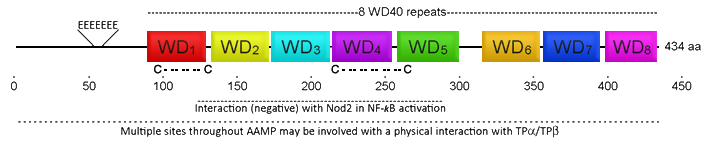
The bulk of AAMPs sequence is constituted by WD40 domains that are known to commonly fold to form a platform for active portions of a protein. Thus the stretch of contiguous glutamic acid residues should be available for interactions with other proteins. Also, binding of other proteins may occur to regions of these repeats. The WD40 repeats are known to mediate aggregation of subunits to form complex, multi-protein structures. Two immunoglobulin-type domains are designated by pairs of cysteines, (C96 - C130) and (C216 - C265). AAMP may play a negative role in Nod2-mediated NF-kB activation via a physical interaction in the region indicated. A physical interaction between AAMP and thromboxane A2 receptors (TPalpha and TPbeta) has been suggested to occur via multiple sites with no particular domain identified in localization studies.
Description
434 amino acids, 49 kDa protein (NCBI RefSeq, Aug-2011).
Expression
AAMP is widely expressed among many types of mammalian cells and has been conserved in evolution.
Localisation
AAMP was initially detected in the cytoplasm of many types of nucleated mammalian cells and was strongly expressed in endothelial cells, cytotrophoblasts, and poorly differentiated colon adenocarcinoma cells in lymphatics. AAMP has been observed at the luminal edges of endometrial cells and has been found in the extracellular environment of vascular-associated mesenchymal cells.
Function
Functional studies and associations suggest roles for AAMP in angiogenesis, including endothelial tube formation, migration of endothelial and smooth muscle cells, neointima formation, and thromboxane A receptor interactions. In immune cells AAMP may be involved in the regulation of NF-kappaB activation mediated by Nod2. The common occurrence of WD40 domains in signaling proteins supports a signaling function as a possibility for AAMP. The epitope, ESESES, that AAMP shares with alpha-actinin and a smaller protein specific for fast skeletal muscle, suggests that it may have cytoskeletal interactions. Although AAMP was described as having heparin-binding capacity in melanoma cells, the NCBI RefSeq (Aug-2011) version of AAMP does not include the heparin-binding sequence (encodes RRLRR) in the coding sequence. The RefSeq version of AAMP identifies the initiating methionine (85-87) as being 3 to the sequence encoding RRLRR (70-84).
Homology
AAMP shares homology with the other members of the WD40 repeat superfamily. Several of the WD40 repeat proteins also contain an amino terminal run of glutamic acid residues outside of their WD repeats. The two immunoglobulin-type domains in AAMP resemble those of the immunoglobulin superfamily members, including domains of NCAM, DCC, NgCAM, etc.
Mutations
Note
AAMP was initially cloned and sequenced as a transcript for a 452 aa, 52 kDa protein. It was obtained from an expression library derived from melanoma cells of a brain metastasis. However the amino terminus was missing from the library clone. AAMPs amino terminus was determined by 5 RACE from human brain mRNA. Two versions were obtained and both differed from the NCBI RefSeq (Aug-2011) version of AAMP. The one shown contains coding sequence upstream from the initiating methionine in the RefSeq version. This alternative form may represent a fusion protein due to an in-frame insertion or a chromosomal rearrangement. AAMP potentially gains heparin binding functionality when sequence upstream from AUG at nucleotides 85-87 is preceded by an alternative initiating methionine codon that enables translation of the codons for RRLRR.

rAAMP encoding a 452 aa protein (alternative form). An alternative AUG was detected when the amino terminus was manually sequenced with 5 RACE using brain mRNA. It is shown in red. Its upstream location permits 17 codons to encode amino acids, including 5 codons for RRLRR, a heparin-binding site. Sequences of the alternative forms described for AAMP are the same as the NCBI RefSeq (Aug-2011) version of AAMP for nucleotides 34-1792 and the first 25 adenosines in the poly-A tail.
Germinal
None are known.
Somatic
Chromosomal rearrangements or insertions that place an initiating methionine codon further upstream than the methionine at 85-87 permit AAMP to gain heparin binding function when nucleotides 70-84 are translated.
Implicated in
Entity name
Gastrointestinal stromal tumor (GIST)
Note
GISTs are the most common mesenchymal tumors of the digestive tract and are believed to arise from the interstitial cells of Cajal. They respond to imitanib, a tyrosine kinase inhibitor, which is also used to treat myeloid leukemia. Expression of AAMP was found to be increased in GISTs with mutated KIT. Expression of AAMP among various soft tissue sarcomas and normal tissues was highest in the GISTs. AAMP ranks high among the upregulated genes in GISTs.
Entity name
Myeloid leukemia (chronic (CML) form
Note
AAMP is expressed in myeloid leukemia cell lines and its expression is repressed by imitanib (mainline treatment drug for chronic myeloid leukemia), deferasirox (iron chelator that decreases cell proliferation), and anisomycin, an inducer of apoptosis.
Entity name
Myeloid leukemia acute (AML) form
Note
AAMP is expressed in myeloid leukemia cell lines and its expression is repressed by imitanib (mainline treatment drug for chronic myeloid leukemia), deferasirox (iron chelator that decreases cell proliferation), and anisomycin, an inducer of apoptosis.
Entity name
Lymphoma (B and T cell origins, non-Hodgkins and Hodgkins types)
Note
AAMP is expressed in activated T lymphocytes, monocytes, and lymphoma cells. Compared to normal B cells, AAMP is increased in non-Hodgkins lymphomas and in classical Hodgkins lymphoma.
Entity name
Melanoma (melanocyte origin, usually skin)
Note
In lysates of a melanoma cell line obtained from a brain metastasis, the size of the protein that reacted with anti-AAMP was 52 kDa, thus corresponding to the size predicted by an alternative transcript. The alternative version of AAMP could have resulted from a chromosomal rearrangement due to 2q35 breakage in the amino terminal region of AAMP. Placement of AUG at the 5 end of nucleotide 34 to serve as an alternative initiating methionine codon permits expression of the heparin binding site, RRLRR (nucleotides 70-84 in the NCBI ReqSeq (Aug-2011) version of AAMP) as a gain of function.
Entity name
Breast cancer (ductal cell origin most common)
Note
Expression profiling of human breast cancer cells versus mammary epithelial cells revealed higher expression of AAMP in the tumor cells. AAMP expression is higher in ductal carcinoma in situ (DCIS) with necrosis compared to DCIS without necrosis. However, expression profiling of DCIS and invasive ductal carcinoma (IDC) paired specimens from the same patients revealed decreased AAMP in IDC. AAMP expression may be relevant for the development of DCIS.
Entity name
Glial brain tumors (neuroectodermal cell origin)
Note
When compared with normal, glioblastomas (Grade IV astrocytomas) and oligodendrogliomas (Grades II - III) demonstrated slightly elevated levels of AAMP expression. Expression of AAMP was increased in drug resistant glioblastomas, primary and recurrent.
Entity name
Colon neoplasia (benign adenomas and carcinoma arise from glandular cells of the mucosa in the gastrointestinal tract)
Note
Expression profiling of normal mucosa and colorectal adenomas from the same patients showed that AAMP was slightly increased in the adenomas. However, a small dataset of colon tubular adenomas harboring focal adenocarcinomas, with microdissections of paired samples from each, showed that AAMP may become decreased in the incipient carcinomas. Although AAMP may play a role in the development of colonic neoplasia, it has not been shown to be positively involved in progression of adenomas to malignancy.
Entity name
Epidermoid carcinoma (keratinocyte origin if arises in skin)
Note
AAMP is expressed in squamous carcinoma cell lines. In one cell line studied with PTEN knocked down, the expression of AAMP also fell significantly. Also, for tumors from a radiosensitive cell line, AAMP expression fell significantly in radioresistant tumors derived from the sensitive cell line.
Entity name
Cervical cancer (usually arises from squamous type cells)
Note
In a study of cervical carcinoma HeLa cells treated with epidermal growth factor in a time course, expression of AAMP was increased at 2-8 hours.
Entity name
Ovarian cancer (often arises from serous cells)
Note
Cancer cells prepared from primary cultures of ovarian papillary serous adenocarcinomas revealed increased AAMP expression in 2 of 3 carboplatin resistant tumors whereas none of the tumors from 3 patients with sensitivity to carboplatin demonstrated comparable levels.
Entity name
Papillary thyroid carcinoma (arises from cells in thyroid follicles)
Note
Analysis of papillary thyroid carcinoma tumors matched with normal thyroid from nine patients found that AAMP expression fell slightly in the tumors.
Entity name
Pulmonary carcinoma (multiple types of cells can be the origin)
Note
AAMPs expression in a lung alveolar adenocarcinoma cell line was down-regulated by TGF-beta that was added to induce an epithelial-mesenchymal transition.
Entity name
Chromosomal rearrangements at 2q35
Note
The location of AAMP at 2q35 imparts susceptibility to chromosomal rearrangements involving the terminal region of chromosome 2s long arm, q. Terminal regions are more susceptible to rearrangements than the midregions of chromosomes. Fusion transcripts and proteins result from breakage and rearrangements that occur in unstable genomes. Several fusion proteins resulting from rearrangements involving other genes in this region have been reported in association with malignancy. Rearrangements that place in-frame coding sequence upstream from nucleotides 70-84 in the NCBI ReqSeq (Aug-2011) version of AAMP permit a gain of function, i.e. heparin-binding, to occur.
Article Bibliography
| Pubmed ID | Last Year | Title | Authors |
|---|---|---|---|
| 12473591 | 2002 | Analysis of gene expression in ductal carcinoma in situ of the breast. | Adeyinka A et al |
| 11751374 | 2001 | Gastrointestinal stromal tumors with KIT mutations exhibit a remarkably homogeneous gene expression profile. | Allander SV et al |
| 11969303 | 2002 | Extracellular angio-associated migratory cell protein plays a positive role in angiogenesis and is regulated by astrocytes in coculture. | Beckner ME et al |
| 19535145 | 2009 | A function for AAMP in Nod2-mediated NF-kappaB activation. | Bielig H et al |
| 12187124 | 2002 | Characterization of differential gene expression in quiescent and invasive human arterial smooth muscle cells. | Blindt R et al |
| 17359542 | 2007 | Diagnostic and prognostic gene expression signatures in 177 soft tissue sarcomas: hypoxia-induced transcription profile signifies metastatic potential. | Francis P et al |
| 18634988 | 2008 | Angio-associated migratory cell protein and smooth muscle cell migration in development of restenosis and atherosclerosis. | Holvoet P et al |
| 21172430 | 2011 | Interaction of angio-associated migratory cell protein with the TPα and TPβ isoforms of the human thromboxane A₂ receptor. | Reid HM et al |
| 18634987 | 2008 | Blockade of angio-associated migratory cell protein inhibits smooth muscle cell migration and neointima formation in accelerated atherosclerosis. | Vogt F et al |
Other Information
Locus ID:
NCBI: 14
MIM: 603488
HGNC: 18
Ensembl: ENSG00000127837
Variants:
dbSNP: 14
ClinVar: 14
TCGA: ENSG00000127837
COSMIC: AAMP
RNA/Proteins
Expression (GTEx)
Protein levels (Protein atlas)
References
| Pubmed ID | Year | Title | Citations |
|---|---|---|---|
| 37122729 | 2023 | A crucial exosome-related gene pair (AAMP and ABAT) is associated with inflammatory cells in intervertebral disc degeneration. | 1 |
| 37122729 | 2023 | A crucial exosome-related gene pair (AAMP and ABAT) is associated with inflammatory cells in intervertebral disc degeneration. | 1 |
| 33279622 | 2021 | Angio-associated migratory cell protein (AAMP) interacts with cell division cycle 42 (CDC42) and enhances migration and invasion in human non-small cell lung cancer cells. | 7 |
| 33279622 | 2021 | Angio-associated migratory cell protein (AAMP) interacts with cell division cycle 42 (CDC42) and enhances migration and invasion in human non-small cell lung cancer cells. | 7 |
| 31075398 | 2019 | Angio-associated migratory cell protein interacts with epidermal growth factor receptor and enhances proliferation and drug resistance in human non-small cell lung cancer cells. | 6 |
| 31075398 | 2019 | Angio-associated migratory cell protein interacts with epidermal growth factor receptor and enhances proliferation and drug resistance in human non-small cell lung cancer cells. | 6 |
| 26350504 | 2016 | AAMP Regulates Endothelial Cell Migration and Angiogenesis Through RhoA/Rho Kinase Signaling. | 7 |
| 26350504 | 2016 | AAMP Regulates Endothelial Cell Migration and Angiogenesis Through RhoA/Rho Kinase Signaling. | 7 |
| 23564791 | 2013 | The impact of angio-associated migratory cell protein (AAMP) on breast cancer cells in vitro and its clinical significance. | 7 |
| 23564791 | 2013 | The impact of angio-associated migratory cell protein (AAMP) on breast cancer cells in vitro and its clinical significance. | 7 |
| 21172430 | 2011 | Interaction of angio-associated migratory cell protein with the TPα and TPβ isoforms of the human thromboxane A₂ receptor. | 8 |
| 21172430 | 2011 | Interaction of angio-associated migratory cell protein with the TPα and TPβ isoforms of the human thromboxane A₂ receptor. | 8 |
| 20237496 | 2010 | New genetic associations detected in a host response study to hepatitis B vaccine. | 37 |
| 20237496 | 2010 | New genetic associations detected in a host response study to hepatitis B vaccine. | 37 |
| 19535145 | 2009 | A function for AAMP in Nod2-mediated NF-kappaB activation. | 12 |
Citation
Marie E Beckner
AAMP (angio-associated, migratory cell protein)
Atlas Genet Cytogenet Oncol Haematol. 2011-09-01
Online version: http://atlasgeneticsoncology.org/gene/533/aamp
