DIRAS3 (DIRAS family, GTP-binding RAS-like 3)
2009-09-01 Yinhua Yu , Zhen Lu , Robert Z Luo , Robert C Bast Jr AffiliationThe University of Texas, M.D. Anderson Cancer Center, 1515 Holcombe Blvd, Box 354, Houston, TX 77030, USA
DNA/RNA
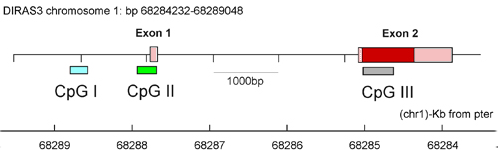
The DIRAS3 gene contains two exons interrupted by a large intron. The red-blocked and opened boxes represent the coding and non-coding regions, respectively. There are three CpG island regions. Blue: CPG island I; green: CpG island II; grey: CpG island III.
Description
DIRAS3 encompasses a 7.2-kb region and includes 2.0 kb of the 5- flanking region, two exons, an intron, and a 1.2-kb 3-flanking region. The first exon contains only the 5-noncoding region consisting of 81 nucleotides, whereas the second exon contains the entire protein-coding region. The two exons are separated by an intron of 3.2 kb. There are three CpG island regions. CPG island I (nucleotide (nt) -1232 to -914) is located about 1 kb upstream of the transcription initiation site; CpG island II (nt -206 to +79) is near the transcription initiation region and adjacent exon 1; CpG island III (nt +3343 to +3691) is located in the protein-encoding region of exon 2.
Transcription
The entire protein-coding region is located within exon 2 and encodes a 229-residue small GTP-binding protein.
Pseudogene
No known pseudogenes.
Proteins

DIRAS3 protein.
Description
DIRAS3 encodes a 26-kDa GTPase. The DIRAS3 gene ORF contains three motifs typical of Ras/Rap family members: (1) a highly conserved GTP binding domain, (2) a putative effector domain YLPTIENTY, and (3) the membrane localizing CAAX motif at the COOH terminus. DIRAS3 contains a unique 34 amino-acid extension at the N-terminus and differs from other members of Ras-superfamily.
Expression
DIRAS3 is expressed in brain, heart, liver, lung, pancreas, breast and ovary.
Localisation
DIRAS is associated at the cell membrane through its prenylation at the C-terminal cysteine residue. Mutation of the conserved CAAX box at the C-terminus led to a loss of its membrane association.
Function
DIRAS3 is a maternally imprinted tumor suppressor gene that belongs to the Ras superfamily of small G proteins. DIRAS3 regulates cell cycle, motility, angiogenesis, autophagy and tumor dormancy. Introduction of this gene into cancer cells that lack DIRAS3 expression inhibits proliferation and motility of cancer cells. DIRAS3 truncates signaling through the Ras/MAP pathway, induces p21WAF1/CIP1, down-regulates cyclin D1, and triggers apoptosis. DIRAS3 is required for autophagy and that re-expression of DIRAS3 protein in ovarian cancer cells will induce autophagic cell death in culture. In xenografts, re-expression of DIRAS3 also induces autophagy, but can also promote tumor dormancy in the presence of factors that promote survival in the cancer microenvironment.
Mutations
Note
Mutations have not been detected.
Implicated in
Entity name
Solid cancers
Disease
Ovarian cancer, breast cancer, pancreatic cancer, hepatocellular carcinoma, oligodendroglial tumor, follicular thyroid cancer.
Prognosis
Loss of DIRAS3 expression is associated with tumor progression in breast cancer and decreased disease-free survival in ovarian cancer.
Oncogenesis
DIRAS3 is monoallelically expressed and maternally imprinted, expression from the paternal allele of DIRAS3 can be lost through LOH, CpG methylation, and transcriptional regulation. DIRAS3 is downregulated in 60% of ovarian and breast cancers: LOH was found in 40% of ovarian and breast cancers. Mutations have not been detected, but the remaining allele is silenced in ovarian cancer and breast cancer by methylation in approximately 10-15 % of cases. In the remaining cancers, DIRAS3 is downregulated by transcriptional mechanisms that involve E2F1 and E2F4, as well as by the loss of RNA binding proteins that decrease the half-life of DIRAS3 mRNA.
Article Bibliography
| Pubmed ID | Last Year | Title | Authors |
|---|---|---|---|
| 12499268 | 2002 | Reexpression of the tumor suppressor gene ARHI induces apoptosis in ovarian and breast cancer cells through a caspase-independent calpain-dependent pathway. | Bao JJ et al |
| 17230502 | 2007 | Multiple histone deacetylases repress tumor suppressor gene ARHI in breast cancer. | Feng W et al |
| 12874100 | 2003 | Reactivation of the silenced and imprinted alleles of ARHI is associated with increased histone H3 acetylation and decreased histone H3 lysine 9 methylation. | Fujii S et al |
| 18612997 | 2009 | ARHI, as a novel suppressor of cell growth and downregulated in human hepatocellular carcinoma, could contribute to hepatocarcinogenesis. | Huang J et al |
| 19435463 | 2009 | ARHI (DIRAS3), an imprinted tumour suppressor gene, binds to importins and blocks nuclear import of cargo proteins. | Huang S et al |
| 19033662 | 2008 | The tumor suppressor gene ARHI regulates autophagy and tumor dormancy in human ovarian cancer cells. | Lu Z et al |
| 12771940 | 2003 | ARHI is a Ras-related small G-protein with a novel N-terminal extension that inhibits growth of ovarian and breast cancers. | Luo RZ et al |
| 11418188 | 2001 | Genomic structure and promoter characterization of an imprinted tumor suppressor gene ARHI. | Luo RZ et al |
| 16061651 | 2005 | A Ras homologue member I directly inhibits signal transducers and activators of transcription 3 translocation and activity in human breast and ovarian cancer cells. | Nishimoto A et al |
| 10797292 | 2000 | ARHI is the center of allelic deletion on chromosome 1p31 in ovarian and breast cancers. | Peng H et al |
| 18302158 | 2008 | Frequent biallelic inactivation and transcriptional silencing of the DIRAS3 gene at 1p31 in oligodendroglial tumors with 1p loss. | Riemenschneider MJ et al |
| 15475444 | 2004 | Expression of the tumor suppressor gene ARHI in epithelial ovarian cancer is associated with increased expression of p21WAF1/CIP1 and prolonged progression-free survival. | Rosen DG et al |
| 14506155 | 2003 | Loss of the expression of the tumor suppressor gene ARHI is associated with progression of breast cancer. | Wang L et al |
| 15546898 | 2005 | Silencing of the maternally imprinted tumor suppressor ARHI contributes to follicular thyroid carcinogenesis. | Weber F et al |
| 10987306 | 2000 | The human ARHI tumor suppressor gene inhibits lactation and growth in transgenic mice. | Xu F et al |
| 12724231 | 2003 | Epigenetic regulation of ARHI in breast and ovarian cancer cells. | Yu Y et al |
| 16757345 | 2006 | Biochemistry and biology of ARHI (DIRAS3), an imprinted tumor suppressor gene whose expression is lost in ovarian and breast cancers. | Yu Y et al |
| 9874798 | 1999 | NOEY2 (ARHI), an imprinted putative tumor suppressor gene in ovarian and breast carcinomas. | Yu Y et al |
| 12874023 | 2003 | Aberrant methylation and silencing of ARHI, an imprinted tumor suppressor gene in which the function is lost in breast cancers. | Yuan J et al |
Other Information
Locus ID:
NCBI: 9077
MIM: 605193
HGNC: 687
Ensembl: ENSG00000162595
Variants:
dbSNP: 9077
ClinVar: 9077
TCGA: ENSG00000162595
COSMIC: DIRAS3
RNA/Proteins
| Gene ID | Transcript ID | Uniprot |
|---|---|---|
| ENSG00000162595 | ENST00000370981 | O95661 |
| ENSG00000162595 | ENST00000646789 | O95661 |
Expression (GTEx)
Protein levels (Protein atlas)
References
| Pubmed ID | Year | Title | Citations |
|---|---|---|---|
| 38169324 | 2024 | DIRAS3 induces autophagy and enhances sensitivity to anti-autophagic therapy in KRAS-driven pancreatic and ovarian carcinomas. | 0 |
| 38203733 | 2024 | Expression of RASSF1A, DIRAS3, and AKAP9 Genes in Thyroid Lesions: Implications for Differential Diagnosis and Prognosis of Thyroid Carcinomas. | 0 |
| 38169324 | 2024 | DIRAS3 induces autophagy and enhances sensitivity to anti-autophagic therapy in KRAS-driven pancreatic and ovarian carcinomas. | 0 |
| 38203733 | 2024 | Expression of RASSF1A, DIRAS3, and AKAP9 Genes in Thyroid Lesions: Implications for Differential Diagnosis and Prognosis of Thyroid Carcinomas. | 0 |
| 37598541 | 2023 | DIRAS3 regulates autophagy in an endometriosis epithelial cell line. | 1 |
| 37598541 | 2023 | DIRAS3 regulates autophagy in an endometriosis epithelial cell line. | 1 |
| 32065482 | 2020 | A risk signature with four autophagy-related genes for predicting survival of glioblastoma multiforme. | 48 |
| 32484926 | 2020 | Elimination of dormant, autophagic ovarian cancer cells and xenografts through enhanced sensitivity to anaplastic lymphoma kinase inhibition. | 7 |
| 32949395 | 2020 | The Role of Methylation in the CpG Island of the ARHI Promoter Region in Cancers. | 2 |
| 32065482 | 2020 | A risk signature with four autophagy-related genes for predicting survival of glioblastoma multiforme. | 48 |
| 32484926 | 2020 | Elimination of dormant, autophagic ovarian cancer cells and xenografts through enhanced sensitivity to anaplastic lymphoma kinase inhibition. | 7 |
| 32949395 | 2020 | The Role of Methylation in the CpG Island of the ARHI Promoter Region in Cancers. | 2 |
| 31077613 | 2019 | Epigenetic inhibition of the tumor suppressor ARHI by light at night-induced circadian melatonin disruption mediates STAT3-driven paclitaxel resistance in breast cancer. | 34 |
| 31088402 | 2019 | Oncogenic Ras is downregulated by ARHI and induces autophagy by Ras/AKT/mTOR pathway in glioblastoma. | 5 |
| 31825828 | 2019 | DIRAS3 (ARHI) Blocks RAS/MAPK Signaling by Binding Directly to RAS and Disrupting RAS Clusters. | 34 |
Citation
Yinhua Yu ; Zhen Lu ; Robert Z Luo ; Robert C Bast Jr
DIRAS3 (DIRAS family, GTP-binding RAS-like 3)
Atlas Genet Cytogenet Oncol Haematol. 2009-09-01
Online version: http://atlasgeneticsoncology.org/gene/702/diras3
