r(8)
2017-02-01 Vishal Ashok, MSc , Tambarahalli S Sundareshan Affiliation1.Department of Cytogenetics, Anand Diagnostic Laboratory, Shivaji Nagar, Bangalore, India; [email protected]; [email protected]
Abstract
Review on r(8) in hematological malignancies with clinical data, structural dynamics and critical genes involved.
Clinics and Pathology
Disease
Refractory Anemia with excessive blasts (RAEB), Acute Myeloid Leukemia (AML), common-Acute Lymphoid Leukemia (c-ALL), T cell Prolymphocytic Leukemia (T-PLL), Small cell B - Non-Hodgkins lymphoma (B-NHL), Radiation and chemotherapy induced genetic aberrations
Phenotype stem cell origin
9 cases out of 15 were AML (Morgan R et al, 1985, Gisselsson D et al, 1999, Nakanishi M et al, 1999, Lindvall C et al, 2000, Berger R et al, 2002, Rothlisberger B et al, 2007, Kar B et al, 2008, Ashok V et al, 2016 ), with M2 being the most common subtype. 2 cases were RAEB (Fugazza G et al, 1996, Keung YK et al, 1997). One case each of c-ALL (Edelhauser M et al, 2000), T-PLL (Oliveria F.M et al, 2007) and B-NHL (Wlodarska I et al, 2004) have been reported (Table 1).
TABLE 1: Summary of 15 cases of Hematological malignancies with r(8)
LEGEND: UF: Unfavorable, F: Favorable
TABLE 1: Summary of 15 cases of Hematological malignancies with r(8)
| Sex/Age | Primary diagnosis | Karyotype (pretreatment) | Karyotype (post treatment) | ring 8 details | Outcome | Authors |
| M/8m | ANLL M4 | 46,XY/46,XY,del(13)(q14q22),1p +, - 8, + r(8) | 46,XY/46,XY,del(13)(q14q22),1p+, - 8, +r(8),- 10,19q+ | -8,+r(8) | UF | Morgan R et al, 1985 |
| M/65 | RAEB | Pseudodiploid karyotype with structural abnormalities and a ring chromosome | 46, XY, del(5)(q13q31),t(7;20)(q22;p13),-8,+r. | -8,+r(8) with telomere deletion | UF | Fugazza et al, 1996 |
| M/74 | RAEB | 48,XY,del(7)(q21),+?r(8)(p23q24.1), +add(21)(q12) /47,idem,-Y,add(20)(q13)/48,idem,del(17)(p12), add(20)(q13)/46,idem,12,add(13)(p11.2),-16,del(17)(p12), -19,add(20)(q13), +mar,3dmin | - | +?r(8)(p23q24.1) | UF | Keung YK et al, 1997 |
| F/73 | AML M1 | 45-47,XX,del(5)(q13),-8,+1-2r,+mar[cp15]/72-76,XXX,+5, del(5)(q13)x2,-7,-8,-9,+13,-16,+19,+20,+mar/46,XX | - | 8q22 amplification with presence of 8p subtelomeric sequences. | - | D Gisselsson 1999 |
| -/72 | AML M2 | 48,XY,-1,+del(1)(p12p22)X2,t(8;18)(p11;p11),-11,+der(18)t(8;18)(p11;p11),del(20)(q11),+r | - | amplification of 8q24 | - | Nakanishi et al, 1999 |
| F/32 | c-ALL | 46 48,XX, r(8)(p?23q?22 24) 2,der(9;22)/46-48,idem,ins(2;8)(q13;p?23q?22- 24)/46, XX | - | r(8)(p?23;q?22-24) X2 | UF | Edelhauser et al, 2000 |
| - | AML M2 | 45,X,-X,r(8),t(8;21)(q22;q22)/46,idem, i(22)(p10) | - | - | - | Florence Salomon-Nguyen et al, 2000 |
| M/74 | AML M5 | 46,XY,der(7)t(7;8)(q31;p11),del(8)(q23),t(12;13)(p13;q21), der(16)t(8;16)(q23;q23)/47-48,idem,r(8)(p11q21)x2 | - | r(8)(p11q21)x 2 | UF | Lindvall C et al 2000 |
| F/19 | AML M2 | 46,XX,-8,t(8;21),+r. | - | -8,+r(8) | F | Berger R et al, 2002 |
| F/71 | Small cell B-NHL | 46,XX,t(2;11)(p11;q13)/46,idem, del(1)(q22q42), r(8) | r(8) negative for 8p23 loci by FISH | UF | Wlodarska et al, 2004 | |
| M/41 | T-PLL | 46,t(X;14)(q28;q11), t(Y;14)(q12;q11), r(8)(::qterfiq10::q10fi qter::), +mar | 46,XY | r [i(?8)(q10)] | - | Oliveria F.M et al, 2007 |
| F/61 | AML M2 | 47,XX,+r(8)/48,XX,+2r/ 46,XX | - | ring consists of amplified 8q24/MYC | - | Rothlisbereger B et al, 2007 |
| F/1 | AML M7 | 46,XX/47,XX,+8/ 47,XX,+r(8) | 46,XX | +r(8) | UF | Kar B et al, 2008 |
| F/70 | AML M2 | 47,XX,r(8)(p23q24) | - | +r(8)(p23q24) | UF | Ashok V et al, 2016 |
LEGEND: UF: Unfavorable, F: Favorable
Epidemiology
There were 5 male and 7 female patients with a median age of 63 years (range: 1 to 84 years), among them 2 were infants (5 months and 15 months) and only 1 pediatric case (19 years) was observed. The age of the adult patients ranged from 32 to 84 years, with a mean age of 65 years.
Clinics
Analysis of 15 cases of r(8) revealed a predominance in myeloid when compared to lymphoid malignancies. 12 patients in the study have presented with leukemia (AML, c-ALL, NHL, T-PLL) and only 2 were in pre-leukemic stage (RAEB) indicating that r(8) is a marker for leukemic condition or "in-transformation" (Fig:1). These findings are in concordance with the review by Gebhart E, 2008.
Patients exposed to radiation have also been found to harbor r(8). Nakanishi et al reported a patient diagnosed with AML who was an atomic bomb survivor. Note: r(8) was also identified in a patient with prostate cancer exposed to chemotherapy and therapeutic radiation in stimulated lymphocytes derived from the peripheral blood (Sabine et al 2013).
Patients exposed to radiation have also been found to harbor r(8). Nakanishi et al reported a patient diagnosed with AML who was an atomic bomb survivor. Note: r(8) was also identified in a patient with prostate cancer exposed to chemotherapy and therapeutic radiation in stimulated lymphocytes derived from the peripheral blood (Sabine et al 2013).
Cytology
No characteristic cytological pattern was observed in the cases reported. However, a high percentage of blast count was observed in 60% of the cases. The median white blood count was 17 x109/L. The median platelet count was 31 x109/L. The median hemoglobin level was 10.35 g/dL
Genes
More than 65% of the cases had gain of chromosome 8 either by partial trisomy or gene amplification. Genes with possible significance in leukemogenesis located on chromosome 8 include MYC on 8q24, KAT6A (MOZ) on 8p11 (Koskinen PJ et al), MOS on 8q22 (Diaz MO et al) and RUNX1T1 (ETO) on 8q22 (Wang J). Role of TRIB1 independently has been associated in myeloid cell transformation and accelerates progression of HOXA9/ MEIS1-induced AML (Nakamura T et al, 2015). It is also observed to be associated with MYC amplification as represented in a case of AML by Rothlisberger B et al, 2006.
Treatment
A case of AML treated with interferon-e and granulocyte colony-stimulating factor showed no improvement with patient succumbing to sepsis (Fugazza G et al, 1996). Similarly another case of AML-M2 treated with hydroxyurea also had unfavorable outcome (Ashok V et al, 2016). But in a case of AML-M2, treatment with polychemotherapy (Protocol LAME 91) resulted in complete remission (Berger R et al, 2002). This is attributed to the presence of a good prognostic indicator in addition to r(8). In a case of AML-M7, UK MRC AML protocol resulted in hematologic and cytogenetic remission. Patient developed acute myelofibrosis followed by high-risk transplantation using unrelated cord blood stem cells. Patient died 11 days after transplant (Kar B et al, 2008).
In a case of T-ALL, two cycles of Chlorambucil (4 mg/day) and Fludarabine (25 mg/m2) had no improvement. A change in treatment protocol with seven weekly doses of Campath-1H (30 mg), resulted in complete regression of lymphadenopathy and hepatosplenomegaly with hematologic remission (Oliveria F.M et al, 2007). In another case of ALL, complete hematologic remission was achieved after treatment according to the GMALL-protocol (Vincristine, Daunorubicin, Asparaginase, and Prednisolone) and HAM (high-dose Cytarabine and Mitoxantrone) as consolidation therapy. Due to relapse, the patient was treated by fractionated high-dose whole body irradiation (13.2 Gy) and high-dose chemotherapy (Cyclophosphamide) followed by allogeneic peripheral stem cell transplantation. The patient developed refractory pancytopenia and died of terminal cachexia (Edelhauser et al, 2000)
In a case of T-ALL, two cycles of Chlorambucil (4 mg/day) and Fludarabine (25 mg/m2) had no improvement. A change in treatment protocol with seven weekly doses of Campath-1H (30 mg), resulted in complete regression of lymphadenopathy and hepatosplenomegaly with hematologic remission (Oliveria F.M et al, 2007). In another case of ALL, complete hematologic remission was achieved after treatment according to the GMALL-protocol (Vincristine, Daunorubicin, Asparaginase, and Prednisolone) and HAM (high-dose Cytarabine and Mitoxantrone) as consolidation therapy. Due to relapse, the patient was treated by fractionated high-dose whole body irradiation (13.2 Gy) and high-dose chemotherapy (Cyclophosphamide) followed by allogeneic peripheral stem cell transplantation. The patient developed refractory pancytopenia and died of terminal cachexia (Edelhauser et al, 2000)
Prognosis
Presence of ring chromosomes in hematological malignancies can influence disease progression and clinical outcome due to heterogeneity in size, origin and genes involved. Solid tumors exhibit a higher incidence of ring chromosomes with greater complexities in their structure. (Gisselson, 1998, Gebhart, 2008).
Presence of r(8) in hematological malignancies results in gain of chromosome 8 in majority of cases (see below). Trisomy 8 is the most common numerical abnormality in myeloid malignancies and is associated with intermediate to poor outcome (Heim S, Mitelman F, 2009). Presence of other prognostic markers appear to be the driving factor in disease progression rather than r(8). This is represented in a case of AML, where presence of t(8;21) with a r(8) had favorable outcome. Conversely, in a case of Ph positive ALL with r(8), patient went into early relapse with high blast count. Similarly in a case of RAEB with deletion of 7q and r(8), patient died within 2 months of initial diagnosis owing to aggressive nature of the disease.
Presence of r(8) in hematological malignancies results in gain of chromosome 8 in majority of cases (see below). Trisomy 8 is the most common numerical abnormality in myeloid malignancies and is associated with intermediate to poor outcome (Heim S, Mitelman F, 2009). Presence of other prognostic markers appear to be the driving factor in disease progression rather than r(8). This is represented in a case of AML, where presence of t(8;21) with a r(8) had favorable outcome. Conversely, in a case of Ph positive ALL with r(8), patient went into early relapse with high blast count. Similarly in a case of RAEB with deletion of 7q and r(8), patient died within 2 months of initial diagnosis owing to aggressive nature of the disease.
Cytogenetics
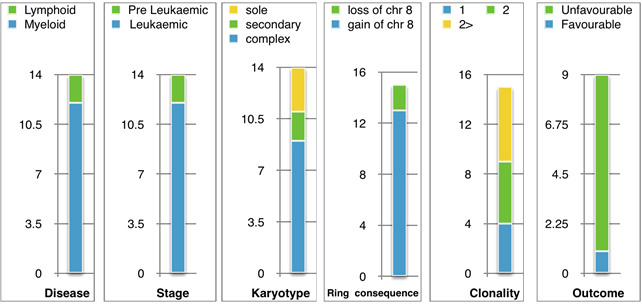
Graphical representation of r(8) dynamics in hematological malignancies.
Cytogenetics morphological
Based on the origin, ring chromosomes in hematological malignancies can be of two types:
1. Ring chromosome of a single origin:
-8, + r(8): formation can be due to loss of telomeric sequences causing the reattachment of the p and q arms (Morgan R et al, 1985; Fugazza et al, 1996; Berger R et al, 2002; Oliveria F.M 2007).
+ r(8) with two normal chromosomes 8: It presents as a gain of genetic material resulting in partial trisomy (Keueng YK et al 1996, Edelhauser et al, 2000, Kar B et al, 2008,Yamamoto K et al, 2013, Ashok V et al, 2016). Clustering of repetitive sequences resulting in amplification of critical genes have also been reported (Rothlisberger et al 2007, Koka R et al, 2016). r(8) can also comprise repetitive genetic sequences that results in gene amplification (Rothlisberger B et al, 2007).
2. Ring chromosome of multiple origin: Ring chromosomes can be derived by fusion of genetic material from multiple chromosomes (Sessarego et al 1998, Fonatsch C et al, 2001, Kim MH et al, 2001, Mrozek et al, 2002). Rings are also known to harbor fusion oncogenes such as BCR/ ABL1 (Gutierrez CB et al, 2016).
r(8) has a strong association with complex karyotypes and clonality, resulting in relapse and poor clinical outcome as represented in Table 1.
r(8) observed in this review are of singular origin. Majority of cases are associated with complex karyotypes and/or presence of multiple clones (Fig 1) which are both indicators of genetic instability and disease progression. Amplification of 8q22 (D Gisselsson, 1999), 8q24 (Nakanishi et al, 1999) and co-amplification of MYB and TRBI1 (Rothlisberger B et al, 2006) have been observed in cases of AML. Inter cellular variation in size and number was observed in only one case, where stimulated lymphocyte culture yielded several clones with varied number and sized ring chromosome 8 (Sabine et al, 2013).
1. Ring chromosome of a single origin:
-8, + r(8): formation can be due to loss of telomeric sequences causing the reattachment of the p and q arms (Morgan R et al, 1985; Fugazza et al, 1996; Berger R et al, 2002; Oliveria F.M 2007).
+ r(8) with two normal chromosomes 8: It presents as a gain of genetic material resulting in partial trisomy (Keueng YK et al 1996, Edelhauser et al, 2000, Kar B et al, 2008,Yamamoto K et al, 2013, Ashok V et al, 2016). Clustering of repetitive sequences resulting in amplification of critical genes have also been reported (Rothlisberger et al 2007, Koka R et al, 2016). r(8) can also comprise repetitive genetic sequences that results in gene amplification (Rothlisberger B et al, 2007).
2. Ring chromosome of multiple origin: Ring chromosomes can be derived by fusion of genetic material from multiple chromosomes (Sessarego et al 1998, Fonatsch C et al, 2001, Kim MH et al, 2001, Mrozek et al, 2002). Rings are also known to harbor fusion oncogenes such as BCR/ ABL1 (Gutierrez CB et al, 2016).
r(8) has a strong association with complex karyotypes and clonality, resulting in relapse and poor clinical outcome as represented in Table 1.
r(8) observed in this review are of singular origin. Majority of cases are associated with complex karyotypes and/or presence of multiple clones (Fig 1) which are both indicators of genetic instability and disease progression. Amplification of 8q22 (D Gisselsson, 1999), 8q24 (Nakanishi et al, 1999) and co-amplification of MYB and TRBI1 (Rothlisberger B et al, 2006) have been observed in cases of AML. Inter cellular variation in size and number was observed in only one case, where stimulated lymphocyte culture yielded several clones with varied number and sized ring chromosome 8 (Sabine et al, 2013).
Cytogenetics molecular
Diagnostic tools such as Fluorescent In Situ Hybridization (FISH) and Spectral Karyotyping in addition to conventional cytogenetic studies have helped in identifying structural and functional characteristics such as telomere status, gene amplification and partial trisomy. Molecular studies supplement additional prognostic information, which is significant in understanding disease progression and clinical management of the patients.
Genes Involved and Proteins
Article Bibliography
| Pubmed ID | Last Year | Title | Authors |
|---|---|---|---|
| 12381450 | 2002 | Ring chromosome 8 and translocation t(8;21) in a patient with acute myeloblastic leukemia. | Berger R et al |
| 9739012 | 1998 | Characterization of recurrent homogeneously staining regions in 72 breast carcinomas. | Bernardino J et al |
| 27895712 | 2016 | Philadelphia chromosome duplication as a ring-shaped chromosome. | Borjas-Gutierrez C et al |
| 3860954 | 1985 | The role of the c-mos gene in the 8;21 translocation in human acute myeloblastic leukemia. | Diaz MO et al |
| 11477656 | 2001 | Amplification of ribosomal RNA genes in acute myeloid leukemia. | Fonatsch C et al |
| 8689606 | 1996 | Loss of telomeric sequences in a ring derived from chromosome 8 in refractory anemia with excess of blasts in transformation. | Fugazza G et al |
| 18758155 | 2008 | Ring chromosomes in human neoplasias. | Gebhart E et al |
| 10369161 | 1999 | The structure and dynamics of ring chromosomes in human neoplastic and non-neoplastic cells. | Gisselsson D et al |
| 23100969 | 2009 | Ring chromosome 8 and trisomy 8 in a patient with acute myeloid leukemia. | Kar B et al |
| 11343775 | 2001 | The application of comparative genomic hybridization as an additional tool in the chromosome analysis of acute myeloid leukemia and myelodysplastic syndromes. | Kim MH et al |
| 8448376 | 1993 | Role of myc amplification and overexpression in cell growth, differentiation and death. | Koskinen PJ et al |
| 11979548 | 2002 | Spectral karyotyping in patients with acute myeloid leukemia and a complex karyotype shows hidden aberrations, including recurrent overrepresentation of 21q, 11q, and 22q. | Mrózek K et al |
| 26517931 | 2015 | The role of Trib1 in myeloid leukaemogenesis and differentiation. | Nakamura T et al |
| 11566338 | 2001 | Supernumerary ring chromosomes in dermatofibrosarcoma protuberans may contain sequences from 8q11.2-qter and 17q21-qter: a combined cytogenetic and comparative genomic hybridization study. | Nishio J et al |
| 10612811 | 2000 | Dysregulation of HMGIC in a uterine lipoleiomyoma with a complex rearrangement including chromosomes 7, 12, and 14. | Pedeutour F et al |
| 17574965 | 2007 | TRIB1 overexpression in acute myeloid leukemia. | Röthlisberger B et al |
| 10829078 | 2000 | The t(1;12)(q21;p13) translocation of human acute myeloblastic leukemia results in a TEL-ARNT fusion. | Salomon-Nguyen F et al |
| 9797774 | 1998 | Complex structural involvement of chromosome 7 in primary myelodysplastic syndromes determined by fluorescence in situ hybridization. | Sessarego M et al |
| 9230207 | 1997 | Transformation properties of the ETO gene, fusion partner in t(8:21) leukemias. | Wang J et al |
| 15306823 | 2004 | Variant t(2;11)(p11;q13) associated with the IgK-CCND1 rearrangement is a recurrent translocation in leukemic small-cell B-non-Hodgkin lymphoma. | Wlodarska I et al |
| 23995114 | 2013 | Gain of 11q by an additional ring chromosome 11 and trisomy 18 in CD5-positive intravascular large B-cell lymphoma. | Yamamoto K et al |
| 18294235 | 2009 | Translocations t(X;14)(q28;q11) and t(Y;14)(q12;q11) in T-cell prolymphocytic leukemia. | de Oliveira FM et al |
Summary
Note
r(8) occurs more often in myeloid than in lymphoid malignancies. Unlike in solid tumors, where r(8) has shown to contain material from other chromosomes (Bernardino J et al, 1998, Pedeutour F et al, 2000, Nishio et al, 2001), r(8) in hematological malignancies are of a singular origin (Gebhart 2008).
Citation
Vishal Ashok, MSc ; Tambarahalli S Sundareshan
r(8)
Atlas Genet Cytogenet Oncol Haematol. 2017-02-01
Online version: http://atlasgeneticsoncology.org/haematological/1472/r(8)
