del(21)(q21q22) USP16/RUNX1
2013-10-01 Daniel Birnbaum , Marie-Joelle Mozziconacci Affiliation1.Departement de Biopathologie et Laboratoire d Oncologie Moleculaire, Centre de Recherche en Cancerologie de Marseille, UMR1068 Inserm, Institut Paoli-Calmettes 27 Boulevard Lei Roure 13009 Marseille, France (MJM); Laboratoire d Oncologie Moleculaire, Centre de Recherche en Cancerologie de Marseille, UMR1068 Inserm, Institut Paoli-Calmettes 27 Boulevard Lei Roure 13009 Marseille, France (DB)
Clinics and Pathology
Disease
AML-M4
Note
Male patient 74 year-old.
Phenotype stem cell origin
CD4, 11b, 13, 14, 15, 33, 36, 56, 117 positive.
Etiology
Thrombocytopenia 2 years before, chronic myelomonocytic leukemia (CMML) 1 year before.
Epidemiology
Toxic exposure at work (oil by-products).
Clinics
Bilateral inguinal ADP. No hepatosplenomegaly. No involvement of central nervous system. Tricytopenia: WBC 2.9x10⁹/L, Hb 10.7g/dl and platelets 12x109/L.
Cytology
Hypercellular bone marrow, rare megakaryocytes. 72% blast cells. AML-M4 with no morphologic arguments for a secondary leukemia.
Treatment
Induction Idarubicin/Aracytin. GFM Azacytidin protocol.
Evolution
Survival 2.5 years.
Cytogenetics
Note
RHG banding on bone marrow.
Cytogenetics morphological
47,XY,+8[11]/46,XY[9]
Cytogenetics molecular
ND
Genes Involved and Proteins
Gene name
USP16 (ubiquitin specific peptidase 16)
Location
21q21.3
Gene name
RUNX1 (runt-related transcription factor 1 (acute myeloid leukemia 1; aml1 oncogene))
Location
21q22.12
Result of the Chromosomal Anomaly
Note
The aCGH profile (244K CGH Microarrays Hu-244A, Agilent Technologies, Massy, France) showed two losses at 21q21.3 and q22.12 of about 1.04 Mb and 0.82 Mb, respectively (Figure 1A). They spanned the 3 part of USP16, including exons 2 to 19, and the 5 part of RUNX1 (including exons 1 to 4), respectively.
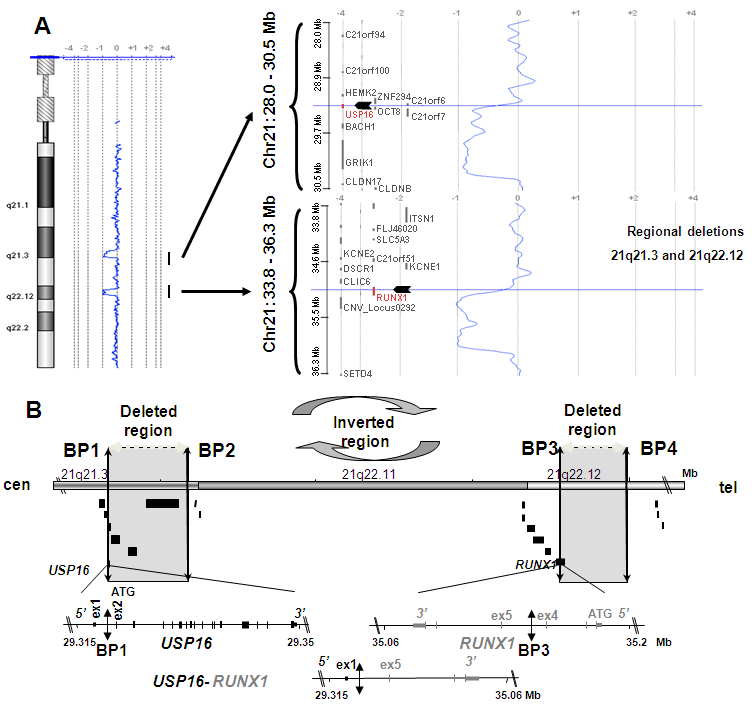
Figure 1A: Genomic rearrangement involving USP16 and RUNX1 genes in a CMML. Profile of chromosome 21 shows regional deletions in 21q21.3 and 21q22.12. Arrowheads point to USP16 and RUNX1 genes targeted by transition profiles located in these respective regions. Figure 1B: USP16-RUNX1 rearrangement. Inversion of the 21q21.3-q22.12 region and generation of USP16-RUNX1 gene fusion. Organization of chromosomal region 21q21.3-q22.12 with the location of the breakpoints (BP) and deleted regions. The potential gene breakages and deleted regions were refined to an interval (vertical arrows and grey boxes, respectively) defined by aCGH. Breakpoints BP1 and BP3 targeting USP16 and RUNX1 are associated with deletions defined by intervals [BP1-BP2] and [BP3-BP4]. The USP16-RUNX1 gene fusion characterized by RT-PCR is explained by the inversion of the central interval [BP2-BP3]. ATG codons are in exon 2 (ex 2) and exon 1 (ex 1) of USP16 and RUNX1, respectively. The event fuses exon 1 of USP16 to exon 5 of RUNX1 not preserving the canonical ATG.
Description
A cryptic inv(21)(q21q22) associated with a microdeletion at one of the breakpoints, and a fusion involving RUNX1 and USP16 (encoding a de-ubiquitinating enzyme). This was confirmed by nested PCR amplification of reverse-transcribed RNA from the patients BM cells, which detected a 245 bp-long USP16-RUNX1 transcript. No reciprocal transcript was detected. Sequence analysis showed that the result of the inversion/fusion generated a chimeric USP16-RUNX1 transcript.
Transcript
The USP16-RUNX1 fusion transcript did not have an open reading frame using the canonical start codons of USP16 or RUNX1. However, multiple ATG codons through exons 5 to 7 of the fused RUNX1 sequence could be used as new start codons and generate truncated RUNX1 proteins.
The break/fusion was not present in the germline since we did not find the USP16-RUNX1 transcript in buccal smear cells of the patient.
The break/fusion was not present in the germline since we did not find the USP16-RUNX1 transcript in buccal smear cells of the patient.
Detection protocole
The 21q inversion was not detectable by karyotyping and would not have been detected by array-CGH if not for the interstitial microdeletion.
Highly cited references
| Pubmed ID | Year | Title | Citations |
|---|---|---|---|
| 18925961 | 2008 | Genome profiling of chronic myelomonocytic leukemia: frequent alterations of RAS and RUNX1 genes. | 45 |
Article Bibliography
| Pubmed ID | Last Year | Title | Authors |
|---|---|---|---|
| 18925961 | 2008 | Genome profiling of chronic myelomonocytic leukemia: frequent alterations of RAS and RUNX1 genes. | Gelsi-Boyer V et al |
Summary
Fusion gene
USP16/RUNX1 USP16 (21q21.3) RUNX1 (21q22.12) M del(21)(q21q22)
Note
Microdeletions and inversion at 21q21 leading to USP16-RUNX1 fusion in CMML.
Citation
Daniel Birnbaum ; Marie-Joelle Mozziconacci
del(21)(q21q22) USP16/RUNX1
Atlas Genet Cytogenet Oncol Haematol. 2013-10-01
Online version: http://atlasgeneticsoncology.org/haematological/1607/del(21)(q21q22)
