EBV positive DLBCL, NOS
2018-07-01 Ding-Bao Chen Affiliation1.Department of Pathology, Peking University Peoples Hospital, Beijing 100044, Peoples Republic of China; [email protected]
Abstract
Epstein-Barr virus positive DLBCL, NOS (EBV + DLBCL, NOS) occurs in apparently immunocompetent patients usually older than 50 years, which can also occur in younger patients and has a worse prognosis than EBV negative tumors. EBV + DLBCL, NOS has a broader morphological spectrum. Here the clinicopathological of EBV positive DLBCL will be discussed.
Clinics and Pathology
Disease
EBV+ diffuse large B-cell lymphoma (DLBCL), NOS was initially described by Oyama et al in 2003 (Oyama et al,2003). The 2008 monograph included "EBV-positive DLBCL of the elderly" as a provisional entity. These tumors occur in apparently immunocompetent patients usually older than 50 years and have a worse prognosis than EBV negative tumors. But EBV+ DLBCL have been increasingly recognized in younger patients, with a broader morphological spectrum and better survival than initially thought. This new information has led to substitution of the modifier "elderly" with "not otherwise specified" (EBV+ DLBCL, NOS) in the updated classification (Swerdlow, et al ,2008. Swerdlow, et al, 2016. Nicolae A, et al, 2015. Uccini S, et al, 2015. Ok CY, et al. 2013).
Phenotype stem cell origin
The neoplastic cells are of B-cell lineage, expressing the pan B-cell antigens CD19, CD20, CD22, CD79a, and PAX5 and are negative for pan T-cell antigents. Immunoglobulin light chain restriction may be difficult to demonstrate, except in cases with immunoblastic or plasmablastic features in which cytoplasmic Ig can be assessed. Plasmacytoid cases can be weakly positive or negative CD20. EBV+ DLBCL of the elderly usually has an ABC immunophenotype being MUM1/IRF41 and CD102 and usually BCL6. BCL-2 and CD30 are usually positive, and CD15 is negative. It is speculated that either there is a change in B-cell population during aging or there is putative pathological specificity of EBV in elderly patients with DLBCL. Most cases displayed a striking shift to an ABC immunophenotype with prominent activation of NF-kB pathway (Swerdlow, et al ,2008. Swerdlow, et al ,2016).
Epidemiology
The median age of patients with EBV+ DLBCL is 71 years (range, 50-91 years), however, younger patients can be affected. There is a slight male predominance, with a male to female ratio of 1.4 :1. There is a higher prevalence of EBV+ DLBCL among East Asians (8.7%-11.4%) compared with 5% in Western countries. The definitive criterion for EBV positivity in EBV+ DLBCL remains under discussion (Swerdlow, et al ,2008).
Clinics
EBV+ DLBCL is characterized by higher age distribution and an aggressive clinical course with a median survival of 2 years in Asian patients. Initial reports emphasized that EBV+ DLBCL of the elderly commonly involved extranodal sites. Site of primary extranodal involvement include the skin, soft tissue, bones, nasal cavity, pharynx/hypopharynx, tonsils, tongue, lung, pleura, stomach, liver, spleen, peritoneum, cecum, and bone marrow. Patients with EBV+ DLBCL of the elderly have a poorer overall survival and progression-free survival than patients with Activated B-cell-like (ABC) -type EBV-negative DLBCL in older European patients (Swerdlow, et al ,2008).
Pathology
Two morphologic subtypes of EBV+ DLBCL have been recognized: polymorphic and monomorphic. Both subtypes may include large transformed cells or immunoblasts, as well as HRS-like giant cells and may demonstrate increased mitotic activity and areas of geographic necrosis.
The polymorphic subtype displays a broad range of B-cell maturation, and lesions are composed of centroblasts, immunoblasts, and plasmablasts with a variable component of admixed reactive cells, including small lymphocytes, plasma cells, histiocytes, and epithelioid histiocytes.
The monomorphic subtype of EBV+ DLBCL of the elderly is composed of monotonous sheets of large transformed B cells. Cases of EBV+ DLBCL of the elderly also can have a mixed pattern with intermingled polymorphic/and monomorphic areas, suggesting that the subtypes represent 2 ends of a morphologic spectrum.
The polymorphic subtype displays a broad range of B-cell maturation, and lesions are composed of centroblasts, immunoblasts, and plasmablasts with a variable component of admixed reactive cells, including small lymphocytes, plasma cells, histiocytes, and epithelioid histiocytes.
The monomorphic subtype of EBV+ DLBCL of the elderly is composed of monotonous sheets of large transformed B cells. Cases of EBV+ DLBCL of the elderly also can have a mixed pattern with intermingled polymorphic/and monomorphic areas, suggesting that the subtypes represent 2 ends of a morphologic spectrum.
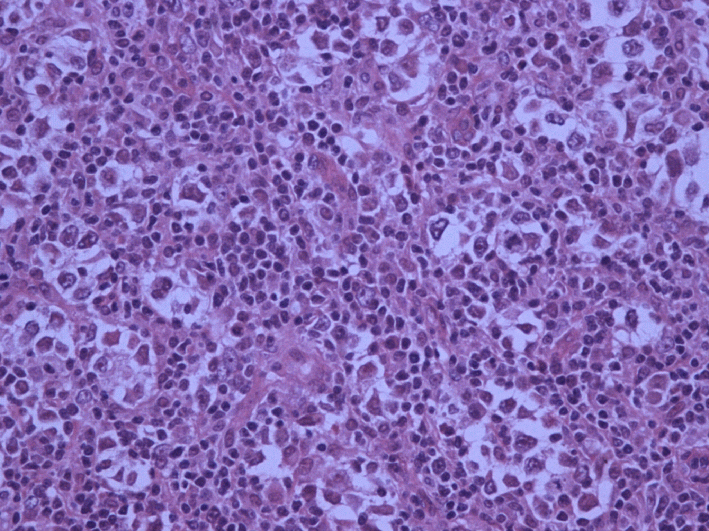
Figure1. EBV+ DLBCL, polymorphic subtype. A broad range of B-cell maturation, composed of centroblasts, immunoblasts, and plasmablasts with a variable component of admixed reactive cells (HE staining).
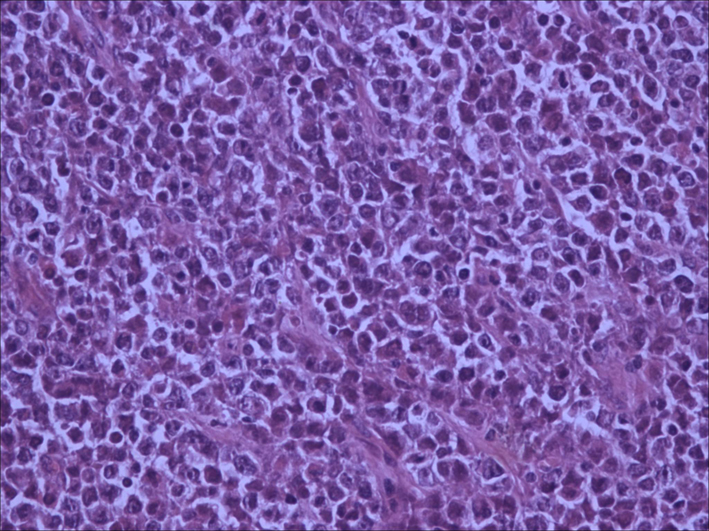
Figure 2. EBV+ DLBCL, monomorphic subtype. Sheets of large transformed B cells HE staining).
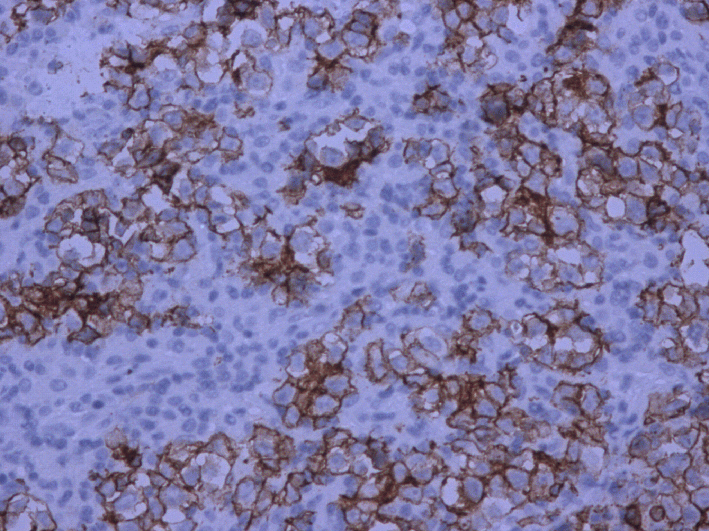
Figure 3. The lymphoid cells are positive for CD20.
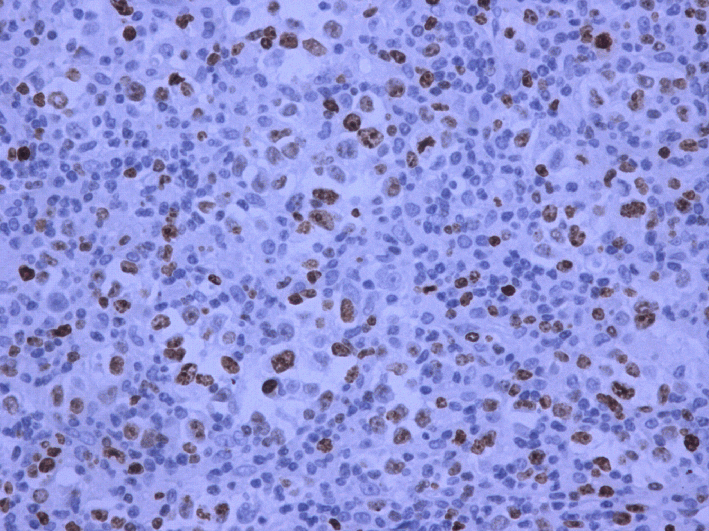
Figure 4. The lymphoid cells are positive for EBER (In situ hybridization).
Treatment
EBV+ DLBCLs, including EBV+DLBCL of the elderly, respond more poorly to treatment with a poorer outcome compared with patients who have EBV-negative DLBCL. Novel therapeutic approaches need to be considered for patients with EBV+ DLBCL. Possible therapeutic approaches include (1) EBV-specific adoptive immunotherapy; (2) miRNA-targeted therapy; (3) combination therapy based on EBV lytic phase induction followed by exposure of the tumor cells to antiherpsvirus drugs (Swerdlow, et al ,2008. Swerdlow, et al ,2016). Less toxic treatment strategy such as a cell therapy for EBV-specific viral antigens will be needed and should be evaluated in clinical trials (Oyama T, et al, 2007).
Prognosis
Young patients present with nodal disease and have a good prognosis (Nicolae A, et al 2015). The International prognostic index (IPI) and the Oyama score can be used for risk-stratification. The Oyama score includes age >70 years and presence of B symptoms. The expression of CD30 is emerging as a potential adverse, and targetable, prognostic factor (Castillo JJ, et al. 2018). In contrast to non-Western populations, the North American population had a low prevalence of EBV+ DLBCL that did not convey an adverse prognosis. A history of immunosuppression, while known to be a risk factor for the development of diffuse large B-cell lymphoma, did not affect subsequent prognosis (Tracy SI, et al, 2018).
Genes Involved and Proteins
Article Bibliography
| Pubmed ID | Last Year | Title | Authors |
|---|---|---|---|
| 29984868 | 2018 | EBV-positive diffuse large B-cell lymphoma, not otherwise specified: 2018 update on diagnosis, risk-stratification and management. | Castillo JJ et al |
| 25999451 | 2015 | EBV-positive large B-cell lymphomas in young patients: a nodal lymphoma with evidence for a tolerogenic immune environment. | Nicolae A et al |
| 23649469 | 2013 | EBV-positive diffuse large B-cell lymphoma of the elderly. | Ok CY et al |
| 26101854 | 2015 | Age cutoff for Epstein-Barr virus-positive diffuse large B-cell lymphoma--is it necessary? | Ok CY et al |
| 12502924 | 2003 | Senile EBV+ B-cell lymphoproliferative disorders: a clinicopathologic study of 22 patients. | Oyama T et al |
| 17785567 | 2007 | Age-related EBV-associated B-cell lymphoproliferative disorders constitute a distinct clinicopathologic group: a study of 96 patients. | Oyama T et al |
| 26980727 | 2016 | The 2016 revision of the World Health Organization classification of lymphoid neoplasms. | Swerdlow SH et al |
| 29170255 | 2018 | Outcomes among North American patients with diffuse large B-cell lymphoma are independent of tumor Epstein-Barr virus positivity or immunosuppression. | Tracy SI et al |
| 25704629 | 2015 | Epstein-Barr virus-positive diffuse large B-cell lymphoma in children: a disease reminiscent of Epstein-Barr virus-positive diffuse large B-cell lymphoma of the elderly. | Uccini S et al |
Citation
Ding-Bao Chen
EBV positive DLBCL, NOS
Atlas Genet Cytogenet Oncol Haematol. 2018-07-01
Online version: http://atlasgeneticsoncology.org/haematological/1834/ebv-positive-dlbcl-nos
