Bladder: Squamous cell carcinoma
1999-10-01 Jean-Loup Huret , Claude Léonard Affiliation1.Genetics, Dept Medical Information, University of Poitiers, CHU Poitiers Hospital, F-86021 Poitiers France
Classification
Classification
existence of different histologic types of bladder cancer: sqamous cell carcinoma, herein described transitional cell carcinoma adenocarcinoma, rare poorly differenciated carcinoma/small cell carcinoma, exceptional
Clinics and Pathology
Etiology
most often secondary to bilharzial infection (schistosoma haematobium), may be associated with other types of long term irritations: chronic infections, calculi, treatment with cyclophosphamid
Epidemiology
geographic areas of high incidence: represents 70 to 80% of the cases of badder cancer in the Middle East and in Africa, in particular in Egypt, were it is the most common adult cancer; only 5% in Europe and in the USA, where the transitional cell carcinoma represents 90-95 % of cases
Pathology
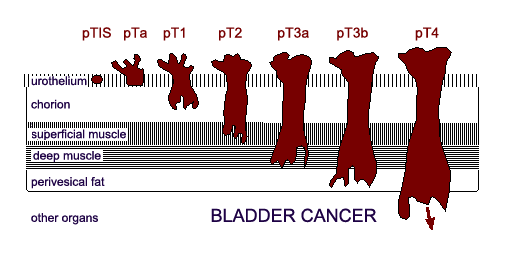
grading and staging: tumours are: graded by the degree of cellular atypia (G0->G3), and staged: pTIS carcinoma in situ (but high grade), and pTa papillary carcinoma, both mucosally confined; pT1 lamina propria invasive; pT2 infiltrates the superficial muscle, and pT3a, the deep mucle; pT3b invasion into perivesical fat; pT4 extends into neighbouring structures and organs
Prognosis
considered to have a poorer prognosis than the transitional cell carcinoma
Cytogenetics
Cytogenetics morphological
highly complex karyotypes, yet poorly known allelic losses are frequent; the most frequent regions involved in loss of heterozygocity (LOH) are 3p, 8p, 9p, 9q, 17p; the karyotype is more complex in advanced grades/stages, as in transitional cell carcinoma Chromosome 7: trisomy 7 seems to be more frequent than in transitional cell carcinoma, and is found more often in advanced stages; unknown significance as +7 may also be found in normal tissues Chromosome 9: monosomy 9 is an early event and might even occur at dysplastic stages; allelic losses are frequent, mainly in 9p (65%), more often than for transitional cell carcinoma; LOH are found in particular in the locus where CDKN2/P16 sits; homozygous deletion of P16 is frequent (50%) and may also be found in squamous metaplasias from cancerous patients (but not in squamous metaplasias from non cancerous patients); trisomy 9, on the other hand, would be frequent in advance diseases Chromosome 17: P53 is often implicated, especially in high grades/stages; the profile of mutations of P53 is different from what is found in transitional cell carcinoma
Cytogenetics molecular
comparative genomic hybridization (CGH) and multi-FISH (M-FISH) are complementary tools to determine respectively unbalanced segments and structural rearrangements in these complex karyotypes
Genes Involved and Proteins
Note
multistep process; largely unknown
Article Bibliography
| Pubmed ID | Last Year | Title | Authors |
|---|---|---|---|
| 10791925 | 1999 | Expression of p21WAF1/CIP1 in bladder cancer: relation to schistosomiasis. | Eissa S et al |
| 10702404 | 2000 | DNA copy number changes in Schistosoma-associated and non-Schistosoma-associated bladder cancer. | El-Rifai W et al |
| 9546064 | 1998 | Chromosomal abnormalities in two bladder carcinomas with secondary squamous cell differentiation. | Fadl-Elmula I et al |
| 8712180 | 1996 | Aberrations of chromosomes 9 and 17 in bilharzial bladder cancer as detected by fluorescence in situ hybridization. | Ghaleb AH et al |
| 7658499 | 1995 | High frequency of chromosome 9p allelic loss and CDKN2 tumor suppressor gene alterations in squamous cell carcinoma of the bladder. | Gonzalez-Zulueta M et al |
| 9720535 | 1998 | Numerical aberrations of chromosomes 7, 9 and 17 in squamous cell and transitional cell cancer of the bladder: a comparative study performed by fluorescence in situ hybridization. | Pycha A et al |
| 10048962 | 1999 | Partial allelotype of schistosomiasis-associated bladder cancer. | Shaw ME et al |
| 9881704 | 1998 | Early acquisition of homozygous deletions of p16/p19 during squamous cell carcinogenesis and genetic mosaicism in bladder cancer. | Tsutsumi M et al |
| 7875039 | 1994 | Bladder irrigation specimens assayed by fluorescence in situ hybridization to interphase nuclei. | Wheeless LL et al |
Citation
Jean-Loup Huret ; Claude Léonard
Bladder: Squamous cell carcinoma
Atlas Genet Cytogenet Oncol Haematol. 1999-10-01
Online version: http://atlasgeneticsoncology.org/solid-tumor/5062/bladder-squamous-cell-carcinoma
