Liver: Mesenchymal hamartoma with t(11;19)(q11;q13) MALAT1/MHLB1
2008-06-01 Stevan Knezevich Affiliation1.BC Cancer Research Centre (BCCRC), Vancouver, British Columbia, Canada
Summary
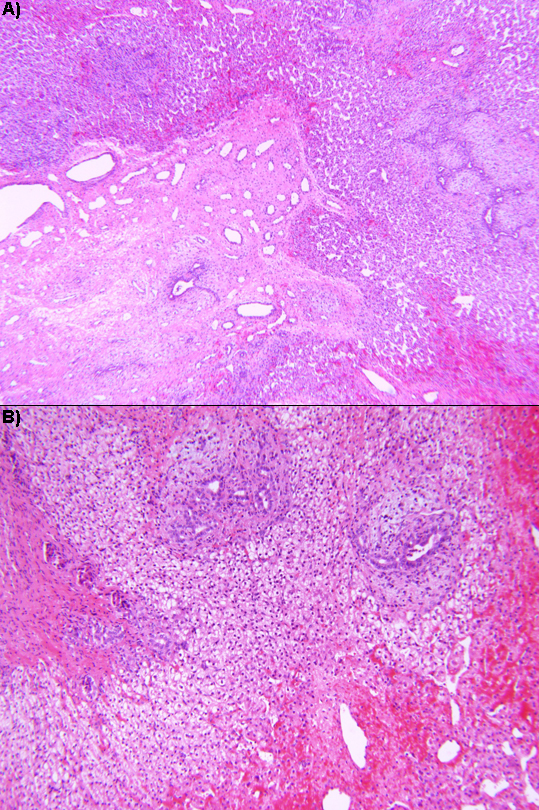
A) Low power view showing a benign proliferation of abnormally branched bile ducts, with no atypical features, amongst a loose myxoid background. Also seen in this view are numerous mesenchymal cells with cleared cytoplasm and small, hyperchromatic nuclei. B) Higher power view showing the abnormally branched bile ducts and mesenchymal cells.
Classification
Note
It represents the second most common benign liver tumor, but its role as a malignant precursor is still not clear.
Clinics and Pathology
Embryonic origin
Mesoderm
Etiology
Unknown
Epidemiology
Second most common liver tumor following hepatic hemangiomas.
Pathology
Unknown. There are several possibilities with regards to the pathophysiology of MHL. One should always consider the possibility that the recurring translocation has little or nothing to do with tumor formation, but is rather found as a secondary phenomenon. If we assume that the translocation product is responsible, then the following possibilities exist:
The MALAT-1 gene is disrupted by the translocation and not allowed to perform its usual functions. This leaves one functional copy per cell, which may not be enough. Alternatively, the derivative MALAT product may interfere with the wild type gene product. The MALAT-1 gene gains a new function or loses regulatory function by the loss of either the 5 or 3 half of the original gene product.
There is a novel translocation product produced with an as of yet to be determined gene product on chromosome 19.
There is a novel translocation product produced with an as of yet to be determined gene product on chromosome 19.
Treatment
Surgical resection remains the mainstay of treatment. Other accounts of cyst aspiration in utero have been documented with mixed results. When possible, a watch and wait approach has also been employed, since these tumors tend to spontaneously regress over time.
Prognosis
When there is complete resection of the tumor, the prognosis is excellent. When aspiration or watching and waiting are the primary means of treatment, then the prognosis is not as clear cut and is evaluated on a case by case basis.
Genes Involved and Proteins
Note
MALAT-1 and MHLB1. The latter is not a gene per se, but rather a breakpoint located on chromosome 19. It is unclear as of yet, whether the breakpoint occurs in a novel gene or whether it serves to disrupt MALAT-1 through a translocation event. If MALAT-1 is the 5 end of the translocation product, then no protein is expected from such a fusion as MALAT-1 is not translated. If there is a gene within the chromosome 19 breakpoint and it acts as the 5 end of the novel translocation product, then the possibility of a novel protein exists.
Gene name
MALAT1 (metastasis associated lung adenocarcinoma transcript 1 (non-protein coding))
Location
11q13.1
Note
MALAT-1 was initially found as an overexpressed molecule in lung adenocarcinomas. It is normally expressed in a wide variety of tissues with some of the highest levels of expression found in the pancreas. It was found to be rearranged in a subset of renal cell carcinomas harboring the t(6;11)(p21;q13). Recent studies have found MALAT-1 to be overexpressed in a number of carcinomas, endometrial stromal sarcomas of the uterus, and its expression can be used to monitor response to chemotherapy in osteosarcomas.
Dna rna description
Two isoforms have been discovered. The short isoform is 8110 bp while the long isoform is 8352 bp. Both isoforms harbor a splice site at the 5 end, while the short isoform has an additional splice site near the middle that results in a shorter overall product.
Protein description
Non-translated RNA product.
Article Bibliography
| Pubmed ID | Last Year | Title | Authors |
|---|---|---|---|
| 12719541 | 2003 | Cloning of an Alpha-TFEB fusion in renal tumors harboring the t(6;11)(p21;q13) chromosome translocation. | Davis IJ et al |
| 17660802 | 2007 | Prognostic significance of drug-regulated genes in high-grade osteosarcoma. | Fellenberg J et al |
| 12970751 | 2003 | MALAT-1, a novel noncoding RNA, and thymosin beta4 predict metastasis and survival in early-stage non-small cell lung cancer. | Ji P et al |
| 12837690 | 2003 | Upregulation of the transcription factor TFEB in t(6;11)(p21;q13)-positive renal cell carcinomas due to promoter substitution. | Kuiper RP et al |
| 16878148 | 2007 | A large noncoding RNA is a marker for murine hepatocellular carcinomas and a spectrum of human carcinomas. | Lin R et al |
| 15552795 | 2004 | Genome-wide screening for prognosis-predicting genes in early-stage non-small-cell lung cancer. | Müller-Tidow C et al |
| 17285572 | 2007 | Characterization of t(6;11)(p21;q12) in a renal-cell carcinoma of an adult patient. | Pecciarini L et al |
| 18006640 | 2008 | Long, abundantly expressed non-coding transcripts are altered in cancer. | Perez DS et al |
| 17311249 | 2007 | DNA sequence of the translocation breakpoints in undifferentiated embryonal sarcoma arising in mesenchymal hamartoma of the liver harboring the t(11;19)(q11;q13.4) translocation. | Rajaram V et al |
| 15325096 | 2004 | Hepatic mesenchymal hamartoma with translocation involving chromosome band 19q13.4: a recurrent abnormality. | Rakheja D et al |
| 16441420 | 2006 | Phenotypic characterization of endometrial stromal sarcoma of the uterus. | Yamada K et al |
Citation
Stevan Knezevich
Liver: Mesenchymal hamartoma with t(11;19)(q11;q13) MALAT1/MHLB1
Atlas Genet Cytogenet Oncol Haematol. 2008-06-01
Online version: http://atlasgeneticsoncology.org/solid-tumor/5527/liver-mesenchymal-hamartoma-with-t(11
