Soft Tissues: Lymphangioleiomyoma
2009-04-01 Connie G Glasgow , Angelo M Taveira-DaSilva , Joel Moss Affiliation1.Translational Medicine Branch, NHLBI, NIH, Building 10, Room 6D05, MSC 1590, Bethesda, Maryland 20892-1590, USA
Classification
Note
Clinics and Pathology
Note
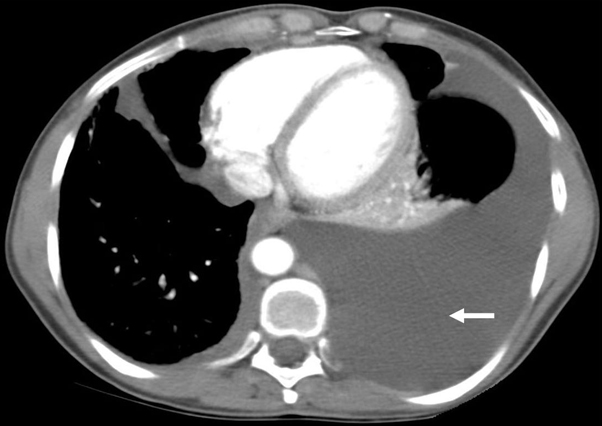
Abdomino-pelvic lymphangioleiomyomas may present with abdominal pain as an acute abdomen, with a neuropathy or with abdominal bloating. Thoraco-abdominal lymphadenopathy and lymphangioleiomyomas, along with chylothorax (Figure 1) or ascites may suggest the presence of a malignant lymphoproliferative disease.
Etiology
Epidemiology
Pathology
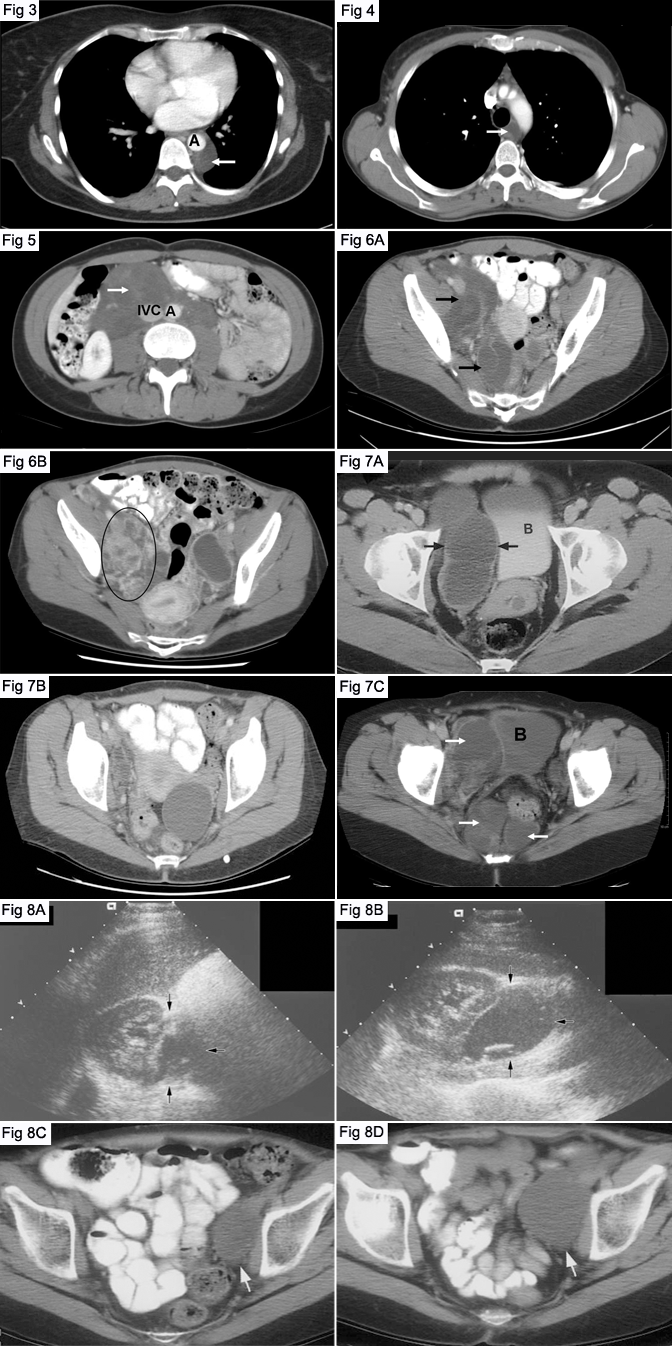
Radiologic Imaging: Retroperitoneal lymphangioleiomyomas have a distinctive radiologic appearance (Figures 3-7), and diurnal variation in size of the tumor masses can be demonstrated by ultrasonography or computed tomography scans (Figure 8). Lymphangioleiomyomas are well characterized by either ultrasonography or computed tomography scanning, appearing as well-circumscribed lobular, thin or thick-walled masses without evidence of necrosis or hemorrhage. Masses greater than 3 cm in diameter are usually cystic in appearance and many contain fluid, presumably chyle. Lesions as large as 20 cm in diameter have been observed. In patients with LAM, the lesions most often occur in the retroperitoneal region.
Treatment
Sirolimus: The TSC1 and TSC2 genes encode respectively, hamartin and tuberin. Although Hamartin and tuberin may have individual functions, they are also known to interact in a cytosolic complex. Hamartin may play a role in the reorganization of the actin cytoskeleton. Tuberin has roles in pathways controlling cell growth and proliferation. It is a negative regulator of cell cycle progression, and loss of tuberin function shortens the G1 phase of the cell cycle. Tuberin binds p27KIP1, a cyclin-dependent kinase inhibitor, thereby preventing its degradation and leading to inhibition of the cell cycle. Tuberin also integrates signals from growth factors and energy stores through its interaction with mTOR (mammalian target of rapamycin). Tuberin has Rheb GAP (Ras homolog enriched in brain GTPase-activating protein) activity, which converts active Rheb-GTP to inactive Rheb-GDP. Rheb regulates mTOR, a serine/threonine kinase that phosphorylates at least two substrates: 4E-BP1, allowing cap-dependent translation, and S6K1, leading to translation of 5 TOP (terminal oligopyrimidine tract)-containing RNAs. Phosphorylation of tuberin by Akt, which is activated by growth factors, leads to inhibition of tuberin, resulting in cell growth and proliferation. Phosphorylation of tuberin by AMPK (AMP-activated kinase) activates tuberin and further promotes inhibition of cell growth in conditions of energy deprivation.
Sirolimus, an inmmunosuppressive agent, inactivates mTOR. Sirolimus has been shown to induce apoptosis of tumors in rodents and decrease the size of renal angiomyolipomas in patients with lymphangioleiomyomatosis or TSC. Further, sirolimus was effective in decreasing the size of chylous effusions and lymphangioleiomyomas in one patient with LAM and improved chylous effusions in another patient who underwent lung transplantation.
Evolution
Prognosis
Genes Involved and Proteins
Note
Article Bibliography
| Pubmed ID | Last Year | Title | Authors |
|---|---|---|---|
| 16716823 | 2006 | Pleural disease in lymphangioleiomyomatosis. | Almoosa KF et al |
| 11687685 | 2001 | Lymphangioleiomyomatosis: CT of diurnal variation of lymphangioleiomyomas. | Avila NA et al |
| 17105849 | 2007 | Sporadic lymphangioleiomyomatosis and tuberous sclerosis complex with lymphangioleiomyomatosis: comparison of CT features. | Avila NA et al |
| 10887241 | 2000 | Lymphangioleiomyomatosis: abdominopelvic CT and US findings. | Avila NA et al |
| 18184959 | 2008 | Sirolimus for angiomyolipoma in tuberous sclerosis complex or lymphangioleiomyomatosis. | Bissler JJ et al |
| 9752440 | 1998 | [Pleuro-peritoneal Denver shunt in treatment of chronic pleurisy]. | Boudard C et al |
| 15583138 | 2004 | Molecular and genetic analysis of disseminated neoplastic cells in lymphangioleiomyomatosis. | Crooks DM et al |
| 18184971 | 2008 | Sirolimus therapy in tuberous sclerosis or sporadic lymphangioleiomyomatosis. | Davies DM et al |
| 8745754 | 1995 | [Pulmonary lymphangiomyomatosis: a 3-year follow-up of medroxyprogesterone acetate therapy. Apropos of a case]. | Druelle S et al |
| 11031360 | 2000 | Lymphangioleiomyomatosis (LAM): a review of clinical and morphological features. | Ferrans VJ et al |
| 12823048 | 2003 | Localized retroperitoneal lymphangioleiomyomatosis mimicking malignancy. A case report and review of the literature. | Jaiswal VR et al |
| 11083892 | 2000 | Clinical experience of lymphangioleiomyomatosis in the UK. | Johnson SR et al |
| 9510588 | 1998 | Retroperitoneal lymphangioleiomyomatosis: CT appearance. | Kehagias D et al |
| 11202475 | 2001 | Lymphangioleiomyomatosis. | Kelly J et al |
| 8753114 | 1996 | [Lymphangiomyomatosis with chylous ascites treatment successfully by peritoneo-venous shunting]. | Kimura M et al |
| 16160479 | 2005 | Lymphangiogenesis-mediated shedding of LAM cell clusters as a mechanism for dissemination in lymphangioleiomyomatosis. | Kumasaka T et al |
| 12368177 | 2002 | Lymphangiomyomatosis mimicking an abdominal lymphoma. | Llopis I et al |
| 12727053 | 2003 | Lymphangioleiomyomatosis initially presenting with abdominal pain: a case report. | Lu HC et al |
| 15289232 | 2004 | Successful octreotide treatment of chylous pleural effusion and lymphedema in the yellow nail syndrome. | Makrilakis K et al |
| 11070117 | 2000 | Extrapulmonary lymphangioleiomyomatosis (LAM): clinicopathologic features in 22 cases. | Matsui K et al |
| 11520735 | 2001 | Prevalence and clinical characteristics of lymphangioleiomyomatosis (LAM) in patients with tuberous sclerosis complex. | Moss J et al |
| 19021963 | 2008 | Sirolimus ameliorated post lung transplant chylothorax in lymphangioleiomyomatosis. | Ohara T et al |
| 14717788 | 2004 | Magnetic resonance screening of iron status in transfusion-dependent beta-thalassaemia patients. | Ooi GC et al |
| 12576391 | 2003 | Chylothorax in lymphangioleiomyomatosis. | Ryu JH et al |
| 16210669 | 2006 | The NHLBI lymphangioleiomyomatosis registry: characteristics of 230 patients at enrollment. | Ryu JH et al |
| 17034294 | 2006 | Vascular endothelial growth factor-D is increased in serum of patients with lymphangioleiomyomatosis. | Seyama K et al |
| 17470843 | 2007 | Sirolimus treatment for pulmonary lymphangioleiomyomatosis. | Taillé C et al |
| 17075565 | 2006 | Lymphangioleiomyomatosis. | Taveira-DaSilva AM et al |
| 10092335 | 1999 | Octreotide for therapy of chylous ascites in yellow nail syndrome. | Widjaja A et al |
| 10354698 | 1998 | [Use of pleuro-peritoneal shunt in the treatment of chronic chylothorax]. | Wójcik P et al |
| 12818883 | 2003 | Atypical presentation of lymphangioleiomyomatosis as acute abdomen: CT diagnosis. | Wong YY et al |
Citation
Connie G Glasgow ; Angelo M Taveira-DaSilva ; Joel Moss
Soft Tissues: Lymphangioleiomyoma
Atlas Genet Cytogenet Oncol Haematol. 2009-04-01
Online version: http://atlasgeneticsoncology.org/solid-tumor/5868/soft-tissues-lymphangioleiomyoma
