t(3;4)(p21;q34)
2007-08-01 Adriana Zamecnikova Affiliation1.Kuwait Cancer Control Center, Laboratory of Cancer Genetics, Department of Hematology, Shuwaikh, 70653, Kuwait
Clinics and Pathology
Disease
Myeloid lineage, found in 1 myelodysplastic syndrome (MDS) and 1 Acute Myeloid Leukemia (AML)
Phenotype stem cell origin
MDS-RA and M1 AML by FAB criteria, a primitive myeloid progenitor is likely to be involved
Etiology
No known prior exposure
Epidemiology
Only 2 cases to date, a 69 yr old female and a 31 yr old male, sex ratio 1M/1F
Clinics
Elevated WBC (68x109/l), 93% blasts in blood, lymphadenopaty, hepatosplenomegaly, high LDH in AML patient
Cytology
Positive for CD 34, HLDR, CD33, CD68, MPO in AML
Treatment
Chemotherapy followed by bone marrow transplantation in AML
Evolution
After the first cycle of therapy, persistent bone marrow infiltration with 11% blasts
Prognosis
Survival 6 month in MDS, 15 month+ in AML
Cytogenetics
Cytogenetics morphological
May be misinterpreted as t(3;5) in suboptimal preparations
Cytogenetics molecular
FISH analysis is recommended to exclude the more frequent t(3;5)
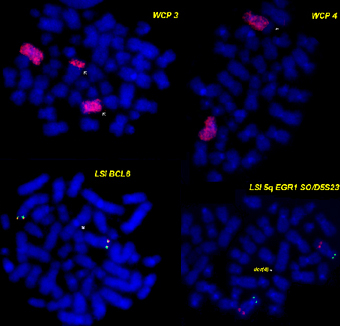
FISH with WCP 3 and 4 and LSI BCL6 and 5q EGR1 probes.
Additional anomalies
t(3;4)(p21;q34) is part of a complex karyotype in MDS case associated with del(20q), sole abnormality in AML case
Genes Involved and Proteins
Note
3p21 is a recurrent breakpoint in MDS/AML and t-MDS/t-AML suggesting, 3p21 site is likely to contain a gene (genes) involved in the pathogenesis of t(3;4)(p21;q34). Frequent deletion or allelic loss of band 3p21 is common in solid tumors, indicating the presence of tumor suppressor genes on this chromosome arm. The association among structural chromosome 3 aberrations and fragile sites on 3p may indicate the importance of previous mutagen exposure in the etiology of these diseases.
Although several cancer-related genes have been located to 3p21, no gene has yet been identified to be related with hematological malignancies. One of the candidate genes may be the AF3p21 gene, a novel fusion partner of the MLL gene described in a patient who had developed therapy-related leukemia with t(3;11)(p21;q23). AF3p21 encodes a protein localized exclusively in the cell nucleus, suggesting the possibility that AF3p21 protein plays a role in signal transduction in the nucleus.
Although several cancer-related genes have been located to 3p21, no gene has yet been identified to be related with hematological malignancies. One of the candidate genes may be the AF3p21 gene, a novel fusion partner of the MLL gene described in a patient who had developed therapy-related leukemia with t(3;11)(p21;q23). AF3p21 encodes a protein localized exclusively in the cell nucleus, suggesting the possibility that AF3p21 protein plays a role in signal transduction in the nucleus.
Article Bibliography
| Pubmed ID | Last Year | Title | Authors |
|---|---|---|---|
| 11241789 | 2001 | Genomic organization, tissue expression, and cellular localization of AF3p21, a fusion partner of MLL in therapy-related leukemia. | Hayakawa A et al |
| 17074585 | 2006 | Risk factor analysis in myelodysplastic syndrome patients with del(20q): prognosis revisited. | Liu YC et al |
| 10648423 | 2000 | Novel SH3 protein encoded by the AF3p21 gene is fused to the mixed lineage leukemia protein in a therapy-related leukemia with t(3;11) (p21;q23). | Sano K et al |
| 8976389 | 1996 | 3p21 is a recurrent treatment-related breakpoint in myelodysplastic syndrome and acute myeloid leukemia. | Shi G et al |
Summary
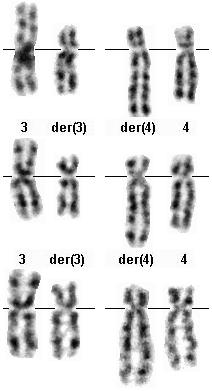
t(3;4)(p21;q34) G-banding
Citation
Adriana Zamecnikova
t(3;4)(p21;q34)
Atlas Genet Cytogenet Oncol Haematol. 2007-08-01
Online version: http://atlasgeneticsoncology.org/haematological/1433/t(3;4)(p21;q34)
