t(8;9)(p12;q33) CNTRL/FGFR1
2004-01-01 Jacques Boyer Affiliation1.Laboratoire d hématologie, CH du MANS, France
Clinics and Pathology
Disease
Myeloproliferative disorder that is frequently associated with T-cell, or less commonly B-cell non Hodgkin lymphoma.
Phenotype stem cell origin
May involve a stem cell.
Epidemiology
9 cases are described ; sexe ratio : 6M/3F.
Clinics
Agressive disease ; myeloid hyperplasia progressing to myelodysplasia and T or B-cell lymphoma, splenomegaly, lymph node.
High WBC with myelemia with frequently eosinophilia and sometimes monocytosis (near CMLL).
High WBC with myelemia with frequently eosinophilia and sometimes monocytosis (near CMLL).
Evolution
The disease transforms to AML or occasionally ALL in a median of 6 months.
Prognosis
Median survival : 12 months.
Cytogenetics
Cytogenetics morphological
This translocation is a variant of the t(8 ;13)(p12 ;q12).
Additional anomalies
+der(9), +21
Genes Involved and Proteins
Gene name
FGFR1 (Fibroblast Growth Factor Receptor 1)
Location
8p11.23
Gene name
CNTRL (centriolin)
Location
9q33.2
Dna rna description
DNA : 26kb - 19 exons
RNA : Three mains transcripts of approximatly 7.5, 4.5 and 1.5 kb. CEP transcripts are barely expressed in thymus and peripheral blood cells.
RNA : Three mains transcripts of approximatly 7.5, 4.5 and 1.5 kb. CEP transcripts are barely expressed in thymus and peripheral blood cells.
Protein description
CEP110 gene codes for a 994-amino acid coiled-coil protein with 4 consensus leucine zippers (centrosome associated P110 protein).
Result of the Chromosomal Anomaly
Description
The t(8;9) breakpoint in the FGFR1 gene is localized in exon 8, 12 bp upstream of the exon 8/intron 8 junction. It is distinct from the breakpoints in the t(6;8) and t(8;13) but it preserves the same FGFR1 sequence in the chimeric protein.
The breakpoint in the CEP110 is localized in exon 15.
The translocation leads to the formation of the two reciprocal transcripts.The CEP110-FGFR1 fusion protein encodes an aberrant tyrosine kinase of 150-kd wich retains most of CEP110 with the leucine zipper motif and the catalytic domain of FGFR1. The CEP110-FGFR1 protein has a constitutive kinase activity and is located within the cell cytoplasm contrasting with the centrosome and membrane localizations of the wildtype respective proteins. The FGFR1-CEP110 protein contains the FGFR1 N-terminal region with its ligand-binding and transmembrane domains and the CEP110 C-terminal region.
The breakpoint in the CEP110 is localized in exon 15.
The translocation leads to the formation of the two reciprocal transcripts.
Oncogenesis
Activated aberrant tyrosine kinase are likely to promote leukemogenesis through contitutive activation of the FGFR1 kinase. This activation may be mediated by dimerisation of the portion of the fusion protein wich contains the leucine zippers.
This activation may interacts with the cell proliferation and the apoptose, additional anomalies may also play an important role in the evolution of the disease.
This activation may interacts with the cell proliferation and the apoptose, additional anomalies may also play an important role in the evolution of the disease.
Highly cited references
| Pubmed ID | Year | Title | Citations |
|---|---|---|---|
| 27245147 | 2016 | FGFR inhibitors: Effects on cancer cells, tumor microenvironment and whole-body homeostasis (Review). | 137 |
| 23777766 | 2013 | Dysregulated signaling pathways in the development of CNTRL-FGFR1-induced myeloid and lymphoid malignancies associated with FGFR1 in human and mouse models. | 42 |
| 31250523 | 2019 | Targeted therapy and disease monitoring in CNTRL-FGFR1-driven leukaemia. | 0 |
Article Bibliography
| Pubmed ID | Last Year | Title | Authors |
|---|---|---|---|
| 12094244 | 2002 | Tyrosine kinase fusion genes in chronic myeloproliferative diseases. | Cross NC et al |
| 10688839 | 2000 | FGFR1 is fused to the centrosome-associated protein CEP110 in the 8p12 stem cell myeloproliferative disorder with t(8;9)(p12;q33). | Guasch G et al |
| 11919391 | 2002 | The 8p11 myeloproliferative syndrome: a distinct clinical entity caused by constitutive activation of FGFR1. | Macdonald D et al |
| 11550283 | 2001 | Identification of four new translocations involving FGFR1 in myeloid disorders. | Sohal J et al |
Summary
Fusion gene
CNTRL/FGFR1 CNTRL (9q33.2) FGFR1 (8p11.23) M|CNTRL/FGFR1 CNTRL (9q33.2) FGFR1 (8p11.23) M t(8;9)(p11;q33)|CNTRL/FGFR1 CNTRL (9q33.2) FGFR1 (8p11.23) TIC
Note
8p12 myeloproliferative syndrome (EMS) / stem cell leukemia-lymphoma syndrome (SCLL) belongs to the tyrosine kinase fusion genes chronic myeloproliferative diseases .
It is associated with recurent translocations :t(6;8)(q27;p12), t(8;9)(p12;q33), t(8;11)(p12;p15), t(8;12)(p12;q15), t(8;13)(p12;q12), t(8;17)(p12;q25), t(8;19)(p12;q13), t(8;22)(p12;q11)
It is associated with recurent translocations :
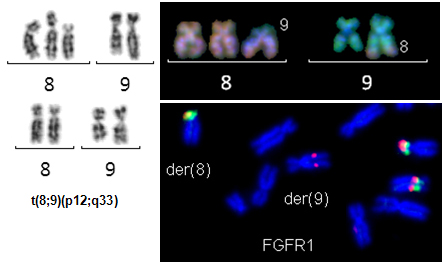
t(8;9)(p12;q33) - Courtesy Melanie Zenger and Claudia Haferlachxi
Citation
Jacques Boyer
t(8;9)(p12;q33) CNTRL/FGFR1
Atlas Genet Cytogenet Oncol Haematol. 2004-01-01
Online version: http://atlasgeneticsoncology.org/haematological/1129/t(8;9)(p12;q33)-cntrl-fgfr1
