t(9;14)(p13;q32) PAX5/IGH
2002-10-01 Pascale De Paepe , Frank Speleman , Bruce Poppe Affiliation1.Center for Medical Genetics, Ghent University Hospital MRB, De Pintelaan 185, 9000 Ghent, Belgium
Clinics and Pathology
Disease
Rare recurrent chromosomal aberration, exclusively detected in B-cell lymphoproliferative disorders.
Phenotype stem cell origin
B lymphocyte.
Epidemiology
Originally reported to be associated with a low-grade mature B-cell phenotype with plasmacytoid differentiation such as lymphoplasmacytic lymphoma, multiple myeloma/ plasma cell leukemia and chronic lymphocytic leukemia. However, the relatively frequent occurrence in diffuse large B-cell lymphoma, with or without a preceding faze of a low-grade lymphoma, suggests that this chromosomal aberration has a much wider clinical spectrum or is associated with disease progression. In addition, the t(9;14)(p13;q32) has been described occasionally in follicular lymphoma, mantle cell lymphoma and splenic marginal zone lymphoma.
Prognosis
No prognostic relevance has been attributed to the presence of the t(9;14)(p13;q32).
Cytogenetics
Cytogenetics morphological
The t(9;14)(p13;q32) is readily recognisable with G- as well as R-banding. The presence of complex chromosomal aberrations, however, can mask the presence of this rearrangement.
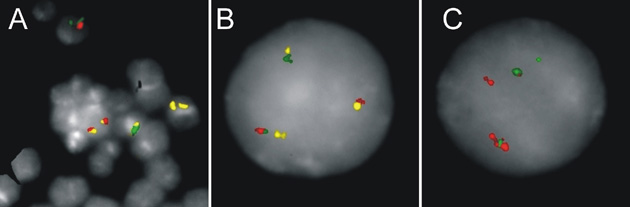
Dual and triple colour hybridisations demonstrating the presence of a t(9;14)(p13;q32) resulting in PAX5/IGH rearrangement. A,B: partial metaphase and interphase nucleus cohybridized with PAX5 locus specific probes (yellow) and dual colour interphaze cytogenetics using IgH flanking probes (red) and PAX5 locus specific probes.
Additional anomalies
No recurrent additional aberrations have been described. However, the majority of t(9;14)(p13;q32) have been reported in addition to complex chromosomal aberrations.
Variants
In addition to the t(9;14)(p13;q32), other translocations presumably involving the immunoglobulin light chain genes and PAX5 have been reported, such as the t(2;9)(p12;p13) and the t(9;22)(p13;q11).
Genes Involved and Proteins
Gene name
IGH (Immunoglobulin Heavy)
Location
14q32.33
Gene name
PAX5 (paired box gene 5)
Location
9p13.2
Dna rna description
The PAX5 coding region extends over a genomic interval of approximately 200kb and comprises 10 exons. Two alternative transcripts have been identified, originating from alternative promotor usage, containing exon 1A or 1B. Full length mRNA is 3650bp.
Protein description
PAX5 belongs to the paired box family of transcription factors, involved in a multitude of developmental processes. PAX5 was originally identified as a B-cell specific transcription factor (hence its original name, BSAP). Recently it has been shown that PAX5 expression is continuously required in B cell lineage commitment during early B cell development.
Result of the Chromosomal Anomaly
Description
Translocation of the entire PAX5 gene to chromosome 14. The breakpoints at 9p13 are heterogeneous and can reside up to 200kb upstream (i.e. centromeric) of PAX5.
Detection protocole
The variability of the chromosomal breakpoints at 9p13 as well 14q32 precludes genomic PCR approaches for detection of IgH PAX5 juxtaposition. In addition, the expression pattern of PAX5 hampers RT-PCR methods for demonstrating elevated PAX5 expression in B-cell proliferations with suspected or proven PAX5 rearrangement. Currently, the only methods for detecting IgH PAX5 juxtaposition reliably include conventional and molecular cytogenetics.
Description
In analogy to other 14q32 rearrangements, no fusion gene is created by the translocation. Rather, the genomic rearrangement leads to forced PAX5 expression.
Oncogenesis
In contrast to the novel insights in the role of PAX5 in B-cell lineage commitment, little is know on the role of PAX5 in the malignant transformation of B cells. The recent demonstration of PAX5 hypermutation in diffuse large-cell lymphomas, in addition to PAX5 overexpression associated with the t(9;14), suggest that PAX5 acts as a dominant oncogene.
Highly cited references
| Pubmed ID | Year | Title | Citations |
|---|---|---|---|
| 15942942 | 2005 | PAX5/IGH rearrangement is a recurrent finding in a subset of aggressive B-NHL with complex chromosomal rearrangements. | 0 |
| 31955451 | 2020 | Diffuse large B-cell lymphoma carrying t(9;14)(p13;q32)/PAX5-immunoglobulin heavy chain gene is characterized by nuclear positivity of MUM1 and PAX5 by immunohistochemistry. | 0 |
Article Bibliography
| Pubmed ID | Last Year | Title | Authors |
|---|---|---|---|
| 9892103 | 1999 | High incidence of cryptic translocations involving the Ig heavy chain gene in multiple myeloma, as shown by fluorescence in situ hybridization. | Avet-Loiseau H et al |
| 2116362 | 1990 | A novel B-cell lineage-specific transcription factor present at early but not late stages of differentiation. | Barberis A et al |
| 8650231 | 1996 | Deregulation of PAX-5 by translocation of the Emu enhancer of the IgH locus adjacent to two alternative PAX-5 promoters in a diffuse large-cell lymphoma. | Busslinger M et al |
| 8943844 | 1996 | The t(9;14)(p13;q32) chromosomal translocation associated with lymphoplasmacytoid lymphoma involves the PAX-5 gene. | Iida S et al |
| 12098702 | 2002 | Reversion of B cell commitment upon loss of Pax5 expression. | Mikkola I et al |
| 10524622 | 1999 | Commitment to the B-lymphoid lineage depends on the transcription factor Pax5. | Nutt SL et al |
| 1384792 | 1992 | t(9;14)(p13;q32) denotes a subset of low-grade non-Hodgkin's lymphoma with plasmacytoid differentiation. | Offit K et al |
| 10784387 | 2000 | The t(9;14)(p13;q32) translocation in B-cell non-Hodgkin's lymphoma. | Ohno H et al |
| 11460166 | 2001 | Hypermutation of multiple proto-oncogenes in B-cell diffuse large-cell lymphomas. | Pasqualucci L et al |
| 11579466 | 2001 | Detection of illegitimate rearrangement within the immunoglobulin locus on 14q32.3 in B-cell malignancies using end-sequenced probes. | Poulsen TS et al |
Summary
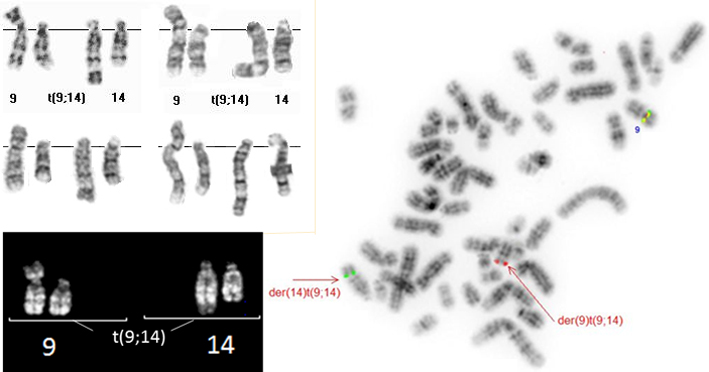
t(9;14)(p13;q32) PAX5/IGH G- banding Upper row left: -Courtesy Bruce Poppe, Pascale De Paepe, Frank Speleman, middle - Courtesy Jean-Luc Lai, Middle row - Courtesy Diane H. Norback, Eric B. Johnson, Sara Morrison-Delap. Bottom row: R-banded karyotype and (right) FISH using dual color break apart probe PAX5/9p13 (Empire genomics) - Courtesy Karolien Beel, Peter Meeus, Geneviu00e8ve Ameye and Lucienne Michaux
Citation
Pascale De Paepe ; Frank Speleman ; Bruce Poppe
t(9;14)(p13;q32) PAX5/IGH
Atlas Genet Cytogenet Oncol Haematol. 2002-10-01
Online version: http://atlasgeneticsoncology.org/haematological/2018/t(9;14)(p13;q32)-pax5-igh
