CAV1 (caveolin 1, caveolae protein, 22kDa)
2008-12-01 Cristiana Tanase AffiliationVictor Babes National Institute of Pathology, 99-101, Splaiul Independentei, Sector 5, Bucharest, Romania
Identity
HGNC
LOCATION
7q31.2
LOCUSID
ALIAS
BSCL3,CGL3,LCCNS,MSTP085,PPH3,VIP21
FUSION GENES
DNA/RNA
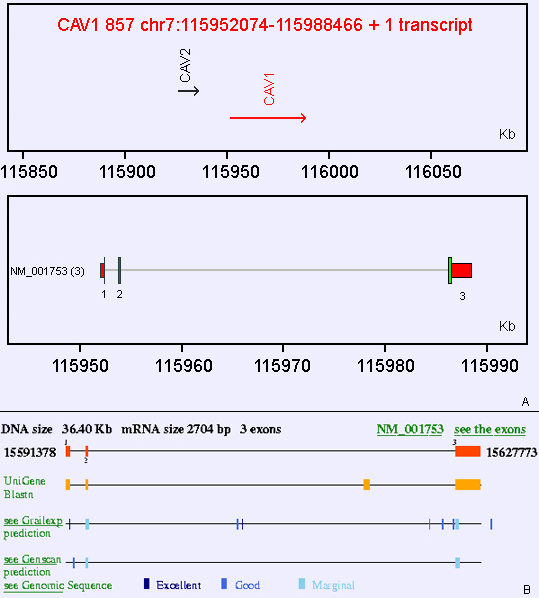
Figure A.
Figure B. present in the contig : NT 079596 of Genbank
Description
The gene consists of 3 exons (respectively 30, 165 and 342 bp long) separated by two introns of 1.5 kb and 32 kb. Two isoforms have been identified: caveolin-1alpha (corresponding to the 2-178 sequence) and caveolin-1beta (corresponding to the 32-178 sequence). The two isoforms are generated by alternative splicing of the CAV1 gene (Kogo et al., 2000) and by alternative initiation of the same mRNA translation (Shatz et al., 2008).
Proteins
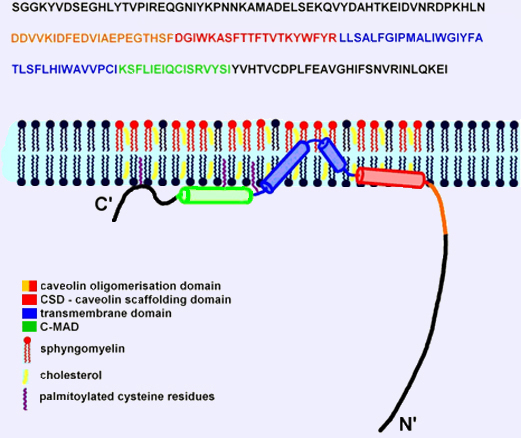
Structure of caveolin-1. Primary structure of caveolin (upper part of the image) with aminoacids colored to illustrate classic domains considered within its molecule. Tertiary structure of caveolin depicted in the lower part of the image shows: 4 alpha-helices, one corresponding to CSD partially embeded in the membrane, 2 alpha-helices corresponding to the transmembrane domain and an alpha helix in C-terminal end with variable length according to different authors. A beta-sheet organized region is also thought to exist in the oligomerisation domain of CAV1.
Description
CAV1 (21-24kDa) is an integral membrane protein, expressing two isoforms (alpha and beta) of different length and distinct potential in caveolae formation. The full length CAV1 (isoform alpha, 178 aminoacids) has a hairpin-like structure spanning the plasmatic membrane, both C- and N-termini facing the cytosol. The beta isoform is 31 aminoacids shorter and is translated from the same mRNA as the longer form, but at divergent translation initiation sites. Both isoforms have two hydrophilic domains at the C- and N-termini, that flank a hydrophobic central domain. Several functional domains were defined. The membrane attachment domains are located at the N- and C-termini and are designated as N-MAD (residues 82-101) and C-MAD (residues 135-150). CAV1 containes palmitoylation sites on Cys 133, 143 and 156, involved in membrane anchorage. The central region (residues 102-134) (TMD) was first suggested to be the transmembrane domain, but, after predicting its beta-sheet rather than alpha-helix conformation, it was suggested that it is involved in hetero-oligomerization of CAV1 with caveolin-2 and in specific interactions with other proteins. The caveolin scaffolding domain (CSD), located at the N-terminus (aminoacids 82-101), is involved in the binding and inhibition of proteins containing a defined caveolin binding motif, such as ωxxxxωxxω or ωxωxxxxω - where ω is an aromatic aminoacid (Trp, Phe or Tyr). The oligomerization domain (aminoacids 61-101) contains CSD and directs the formation of homooligomers (14-16 CAV1 molecules), which interact with cholesterol and signaling molecules.
The structure of CAV1 underlies two separate important functions of the protein: membrane attachment and protein-protein interaction. CAV1 is reported to be involved in various cellular functions, like vesicular transport and regulation of signal transduction in cellular adhesion, growth, and survival.
The structure of CAV1 underlies two separate important functions of the protein: membrane attachment and protein-protein interaction. CAV1 is reported to be involved in various cellular functions, like vesicular transport and regulation of signal transduction in cellular adhesion, growth, and survival.
Expression
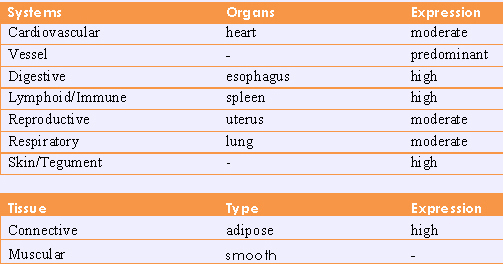
The table below shows the expression of CAV1 in different organs and tissues.
Localisation
CAV1 is localized in the cytoplasmic side of the peripheral membrane of the cell in caveolae and in the Golgi apparatus membrane.
Membrane protein of caveolae. Potential hairpin-like structure in the membrane.
Membrane protein of caveolae. Potential hairpin-like structure in the membrane.
Function
- Transforming suppressor activity in T cell leukemia.
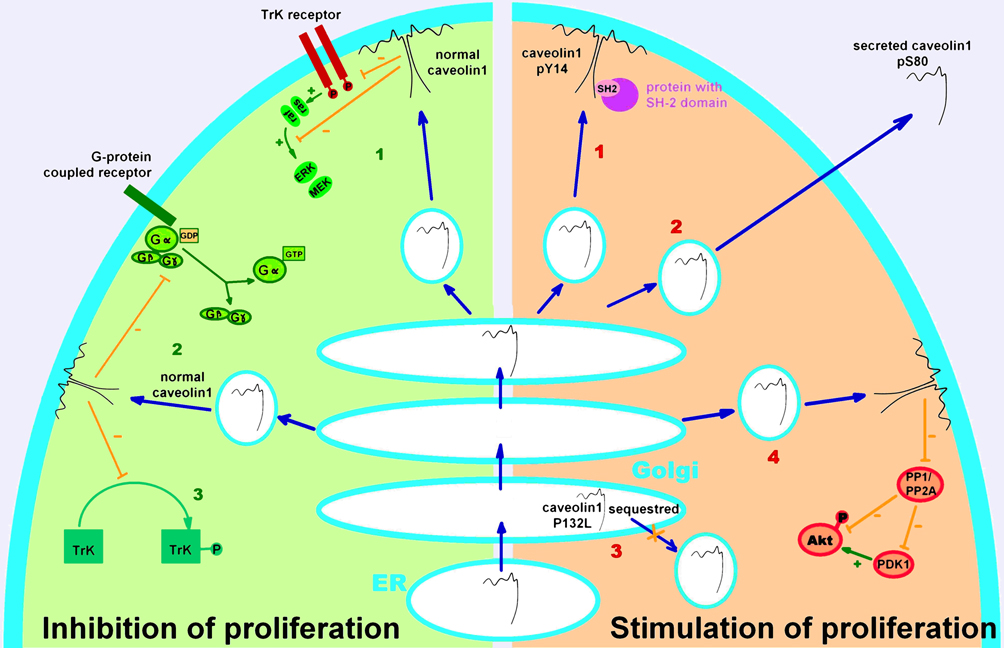
- Playing a functional role in a novel post-Golgi trafficking pathway.
- Playing a crucial role in the mechanisms that coordinate lipid metabolism with the proliferative response occurring in the liver after cellular injury.
- Being essential for liver regeneration.
- Regulating the trafficking of SLC1A1 on and off the plasma membrane.
- As an important regulator of downstream signaling and membrane targeting of EPHB1.
- CAV1 represents a key switch between tumor suppression and metastases promotion.
- Playing a functional role in a novel post-Golgi trafficking pathway.
- Playing a crucial role in the mechanisms that coordinate lipid metabolism with the proliferative response occurring in the liver after cellular injury.
- Being essential for liver regeneration.
- Regulating the trafficking of SLC1A1 on and off the plasma membrane.
- As an important regulator of downstream signaling and membrane targeting of EPHB1.
- CAV1 represents a key switch between tumor suppression and metastases promotion.
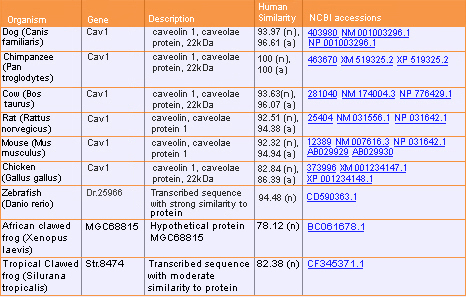
Homology
The table above shows the homology of CAV1 with different organisms.
Mutations
Somatic
Converting proline-132 to leucine is a dominant-negative mutation of caveolin-1 that occurs in 16% of primary human breast cancer. Also identified six novel CAV1 mutations associated with ERalpha-positive breast cancers (W128Stop, Y118H, S136R, I141T, Y148H, and Y148S) (Li et al., 2006).This point mutation in the membrane spanning domain leads to mislocalization and intracellular retention of endogenous caveolin-1 and causes morphological transformation in NIH3T3 cells (Hayashi et al., 2001; Lee et al., 2002).
Converting isoleucine-141 to phenylalanine is a missense mutation of caveolin-1 found in human oral squamous cell carcinoma (Han et al., 2004).
Converting isoleucine-141 to phenylalanine is a missense mutation of caveolin-1 found in human oral squamous cell carcinoma (Han et al., 2004).
Implicated in
Note
Clinical studies accordingly validated high caveolin-1 expression as a negative prognostic factor for the overall and/or disease-free survival in patients with tumors of gastrointestinal (GI) tract (esophagus and oral cavity, pancreas, kidney), prostate, breast, lung, and brain (meningioma). For other entities, including the GI-tract (stomach, colon, liver), bladder, thyroid, brain (glioma) and Ewings sarcoma, increased caveolin-1 expression compared to matched normal tissue was validated by several independent detection methods (immunohistochemestry, pPCR, cDNAarray), however correlation with clinical outcome is pending (Burgermeister et al., 2008).
Entity name
Pancreatic cancer
Prognosis
CAV1 expression is increased in pancreatic adenocarcinoma relative to peritumoral tissue. CAV1 expression correlates with tumor size, histological grade, conventional tissue marker for tumor progression and with reduced survival time after tumor resection. Increased CAV1 expression is an independent unfavorable prognostic factor following surgical resection. (Tanase, 2008; Suzuoki et al., 2002).
Entity name
Prostate cancer
Prognosis
CAV1 expression is increased in metastatic human prostate cancer and that CAV1 cellular protein expression is predictive of recurrence of the disease after radical prostatectomy. Recently, we reported that CAV1 is secreted by androgen-insensitive prostate cancer cells, and we detected, by Western blotting, CAV1 in the high-density lipoprotein(3) fraction of serum specimens from patients with prostate cancer. (Tahir et al., 2003).
Entity name
Lung cancer
Prognosis
Overexpression of caveolin-1 is significantly correlated with a poor prognosis in patients with pleomorphic carcinoma of the lung (PCL) and that it is a marker for predicting prognosis in PCL (Moon et al., 2005).
Entity name
Tyroid papillary carcinoma
Prognosis
Studies investigated caveolin-1 expression in thyroid neoplasms by means of immunohistochemistry. Normal follicular cells did not express caveolin-1. In papillary carcinoma, caveolin-1 expression was observed in high incidence, and especially in microcancer. (Ito et al., 2002).
Entity name
Brain tumors
Prognosis
All studied astrocitomas of any grade (from II to IV) were CAV1 positive, displaying staining patterns and intensity specifically associated to the different tumor grades. In glioblastomas and gliosarcomas, CAV1 staining is extremely intense, typically localized at the cell membrane and recognized a variable percentage of cells, including the majority of spindle cells and palisade-oriented perinecrotic cells. In contrast oligodendrogliomas lacks CAV1 immunoreactivity. A well structured membrane pattern of CAV1 associates with tumor progression, suggesting a neoplastic shift towards a mesenchymal phenotype. (Cassoni et al., 2007).
Entity name
Mammary carcinoma
Prognosis
No Caveolin-1 expression was observed in epithelial cells of normal breast tissue, benign breast disease and ductal carcinoma in situ. However, Caveolin-1 expression was found in 32 of 109 cases of invasive breast carcinomas (29.4%). Caveolin-1 expression in invasive breast cancer could neither be correlated with survival parameters such as overall or disease-free survival nor with established clinical and pathological markers. (Liedtke et al., 2007).
Article Bibliography
| Pubmed ID | Last Year | Title | Authors |
|---|---|---|---|
| 18482795 | 2008 | Caveats of caveolin-1 in cancer progression. | Burgermeister E et al |
| 17460461 | 2007 | Caveolin-1 expression is variably displayed in astroglial-derived tumors and absent in oligodendrogliomas: concrete premises for a new reliable diagnostic marker in gliomas. | Cassoni P et al |
| 14719121 | 2004 | Mutation and aberrant expression of Caveolin-1 in human oral squamous cell carcinomas and oral cancer cell lines. | Han SE et al |
| 11289096 | 2001 | Invasion activating caveolin-1 mutation in human scirrhous breast cancers. | Hayashi K et al |
| 11953823 | 2002 | Caveolin-1 overexpression is an early event in the progression of papillary carcinoma of the thyroid. | Ito Y et al |
| 10631317 | 2000 | Caveolin-1 isoforms are encoded by distinct mRNAs. Identification Of mouse caveolin-1 mRNA variants caused by alternative transcription initiation and splicing. | Kogo H et al |
| 12091389 | 2002 | Src-induced phosphorylation of caveolin-2 on tyrosine 19. Phospho-caveolin-2 (Tyr(P)19) is localized near focal adhesions, remains associated with lipid rafts/caveolae, but no longer forms a high molecular mass hetero-oligomer with caveolin-1. | Lee H et al |
| 16723714 | 2006 | Caveolin-1 mutations in human breast cancer: functional association with estrogen receptor alpha-positive status. | Li T et al |
| 17915016 | 2007 | Caveolin-1 expression in benign and malignant lesions of the breast. | Liedtke C et al |
| 16334154 | 2005 | Expression of caveolin-1 in pleomorphic carcinoma of the lung is correlated with a poor prognosis. | Moon KC et al |
| 18300018 | 2008 | Caveolin-1: a tumor-promoting role in human cancer. | Shatz M et al |
| 12402154 | 2002 | Impact of caveolin-1 expression on prognosis of pancreatic ductal adenocarcinoma. | Suzuoki M et al |
| 14506154 | 2003 | Development of an immunoassay for serum caveolin-1: a novel biomarker for prostate cancer. | Tahir SA et al |
| 18598222 | 2008 | Caveolin-1: a marker for pancreatic cancer diagnosis. | Tanase CP et al |
Other Information
Locus ID:
NCBI: 857
MIM: 601047
HGNC: 1527
Ensembl: ENSG00000105974
Variants:
dbSNP: 857
ClinVar: 857
TCGA: ENSG00000105974
COSMIC: CAV1
RNA/Proteins
Expression (GTEx)
Pathways
Protein levels (Protein atlas)
References
| Pubmed ID | Year | Title | Citations |
|---|---|---|---|
| 37758852 | 2024 | Clinical value of echocardiography combined with serum Cav-1, NFATc1, and PAI-1 in the diagnosis of Kawasaki disease complicated with coronary artery lesions. | 0 |
| 38164042 | 2024 | Cav-1 regulates the bile salt export pump on the canalicular membrane of hepatocytes by PKCα-associated signalling under cholesterol stimulation. | 1 |
| 38395374 | 2024 | Suppression of hypoxia-induced CAV1 autophagic degradation enhances nanoalbumin-paclitaxel transcytosis and improves therapeutic activity in pancreatic cancer. | 0 |
| 38526159 | 2024 | Scaffolds and the scaffolding domain: an alternative paradigm for caveolin-1 signaling. | 0 |
| 38627940 | 2024 | Caveolin-1's dual impact on endometrioid endometrial carcinoma: a histopathological and immunohistochemical study. | 0 |
| 38649663 | 2024 | Ago2/CAV1 interaction potentiates metastasis via controlling Ago2 localization and miRNA action. | 0 |
| 38834004 | 2024 | Inhibition of glycolysis and Src/Akt signaling reduces Caveolin-1-enhanced metastasis. | 0 |
| 38959243 | 2024 | High Caveolin-1 mRNA expression in triple-negative breast cancer is associated with an aggressive tumor microenvironment, chemoresistance, and poor clinical outcome. | 0 |
| 37758852 | 2024 | Clinical value of echocardiography combined with serum Cav-1, NFATc1, and PAI-1 in the diagnosis of Kawasaki disease complicated with coronary artery lesions. | 0 |
| 38164042 | 2024 | Cav-1 regulates the bile salt export pump on the canalicular membrane of hepatocytes by PKCα-associated signalling under cholesterol stimulation. | 1 |
| 38395374 | 2024 | Suppression of hypoxia-induced CAV1 autophagic degradation enhances nanoalbumin-paclitaxel transcytosis and improves therapeutic activity in pancreatic cancer. | 0 |
| 38526159 | 2024 | Scaffolds and the scaffolding domain: an alternative paradigm for caveolin-1 signaling. | 0 |
| 38627940 | 2024 | Caveolin-1's dual impact on endometrioid endometrial carcinoma: a histopathological and immunohistochemical study. | 0 |
| 38649663 | 2024 | Ago2/CAV1 interaction potentiates metastasis via controlling Ago2 localization and miRNA action. | 0 |
| 38834004 | 2024 | Inhibition of glycolysis and Src/Akt signaling reduces Caveolin-1-enhanced metastasis. | 0 |
Citation
Cristiana Tanase
CAV1 (caveolin 1, caveolae protein, 22kDa)
Atlas Genet Cytogenet Oncol Haematol. 2008-12-01
Online version: http://atlasgeneticsoncology.org/gene/932/cav1
