CDK4 (cyclin-dependent kinase 4)
2007-01-01 Anders Molven AffiliationSection for Pathology, The Gade Institute, Haukeland University Hospital, N-5021 Bergen, Norway
DNA/RNA
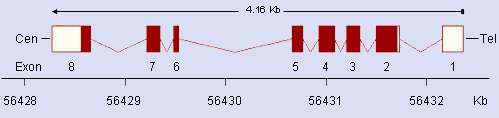
Genomic organization of the CDK4 gene on chromosome 12.
Description
CDK4 is a relatively compact gene that spans 4.16 kb of genomic DNA on the long arm of chromosome 12, in the telomere-to-centromere orientation. The gene consists of eight exons of which the first exon is non-coding. The start codon is located in the beginning of exon 2 and the stop codon in the beginning of exon 8.
Transcription
The CDK4 mRNA is 1.44 kb. In the Ensembl database, also a shorter, alternatively spliced transcript (Q96BE9_HUMAN) is listed, but there is no biological evidence for a function of this transcript or the polypeptide it may encode.
Pseudogene
The Ensembl database lists OTTHUMG00000011002 (Vega gene RP11-414B7.1) on chromosome 1 as a processed pseudogene of CDK4.
Proteins
Description
The open reading frame encodes a 303 amino acid protein with an estimated molecular weight of 33.7 kDa. CDK4 is member of the Ser-Thr protein kinase family and its catalytic domain extends from amino acid 6 to 295.
Expression
CDK4 is expressed in a variety of normal cells and tissues as well as in cancer cells. The protein is often overexpressed in human tumors (e.g. malignant melanoma, glioma, sarcoma and carcinomas of the breast, colon, lung, ovary and oral cavity).
Localisation
Nuclear or nuclear/cytoplasmic
Function
CDK4 constitutes the catalytic subunit of a heterodimeric Ser/Thr protein kinase which is involved in controlling progression through the G1 phase of the cell cycle. The activating partner of CDK4 (the regulatory subunit) is one of the D-type cyclins: CCND1, CCND2 or CCND3. Once activated, the CDK4-cyclin D complex phosphorylates members of the retinoblastoma protein family ( pRb, p107, p130). The activity of CDK4 is inhibited by the p16 (INK4A) protein, which interferes with the cyclin D-binding region.
Homology
CDK4 belongs to the mammalian Cdk family, which includes about 20 members. The cyclin-binding domain of CDK4 has the amino acid sequence PISTVRE. The overall identity of CDK4 to CDK1 is 42%.
Mutations
Germinal
Germ-line mutations in the CDK4 gene have so far only been found in families with inherited malignant melanoma and multiple atypical nevi. There are six such families reported. The mutations affect the Arg encoded by codon 24, changing it either to Cys (two families) or to His (four families).
Somatic
Amplification of the chromosomal region that includes CDK4 is commonly seen in gliomas and several subgroups of sarcomas, and may also occur in other tumors such a malignant melanomas. Point mutations have only rarely been observed and are of unknown biological significance.
Implicated in
Entity name
Sporadic malignant melanoma
Entity name
Glioma
Disease
Anaplastic astrocytoma and glioblastoma multiforme
Entity name
Sarcoma
Disease
In particular liposarcoma, alveolar rhabdomyosarcoma and osteosarcoma
Article Bibliography
| Pubmed ID | Last Year | Title | Authors |
|---|---|---|---|
| 16291983 | 2005 | Distinct sets of genetic alterations in melanoma. | Curtin JA et al |
| 8221695 | 1993 | Coamplification of the CDK4 gene with MDM2 and GLI in human sarcomas. | Khatib ZA et al |
| 16236519 | 2005 | Mammalian cyclin-dependent kinases. | Malumbres M et al |
| 15880589 | 2005 | A large Norwegian family with inherited malignant melanoma, multiple atypical nevi, and CDK4 mutation. | Molven A et al |
| 8044775 | 1994 | Amplification of multiple genes from chromosomal region 12q13-14 in human malignant gliomas: preliminary mapping of the amplicons shows preferential involvement of CDK4, SAS, and MDM2. | Reifenberger G et al |
| 9407626 | 1998 | Molecular changes during the genesis of human gliomas. | Sehgal A et al |
| 9425228 | 1998 | Prevalence of p16 and CDK4 germline mutations in 48 melanoma-prone families in France. The French Familial Melanoma Study Group. | Soufir N et al |
| 8528263 | 1996 | Germline mutations in the p16INK4a binding domain of CDK4 in familial melanoma. | Zuo L et al |
Other Information
Locus ID:
NCBI: 1019
MIM: 123829
HGNC: 1773
Ensembl: ENSG00000135446
Variants:
dbSNP: 1019
ClinVar: 1019
TCGA: ENSG00000135446
COSMIC: CDK4
RNA/Proteins
Expression (GTEx)
Pathways
Protein levels (Protein atlas)
PharmGKB
| Entity ID | Name | Type | Evidence | Association | PK | PD | PMIDs |
|---|---|---|---|---|---|---|---|
| PA445968 | Turner Syndrome | Disease | ClinicalAnnotation | associated | PD | 23567489 | |
| PA451446 | somatropin recombinant | Chemical | ClinicalAnnotation | associated | PD | 23567489 |
References
| Pubmed ID | Year | Title | Citations |
|---|---|---|---|
| 37694982 | 2024 | N6-methyladenosine-induced METTL1 promotes tumor proliferation via CDK4. | 1 |
| 38135020 | 2024 | Beyond cell cycle regulation: The pleiotropic function of CDK4 in cancer. | 0 |
| 38378843 | 2024 | Deregulation of the p19/CDK4/CDK6 axis in Jak2(V617F) megakaryocytes accelerates the development of myelofibrosis. | 0 |
| 38520914 | 2024 | Combined SET7/9 and CDK4 inhibition act synergistically against osteosarcoma. | 0 |
| 38588409 | 2024 | Comprehensive Transcriptomic Analysis of EWSR1::WT1 Targets Identifies CDK4/6 Inhibitors as an Effective Therapy for Desmoplastic Small Round Cell Tumors. | 0 |
| 38732173 | 2024 | DDX18 Facilitates the Tumorigenesis of Lung Adenocarcinoma by Promoting Cell Cycle Progression through the Upregulation of CDK4. | 0 |
| 37694982 | 2024 | N6-methyladenosine-induced METTL1 promotes tumor proliferation via CDK4. | 1 |
| 38135020 | 2024 | Beyond cell cycle regulation: The pleiotropic function of CDK4 in cancer. | 0 |
| 38378843 | 2024 | Deregulation of the p19/CDK4/CDK6 axis in Jak2(V617F) megakaryocytes accelerates the development of myelofibrosis. | 0 |
| 38520914 | 2024 | Combined SET7/9 and CDK4 inhibition act synergistically against osteosarcoma. | 0 |
| 38588409 | 2024 | Comprehensive Transcriptomic Analysis of EWSR1::WT1 Targets Identifies CDK4/6 Inhibitors as an Effective Therapy for Desmoplastic Small Round Cell Tumors. | 0 |
| 38732173 | 2024 | DDX18 Facilitates the Tumorigenesis of Lung Adenocarcinoma by Promoting Cell Cycle Progression through the Upregulation of CDK4. | 0 |
| 35982377 | 2023 | Overexpressed Cyclin D1 and CDK4 proteins are responsible for the resistance to CDK4/6 inhibitor in breast cancer that can be reversed by PI3K/mTOR inhibitors. | 17 |
| 36244542 | 2023 | IKBIP, a novel glioblastoma biomarker, maintains abnormal proliferation of tumor cells by inhibiting the ubiquitination and degradation of CDK4. | 5 |
| 36617978 | 2023 | MicroRNA-1205 Suppresses Hepatocellular Carcinoma Cell Proliferation via a CSNK2B/CDK4 Axis. | 1 |
Citation
Anders Molven
CDK4 (cyclin-dependent kinase 4)
Atlas Genet Cytogenet Oncol Haematol. 2007-01-01
Online version: http://atlasgeneticsoncology.org/gene/238/cdk4
