Identity
HGNC
LOCATION
17q23.1
LOCUSID
ALIAS
CHC,CHC17,CLH-17,CLTCL2,Hc,MRD56
FUSION GENES
DNA/RNA
Transcription
32 exons, 6111 bp mRNA
Proteins
Description
Clathrin is the major protein constituent of the coat that surrounds organelles (cytoplasmic vesicles) to mediate selective protein transport. Clathrin coats are involved in receptor-mediated endocytosis and intracellular trafficking and recycling of receptors, which accounts for its characteristic punctate cytoplasmic and perinuclear cellular distribution. Structurally, clathrin is a triskelion (three-legged) shaped protein complex that is composed of a trimer of heavy chains (CLTC) each bound to a single light chain. CLTC is a 1675 amino acid residue protein encoded by a gene consisting of 32 exons. Its known domains include a N-terminal globular domain (residues 1-494) that interacts with adaptor proteins (AP-1, AP-2, b-arrestin), a light chain-binding region (residues 1074-1552), and a trimerization domain (residues 1550-1600) near the C-terminus.
Localisation
Cytoplasmic vesicles
Function
mediate endocytosis of transmembrane receptors.
Implicated in
Entity name
Disease
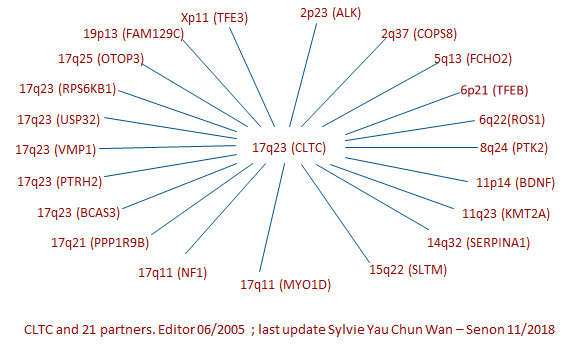
ALCL are high grade non Hodgkin lymphomas; ALK+ ALCL are ALCL where ALK is involved in a fusion gene; ALK+ ALCL represent 50 to 60 % of ALCL cases (they are CD30+, ALK+;); belong to the "cytoplasmic ALK+" subset.
Prognosis
Although presenting as a high grade tumour, a 80% five yr survival is associated with this anomaly
Hybrid gene
5 CLTC - 3 ALK
Fusion protein
NH2 CLTC - COOH ALK
Entity name
Inflammatory myofibroblastic tumors with t(2;17)(p23;q23)
Note
In these tumors, the fusion point in CLTC is identical, being at amino acid 1634 (corresponding to the 3 end of exon 31 of CLTC), such that almost all of CLTC is included in the fusion protein, including its trimerization domain . As a fusion partner, CLTC has been postulated to provide CLTC-ALK with deregulated expression driven by its constitutively activated promoter and constitutive oligomerization of the chimeric protein via the CLTC multimerization domains normally used for clathrin coat assembly. Since ALK is a tyrosine kinase that is activated by cross-phosphorylation following ligand binding, CLTC-ALK-induced oligomerization may result in a constitutively activated ALK tyrosine kinase domain. In this sense, CLTC is likely to function in CLTC-ALK as other prototypical "dimerizing translocation partners" in fusions involving tyrosine kinase genes.
Disease
rare soft tissue tumour found in children and young adults
Prognosis
good prognosis
Hybrid gene
5 CLTC - 3 ALK
Entity name
Xp11 renal translocation carcinoma with t(X;17)(p11;q23)
Note
In the CLTC-TFE3 fusion, the fusion point on CLTC is at amino acid 932 (corresponding to the end of exon 17), thereby excluding the CLTC trimerization domain from the predicted fusion protein. As in other TFE3 gene fusions, the nuclear localization and DNA binding domains of TFE3 are retained in CLTC-TFE3. Based on these features and existing data on other TFE3 fusion proteins, CLTC-TFE3 may act as an aberrant transcription factor, with the CLTC promoter driving constitutive expression.
Disease
rare renal carcinoma (single case report)
Prognosis
Unknown prognosis
Hybrid gene
5 CLTC 3TFE3
Breakpoints
Article Bibliography
| Pubmed ID | Last Year | Title | Authors |
|---|---|---|---|
| 12917640 | 2003 | A novel CLTC-TFE3 gene fusion in pediatric renal adenocarcinoma with t(X;17)(p11.2;q23). | Argani P et al |
| 11485898 | 2001 | Fusion of the ALK gene to the clathrin heavy chain gene, CLTC, in inflammatory myofibroblastic tumor. | Bridge JA et al |
| 12112524 | 2002 | Identification of novel fusion partners of ALK, the anaplastic lymphoma kinase, in anaplastic large-cell lymphoma and inflammatory myofibroblastic tumor. | Cools J et al |
| 1765375 | 1991 | Human clathrin heavy chain (CLTC): partial molecular cloning, expression, and mapping of the gene to human chromosome 17q11-qter. | Dodge GR et al |
| 10966473 | 2000 | Clathrin. | Kirchhausen T et al |
| 9242916 | 1997 | Clathrin-coated vesicle formation and protein sorting: an integrated process. | Schmid SL et al |
| 10360576 | 1999 | Clathrin self-assembly is mediated by a tandemly repeated superhelix. | Ybe JA et al |
Other Information
Locus ID:
NCBI: 1213
MIM: 118955
HGNC: 2092
Ensembl: ENSG00000141367
Variants:
dbSNP: 1213
ClinVar: 1213
TCGA: ENSG00000141367
COSMIC: CLTC
RNA/Proteins
Expression (GTEx)
Pathways
Protein levels (Protein atlas)
References
| Pubmed ID | Year | Title | Citations |
|---|---|---|---|
| 37522373 | 2023 | Expanding Our Knowledge of Molecular Pathogenesis in Histiocytoses: Solitary Soft Tissue Histiocytomas in Children With a Novel CLTC::SYK Fusion. | 0 |
| 37624798 | 2023 | Knockout of CLTC gene reduces but not completely block SFTSV infection. | 0 |
| 37522373 | 2023 | Expanding Our Knowledge of Molecular Pathogenesis in Histiocytoses: Solitary Soft Tissue Histiocytomas in Children With a Novel CLTC::SYK Fusion. | 0 |
| 37624798 | 2023 | Knockout of CLTC gene reduces but not completely block SFTSV infection. | 0 |
| 34230591 | 2022 | Novel CLTC variants cause new brain and kidney phenotypes. | 3 |
| 35289445 | 2022 | Molecular investigation of ALK-rearranged epithelioid fibrous histiocytomas identifies CLTC as a novel fusion partner and evidence of fusion-independent transcription activation. | 1 |
| 34230591 | 2022 | Novel CLTC variants cause new brain and kidney phenotypes. | 3 |
| 35289445 | 2022 | Molecular investigation of ALK-rearranged epithelioid fibrous histiocytomas identifies CLTC as a novel fusion partner and evidence of fusion-independent transcription activation. | 1 |
| 33476648 | 2021 | SARS-CoV-2 infects cells after viral entry via clathrin-mediated endocytosis. | 261 |
| 34185412 | 2021 | Deregulation of CLTC interacts with TFG, facilitating osteosarcoma via the TGF-beta and AKT/mTOR signaling pathways. | 5 |
| 34436540 | 2021 | Clathrin: the molecular shape shifter. | 9 |
| 33476648 | 2021 | SARS-CoV-2 infects cells after viral entry via clathrin-mediated endocytosis. | 261 |
| 34185412 | 2021 | Deregulation of CLTC interacts with TFG, facilitating osteosarcoma via the TGF-beta and AKT/mTOR signaling pathways. | 5 |
| 34436540 | 2021 | Clathrin: the molecular shape shifter. | 9 |
| 31562907 | 2020 | Clathrin switches transforming growth factor-β role to pro-tumorigenic in liver cancer. | 22 |
Citation
Pedram Argani ; Marc Ladanyi
CLTC (clathrin heavy polypeptide)
Atlas Genet Cytogenet Oncol Haematol. 2005-04-01
Online version: http://atlasgeneticsoncology.org/gene/360/cltc
Historical Card
2003-08-01 CLTC (clathrin heavy polypeptide) by Jean-Loup Huret,Sylvie Senon Affiliation
Genetics, Dept Medical Information, University of Poitiers, CHU Poitiers Hospital, F-86021 Poitiers, France
2001-08-01 CLTC (clathrin heavy polypeptide) by Jean-Loup Huret Affiliation
Genetics, Dept Medical Information, University of Poitiers, CHU Poitiers Hospital, F-86021 Poitiers, France
