CSF1R (colony stimulating factor 1 receptor, formerly McDonough feline sarcoma viral (v-fms) oncogene homolog)
2008-04-01 John Adams Fischer , Stefano Rossetti , Nicoletta Sacchi AffiliationRoswell Park Cancer Institute, Department of Cancer Biology, Elm, Carlton Streets, Buffalo, NY 14263, USA
Identity
HGNC
LOCATION
5q32
IMAGE

LEGEND
CSF1R (colony stimulating factor 1 receptor, formerly McDonough feline sarcoma viral (v-fms) oncogene homolog) Hybridization with Vysis CSF1R/D5S23, D5S721 FISH Probe Kit (Abbott Molecular, US) showing the CSF1R gene located on 5q32 (red signals) - Courtesy Adriana Zamecnikova
LOCUSID
ALIAS
BANDDOS,C-FMS,CD115,CSF-1R,CSFR,FIM2,FMS,HDLS,M-CSF-R
FUSION GENES
DNA/RNA
Note
The presence of an anti-sense CSF1R transcript starting within the FIRE region has been reported in mouse macrophages and B cells.
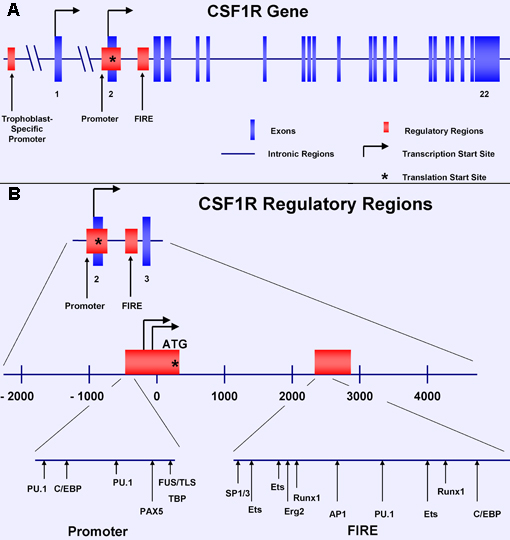
A: Genomic structure of the human CSF1R gene.
B: Scheme showing the regulatory regions of the mouse Csf1r gene. The regulatory regions and transcription binding sites within are highly conserved between mouse and human. (Diagram based on Bonifer et al. Frontiers in Bioscience 2008)
Description
The human CSF1R gene, on the minus strand, spans a region of 60,077 bases (Start: 149,413,051 bp from pter; End: 149,473,128 bp from pter) interrupted by introns ranging from 26kb for intron 1, to a range between 6.3kb to less than 0.1 kb for the other introns. The human CSF1R gene is composed of a total of 22 exons, of which the first exon is non-coding and where the remaining 21 exons (starting with exon 2) encode for the CSF1R protein.
The human CSF1R and mouse Csf1r genomic structures are highly conserved.
The human CSF1R and mouse Csf1r genomic structures are highly conserved.
Transcription
The 5 end of the human CSF1R gene has 2 alternative transcription start site regions, preceded by two alternative promoters. The transcription of CSF1R mRNA can be initiated at the two independent start sites in a tissue specific manner. The transcription of exon 1 through exon 22 occurs only in placental trophoblasts, and is driven by a trophoblast-specific promoter approximately 20kb upstream of the first exon. The transcript produced is predicted to be approximately 4kb long. In macrophages and a few other tissues (see expression section) transcription of CSF1R occurs only from exon 2 through exon 22 producing a transcript predicted to be approximately 3.9kb in length, which is translated into the CSF1R protein. The transcription this transcript is under the control of two major regulatory regions, which are highly conserved between human and mouse: the Promoter upstream of exon 2 and the fms-intronic regulatory region (FIRE). Most studies on CSF1R transcriptional regulation have focused on the mouse gene. However, most of the features of mouse Csf1r are highly conserved in human.
The mouse Csf1r promoter is TATA-less, and drives transcription from multiple sites (known as broad class transcription start sites). This promoter is not GC rich and there are no CpG islands in the vicinity. This promoter contains binding sites for various transcription factors including: PU.1, C/EBP, PAX5, and FUS/TLS - TBP. The mouse FIRE region is located in the second intron, approximately 2kb downstream from the transcription start site. It contains binding sites for a number of transcription factors including: Sp1 / Sp3, Ets, Egr-2 / Sp1, Runx1, AP-1 as well as PU.1 and C/EBP. With a few exceptions, the features described for the mouse Csfr1 regulatory regions are highly conserved in human. Specifically, the human CSF1R can be regulated in a hormone dependent fashion via a glucocorticoid response element present in the human CSF1R promoter, but not in the mouse Csf1r promoter.
The mouse Csf1r promoter is TATA-less, and drives transcription from multiple sites (known as broad class transcription start sites). This promoter is not GC rich and there are no CpG islands in the vicinity. This promoter contains binding sites for various transcription factors including: PU.1, C/EBP, PAX5, and FUS/TLS - TBP. The mouse FIRE region is located in the second intron, approximately 2kb downstream from the transcription start site. It contains binding sites for a number of transcription factors including: Sp1 / Sp3, Ets, Egr-2 / Sp1, Runx1, AP-1 as well as PU.1 and C/EBP. With a few exceptions, the features described for the mouse Csfr1 regulatory regions are highly conserved in human. Specifically, the human CSF1R can be regulated in a hormone dependent fashion via a glucocorticoid response element present in the human CSF1R promoter, but not in the mouse Csf1r promoter.
Pseudogene
The first CSF1R intron contains a transcriptionally inactive ribosomal protein L7 processed pseudogene that is oriented in the opposite direction of the CSF1R gene itself. This pseudogene is not functional but its sequence is highly conserved across all mammalian species.
Proteins
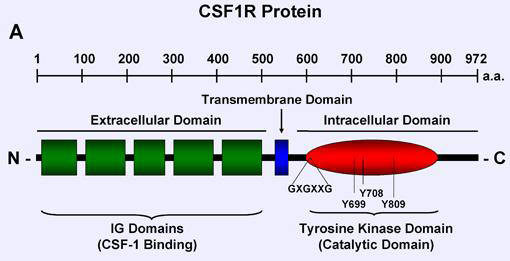
CSF1R Protein Structure. A. Schematic representation of CSF1R protein showing the CSF1-binding IG domains in the extracellular portion, and the tyrosine kinase catalytic domain in the intracellular portion. Phosphorylated tyrosines (Y) are indicated.
Description
The CSF1R protein consists of 972 amino acids and has a molecular mass of approximately 108 kDa. However due to post-translational modifications, which include phosphorylation, glycosylation, and the acquisition of N-linked oligosaccharides, the proteins molecular size increases. The CSF1R protein also contains a signal peptide and a 512 amino acid N-terminal extracellular segment which contains the ligand binding domain, a hydrophobic 25 amino acid membrane spanning region, and intracellular domain 435 amino acids in length that includes all sequences necessary for tyrosine kinase activity (occurring at tyrosine (Y) Y699 and Y708, as well as Y809). The CSF1R protein contains a glycine-rich signature sequence that is characteristic of kinases, as well as an ATP binding site at lysine (K) K616. The immature intracellular glycoprotein has a molecular mass of 130 kDa after it acquires N-linked oligosaccharides of the high mannose type during co-translational glycosylation. The molecular mass of CSF1R is increased further during intracellular transport to the plasma membrane, where the glycoproteins N-linked carbohydrates undergo modifications in the Golgi complex, resulting in an increase to 150 kDa molecular mass. There are variations in molecular mass of CSF1R across species due to the differential processing of carbohydrate chains in a species specific manner.

CSF1R Protein Structure. B. Diagram of the 2.7 A Crystal Structure of the Autoinhibited Human CSF1R/ kinase Domain (as described in Walter et al. J. Mol. Biol. 2007).
Expression
The major site of CSF1R expression is in macrophages. In hematopoiesis, CSF1R is upregulated during monocytic differentiation, but is downregulated during granulopoiesis. CSF1R is expressed predominantly in committed macrophage precursors (CFU-Ms), monocytes, and tissue macrophages. CSF1R mRNA can be detected granulocytes, but is not translated. CSF1R mRNA/protein expression has been reported also in non-hematopoietic cells such as trophoblasts (where is seems to derive from an alternative transcript including the non-coding exon 1), osteoclasts, smooth muscle cells, and neurons, as well as in female mammary gland epithelium during development and lactation. Expression of CSF1R mRNA/protein has also been reported in breast, ovarian, and endometrial tumors, as well as in hepatocellular carcinomas.
CSF1R expression during hematopoiesis is regulated by tissue-specific sets of transcription factors that play a key role in myeloid differentiation. CSF1R is activated in a synergistic manner by the co-expression of the macrophage-specific transcription factor Pu.1 and c-Ets-2. During B-cell lineage restriction and differentiation, the CSF1R gene is repressed by the transcription factor PAX5. It has been shown that PAX5 is required during B-cell differentiation to keep CSF1R in a silent state. It has also been shown that CSF1R can be repressed by Foxp1, a forkhead transcription factor that is in turn regulated by the Beta-2-integrin Mac-1.
CSF1R expression during hematopoiesis is regulated by tissue-specific sets of transcription factors that play a key role in myeloid differentiation. CSF1R is activated in a synergistic manner by the co-expression of the macrophage-specific transcription factor Pu.1 and c-Ets-2. During B-cell lineage restriction and differentiation, the CSF1R gene is repressed by the transcription factor PAX5. It has been shown that PAX5 is required during B-cell differentiation to keep CSF1R in a silent state. It has also been shown that CSF1R can be repressed by Foxp1, a forkhead transcription factor that is in turn regulated by the Beta-2-integrin Mac-1.
Localisation
CSF1R is located at the cell plasma membrane. Transport of CSF1R from the endoplasmic reticulum (the site of synthesis) to the plasma membrane occurs efficiently with detection of the receptor at the surface within 30 minutes of synthesis.
Function
CSF1R is the receptor for the ligand colony stimulating factor-1 (CSF1). CSF1R is an integral transmembrane glycoprotein that exhibits ligand-induced tyrosine-specific protein kinase activity, which triggers a signaling cascade eventually affecting transcription of CSF1-responsive genes. CSF1R tyrosine phosphorylation is induced upon binding of CSF1, leading to activation of Ras / Erk and class I-A phosphatidylinositol 3-kinase signaling pathways, which in turn activate the signal transducers and activators of transcription (STATs) pathways, specifically STAT1, STAT3, and STAT5. CSF1R activation by CSF1 results in increased growth, proliferation and differentiation.
Homology
Like the CSF1R gene, the CSF1R protein sequence appears to be conserved across Euteleostomi (vertebrates) including: Homo sapiens (Human), Canis lupus familiaris (Dog), Mus musculus (Mouse), Rattus norvegicus (Rat), Gallus gallus (Chicken), and Danio rerio (Zebrafish).
CSF1R is a member of the gp140 family of the type I cytokine receptor group and shares a high degree of amino acid sequence homology to platelet-derived growth factor receptor (PDGFRB), specifically in its kinase domain.
CSF1R is a member of the gp140 family of the type I cytokine receptor group and shares a high degree of amino acid sequence homology to platelet-derived growth factor receptor (PDGFRB), specifically in its kinase domain.
Mutations
Germinal
None identified as of yet.
Somatic
Chromosomal abnormalities: A partial deletion of chromosome 5 containing the CSF1R locus has been consistently observed in patients with myelodysplastic syndrome. The CSF1R locus is also affected by the acute megakaryoblastic leukemia-associated translocation t(3;5)(p21;q33) in which the CSF1R gene on chromosome 5 is fused to the RBM6 gene on chromosome 3, resulting in a fusion protein RBM6-CSF1R.
Gene mutations: CSF1R point mutations have been detected mainly in hematopoietic/lymphoid tissue and liver, where they correlate with myelodysplastic syndrome and acute myeloid leukemia (AML) and hepatocellular carcinoma, respectively. Specifically, mutations at codons 301 (exon 7) and 969 (exon 22) seem to occur with a higher frequency in both tissues. According to earlier studies these are activating mutations that would play a role in leukemogenesis. However, later studies have failed to find these mutations in AML patients. Additional mutations were discovered in AML patients at codons 245 (exon 6) and 413 (exon 9). However, their contribution to leukemogenesis is not known.
Epi-mutations: Specific fusion proteins resulting from leukemia-associated chromosomal translocations, including the AML1-MTG fusion proteins, result in transcriptional down-regulation of specific AML1 target genes such as CSF1R. AML1-MTG-induced CSF1R downregulation is epigenetic, as it is marked by specific repressive histone changes as well as DNA hypermethylation at the CSF1R regulatory regions. CSF1R epigenetic down-regulation is associated with block of myeloid differentiation and defects in cell proliferation in vitro.
Gene mutations: CSF1R point mutations have been detected mainly in hematopoietic/lymphoid tissue and liver, where they correlate with myelodysplastic syndrome and acute myeloid leukemia (AML) and hepatocellular carcinoma, respectively. Specifically, mutations at codons 301 (exon 7) and 969 (exon 22) seem to occur with a higher frequency in both tissues. According to earlier studies these are activating mutations that would play a role in leukemogenesis. However, later studies have failed to find these mutations in AML patients. Additional mutations were discovered in AML patients at codons 245 (exon 6) and 413 (exon 9). However, their contribution to leukemogenesis is not known.
Epi-mutations: Specific fusion proteins resulting from leukemia-associated chromosomal translocations, including the AML1-MTG fusion proteins, result in transcriptional down-regulation of specific AML1 target genes such as CSF1R. AML1-MTG-induced CSF1R downregulation is epigenetic, as it is marked by specific repressive histone changes as well as DNA hypermethylation at the CSF1R regulatory regions. CSF1R epigenetic down-regulation is associated with block of myeloid differentiation and defects in cell proliferation in vitro.
Implicated in
Entity name
Disease
The human CSF1R gene is consistently lost by partial deletions occurring in chromosome 5 in MDS patients. Moreover, specific deletion of the CSFS1R gene has been detected in as many as 40% of MDS patients.
Entity name
Disease
Early studies had suggested a link between AML and the presence of CSF1R codon 301 and 969 activating mutations. While there is strong evidence that these mutations have potential transforming activity, recent studies have failed to find these mutations in AML patients. Thus the pathogenic role of CSF1R mutations in leukemogenesis is still controversial.
CSF1R might be involved in leukemia through mechanisms other than gene mutations. CSF1R downregulation has been reported in specific AML subtypes. One of the factors that may lead to CSF1R downregulation is the expression of the AML-associated fusion proteins AML1-MTG8 (AML1-ETO) and AML1-MTG16, derived from the t(8;21) and t(16;21) chromosomal translocations, respectively. Specifically, in patients with the t(8;21) translocation, which accounts for approximately 12% of all AML cases, CSF1R down-regulation is marked by epigenetic repressive changes (epi-mutations).
CSF1R might be involved in leukemia through mechanisms other than gene mutations. CSF1R downregulation has been reported in specific AML subtypes. One of the factors that may lead to CSF1R downregulation is the expression of the AML-associated fusion proteins AML1-MTG8 (AML1-ETO) and AML1-MTG16, derived from the t(8;21) and t(16;21) chromosomal translocations, respectively. Specifically, in patients with the t(8;21) translocation, which accounts for approximately 12% of all AML cases, CSF1R down-regulation is marked by epigenetic repressive changes (epi-mutations).
Entity name
Disease
CSF1R has been reported to be affected by the chromosomal translocation t(3;5)(p21;q33) in the AMKL cell line MKPL-1. The fusion protein produced by this translocation, RBM6-CSF1R is found only in the cytoplasm and is constitutively active in the megakaryocyte lineage. The RBM6-CSF1R confers IL-3 independence to the mouse Pro-B cell line BaF3, and induced myeloproliferative disease in a murine transplant model. The AMKL subtype represents 1% or less of the cases of AML. It most often occurs in children, and is associated with Down syndrome. The prognosis for AMKL is poor.
Entity name
Breast Cancer
Disease
58% of all breast carcinomas and 85% of invasive breast carcinomas express higher levels of CSF1R compared to normal resting breast tissue. It has been demonstrated that exogenous expression of CSF1R in untransformed human mammary epithelial cells results in aberrant acinar morphogenesis, anchorage-independent growth and an invasive phenotype. Expression of CSF1R in breast tumors correlates with increased invasiveness and adverse prognostic features like high histological grade, and an advanced clinical stage of presentation of breast cancer.
Entity name
Cervical Cancer
Disease
A significant increase in CSF1R expression has been reported in cervical carcinomas as compared to normal cervical tissue. The expression of CSF1R in cervical cancer is usually associated with a more aggressive and invasive disease. It has been suggested that there is an autocrine mode of regulation by CSF1 in this cancer cell type.
Breakpoints
Note
The only breakpoint known for the CSF1R gene can be inferred by the identification of the novel fusion protein RBM6-CSF1R, in which the N-terminal portion of the RBM6 (a.a. 1-36) is fused to the C-terminal portion of CSF1R (a.a. 574-972). This fusion protein is predicated to be produced by the translocation t(3;5)(p21;q33).
Article Bibliography
| Pubmed ID | Last Year | Title | Authors |
|---|---|---|---|
| 1825026 | 1991 | Expression of the macrophage colony-stimulating factor and its receptor in gynecologic malignancies. | Baiocchi G et al |
| 15062647 | 2004 | Regulation of myeloid development and function by colony stimulating factors. | Barreda DR et al |
| 17981568 | 2008 | The transcriptional regulation of the Colony-Stimulating Factor 1 Receptor (csf1r) gene during hematopoiesis. | Bonifer C et al |
| 11756160 | 2002 | Targeted disruption of the mouse colony-stimulating factor 1 receptor gene results in osteopetrosis, mononuclear phagocyte deficiency, increased primitive progenitor cell frequencies, and reproductive defects. | Dai XM et al |
| 15637141 | 2005 | Macrophage colony-stimulating factor receptor c-fms is a novel target of imatinib. | Dewar AL et al |
| 15917650 | 2005 | Inhibition of c-fms by imatinib: expanding the spectrum of treatment. | Dewar AL et al |
| 11071910 | 2000 | Colony-stimulating factor-1 receptor utilizes multiple signaling pathways to induce cyclin D2 expression. | Dey A et al |
| 11891846 | 2002 | Hormonal regulation of the c-fms proto-oncogene in breast cancer cells is mediated by a composite glucocorticoid response element. | Flick MB et al |
| 15806141 | 2005 | c-FMS chromatin structure and expression in normal and leukaemic myelopoiesis. | Follows GA et al |
| 17360941 | 2007 | A novel fusion of RBM6 to CSF1R in acute megakaryoblastic leukemia. | Gu TL et al |
| 9261328 | 1997 | CSF-1 signal transduction. | Hamilton JA et al |
| 12480707 | 2003 | AML1/MTG8 oncogene suppression by small interfering RNAs supports myeloid differentiation of t(8;21)-positive leukemic cells. | Heidenreich O et al |
| 6302985 | 1983 | Isolation of v-fms and its human cellular homolog. | Heisterkamp N et al |
| 17556068 | 2007 | Evaluation of chromosome 5 aberrations in complex karyotypes of patients with myeloid disorders reveals their contribution to dicentric and tricentric chromosomes, resulting in the loss of critical 5q regions. | Herry A et al |
| 16007221 | 2005 | The Runx1 transcription factor controls CSF-1-dependent and -independent growth and survival of macrophages. | Himes SR et al |
| 8981363 | 1997 | Regulation of CSF-1 receptor expression. | Hume DA et al |
| 11775455 | 2002 | Expression of CSF-1 and its receptor CSF-1R in non-hematopoietic neoplasms. | Kascinski B et al |
| 17332318 | 2007 | Elevated expression of the oncogene c-fms and its ligand, the macrophage colony-stimulating factor-1, in cervical cancer and the role of transforming growth factor-beta1 in inducing c-fms expression. | Kirma N et al |
| 16514418 | 2006 | Colony-stimulating factor-1 requires PI3-kinase-mediated metabolism for proliferation and survival in myeloid cells. | Lee AW et al |
| 1385636 | 1992 | Rare point mutation at codon 301 and 969 of FMS/M-CSF receptor in acute myelomonocytic and monocytic leukemia. | Natazuka T et al |
| 4028159 | 1985 | Expression of the human c-fms proto-oncogene in hematopoietic cells and its deletion in the 5q- syndrome. | Nienhuis AW et al |
| 8112745 | 1994 | Autosomal dominant cyclic hematopoiesis: exclusion of linkage to the major hematopoietic regulatory gene cluster on chromosome 5. | Palmer SE et al |
| 1532134 | 1992 | Expression of the colony-stimulating factor-1 receptor (c-fms proto-oncogene product) in the human uterus and placenta. | Pampfer S et al |
| 11886377 | 2002 | Class III receptor tyrosine kinases: role in leukaemogenesis. | Reilly JT et al |
| 3011859 | 1986 | Expression of the human c-fms proto-oncogene product (colony-stimulating factor-1 receptor) on peripheral blood mononuclear cells and choriocarcinoma cell lines. | Rettenmier CW et al |
| 16007222 | 2005 | Myeloid maturation block by AML1-MTG16 is associated with Csf1r epigenetic downregulation. | Rossetti S et al |
| 12695672 | 2003 | Oncogenic potential of the c-FMS proto-oncogene (CSF-1 receptor). | Roussel MF et al |
| 14709771 | 2004 | The role of CSF-1 in normal physiology of mammary gland and breast cancer: an update. | Sapi E et al |
| 2153029 | 1990 | Colony-stimulating factor-1 receptor. | Sherr CJ et al |
| 3022923 | 1986 | The fms gene and the CSF-1 receptor. | Sherr CJ et al |
| 2852667 | 1988 | Colony-stimulating factor-1 receptor (c-fms). | Sherr CJ et al |
| 2848991 | 1988 | The role of the CSF-1 receptor gene (C-fms) in cell transformation. | Sherr CJ et al |
| 16781947 | 2006 | Integrin signals, transcription factors, and monocyte differentiation. | Shi C et al |
| 17960171 | 2008 | Cooperating mutations of receptor tyrosine kinases and Ras genes in childhood core-binding factor acute myeloid leukemia and a comparative analysis on paired diagnosis and relapse samples. | Shih LY et al |
| 8981357 | 1997 | Biology and action of colony--stimulating factor-1. | Stanley ER et al |
| 16482219 | 2006 | The mechanism of repression of the myeloid-specific c-fms gene by Pax5 during B lineage restriction. | Tagoh H et al |
| 15483629 | 2004 | Epigenetic silencing of the c-fms locus during B-lymphopoiesis occurs in discrete steps and is reversible. | Tagoh H et al |
| 17420255 | 2007 | c-Fms tyrosine 559 is a major mediator of M-CSF-induced proliferation of primary macrophages. | Takeshita S et al |
| 17292918 | 2007 | The 2.7 A crystal structure of the autoinhibited human c-Fms kinase domain. | Walter M et al |
| 10462686 | 1999 | Expression of colony stimulating factor-1 receptor (CSF-1R) by CNS neurons in mice. | Wang Y et al |
| 2523515 | 1989 | Posttranscriptional stabilization of c-fms mRNA by a labile protein during human monocytic differentiation. | Weber B et al |
| 15117969 | 2004 | Autocrine CSF-1R activation promotes Src-dependent disruption of mammary epithelial architecture. | Wrobel CN et al |
| 14969845 | 2004 | The relationship between point mutation and abnormal expression of c-fms oncogene in hepatocellular carcinoma. | Yang DH et al |
| 15144560 | 2004 | Association of the T allele of an intronic single nucleotide polymorphism in the colony stimulating factor 1 receptor with Crohn's disease: a case-control study. | Zapata-Velandia A et al |
| 8577711 | 1996 | The chimeric genes AML1/MDS1 and AML1/EAP inhibit AML1B activation at the CSF1R promoter, but only AML1/MDS1 has tumor-promoter properties. | Zent CS et al |
Other Information
Locus ID:
NCBI: 1436
MIM: 164770
HGNC: 2433
Ensembl: ENSG00000182578
Variants:
dbSNP: 1436
ClinVar: 1436
TCGA: ENSG00000182578
COSMIC: CSF1R
RNA/Proteins
Expression (GTEx)
Pathways
Protein levels (Protein atlas)
References
| Pubmed ID | Year | Title | Citations |
|---|---|---|---|
| 37839910 | 2024 | CSF1R-related disorder: State of the art, challenges, and proposition of a new terminology. | 2 |
| 38059599 | 2024 | A recurrent pathogenic splicing mutation of Colony-stimulating factor 1 receptor is responsible for a Chinese family with diffuse leukoencephalopathy. | 0 |
| 38227801 | 2024 | Inhibition of CSF1R and KIT With Pexidartinib Reduces Inflammatory Signaling and Cell Viability in Endometriosis. | 2 |
| 38330850 | 2024 | Colony Stimulating Factor-1 Receptor: An emerging target for neuroinflammation PET imaging and AD therapy. | 0 |
| 38428734 | 2024 | Colony stimulating factor-1 receptor drives glomerular parietal epithelial cell activation in focal segmental glomerulosclerosis. | 0 |
| 38465843 | 2024 | The Phenotypic and Genotypic Spectrum of CSF1R-Related Disorder in China. | 1 |
| 38576039 | 2024 | An adapted protocol to derive microglia from stem cells and its application in the study of CSF1R-related disorders. | 0 |
| 38870011 | 2024 | Unifying considerations and evidence of macrophage activation mosaicism through human CSF1R and M1/M2 genes. | 0 |
| 37839910 | 2024 | CSF1R-related disorder: State of the art, challenges, and proposition of a new terminology. | 2 |
| 38059599 | 2024 | A recurrent pathogenic splicing mutation of Colony-stimulating factor 1 receptor is responsible for a Chinese family with diffuse leukoencephalopathy. | 0 |
| 38227801 | 2024 | Inhibition of CSF1R and KIT With Pexidartinib Reduces Inflammatory Signaling and Cell Viability in Endometriosis. | 2 |
| 38330850 | 2024 | Colony Stimulating Factor-1 Receptor: An emerging target for neuroinflammation PET imaging and AD therapy. | 0 |
| 38428734 | 2024 | Colony stimulating factor-1 receptor drives glomerular parietal epithelial cell activation in focal segmental glomerulosclerosis. | 0 |
| 38465843 | 2024 | The Phenotypic and Genotypic Spectrum of CSF1R-Related Disorder in China. | 1 |
| 38576039 | 2024 | An adapted protocol to derive microglia from stem cells and its application in the study of CSF1R-related disorders. | 0 |
Citation
John Adams Fischer ; Stefano Rossetti ; Nicoletta Sacchi
CSF1R (colony stimulating factor 1 receptor, formerly McDonough feline sarcoma viral (v-fms) oncogene homolog)
Atlas Genet Cytogenet Oncol Haematol. 2008-04-01
Online version: http://atlasgeneticsoncology.org/gene/40161/csf1r
