EP400 (E1A binding protein p400)
2007-06-01 Sandrine Tyteca AffiliationChromatin, Cell Proliferation group, LBCMCP-UMR 5088 CNRS, Universite Paul Sabatier, Bat 4R3B1, 118 route de Narbonne, 31062 Toulouse Cedex 9, France
Identity
HGNC
LOCATION
12q24.33
LOCUSID
ALIAS
CAGH32,P400,TNRC12
FUSION GENES
DNA/RNA
Description
The EP400 gene consists of 52 exons and spans 130.5 kb of genomic sequence on chromosome 12.
Transcription
The predominant mRNA transcribed from this gene is 12,265 nt long. This is actually the isoform 2 of EP400.
Three other isoforms generated by alternative splicing have been described :
Isoform 1 retains an alternatively spliced sequence inside intron 2.
Isoform 3 lacks exon 4.
Isoform 4 lacks exon 23.
Three other isoforms generated by alternative splicing have been described :
Pseudogene
There is an EP400 pseudogene termed "EP400 N-terminal like" (EP400-NL) in the same locus.
Proteins
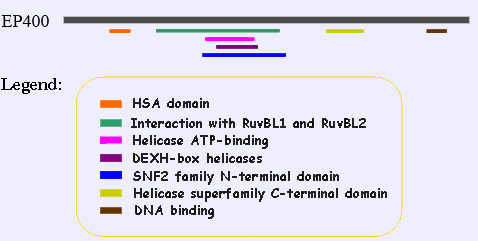
Description
The EP400 protein (isoform 2) is 3124 amino acids long and its molecular weight is about 400 kDa. It was cloned and characterized in 2001 thanks to its interation with the E1A oncoprotein.
Isoform 1 produces a 3160 aa long protein.
Isoform 3 produces a 3087 aa long protein.
Isoform 4 produces a 3043 aa long protein.
There has been no experimental confirmation for isoforms 3 and 4.
The only described post-translational modification is a phosphorylation on Ser736.
There has been no experimental confirmation for isoforms 3 and 4.
The only described post-translational modification is a phosphorylation on Ser736.
Expression
No data.
Localisation
EP400 belongs to chromatin remodelling complexes which are located in the nucleus, so it is probably nuclear. However, its cellular localization has not been formally monitored to date.
Function
EP400 belongs to the SWI2/SNF2 family of ATPases and is found in two highly related chromatin remodelling complexes : the Tip60 and p400 complexes. In these complexes, EP400 is associated with other enzymes such as the Tip60 histone acetyltransferase and/or the RuvBL1 and RuvBL2 helicases. (Note : putative specific functions of each splicing variant have not been investigated to date) Functions at the cellular level :
EP400 has been implicated in cell cycle control, apoptosis and development.
First, the depletion of EP400 in untransformed human fibroblasts leads to senescence through induction of the p53-p21 pathway. Likewise, the EP400 knock-down induces a p21-dependent cell cycle arrest in human cell lines. According to these results, EP400 seems to favour cell proliferation.
On the other hand, EP400 is required for E1A-mediated apoptosis. Similarly, EP400 is required for apoptosis upon DNA damage in human cell lines. Thus, EP400 also favours apoptosis, possibly through preventing cell cycle arrest.
Finally, the murine homolog of EP400 appears to be involved in embryonic hematopoiesis. Functions at the molecular level :
EP400 has ATP-dependent chromatin remodelling activity. Accordingly, EP400 was shown to be recruited along with the Tip60 complex on promoters by the c-myc and E2F transcription factors. Moreover, the EP400 homolog in drosophila is able to exchange specific histone variants at double-strand breaks.
EP400 has been implicated in cell cycle control, apoptosis and development.
First, the depletion of EP400 in untransformed human fibroblasts leads to senescence through induction of the p53-p21 pathway. Likewise, the EP400 knock-down induces a p21-dependent cell cycle arrest in human cell lines. According to these results, EP400 seems to favour cell proliferation.
On the other hand, EP400 is required for E1A-mediated apoptosis. Similarly, EP400 is required for apoptosis upon DNA damage in human cell lines. Thus, EP400 also favours apoptosis, possibly through preventing cell cycle arrest.
Finally, the murine homolog of EP400 appears to be involved in embryonic hematopoiesis.
EP400 has ATP-dependent chromatin remodelling activity. Accordingly, EP400 was shown to be recruited along with the Tip60 complex on promoters by the c-myc and E2F transcription factors. Moreover, the EP400 homolog in drosophila is able to exchange specific histone variants at double-strand breaks.
Homology
EP400 contains the SNF2 N-terminal domain shared by all ATPases of the SWI2/SNF2 family (SNF2, STH1, RAD16, RAD54, ISWI...). It also bears helicase-specific domains (see diagram):
an helicase C-terminal domain
an HSA domain
a DEXH box which contains the ATP-binding region. M.musculus : Ep400
R.norvegicus : Ep400
G.gallus : EP400
D.melanogaster : DOM or domino
Putative homologs in other species (non exhaustive) :
Implicated in
Entity name
Cancers
Oncogenesis
It was shown that EP400 is a target for the E1A viral oncoprotein transforming activity.
Indeed, studies showed that the overexpression of specific EP400 fragments corresponding to the E1A binding region (the SWI2/SNF2 domain) enhance the ability of E1A to transform rat embryo fibroblasts in the presence of ras. Moreover, the same fragments are able to partially restore the transforming activity of a tranformation-defective E1A mutant.
Indeed, studies showed that the overexpression of specific EP400 fragments corresponding to the E1A binding region (the SWI2/SNF2 domain) enhance the ability of E1A to transform rat embryo fibroblasts in the presence of ras. Moreover, the same fragments are able to partially restore the transforming activity of a tranformation-defective E1A mutant.
Article Bibliography
| Pubmed ID | Last Year | Title | Authors |
|---|---|---|---|
| 15302935 | 2004 | Large-scale characterization of HeLa cell nuclear phosphoproteins. | Beausoleil SA et al |
| 15655109 | 2005 | The p400 E1A-associated protein is a novel component of the p53 --> p21 senescence pathway. | Chan HM et al |
| 17486071 | 2007 | p400 function is required for the adenovirus E1A-mediated suppression of EGFR and tumour cell killing. | Flinterman MB et al |
| 12776177 | 2003 | MYC recruits the TIP60 histone acetyltransferase complex to chromatin. | Frank SR et al |
| 11509179 | 2001 | The p400 complex is an essential E1A transformation target. | Fuchs M et al |
| 15528408 | 2004 | Acetylation by Tip60 is required for selective histone variant exchange at DNA lesions. | Kusch T et al |
| 15741165 | 2005 | p400 is required for E1A to promote apoptosis. | Samuelson AV et al |
| 16601686 | 2006 | Tip60 and p400 are both required for UV-induced apoptosis but play antagonistic roles in cell cycle progression. | Tyteca S et al |
| 17535249 | 2007 | Critical role of the p400/mDomino chromatin-remodeling ATPase in embryonic hematopoiesis. | Ueda T et al |
Other Information
Locus ID:
NCBI: 57634
MIM: 606265
HGNC: 11958
Ensembl: ENSG00000183495
Variants:
dbSNP: 57634
ClinVar: 57634
TCGA: ENSG00000183495
COSMIC: EP400
RNA/Proteins
| Gene ID | Transcript ID | Uniprot |
|---|---|---|
| ENSG00000183495 | ENST00000330386 | A0A0A0MR70 |
| ENSG00000183495 | ENST00000332482 | A0A0A0MR72 |
| ENSG00000183495 | ENST00000333577 | A0A0A0MR80 |
| ENSG00000183495 | ENST00000389561 | Q96L91 |
Expression (GTEx)
Pathways
Protein levels (Protein atlas)
References
| Pubmed ID | Year | Title | Citations |
|---|---|---|---|
| 33099470 | 2020 | TIP60/P400/H4K12ac Plays a Role as a Heterochromatin Back-up Skeleton in Breast Cancer. | 5 |
| 33099470 | 2020 | TIP60/P400/H4K12ac Plays a Role as a Heterochromatin Back-up Skeleton in Breast Cancer. | 5 |
| 26578561 | 2016 | Control of alternative end joining by the chromatin remodeler p400 ATPase. | 14 |
| 26669263 | 2016 | EP400 Deposits H3.3 into Promoters and Enhancers during Gene Activation. | 62 |
| 27814680 | 2016 | Ataxia telangiectasia mutated (ATM) interacts with p400 ATPase for an efficient DNA damage response. | 0 |
| 26578561 | 2016 | Control of alternative end joining by the chromatin remodeler p400 ATPase. | 14 |
| 26669263 | 2016 | EP400 Deposits H3.3 into Promoters and Enhancers during Gene Activation. | 62 |
| 27814680 | 2016 | Ataxia telangiectasia mutated (ATM) interacts with p400 ATPase for an efficient DNA damage response. | 0 |
| 24332572 | 2014 | A blood-based three-gene signature for the non-invasive detection of early human hepatocellular carcinoma. | 39 |
| 24332572 | 2014 | A blood-based three-gene signature for the non-invasive detection of early human hepatocellular carcinoma. | 39 |
| 23982490 | 2013 | Senescence-associated protein p400 is a prognostic marker in renal cell carcinoma. | 14 |
| 23982490 | 2013 | Senescence-associated protein p400 is a prognostic marker in renal cell carcinoma. | 14 |
| 23064015 | 2012 | The p400/Brd8 chromatin remodeling complex promotes adipogenesis by incorporating histone variant H2A.Z at PPARγ target genes. | 11 |
| 23146670 | 2012 | Decrease of p400 ATPase complex and loss of H2A.Z within the p21 promoter occur in senescent IMR-90 human fibroblasts. | 7 |
| 23266955 | 2012 | The chromatin remodeler p400 ATPase facilitates Rad51-mediated repair of DNA double-strand breaks. | 41 |
Citation
Sandrine Tyteca
EP400 (E1A binding protein p400)
Atlas Genet Cytogenet Oncol Haematol. 2007-06-01
Online version: http://atlasgeneticsoncology.org/gene/40457/ep400
