GPHN (Gephyrin)
2002-03-01 Brigitte David-Watine AffiliationUnité de Biologie Cellulaire du Noyau, CNRS URA 2582, Département de Biologie Cellulaire et Infection, Institut Pasteur, 25, Rue du Docteur Roux, 75724 Paris Cedex 15, France
Identity
HGNC
LOCATION
14q23.3
LOCUSID
ALIAS
GEPH,GPH,GPHRYN,HKPX1,MOCODC
FUSION GENES
DNA/RNA
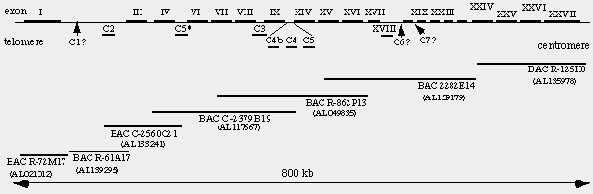
Exon-intron organization of the human gephyrin gene: Exons coding for the geghyrin are depicted by large traits and roman numerals with the alternative cassettes C1-C7 and exon VIII represented beneath the constant exons (exon VIII is putatively another cassette because one cDNA lacking this exon has been isolated). C1, C6 and C7 were not localized but their site of insertion is indicated by a ? as described . Exons and introns sizes are not drawn to scale. Exon I is telomeric to exon XXVII.
Description
29 exons (30 exons with the putative C1 exon), spanning over 800 kb
Transcription
in a telomeric to centromeric direction. The alternative use of different exons, particularly of the exons termed C1 to C7, produces splice variants which are differentially expressed in the central nervous system and other tissues.
Proteins
Note
Gephyrin is a cytoplasmic, peripheral membrane protein that anchors the GlyR as well as a subset of GABAA receptors to the subsynaptic cytoskeleton in neurons
Description
736-770 amino acids; sizes varying from 93-105 kDa to smaller products 52-60 kDa. The N-terminal domain of gephyrin is homologous to the bacterial protein MogA, and the C-terminal domain is homologous to bacterial MoeA, both proteins being involved in the biosynthesis of Moco.
Expression
wide if not ubiquitous, especially in brain, spinal cord, lung, liver and kidney. Precise distribution of expression of the different variants is not known.
Localisation
Gephyrin is a cytoplasmic, peripheral membrane protein.
Function
anchor inhibitory neuronal receptors (glycine, GABA) to the sub-synaptic cytoskeleton; plays a role in Moco biosynthesis.
Homology
bacterial MogA et MoeA, drosophila Cinnamon and Arabidopsis thaliana Cnx1.
Mutations
Note
deletion of the exons 2 and 3 resulting into a frameshift after 21codons of the normal coding sequence. No gephyrin detected in the patients fibroblats.
Implicated in
Entity name
Molybdenum cofactor (Moco) hereditary deficiency syndrome.
Note
Disruption of the gephyrin gene is lethal at birth in the mouse. The mutant phenotype resembles that of humans with hereditary deficiency of molybdenum cofactor and hyperhekplexia, a disease which is associated with defects in glycinergic inhibition in many patients suggesting that gephyrin function may be impaired in patients affected by either of these two diseases.
Prognosis
lethal in the three cases described.
Entity name
Fusion protein
The fusion protein contains the MLL AT hook motifs and a DNA methyl transferase homology domain fused to the C-terminal part of Gephyrin , including a presumed tubulin binding site and a domain homologous to the Escherichia coli molybdenum cofactor biosynthesis protein MoeA.
Article Bibliography
| Pubmed ID | Last Year | Title | Authors |
|---|---|---|---|
| 11418245 | 2001 | The human gephyrin (GPHN) gene: structure, chromosome localization and expression in non-neuronal cells. | David-Watine B et al |
| 11579461 | 2001 | GPHN, a novel partner gene fused to MLL in a leukemia with t(11;14)(q23;q24). | Eguchi M et al |
| 9812897 | 1998 | Dual requirement for gephyrin in glycine receptor clustering and molybdoenzyme activity. | Feng G et al |
| 1319186 | 1992 | Primary structure and alternative splice variants of gephyrin, a putative glycine receptor-tubulin linker protein. | Prior P et al |
| 11095995 | 2001 | A mutation in the gene for the neurotransmitter receptor-clustering protein gephyrin causes a novel form of molybdenum cofactor deficiency. | Reiss J et al |
Other Information
Locus ID:
NCBI: 10243
MIM: 603930
HGNC: 15465
Ensembl: ENSG00000171723
Variants:
dbSNP: 10243
ClinVar: 10243
TCGA: ENSG00000171723
COSMIC: GPHN
RNA/Proteins
Expression (GTEx)
Pathways
Protein levels (Protein atlas)
References
| Pubmed ID | Year | Title | Citations |
|---|---|---|---|
| 35717442 | 2022 | Complex regulation of Gephyrin splicing is a determinant of inhibitory postsynaptic diversity. | 6 |
| 35717442 | 2022 | Complex regulation of Gephyrin splicing is a determinant of inhibitory postsynaptic diversity. | 6 |
| 28073605 | 2017 | Comprehensive association analysis of 27 genes from the GABAergic system in Japanese individuals affected with schizophrenia. | 6 |
| 28883437 | 2017 | Alpha subunit-dependent glycine receptor clustering and regulation of synaptic receptor numbers. | 31 |
| 28073605 | 2017 | Comprehensive association analysis of 27 genes from the GABAergic system in Japanese individuals affected with schizophrenia. | 6 |
| 28883437 | 2017 | Alpha subunit-dependent glycine receptor clustering and regulation of synaptic receptor numbers. | 31 |
| 27002143 | 2016 | IQ Motif and SEC7 Domain-containing Protein 3 (IQSEC3) Interacts with Gephyrin to Promote Inhibitory Synapse Formation. | 14 |
| 27002143 | 2016 | IQ Motif and SEC7 Domain-containing Protein 3 (IQSEC3) Interacts with Gephyrin to Promote Inhibitory Synapse Formation. | 14 |
| 25755278 | 2015 | Protein kinase C-dependent growth-associated protein 43 phosphorylation regulates gephyrin aggregation at developing GABAergic synapses. | 15 |
| 25813846 | 2015 | Human gephyrin is encompassed within giant functional noncoding yin-yang sequences. | 5 |
| 26613940 | 2015 | Simultaneous impairment of neuronal and metabolic function of mutated gephyrin in a patient with epileptic encephalopathy. | 21 |
| 25755278 | 2015 | Protein kinase C-dependent growth-associated protein 43 phosphorylation regulates gephyrin aggregation at developing GABAergic synapses. | 15 |
| 25813846 | 2015 | Human gephyrin is encompassed within giant functional noncoding yin-yang sequences. | 5 |
| 26613940 | 2015 | Simultaneous impairment of neuronal and metabolic function of mutated gephyrin in a patient with epileptic encephalopathy. | 21 |
| 24561070 | 2014 | Exonic microdeletions of the gephyrin gene impair GABAergic synaptic inhibition in patients with idiopathic generalized epilepsy. | 23 |
Citation
Brigitte David-Watine
GPHN (Gephyrin)
Atlas Genet Cytogenet Oncol Haematol. 2002-03-01
Online version: http://atlasgeneticsoncology.org/gene/317/gphn
