DNA/RNA
Description
Gene spans 68,5 kbp on the minus strand at 1q32.1.
Transcription
One known 6586 base transcript, 30 exons. The KIF14 promoter is bound by p130/E2F4 under growth arrest conditions (Cam et al., 2004); further details of transcriptional regulation are currently lacking.
Pseudogene
None annotated.
Proteins
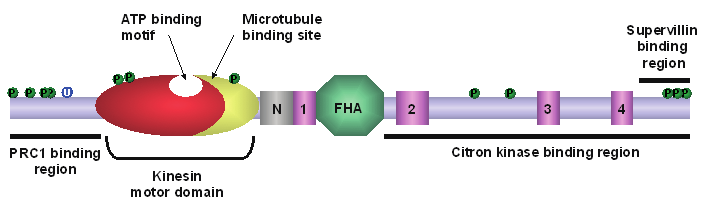
Schematic representation of the KIF14 protein (not to scale). KIF14 contains two major effector domains. The first is a highly conserved 274 aa kinesin motor domain containing an ATP-binding site (aa 447-454) which is involved in microtubule-dependent ATPase activity, and a microtubule binding site (aa 455-628) involved in ATP-dependent protein transport. The second is a 67 aa forkhead-associated (FHA) domain (aa 825-891) which has similarity to the SMAD Mad Homology 2 (MH2) domain, and is involved in mediating protein-protein interactions with phosphoproteins, although no such interactions have been documented for KIF14 (Durocher et al., 2000). In addition to the highly conserved N-type neck region (N) adjacent to the motor domain, KIF14 also contains four other C-terminal regions predicted to form coiled-coil structures (1-4). Phosphorylation sites have been identified in high-throughput studies on Ser-12, Tyr-196, Thr-240, Ser-242, Ser-378, Ser-384, Ser-670, Ser-1200, Ser-1292, Ser-1631, Ser-1636 and Thr-1641 (P) (Nomura et al., 1994; Olsen et al., 2006; Vasilescu et al., 2007; Dephoure et al., 2008), and a ubiquitination site identified on Lys-275 (U) (Olsen et al., 2006; Vasilescu et al., 2007). The kinesin motor and FHA domains are flanked by a 354 aa N-terminal extension, and a 758 aa C-terminal stalk and tail region. The N-terminal extension is involved in the binding of PRC1 (protein-regulating cytokinesis 1), a protein crucial for the proper formation of the central spindle structure during cytokinesis. Citron kinase has been shown to interact with the C-terminal stalk and tail of KIF14, and this interaction is required for proper localization of KIF14 to the mitotic spindle. Supervillin, a membrane protein involved in directing cellular motility, has been shown to associate directly with the distal C-terminal tail of KIF14 and contributes to the establishment or maintenance of the cytokinetic furrow (Smith et al., 2010).
Description
KIF14 is a 186 kDa, 1648 aa protein, containing kinesin motor and forkhead-associated (FHA) domains. It is a member of the N-3 family of kinesins, in which the motor domain lies close to the amino terminus (Miki et al., 2001), although the relatively long N-terminal extension in KIF14 is unique in this family. High-throughput studies have identified phosphorylations on Ser-12, Tyr-196, Thr-240, Ser-242, Ser-378, Ser-384, Ser-670, Ser-1200, Ser-1292, Ser-1631, Ser-1636 and Thr-1641 (P) (Nomura et al., 1994; Olsen et al., 2006; Vasilescu et al., 2007; Dephoure et al., 2008), and ubiquitination on Lys-275 (U) (Olsen et al., 2006; Vasilescu et al., 2007).
Expression
KIF14 was cloned from an immature myeloid cell line, KG-1 (Nomura et al., 1994). By qRT-PCR, KIF14 is expressed at low levels in normal adult tissues and at higher levels in placenta and fetal tissues; highest expression is in fetal thymus and liver (Corson et al., 2005). KIF14 expression varies with the cell cycle, with highest expression at G2-M (Carleton et al., 2006).
Localisation
In HeLa cells, KIF14 is localized to the cytoplasm during interphase, and becomes tightly localized to the midbody and central spindle during cytokinesis (Carleton et al., 2006; Gruneberg et al., 2006).
Function
KIF14 is a mitotic kinesin motor protein with ATPase activity (Carleton et al., 2006). It interacts with protein regulator of cytokinesis 1 (PRC1) and is essential for localizing citron kinase to the mitotic spindle (Gruneberg et al., 2006). KIF14 knockdown results in failure of cytokinesis, leading to multinucleation and/or apoptosis, but no chromosome segregation defects (Carleton et al., 2006; Gruneberg et al., 2006). KIF14 also interacts with supervillin and contributes to the establishment or maintenance of the cytokinetic furrow (Smith et al., 2010). In addition, KIF14 was identified as a β-arrestin 2 interacting protein in the nucleus of mature spermatozoa (Neuhaus et al., 2006).
Homology
There are KIF14 orthologs in several mammalian species. The closest Drosophila melanogaster gene, with 40% amino acid identity, is nebbish/tiovivo, encoding Klp38B (kinesin-like protein 38B). Klp38B is a mitotic kinesin that binds to chromatin and microtubules in the formation of the bipolar spindle and attachment of chromosomes to the spindle, and/or acts in cytokinesis (Molina et al., 1997; Ohkura et al., 1997).
Mutations
Germinal
None yet identified.
Somatic
Missense somatic mutations were detected in two metastatic melanomas. Each mutations was heterozygous and observed in a single tumor. They were c.1490 C>T, P351S and c.1539 C>T, P367L (Wei et al., 2011).
Heterozygous somatic mutations were detected in five breast ductal carcinoma tumors. Each mutation was observed in a single tumor and included three missense mutations (c.3676T>A, p.S1226T; c.4363G>C, p.E1455Q and c.1A>G, p.M1V), one synonymous mutation (c.4539T>A, p.A1513A), and one nonsense mutation (c.4402G>T, p.E1468*) (Wood et al., 2007).
Missense heterozygous somatic mutations were detected in two ovarian carcinomas and each mutation was observed in a single tumor: c.2096G>A, p.R699H and c.4654C>T, p.P1552S (Cancer Genome Atlas Research Network, 2011).
Heterozygous somatic mutations were detected in five breast ductal carcinoma tumors. Each mutation was observed in a single tumor and included three missense mutations (c.3676T>A, p.S1226T; c.4363G>C, p.E1455Q and c.1A>G, p.M1V), one synonymous mutation (c.4539T>A, p.A1513A), and one nonsense mutation (c.4402G>T, p.E1468*) (Wood et al., 2007).
Missense heterozygous somatic mutations were detected in two ovarian carcinomas and each mutation was observed in a single tumor: c.2096G>A, p.R699H and c.4654C>T, p.P1552S (Cancer Genome Atlas Research Network, 2011).
Implicated in
Entity name
Retinoblastoma
Prognosis
KIF14 mRNA and protein expression is greatly increased in retinoblastoma tumors versus normal adult and fetal retina (Corson et al., 2005). mRNA expression is higher in older patients tumors than younger (Madhavan et al., 2007), and shows a modest association with unilateral disease (Madhavan et al., 2009). KIF14 mRNA level increases with the progression from normal retina to benign retinoma to retinoblastoma (Dimaras et al., 2008).
Cytogenetics
KIF14 lies in a "hotspot" of genomic gain at 1q31.3-1q32.1 (Corson et al., 2005). Low-level genomic gain (3-5 copies) of the gene is observed in 50% of tumors (Bowles et al., 2007). High-level amplification has been observed in one tumor (along with, but independent of, MYCN amplification) (Bowles et al., 2007). KIF14 copy number increases during the progression from normal retina to benign retinoma to retinoblastoma (Dimaras et al., 2008).
Oncogenesis
In support of KIF14s importance in retinoblastoma, the mouse ortholog Kif14 is expressed in retinal tumors in the retinal SV40 Large T Antigen (TAg-RB) model of retinoblastoma at levels higher than at any point in mouse retinal development (Pajovic et al., 2011).
Entity name
Breast carcinoma
Prognosis
mRNA expression increases with grade, and is higher in ductal than lobular carcinoma, and in estrogen receptor (ER) negative over ER positive tumors. Expression correlates with proliferation, and overexpression is prognostic for poor overall and disease-free survival (Corson and Gallie, 2006).
Cytogenetics
KIF14 lies in a "hotspot" of genomic gain at 1q31.3-1q32.1. Low-level genomic gain of the gene is observed in 50% of breast cancer cell lines (Bowles et al., 2007).
Entity name
Non-small-cell lung carcinoma (NSCLC)
Prognosis
mRNA expression decreases with differentiation, and is higher in squamous cell than adenocarcinoma. Overexpression is independently prognostic for poor disease-free survival, and prognostic for poor overall survival (Corson et al., 2007).
Oncogenesis
Knockdown of KIF14 decreases proliferation of H1299 NSCLC cells, and decreases their ability to form colonies in soft agar (Corson et al., 2007).
Entity name
Ovarian carcinoma
Prognosis
KIF14 is overexpressed in the majority of ovarian cancers tested (91%). KIF14 mRNA expression is independently prognostic for poor overall survival and prognostic for poor progression-free survival in serous ovarian cancers (Thériault et al., 2012).
Cytogenetics
Low-level gain (3 to 5 copies) of KIF14 is observed in 30% of serous ovarian cancers, and corresponds to high mRNA overexpression (Thériault et al., 2012). KIF14 was the only gene within the documented 1q "hot spot" region of gain (1q31.3-1q32.1) (Corson et al., 2005) to be overexpressed in ovarian carcinomas compared to normal tubal epithelium and ovarian surface epithelium (Thériault et al., 2012).
Oncogenesis
Overexpression of KIF14 enhances proliferation, and in vitro tumorigenic potential in ovarian cancer cell lines. Knockdown significantly reduces in vitro proliferation and tumorigenicity, and induces an apoptotic response (Thériault et al., 2012).
Entity name
Hepatocellular carcinoma (HCC)
Prognosis
KIF14 is overexpressed in HCC.
Cytogenetics
Low-level gain of the KIF14 locus is seen in 58% tumors (Bowles et al., 2007). A KIF14-containing region spanning 1q32.1-1q44 was the second most common alteration in a series of HCC, and KIF14 mRNA and protein expression were increased in tumors with gain of this region (Kim et al., 2008).
Entity name
Pancreatic carcinoma
Prognosis
KIF14 was identified by expression microarray (and confirmed by RT-PCR and immunoblot) as downregulated in neuroinvasive versus non-invasive pancreatic carcinoma cell lines. However, KIF14 was upregulated in chronic pancreatitis and pancreatic cancer versus normal pancreas (Abiatari et al., 2009).
Oncogenesis
Knockdown of KIF14 increased invasiveness of T3M4 cells and also increased resistance to anoikis of these cells (Abiatari et al., 2009).
Entity name
Papillary renal cell tumors
Prognosis
Gain of a region of 1q including KIF14 is associated with fatal progression, and KIF14 is one of two genes overexpressed in tumors with this gain to a higher level than in tumors without 1q gain (Szponar et al., 2009).
Entity name
Glioblastoma multiforme
Cytogenetics
Two translocation breakpoints in a series of 32 tumors mapped to 1q32. KIF14 was identified as an overexpressed gene in a region of somatic gain around this breakpoint (Leone et al., 2012).
Entity name
Laryngeal carcinoma
Oncogenesis
KIF14 is one of three microarray-identified genes validated as a marker of laryngeal carcinoma (Markowski et al., 2009).
Article Bibliography
| Pubmed ID | Last Year | Title | Authors |
|---|---|---|---|
| 19509238 | 2009 | Consensus transcriptome signature of perineural invasion in pancreatic carcinoma. | Abiatari I et al |
| 17099872 | 2007 | Profiling genomic copy number changes in retinoblastoma beyond loss of RB1. | Bowles E et al |
| 15525513 | 2004 | A common set of gene regulatory networks links metabolism and growth inhibition. | Cam H et al |
| 21720365 | 2011 | Integrated genomic analyses of ovarian carcinoma. | |
| 16648480 | 2006 | RNA interference-mediated silencing of mitotic kinesin KIF14 disrupts cell cycle progression and induces cytokinesis failure. | Carleton M et al |
| 16570270 | 2006 | KIF14 mRNA expression is a predictor of grade and outcome in breast cancer. | Corson TW et al |
| 15897902 | 2005 | KIF14 is a candidate oncogene in the 1q minimal region of genomic gain in multiple cancers. | Corson TW et al |
| 17545527 | 2007 | KIF14 messenger RNA expression is independently prognostic for outcome in lung cancer. | Corson TW et al |
| 18669648 | 2008 | A quantitative atlas of mitotic phosphorylation. | Dephoure N et al |
| 18211953 | 2008 | Loss of RB1 induces non-proliferative retinoma: increasing genomic instability correlates with progression to retinoblastoma. | Dimaras H et al |
| 11106755 | 2000 | The molecular basis of FHA domain:phosphopeptide binding specificity and implications for phospho-dependent signaling mechanisms. | Durocher D et al |
| 16431929 | 2006 | KIF14 and citron kinase act together to promote efficient cytokinesis. | Gruneberg U et al |
| 22043308 | 2011 | RNA-Seq analyses generate comprehensive transcriptomic landscape and reveal complex transcript patterns in hepatocellular carcinoma. | Huang Q et al |
| 18803288 | 2008 | Clinical implication of recurrent copy number alterations in hepatocellular carcinoma and putative oncogenes in recurrent gains on 1q. | Kim TM et al |
| 22395973 | 2012 | Integration of global spectral karyotyping, CGH arrays, and expression arrays reveals important genes in the pathogenesis of glioblastoma multiforme. | Leone PE et al |
| 19190782 | 2009 | KIF14 and E2F3 mRNA expression in human retinoblastoma and its phenotype association. | Madhavan J et al |
| 19609547 | 2009 | Metal-proteinase ADAM12, kinesin 14 and checkpoint suppressor 1 as new molecular markers of laryngeal carcinoma. | Markowski J et al |
| 11416179 | 2001 | All kinesin superfamily protein, KIF, genes in mouse and human. | Miki H et al |
| 9396743 | 1997 | A chromatin-associated kinesin-related protein required for normal mitotic chromosome segregation in Drosophila. | Molina I et al |
| 16820410 | 2006 | Novel function of beta-arrestin2 in the nucleus of mature spermatozoa. | Neuhaus EM et al |
| 7584044 | 1994 | Prediction of the coding sequences of unidentified human genes. II. The coding sequences of 40 new genes (KIAA0041-KIAA0080) deduced by analysis of cDNA clones from human cell line KG-1. | Nomura N et al |
| 9152020 | 1997 | Mutation of a gene for a Drosophila kinesin-like protein, Klp38B, leads to failure of cytokinesis. | Ohkura H et al |
| 17081983 | 2006 | Global, in vivo, and site-specific phosphorylation dynamics in signaling networks. | Olsen JV et al |
| 21862643 | 2011 | The TAg-RB murine retinoblastoma cell of origin has immunohistochemical features of differentiated Muller glia with progenitor properties. | Pajovic S et al |
| 20309963 | 2010 | Novel interactors and a role for supervillin in early cytokinesis. | Smith TC et al |
| 19123481 | 2009 | Three genetic developmental stages of papillary renal cell tumors: duplication of chromosome 1q marks fatal progression. | Szponar A et al |
| 21618518 | 2012 | Kinesin family member 14: an independent prognostic marker and potential therapeutic target for ovarian cancer. | Thériault BL et al |
| 17203973 | 2007 | The proteomic reactor facilitates the analysis of affinity-purified proteins by mass spectrometry: application for identifying ubiquitinated proteins in human cells. | Vasilescu J et al |
| 21499247 | 2011 | Exome sequencing identifies GRIN2A as frequently mutated in melanoma. | Wei X et al |
| 17932254 | 2007 | The genomic landscapes of human breast and colorectal cancers. | Wood LD et al |
| 15843429 | 2005 | Functional analysis of human microtubule-based motor proteins, the kinesins and dyneins, in mitosis/cytokinesis using RNA interference. | Zhu C et al |
Other Information
Locus ID:
NCBI: 9928
MIM: 611279
HGNC: 19181
Ensembl: ENSG00000118193
Variants:
dbSNP: 9928
ClinVar: 9928
TCGA: ENSG00000118193
COSMIC: KIF14
RNA/Proteins
| Gene ID | Transcript ID | Uniprot |
|---|---|---|
| ENSG00000118193 | ENST00000367350 | Q15058 |
| ENSG00000118193 | ENST00000614960 | Q15058 |
Expression (GTEx)
Pathways
| Pathway | Source | External ID |
|---|---|---|
| Signal Transduction | REACTOME | R-HSA-162582 |
| Signaling by Rho GTPases | REACTOME | R-HSA-194315 |
| RHO GTPase Effectors | REACTOME | R-HSA-195258 |
| RHO GTPases activate CIT | REACTOME | R-HSA-5625900 |
Protein levels (Protein atlas)
References
| Pubmed ID | Year | Title | Citations |
|---|---|---|---|
| 38070277 | 2024 | MicroRNA-152 specifically targets kinesin family member 14 to suppress the advancement of bladder cancer cells via PI3K/AKT pathway. | 0 |
| 38070277 | 2024 | MicroRNA-152 specifically targets kinesin family member 14 to suppress the advancement of bladder cancer cells via PI3K/AKT pathway. | 0 |
| 36822388 | 2023 | KIF14 mediates cabazitaxel-docetaxel cross-resistance in advanced prostate cancer by promoting AKT phosphorylation. | 3 |
| 36922675 | 2023 | KIF14 promotes proliferation, lymphatic metastasis and chemoresistance through G3BP1/YBX1 mediated NF-κB pathway in cholangiocarcinoma. | 4 |
| 36822388 | 2023 | KIF14 mediates cabazitaxel-docetaxel cross-resistance in advanced prostate cancer by promoting AKT phosphorylation. | 3 |
| 36922675 | 2023 | KIF14 promotes proliferation, lymphatic metastasis and chemoresistance through G3BP1/YBX1 mediated NF-κB pathway in cholangiocarcinoma. | 4 |
| 35156510 | 2022 | Exosomes-derived miR-154-5p attenuates esophageal squamous cell carcinoma progression and angiogenesis by targeting kinesin family member 14. | 8 |
| 35439960 | 2022 | KIF14 affects cell cycle arrest and cell viability in cervical cancer by regulating the p27(Kip1) pathway. | 4 |
| 36192583 | 2022 | Single Nucleotide Variants in KIF14 Gene May Have Prognostic Value in Breast Cancer. | 0 |
| 36227151 | 2022 | Noncoding RNAs-mediated overexpression of KIF14 is associated with tumor immune infiltration and unfavorable prognosis in lung adenocarcinoma. | 3 |
| 35156510 | 2022 | Exosomes-derived miR-154-5p attenuates esophageal squamous cell carcinoma progression and angiogenesis by targeting kinesin family member 14. | 8 |
| 35439960 | 2022 | KIF14 affects cell cycle arrest and cell viability in cervical cancer by regulating the p27(Kip1) pathway. | 4 |
| 36192583 | 2022 | Single Nucleotide Variants in KIF14 Gene May Have Prognostic Value in Breast Cancer. | 0 |
| 36227151 | 2022 | Noncoding RNAs-mediated overexpression of KIF14 is associated with tumor immune infiltration and unfavorable prognosis in lung adenocarcinoma. | 3 |
| 32757684 | 2021 | miR-340 Exerts Suppressive Effect on Retinoblastoma Progression by Targeting KIF14. | 3 |
Citation
Brigitte L Thériault ; Timothy W Corson
KIF14 (kinesin family member 14)
Atlas Genet Cytogenet Oncol Haematol. 2012-04-01
Online version: http://atlasgeneticsoncology.org/gene/44138/kif14
Historical Card
2007-12-01 KIF14 (kinesin family member 14) by Brigitte L Thériault,Timothy W Corson Affiliation
Division of Applied Molecular Oncology, Ontario Cancer Institute\\\/Princess Margaret Hospital, University Health Network, Toronto, ON, Canada (BLT); Department of Molecular, Cellular, Developmental Biology, Yale (TWC)
