Identity
HGNC
LOCATION
9q31.3
LOCUSID
ALIAS
EDG2,Gpcr26,LPA1,Mrec1.3,VZG1,edg-2,rec.1.3,vzg-1
FUSION GENES
DNA/RNA
Note
mRNA length 3104 or 3182 bp, depending on alternative splicing.

Proteins
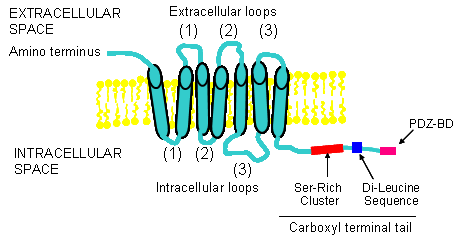
Figure of the LPAR1, a G protein-coupled receptor, spanning the plasma membrane seven times. The receptor has three numbered extracellular and intracellular loops that are involved in signal transduction. Also shown are the amino terminus and carboxyl terminal tail.
Three regions of the carboxyl terminal tail have been shown to be important for the LPAR1 signaling and receptor regulation. LPAR1 contains a canonical Type 1 PDZ binding domain (a.a. 362-364) at the extreme C-terminus. This domain has been shown to be required for LPA-induced cell proliferation and activation of Rho family GTPases via PDZ-Rho guanine nucleotide exchange factors. Further upstream in the carboxyl terminal tail, LPAR1 contains a di-leucine sequence (a.a. 351 and 352), which is required for phorbol ester-induced internalization. Still further upstream lies a serine-rich cluster (a.a. 341-347) that is required for beta-arrestin association, which is critical for signal attenuation and receptor endocytosis.
Description
LPAR1 is an abbreviation for the LPA1 receptor, the first receptor cloned and identified from a growing number of LPA receptors that includes the Edg-family and the purinergic receptors.
Expression
LPAR1 is ubiquitously expressed throughout cells and tissues in the body.
High level of expression is found in amygdale, prefrontal cortex, caudate nucleus, hypothalamus, medulla oblongata, olfactory bulb, parietal lobe, spinal cord and thalamus.
Moderately high level of expression is found in adipocytes, cingulated cortex, occipital lobe, pons, whole brain, globus pallidus, subthalamic nucleus, temporal lobe, appendix, monocytes and smooth muscle.
Slightly above median level of expression is found in bronchial epithelial cells, cerebellum peduncies, dorsal root ganglia, ciliary ganglion, uterus, uterus corpus, atrioventricular node, fetal lung, fetal thyroid, skeletal muscle, cardiac myocytes, salivary gland, tongue and lymph node.
It is also expressed in tissues during neuronal development.
The expression of LPAR1 is increased in blister skin compared to normal skin.
The mRNA of LPAR1 is significantly increased 8 days after unilateral uretheral obstruction in mice kidneys where expression is higher in the medulla than the cortex.
The expression of LPAR1 is variable in cancer.
High level of expression is found in amygdale, prefrontal cortex, caudate nucleus, hypothalamus, medulla oblongata, olfactory bulb, parietal lobe, spinal cord and thalamus.
Moderately high level of expression is found in adipocytes, cingulated cortex, occipital lobe, pons, whole brain, globus pallidus, subthalamic nucleus, temporal lobe, appendix, monocytes and smooth muscle.
Slightly above median level of expression is found in bronchial epithelial cells, cerebellum peduncies, dorsal root ganglia, ciliary ganglion, uterus, uterus corpus, atrioventricular node, fetal lung, fetal thyroid, skeletal muscle, cardiac myocytes, salivary gland, tongue and lymph node.
It is also expressed in tissues during neuronal development.
The expression of LPAR1 is increased in blister skin compared to normal skin.
The mRNA of LPAR1 is significantly increased 8 days after unilateral uretheral obstruction in mice kidneys where expression is higher in the medulla than the cortex.
The expression of LPAR1 is variable in cancer.
Localisation
It is a requirement of G protein-coupled receptor functioning that receptors are embedded into membranes for proper structure. The LPAR1 spans the plasma membrane seven times in a barrel conformation with three extracellular and three intracellular loops. At steady state, LPAR1 is located on the plasma membrane at the cell surface until it binds LPA, which triggers dynamin2-dependent, clathrin-mediated endocytosis into the cell. LPAR1 requires membrane cholesterol for association with beta-arrestin, which targets the receptor to clathrin-coated pits for internalization. In addition to LPA, phorbol ester stimulation of protein kinase C also induces internalization of LPAR1, but this does not require beta-arrestin. Rather, phorbol ester-dependent internalization of LPAR1 requires AP-2 clathrin adaptors. The LPAR1 is subsequently sorted through Rab-5 dependent early and recycling endosomes before it is recycled back to the cell surface or degraded in lysosomes.
The receptor may also be localized to the nuclear membrane in the cell. Some evidence indicates that a portion of the total cellular LPAR1 localizes to the nuclear membrane in PC12 cells, micro-vascular endothelial cells, and human bronchial epithelial cells. The exact function of this nuclear LPAR1 pool is not known.
The receptor may also be localized to the nuclear membrane in the cell. Some evidence indicates that a portion of the total cellular LPAR1 localizes to the nuclear membrane in PC12 cells, micro-vascular endothelial cells, and human bronchial epithelial cells. The exact function of this nuclear LPAR1 pool is not known.
Function
The LPAR1 binds LPA and initiates G protein-dependent signal transduction cascades throughout the cell that result in a number of functional outcomes, depending on the specific cell or tissue type. The G alpha proteins involved are Gi, Gq and G 12/13.
The receptor has critical functions that have been elucidated through gene knock-out studies in mice. LPAR1-null mice have deficiencies in olfactory development that impairs their ability to locate maternal nipples and initiate suckling required for survival. The lack of olfactant detection leads to 50% lethality among pups. Other LPAR1-null mice demonstrate alterations in neurotransmitters that mimic models of schizophrenia. LPAR1-null mice are 10-15% shorter than wild-type mice and have gross anatomical defects due to bone development, including incisor overgrowth that affects ability to feed.
The LPAR1 functions in normal cortical development and commits cortical neuroblasts to differentiate through the neural lineage. It may also play a role in the formation of dendritic spine synapses.
Through autotoxin-generated LPA, LPAR1 mediates neuropathic pain induced by nerve injury.
Activation of the LPAR1 functions in the inflammatory response; receptor activation stimulates the recruitment of macrophages.
The LPAR1 positively regulates motility in a variety of cell types, exerting a dominant signal in the absence of LPAR4.
The receptor has critical functions that have been elucidated through gene knock-out studies in mice. LPAR1-null mice have deficiencies in olfactory development that impairs their ability to locate maternal nipples and initiate suckling required for survival. The lack of olfactant detection leads to 50% lethality among pups. Other LPAR1-null mice demonstrate alterations in neurotransmitters that mimic models of schizophrenia. LPAR1-null mice are 10-15% shorter than wild-type mice and have gross anatomical defects due to bone development, including incisor overgrowth that affects ability to feed.
The LPAR1 functions in normal cortical development and commits cortical neuroblasts to differentiate through the neural lineage. It may also play a role in the formation of dendritic spine synapses.
Through autotoxin-generated LPA, LPAR1 mediates neuropathic pain induced by nerve injury.
Activation of the LPAR1 functions in the inflammatory response; receptor activation stimulates the recruitment of macrophages.
The LPAR1 positively regulates motility in a variety of cell types, exerting a dominant signal in the absence of LPAR4.
Homology
The LPAR1 has significant homology with LPAR2 (57%) and LPAR3 (51%), members of the original or classical endothelial differentiation gene (Edg) family. It has approximately 33-38% homology with individual sphingosine 1-phosphate receptors and no significant homology with the purinergic family of receptors that also bind LPA.
Mutations
Note
There are several single nucleotide polymorphisms (SNPs) reported within the LPAR1 gene and several of these are associated with altered phenotype and disease states.
A functional SNP located in the promoter region of the gene (-2,820G/A; rs10980705) is associated with increased susceptibility to knee osteoarthritis in Japanese by showing an increase in binding and activity.
A change in amino acid sequence at position 125 from glutamine to glutamate in the LPAR1 will result in the ability of the receptor to recognize both S1P and LPA.
A change in amino acid sequence at position 236 from threonine to lysine in the LPAR1 will result in the enhanced activation of serum response factor.
Mutations in the LPAR1 were detected in a small percentage of adenomas and adenocarcinomas of rats given BHP in their drinking water. Missense mutations in the LPAR1 were detected in rat hepatocellular carcinomas induced by N-nitrosodiethylamine and choline-deficient l-amino acid-defined diets.
Deletion of the PDZ domain of the receptor prevents signal attenuation that controls LPA-mediated receptor activation and cell proliferation.
A functional SNP located in the promoter region of the gene (-2,820G/A; rs10980705) is associated with increased susceptibility to knee osteoarthritis in Japanese by showing an increase in binding and activity.
A change in amino acid sequence at position 125 from glutamine to glutamate in the LPAR1 will result in the ability of the receptor to recognize both S1P and LPA.
A change in amino acid sequence at position 236 from threonine to lysine in the LPAR1 will result in the enhanced activation of serum response factor.
Mutations in the LPAR1 were detected in a small percentage of adenomas and adenocarcinomas of rats given BHP in their drinking water. Missense mutations in the LPAR1 were detected in rat hepatocellular carcinomas induced by N-nitrosodiethylamine and choline-deficient l-amino acid-defined diets.
Deletion of the PDZ domain of the receptor prevents signal attenuation that controls LPA-mediated receptor activation and cell proliferation.
Implicated in
Entity name
Various cancers
Note
Overexpression of the LPAR1 in mice contributes to the tumorigenicity and aggressiveness of ovarian cancer.
Prognosis
Upregulation of the LPAR1 appears to enhance tumor progression in the previous examples.
Oncogenesis
The LPAR1 is a proto-oncogene contributing to the metastatic potential of breast cancers and may require signals from ErbB2/HER2 dimerization. In a study designed to assess the functional consequences of overexpression as it relates to breast carcinogenesis, 1000 selected/suspected cDNAs were inserted into immortalized MCF-10A cells and a derivative cell line, MCF-10A.B2 expressing an inducibly active variant of ErbB2. The study examined three assays (cell proliferation, migration and 3-D matrigel acinar morphogenesis) and the LPAR1 scored positive in all three; thus, it was determined to be a proto-oncogene in this disease. Several observations are of interest: first, the LPAR1 induced migration in the absence of ErbB2 activation but not in the absence of dimerization which suggests that the LPAR1 may require weak signals from ligand-independent dimerization of ErbB2 to induce migration; second, in the acinar morphogenesis assay, phenotypical changes of cells with the LPAR1 included the formation of features of invasive tumor cells, such as disorganized acinar structure, large structures and protrusive behavior; third, the LPAR1 was capable of establishing abnormal 3-D morphogenesis in the absence of conditions to dimerize ErbB2.
Entity name
Lung injury
Note
The LPAR1 mediates fibroblast migration and recruitment in the injured lung. The chemotactic activity of fibroblasts is dependent on LPAR1 expression.
Disease
Pulmonary fibrosis
The concentration of LPA is elevated in bronchoalveolar lavage samples from patients with idiopathic pulmonary fibrosis. The fibroblasts of these patients require expression of LPAR1 for the chemotactic activity present in this pathology. Data suggests that LPAR1-null mice are substantially protected from fibroblast accumulation. This corresponds to lung injury where aberrant wound-healing responses exacerbate pulmonary fibrosis pathogenesis.
The concentration of LPA is elevated in bronchoalveolar lavage samples from patients with idiopathic pulmonary fibrosis. The fibroblasts of these patients require expression of LPAR1 for the chemotactic activity present in this pathology. Data suggests that LPAR1-null mice are substantially protected from fibroblast accumulation. This corresponds to lung injury where aberrant wound-healing responses exacerbate pulmonary fibrosis pathogenesis.
Prognosis
LPAR1 links lung injury with pulmonary fibrosis development.
Article Bibliography
| Pubmed ID | Last Year | Title | Authors |
|---|---|---|---|
| 15369458 | 2005 | Phosphorylation and desensitization of the lysophosphatidic acid receptor LPA1. | Avendaño-Vázquez SE et al |
| 11087877 | 2000 | Requirement for the lpA1 lysophosphatidic acid receptor gene in normal suckling behavior. | Contos JJ et al |
| 17656621 | 2008 | Absence of LPA1 signaling results in defective cortical development. | Estivill-Torrús G et al |
| 17056154 | 2007 | Lysophosphatidic acid stimulates neuronal differentiation of cortical neuroblasts through the LPA1-G(i/o) pathway. | Fukushima N et al |
| 12847111 | 2003 | Modulation of pro-inflammatory gene expression by nuclear lysophosphatidic acid receptor type-1. | Gobeil F Jr et al |
| 14697676 | 2003 | LPA1 receptor-deficient mice have phenotypic changes observed in psychiatric disease. | Harrison SM et al |
| 18843048 | 2008 | Role of LPA4/p2y9/GPR23 in negative regulation of cell motility. | Lee Z et al |
| 18325907 | 2008 | A functional SNP in EDG2 increases susceptibility to knee osteoarthritis in Japanese. | Mototani H et al |
| 18466763 | 2008 | Identification of the orphan GPCR, P2Y(10) receptor as the sphingosine-1-phosphate and lysophosphatidic acid receptor. | Murakami M et al |
| 18025263 | 2007 | Lysophosphatidic acid decreases the nuclear localization and cellular abundance of the p53 tumor suppressor in A549 lung carcinoma cells. | Murph MM et al |
| 18501205 | 2008 | Sharpening the edges of understanding the structure/function of the LPA1 receptor: expression in cancer and mechanisms of regulation. | Murph MM et al |
| 12668728 | 2003 | Agonist-induced endocytosis of lysophosphatidic acid-coupled LPA1/EDG-2 receptors via a dynamin2- and Rab5-dependent pathway. | Murph MM et al |
| 19000703 | 2009 | Frequent mutations of lysophosphatidic acid receptor-1 gene in rat liver tumors. | Obo Y et al |
| 16638019 | 2006 | The role of LPA1 in formation of synapses among cultured hippocampal neurons. | Pilpel Y et al |
| 18455518 | 2008 | Lysophosphatidic acid and renal fibrosis. | Pradère JP et al |
| 16018581 | 2005 | Neurochemical changes in LPA1 receptor deficient mice--a putative model of schizophrenia. | Roberts C et al |
| 18089565 | 2008 | Different mechanisms regulate lysophosphatidic acid (LPA)-dependent versus phorbol ester-dependent internalization of the LPA1 receptor. | Urs NM et al |
| 11604399 | 2001 | A single amino acid determines lysophospholipid specificity of the S1P1 (EDG1) and LPA1 (EDG2) phospholipid growth factor receptors. | Wang DA et al |
| 16716145 | 2006 | Integrin signalling regulates the nuclear localization and function of the lysophosphatidic acid receptor-1 (LPA1) in mammalian cells. | Waters CM et al |
| 16512675 | 2006 | Functional proteomics approach to investigate the biological activities of cDNAs implicated in breast cancer. | Witt AE et al |
| 19026987 | 2009 | Mutations of lysophosphatidic acid receptor-1 gene during progression of lung tumors in rats. | Yamada T et al |
| 15755723 | 2005 | Physical and functional interactions of the lysophosphatidic acid receptors with PDZ domain-containing Rho guanine nucleotide exchange factors (RhoGEFs). | Yamada T et al |
| 19001604 | 2008 | Lysophosphatidic acid receptors determine tumorigenicity and aggressiveness of ovarian cancer cells. | Yu S et al |
Other Information
Locus ID:
NCBI: 1902
MIM: 602282
HGNC: 3166
Ensembl: ENSG00000198121
Variants:
dbSNP: 1902
ClinVar: 1902
TCGA: ENSG00000198121
COSMIC: LPAR1
RNA/Proteins
Expression (GTEx)
Pathways
References
| Pubmed ID | Year | Title | Citations |
|---|---|---|---|
| 38712822 | 2024 | CYRI-B-mediated macropinocytosis drives metastasis via lysophosphatidic acid receptor uptake. | 1 |
| 38712822 | 2024 | CYRI-B-mediated macropinocytosis drives metastasis via lysophosphatidic acid receptor uptake. | 1 |
| 36416236 | 2023 | LPAR1 and aberrantly expressed LPAR3 differentially promote the migration and proliferation of malignant peripheral nerve sheath tumor cells. | 0 |
| 37749552 | 2023 | LPA1-mediated inhibition of CXCR4 attenuates CXCL12-induced signaling and cell migration. | 1 |
| 36416236 | 2023 | LPAR1 and aberrantly expressed LPAR3 differentially promote the migration and proliferation of malignant peripheral nerve sheath tumor cells. | 0 |
| 37749552 | 2023 | LPA1-mediated inhibition of CXCR4 attenuates CXCL12-induced signaling and cell migration. | 1 |
| 34559978 | 2022 | Downregulation of acylglycerol kinase suppresses high-glucose-induced endothelial-mesenchymal transition in human retinal microvascular endothelial cells through regulating the LPAR1/TGF-β/Notch signaling pathway. | 3 |
| 35136060 | 2022 | Differential activation mechanisms of lipid GPCRs by lysophosphatidic acid and sphingosine 1-phosphate. | 33 |
| 35166239 | 2022 | LPAR1 regulates enteric nervous system function through glial signaling and contributes to chronic intestinal pseudo-obstruction. | 7 |
| 34559978 | 2022 | Downregulation of acylglycerol kinase suppresses high-glucose-induced endothelial-mesenchymal transition in human retinal microvascular endothelial cells through regulating the LPAR1/TGF-β/Notch signaling pathway. | 3 |
| 35136060 | 2022 | Differential activation mechanisms of lipid GPCRs by lysophosphatidic acid and sphingosine 1-phosphate. | 33 |
| 35166239 | 2022 | LPAR1 regulates enteric nervous system function through glial signaling and contributes to chronic intestinal pseudo-obstruction. | 7 |
| 32438456 | 2021 | Microglial lysophosphatidic acid promotes glioblastoma proliferation and migration via LPA(1) receptor. | 27 |
| 32974731 | 2021 | Activation of Macrophages by Lysophosphatidic Acid through the Lysophosphatidic Acid Receptor 1 as a Novel Mechanism in Multiple Sclerosis Pathogenesis. | 14 |
| 33367557 | 2021 | Lysophosphatidic acid mediated PI3K/Akt activation contributed to esophageal squamous cell cancer progression. | 9 |
Citation
Mandi M Murph ; Harish Radhakrishna
LPAR1 (lysophosphatidic acid receptor 1)
Atlas Genet Cytogenet Oncol Haematol. 2009-04-01
Online version: http://atlasgeneticsoncology.org/gene/40405/lpar1
