STIL (SCL/TAL1 interrupting locus)
2005-10-01 Asher Castiel , Shai Izraeli AffiliationPediatric Hemato-Oncology, Cancer Research Center, Sheba Medical Center, Tel-Hashomer, Ramat Gan, Israel 52621
DNA/RNA
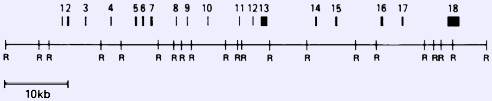
Genomic structure of SIL. EcoRI sites (R) are indicated. Exons are as shown; the smaller exons are not drawn to scale.
Description
18 exons distributed over 70 kb. 5 portion of the gene demonstrating alternate exon utilization.
Proteins
Expression
SIL is an immediate early gene, with ubiquitous expression in proliferating cells and during early embryonic development. SIL protein levels peak during mitosis and are degraded on transition to G1. SIL is phosphorylated in mitosis. It is expressed in multiple cancers. In lung cancer its expression correlates with the expression of mitotic checkpoint genes
Localisation
Cytosolic protein
Function
SIL knockout mouse embryos die in utero displaying holopresencephaly, randomized left/right asymmetry and marked apoptosis of the neural folds. Genetic evidence showed that SIL is required for the Sonic Hedgehog response pathway. SIL phosphorylation and interactions with PIN1 is required for maintenance of the mitotic checkpoint.
Homology
There is no homology to other known proteins.
Mutations
Note
No mutations were found in families with hereditary holoprosencephaly.
Implicated in
Entity name
SIL-TAL1(SCL) fusion.
Note
A submicroscopic deletions fuses the promoter of SIL to TAL1 to induce an abnormal expression of TAL1.
Disease
T-cell ALL. This TAL1-SIL fusion transcript is found in approximately 25% of T-ALL patients.
Cytogenetics
Normal karyotype.
Hybrid gene
the promoter region of the SCL gene, a hematopoietic transcription factor, and the coding region of the SIL gene are deleted. The molecular result of this SIL/SCL rearrangement is an interstitial deletion on chromosome 1 that juxtaposes the 5 portion of the SIL gene to the coding region of the SCL gene. A SIL/SCL fusion mRNA is produced, with SIL exon 1 splicing to SCL exon 3 in a head-to-tail fashion. Because these are both 5 untranslated region (UTR) exons, the net result is that SIL promoter and enhancer elements drive the expression of a full length SCL gene product.
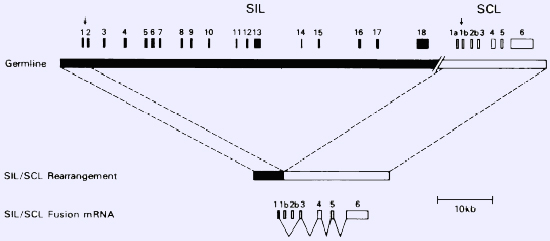
Schematic representation of SIL/SCL fusion mRNA. The germ line SIL (solid boxes) and SCL (open boxes) genomic structures are shown. The deletion breakpoints are indicated with arrows. The SIL/SCL genomic rearrangement is indicated below. The SIL/SCL fusion mRNA is formed by SIL exon 1 (solid box) splicing to SCL exon 3 (open box) in a head-to-tail fashion.
Entity name
SIL overexpression in lung cancer.
Note
SIL is also overexpressed in various solid tumors (melanoma, lymphoma, ovary cancer, breast cancer colon cancer lung and prostate cancer) and leukemic cell lines (Dami-acute megakaryocytic, and K562- erythroid blast crisis of chronic myeloid leukemia).
Disease
High expression in non- small cell lung cancer (NSCLC). In addition, high expression levels in lung adenocarcinoma, lung squamous carcinoma and lung small cell carcinoma.
Prognosis
SIL expression is associated with cell proliferation. In lung cancer, SIL overexpression is correlated with high mitotic activity.
Article Bibliography
| Pubmed ID | Last Year | Title | Authors |
|---|---|---|---|
| 1311214 | 1992 | Involvement of the putative hematopoietic transcription factor SCL in T-cell acute lymphoblastic leukemia. | Aplan PD et al |
| 16024801 | 2005 | Sil phosphorylation in a Pin1 binding domain affects the duration of the spindle checkpoint. | Campaner S et al |
| 12438742 | 2002 | Isolation and characterization of a human novel RAB (RAB39B) gene. | Cheng H et al |
| 12531481 | 2003 | Cloning and characterization of the SIL promoter. | Colaizzo-Anas T et al |
| 15107824 | 2004 | Sil overexpression in lung cancer characterizes tumors with increased mitotic activity. | Erez A et al |
| 9372240 | 1997 | Expression of the SIL gene is correlated with growth induction and cellular proliferation. | Izraeli S et al |
| 11668681 | 2001 | Genetic evidence that Sil is required for the Sonic Hedgehog response pathway. | Izraeli S et al |
Other Information
Locus ID:
NCBI: 6491
MIM: 181590
HGNC: 10879
Ensembl: ENSG00000123473
Variants:
dbSNP: 6491
ClinVar: 6491
TCGA: ENSG00000123473
COSMIC: STIL
RNA/Proteins
Expression (GTEx)
References
| Pubmed ID | Year | Title | Citations |
|---|---|---|---|
| 37101292 | 2023 | STIL/AURKA axis promotes cell proliferation by influencing primary cilia formation in bladder cancer. | 1 |
| 37834064 | 2023 | Molecular Mechanism of STIL Coiled-Coil Domain Oligomerization. | 0 |
| 37101292 | 2023 | STIL/AURKA axis promotes cell proliferation by influencing primary cilia formation in bladder cancer. | 1 |
| 37834064 | 2023 | Molecular Mechanism of STIL Coiled-Coil Domain Oligomerization. | 0 |
| 33725572 | 2021 | circ0000069 promotes cervical cancer cell proliferation and migration by inhibiting miR-4426. | 16 |
| 33725572 | 2021 | circ0000069 promotes cervical cancer cell proliferation and migration by inhibiting miR-4426. | 16 |
| 31607137 | 2020 | STIL is upregulated in nasopharyngeal carcinoma tissues and promotes nasopharyngeal carcinoma proliferation, migration and invasion. | 9 |
| 31754215 | 2020 | Indispensable role of STIL in the regulation of cancer cell motility through the lamellipodial accumulation of ARHGEF7-PAK1 complex. | 12 |
| 32107292 | 2020 | Direct interaction between CEP85 and STIL mediates PLK4-driven directed cell migration. | 4 |
| 33132204 | 2020 | Novel compound heterozygous variants in the STIL gene identified in a Chinese family with presentation of foetal microcephaly. | 1 |
| 31607137 | 2020 | STIL is upregulated in nasopharyngeal carcinoma tissues and promotes nasopharyngeal carcinoma proliferation, migration and invasion. | 9 |
| 31754215 | 2020 | Indispensable role of STIL in the regulation of cancer cell motility through the lamellipodial accumulation of ARHGEF7-PAK1 complex. | 12 |
| 32107292 | 2020 | Direct interaction between CEP85 and STIL mediates PLK4-driven directed cell migration. | 4 |
| 33132204 | 2020 | Novel compound heterozygous variants in the STIL gene identified in a Chinese family with presentation of foetal microcephaly. | 1 |
| 31187582 | 2019 | Knockdown of STIL suppresses the progression of gastric cancer by down-regulating the IGF-1/PI3K/AKT pathway. | 19 |
Citation
Asher Castiel ; Shai Izraeli
STIL (SCL/TAL1 interrupting locus)
Atlas Genet Cytogenet Oncol Haematol. 2005-10-01
Online version: http://atlasgeneticsoncology.org/gene/524/stil
