TNN (tenascin N)
2008-02-01 Martin Degen , Ruth Chiquet-Ehrismann AffiliationFriedrich Miescher Institute for Biomedical Research, Maulbeerstrasse 66, 4058 Basel, Switzerland
DNA/RNA
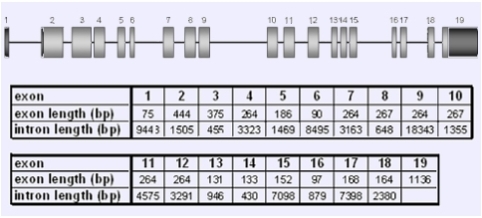
The distribution of the 19 exons is shown in the upper part, whereas the lengths of exons and introns are indicated in the lower part.
Description
The tenascin-W gene consists of 19 exons spanning 80.21 kb of genomic DNA.
Transcription
5005 bp mRNA transcribed in centromeric to telomeric orientation on the forward strand; 3885 bp open reading frame.
The transcript starts with a non-coding exon followed by exon 2, which contains the start codon (ATG) for translation initiation. Exon 1 is located 9448 bp upstream of exon 2.
The transcript starts with a non-coding exon followed by exon 2, which contains the start codon (ATG) for translation initiation. Exon 1 is located 9448 bp upstream of exon 2.
Proteins
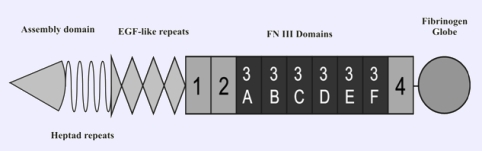
Schematic representation of human tenascin-W is shown.
Description
Tenascin-W is built up of different structural motifs arranged in a linear order, namely amino-terminal heptad repeats, 3.5 EGF-like repeats, 9 FN III domains, and a carboxyl-terminal fibrinogen globe.
The primary sequence encodes a protein of 1294 amino acids. Amino acids 1-16 represent the secretion signal, amino acids 150-254 constitute the EGF-like repeats, and amino acids 255-1054 account for the FNIII domains. FN III domain number 3 was subject to duplication as indicated by the dark boxes in the schematic representation. Tenascin-W is known to form hexameric structures called hexabrachions.
SDS-Page analysis revealed a molecular weight of 160kDa per subunit under reducing conditions.
So far, there is no evidence for alternative splicing.
The primary sequence encodes a protein of 1294 amino acids. Amino acids 1-16 represent the secretion signal, amino acids 150-254 constitute the EGF-like repeats, and amino acids 255-1054 account for the FNIII domains. FN III domain number 3 was subject to duplication as indicated by the dark boxes in the schematic representation. Tenascin-W is known to form hexameric structures called hexabrachions.
SDS-Page analysis revealed a molecular weight of 160kDa per subunit under reducing conditions.
So far, there is no evidence for alternative splicing.
Expression
Initially, tenascin-W was identified in zebrafish where it was expressed in migrating cells of sclerotomal and neural crest origin. More recently, tenascin-W was characterized in mouse and chicken during embryogenesis as well as in the adult organism. These studies revealed that tenascin-W, similar to tenascin-C, shows tight regulation during development and in the adult. Immunohistochemistry showed prominent expression in the developing and adult metanephric kidney, developing and adult periosteum around ribs, and transient expression in smooth muscles of the developing gut, often but not always overlapping with tenascin-C expression. Furthermore, tenascin-W is highly expressed in the tumor stroma in different solid tumors.
Tenascin-W is most likely produced and secreted by mesenchymal cells such as fibroblasts and osteoblasts.
Known stimuli that induce tenascin-W expression include so far tumor necrosis factor alpha (TNFα) and bone morphogenetic protein 2 (BMP2).
Tenascin-W is most likely produced and secreted by mesenchymal cells such as fibroblasts and osteoblasts.
Known stimuli that induce tenascin-W expression include so far tumor necrosis factor alpha (TNFα) and bone morphogenetic protein 2 (BMP2).
Localisation
Extracellular matrix.
Function
Adhesion: Tenascin-W is an adhesive substratum for some cells (osteoblasts, fibroblasts), while others cannot attach and spread on tenascin-W.
Migration: Tenascin-W stimulates the migratory behavior of cells.
Migration: Tenascin-W stimulates the migratory behavior of cells.
Homology
Tenascin-W belongs to the tenascin family, which is a highly conserved family of large oligomeric extracellular matrix proteins. Vertebrate genomes harbor four tenascin genes, which have been termed tenascin-C, tenascin-XB (TNXB), tenascin-R, and tenascin-W.
Human tenascin-W shows high sequence conservation with mouse tenascin-W.
Human tenascin-W shows high sequence conservation with mouse tenascin-W.
Implicated in
Entity name
Breast cancer
Oncogenesis
Tenascin-W is highly expressed in a large fraction of breast cancer patients whereas it is not detectable in normal human mammary tissue. Expression in tumors correlated with tumor grade. There is statistically significant higher mean expression of tenascin-W in low-grade tumors (Grade1/Grade2) compared to high-grade tumors (Grade3).
Tenascin-W is produced in the stromal compartment, most likely by cancer-associated fibroblasts, which are part of a tumor permissive microenvironment that facilitates tumor cell migration. In vitro, presence of tenascin-W stimulated breast cancer cell migration.
Benign tumors as well as carcinomas do express tenascin-W.
Furthermore, tenascin-W is elevated in sera of breast cancer patients compared to that of healthy volunteers.
Tenascin-W is postulated to be a marker for conversion of the normal physiological stroma to an activated stroma in breast cancer.
Tenascin-W is produced in the stromal compartment, most likely by cancer-associated fibroblasts, which are part of a tumor permissive microenvironment that facilitates tumor cell migration. In vitro, presence of tenascin-W stimulated breast cancer cell migration.
Benign tumors as well as carcinomas do express tenascin-W.
Furthermore, tenascin-W is elevated in sera of breast cancer patients compared to that of healthy volunteers.
Tenascin-W is postulated to be a marker for conversion of the normal physiological stroma to an activated stroma in breast cancer.
Entity name
Colorectal cancer
Oncogenesis
Tenascin-W is highly expressed in colorectal cancer patients whereas it is not detectable in the normal colon mucosa. Furthermore, mean tenascin-W level in sera of colorectal cancer patients is statistically increased compared to that in sera of healthy volunteers. Follow-up studies of colorectal cancer patients revealed that 4 out of 5 patients who developed tumor recurrence after treatment showed high tenascin-W levels in their sera. Thus, tenascin-W might have prognostic value as a serum tumor marker.
Article Bibliography
| Pubmed ID | Last Year | Title | Authors |
|---|---|---|---|
| 16534782 | 2006 | Avian tenascin-W: expression in smooth muscle and bone, and effects on calvarial cell spreading and adhesion in vitro. | Meloty-Kapella CV et al |
| 15592496 | 2005 | Tenascin-W is found in malignant mammary tumors, promotes alpha8 integrin-dependent motility and requires p38MAPK activity for BMP-2 and TNF-alpha induced expression in vitro. | Scherberich A et al |
| 16893461 | 2006 | Phylogenetic analysis of the tenascin gene family: evidence of origin early in the chordate lineage. | Tucker RP et al |
| 9552162 | 1998 | Zebrafish tenascin-W, a new member of the tenascin family. | Weber P et al |
Other Information
Locus ID:
NCBI: 63923
MIM: 617472
HGNC: 22942
Ensembl: ENSG00000120332
Variants:
dbSNP: 63923
ClinVar: 63923
TCGA: ENSG00000120332
COSMIC: TNN
RNA/Proteins
| Gene ID | Transcript ID | Uniprot |
|---|---|---|
| ENSG00000120332 | ENST00000239462 | Q9UQP3 |
| ENSG00000120332 | ENST00000621086 | A0A087WXC4 |
| ENSG00000120332 | ENST00000622870 | A0A087WXT0 |
Expression (GTEx)
Pathways
Protein levels (Protein atlas)
References
| Pubmed ID | Year | Title | Citations |
|---|---|---|---|
| 35371015 | 2022 | Tenascin-C can Serve as an Indicator for the Immunosuppressive Microenvironment of Diffuse Low-Grade Gliomas. | 8 |
| 36206596 | 2022 | TNN is first linked to auditory neuropathy. | 0 |
| 35371015 | 2022 | Tenascin-C can Serve as an Indicator for the Immunosuppressive Microenvironment of Diffuse Low-Grade Gliomas. | 8 |
| 36206596 | 2022 | TNN is first linked to auditory neuropathy. | 0 |
| 33603752 | 2020 | Tenascin-W: Discovery, Evolution, and Future Prospects. | 8 |
| 33692777 | 2020 | Tenascin-W Is a Novel Stromal Marker in Biliary Tract Cancers. | 2 |
| 33603752 | 2020 | Tenascin-W: Discovery, Evolution, and Future Prospects. | 8 |
| 33692777 | 2020 | Tenascin-W Is a Novel Stromal Marker in Biliary Tract Cancers. | 2 |
| 28629900 | 2017 | Multiple analyses indicate the specific association of NR1I3, C6 and TNN with low hip BMD risk. | 1 |
| 28629900 | 2017 | Multiple analyses indicate the specific association of NR1I3, C6 and TNN with low hip BMD risk. | 1 |
| 26627873 | 2016 | Targeted next-generation sequencing assay for detection of mutations in primary myopathies. | 43 |
| 26627873 | 2016 | Targeted next-generation sequencing assay for detection of mutations in primary myopathies. | 43 |
| 25868708 | 2015 | Transcriptional regulation of tenascin-W by TGF-beta signaling in the bone metastatic niche of breast cancer cells. | 18 |
| 25868708 | 2015 | Transcriptional regulation of tenascin-W by TGF-beta signaling in the bone metastatic niche of breast cancer cells. | 18 |
| 18306355 | 2008 | Tenascin-W, a new marker of cancer stroma, is elevated in sera of colon and breast cancer patients. | 19 |
Citation
Martin Degen ; Ruth Chiquet-Ehrismann
TNN (tenascin N)
Atlas Genet Cytogenet Oncol Haematol. 2008-02-01
Online version: http://atlasgeneticsoncology.org/gene/44209/tnn
