TNC (tenascin C (hexabrachion))
2008-02-01 Martin Degen , Ruth Chiquet-Ehrismann AffiliationFriedrich Miescher Institute for Biomedical Research, Maulbeerstrasse 66, 4058 Basel, Switzerland
Identity
HGNC
LOCATION
9q33.1
LOCUSID
ALIAS
150-225,DFNA56,GMEM,GP,HXB,JI,TN,TN-C
FUSION GENES
DNA/RNA
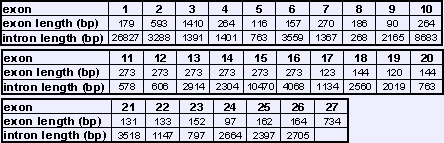
Table shows the lengths of the exons and introns of human tenascin-C.
Description
The tenascin-C gene consists of 27 exons spanning 97.63 kb of genomic DNA.
Transcription
7271 bp mRNA transcribed on the reverse strand; 6333 bp open reading frame.
The transcript starts with a non-coding exon 1 (179 bp) followed by exon 2, which contains the start codon (ATG) for translation initiation. Exon 1 is located 26827 bp upstream of exon 2.
The transcript starts with a non-coding exon 1 (179 bp) followed by exon 2, which contains the start codon (ATG) for translation initiation. Exon 1 is located 26827 bp upstream of exon 2.
Proteins
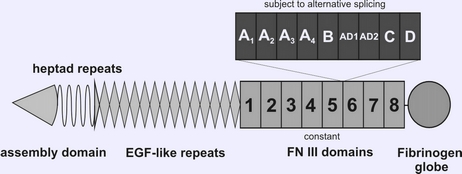
Schematic representation of a monomeric tenascin-C subunit.
Description
Tenascin-C consists of structural motifs arranged in a linear order. Mammalian tenascin-C proteins contain amino-terminal heptad repeats, 14.5 EGF-like repeats, 8 constant FN III domains, whereas 9 additional FN III domains can be included in a combinatorial manner by alternative splicing, and a carboxyl-terminal fibrinogen globe. A prominent feature of tenascin-C is the assembly into hexamers, so-called hexabrachions.
The primary sequence encodes a protein of 2110 amino acids. Amino acids 1-22 represent the secretion signal, amino acids 189-621 constitute the EGF-like repeats, and amino acids 622-1882 account for the FNIII domains. SDS-Page analysis revealed a molecular weight of full-length tenascin-C of 250kDa - 300kDa per subunit under reducing conditions.
Alternative splicing within the stretch of FN III domains results in a great number and diversity in tenascin-C isoforms.
The primary sequence encodes a protein of 2110 amino acids. Amino acids 1-22 represent the secretion signal, amino acids 189-621 constitute the EGF-like repeats, and amino acids 622-1882 account for the FNIII domains. SDS-Page analysis revealed a molecular weight of full-length tenascin-C of 250kDa - 300kDa per subunit under reducing conditions.
Alternative splicing within the stretch of FN III domains results in a great number and diversity in tenascin-C isoforms.
Expression
More than two decades ago, tenascin-C was discovered as an extracellular matrix protein (ECM) enriched in the stroma of gliomas and as a myotendinous antigen. Tenascin-C expression is highly regulated both during development and in the adult. Tenascin-C levels are high during embryogenesis, but almost absent during normal postnatal life with some basal expression detectable in tendons and ligaments only. In adult life, tenascin-C is also expressed within the sub-ventricular zone in the central nervous system, a region that constitutes the neural stem cell niche. A prominent feature of tenascin-C is its re-appearance in response to pathological situations such as infection, inflammation and tissue remodeling. Another striking example of a pathological situation leading to the re-expression of tenascin-C is the onset of tumorigenesis, where tenascin-C is specifically expressed in the activated tumor stroma. Tenascin-C can be induced by various stimuli, such as the pro- and anti-inflammatory cytokines, interleukins, TNFa or IFNg and growth factors such as TGFb , EGF or PDGF. Furthermore, tenascin-C inducing stimuli include mechanical stress, hypoxia, and reactive oxygen species, factors or conditions which also might play a prominent role in tumors.
Localisation
Extracellular matrix.
Function
Adhesion: Tenascin-C acts as an anti-adhesive substratum for a large variety of cells. Active inhibition of cell spreading was further confirmed by mixing tenascin-C together with fibronectin, which is a classical adhesion protein. Whereas cells on fibronectin nicely spread, form focal contacts and actin stress fibers, the same cells plated on a mixed fibronectin-tenascin-C substratum are not able to spread and do not form focal contacts and actin cables.
Migration: Tenascin-C enhances migration and invasiveness of different cancer cells.
Proliferation: Tenascin-C stimulates cancer cell proliferation.
Angiogenesis: Tenascin-C is expressed around angiogenic vessels in many tumors and there is evidence that it promotes and regulates angiogenesis in vitro and in vivo. Moreover, in glioma patients, clinical studies revealed an inhibition of tumor angiogenesis by applying antibodies directed against tenascin-C.
Migration: Tenascin-C enhances migration and invasiveness of different cancer cells.
Proliferation: Tenascin-C stimulates cancer cell proliferation.
Angiogenesis: Tenascin-C is expressed around angiogenic vessels in many tumors and there is evidence that it promotes and regulates angiogenesis in vitro and in vivo. Moreover, in glioma patients, clinical studies revealed an inhibition of tumor angiogenesis by applying antibodies directed against tenascin-C.
Homology
Tenascin-C belongs to the tenascin family, which is a highly conserved family of large oligomeric extracellular matrix proteins. Vertebrate genomes harbor four tenascin genes, which have been termed tenascin-C, tenascin-XB (TNXB), tenascin-R, and tenascin-W.
Mutations
Germinal
A SNP was identified resulting in an amino acid substitution (Leu1677Ile in the tenascin-C FN III domain D) which strongly associates with adult bronchial asthma. Therefore, this SNP might be an asthma marker and may be important in its pathogenesis.
Implicated in
Entity name
Cancer (general)
Oncogenesis
Tenascin-C is strongly expressed in the stroma of various cancers and has been reported to be associated with the invasive front of tumors. For cancers in the lung, colon, and brain, high tenascin-C expression correlates with poor prognosis, whereas in other cancers no clear correlation between tenascin-C and survival or malignancy exists. In search for new diagnostic or prognostic tumor markers, tenascin-C levels have often been analyzed in sera of cancer patients and its potential value as a biomarker has been evaluated. Although elevated tenascin-C serum levels have been found in certain cancers, it still remains a questionable tumor marker. Tenascin-C levels are scattered over a wide range with many cancer patients having normal tenascin-C concentrations and its expression strongly correlates with inflammation or infection.
Entity name
Breast cancer
Oncogenesis
By means of in vivo selection and microarray analysis a gene expression signature was identified that mediates breast cancer metastasis to lung. Tenascin-C is one of those genes that have been found to belong to the lung metastasis signature genes.
A recent study identified tenascin-C as a direct target gene for the microRNA miR-335. This microRNA is specifically lost as human breast cancer cells develop metastatic potential. Knockdown of tenascin-C in the highly metastatic LM2 cells (a metastatic derivative of the human breast cancer cell line MDA-MB-231) reduced migration in a trans-well assay and significantly inhibited lung colonization by LM2 cells.
A recent study identified tenascin-C as a direct target gene for the microRNA miR-335. This microRNA is specifically lost as human breast cancer cells develop metastatic potential. Knockdown of tenascin-C in the highly metastatic LM2 cells (a metastatic derivative of the human breast cancer cell line MDA-MB-231) reduced migration in a trans-well assay and significantly inhibited lung colonization by LM2 cells.
Article Bibliography
| Pubmed ID | Last Year | Title | Authors |
|---|---|---|---|
| 16461331 | 2006 | Vascular tenascin-C regulates cardiac endothelial phenotype and neovascularization. | Ballard VL et al |
| 6342760 | 1983 | Human glioma-mesenchymal extracellular matrix antigen defined by monoclonal antibody. | Bourdon MA et al |
| 6202699 | 1984 | Chick myotendinous antigen. II. A novel extracellular glycoprotein complex consisting of large disulfide-linked subunits. | Chiquet M et al |
| 12845616 | 2003 | Tenascins: regulation and putative functions during pathological stress. | Chiquet-Ehrismann R et al |
| 10842355 | 2000 | The tenascin family of ECM glycoproteins: structure, function, and regulation during embryonic development and tissue remodeling. | Jones FS et al |
| 16115819 | 2005 | Coding SNP in tenascin-C Fn-III-D domain associates with adult asthma. | Matsuda A et al |
| 16049480 | 2005 | Genes that mediate breast cancer metastasis to lung. | Minn AJ et al |
| 16632194 | 2006 | Tenascin-C induced signaling in cancer. | Orend G et al |
| 15743679 | 2005 | Potential oncogenic action of tenascin-C in tumorigenesis. | Orend G et al |
| 7538974 | 1995 | Tenascin-C in serum: a questionable tumor marker. | Schenk S et al |
| 18185580 | 2008 | Endogenous human microRNAs that suppress breast cancer metastasis. | Tavazoie SF et al |
| 8548761 | 1996 | Tenascin-C expression by angiogenic vessels in human astrocytomas and by human brain endothelial cells in vitro. | Zagzag D et al |
Other Information
Locus ID:
NCBI: 3371
MIM: 187380
HGNC: 5318
Ensembl: ENSG00000041982
Variants:
dbSNP: 3371
ClinVar: 3371
TCGA: ENSG00000041982
COSMIC: TNC
RNA/Proteins
Expression (GTEx)
Pathways
Protein levels (Protein atlas)
References
| Pubmed ID | Year | Title | Citations |
|---|---|---|---|
| 37972699 | 2024 | Characteristics of n6-methyladenosine (m6A) regulators and role of FTO/TNC in scleroderma. | 2 |
| 37987507 | 2024 | Engrailed 2 serves as a master regulator of the super-enhancer in the TNC gene locus in non-small cell lung cancer. | 0 |
| 38471098 | 2024 | Association of Tenascin-C Gene Polymorphisms with Risk of Acute Coronary Syndrome in South Indian Population: A Case-Control Genetic Association Study. | 0 |
| 37972699 | 2024 | Characteristics of n6-methyladenosine (m6A) regulators and role of FTO/TNC in scleroderma. | 2 |
| 37987507 | 2024 | Engrailed 2 serves as a master regulator of the super-enhancer in the TNC gene locus in non-small cell lung cancer. | 0 |
| 38471098 | 2024 | Association of Tenascin-C Gene Polymorphisms with Risk of Acute Coronary Syndrome in South Indian Population: A Case-Control Genetic Association Study. | 0 |
| 36458980 | 2023 | A virological view of tenascin-C in infection. | 2 |
| 36878305 | 2023 | Tenascin-C affects invasiveness of EGFR-mutated lung adenocarcinoma through a putative paracrine loop. | 0 |
| 37209968 | 2023 | Tenascins and osteopontin in biological response in cornea. | 1 |
| 37373332 | 2023 | Tenascin-C in Tissue Repair after Myocardial Infarction in Humans. | 2 |
| 37758009 | 2023 | Tenascin-C-EGFR activation induces functional human satellite cell proliferation and promotes wound-healing of skeletal muscles via oleanic acid. | 0 |
| 37929694 | 2023 | Caveolin-1-dependent tenascin C inclusion in extracellular vesicles is required to promote breast cancer cell malignancy. | 2 |
| 36458980 | 2023 | A virological view of tenascin-C in infection. | 2 |
| 36878305 | 2023 | Tenascin-C affects invasiveness of EGFR-mutated lung adenocarcinoma through a putative paracrine loop. | 0 |
| 37209968 | 2023 | Tenascins and osteopontin in biological response in cornea. | 1 |
Citation
Martin Degen ; Ruth Chiquet-Ehrismann
TNC (tenascin C (hexabrachion))
Atlas Genet Cytogenet Oncol Haematol. 2008-02-01
Online version: http://atlasgeneticsoncology.org/gene/42597/tnc-(tenascin-c-(hexabrachion))
