VAV1 (vav 1 oncogene)
2005-01-01 Shulamit Katzav AffiliationExperimental Medicine & Cancer Research, The Hebrew University\\\/Hadassah Medical School, Ein-Karem, P.O.Box 12272, Jerusalem 91120, Israel
DNA/RNA
Transcription
2535 mRNA complete codons
Proteins
Note
Vav1 was discovered when DNA from five esophageal carcinomas were tested for their transforming activity. This newly identified gene represented the sixth oncogene detected in Dr. Barbacids laboratory and it was thus designated Vav1, after the sixth letter of the Hebrew alphabet. Vav1 was activated as an oncogene in vitro by replacement of 67 amino-acid residues of its amino-terminus (CH region) with 19 amino-acids residues of pSV2neo sequences, co-transfected as a selectable marker. Wild-type Vav1 produces minimal transformation of NIH3T3 murine fibroblasts only when the protein is grossly over-expressed. Removal of its amino terminus sequences (65 residues), thus mimicking its original mode of activation, is sufficient to induce Vav1 transformation.
Description
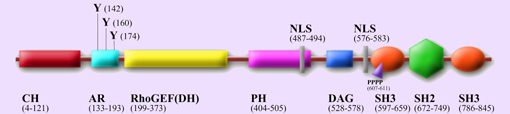
Vav1 encodes a highly unique protein that contains numerous modular motifs known to play a role in tyrosine-mediated signal transduction cascades, such as a dbl homology (DH) region, which exhibits a guanine nucleotide exchange factor (GEF) activity towards the Rho family GTPases; a pleckstrin homology (PH) domain which interacts with polyphosphoinositides; a Src Homology 2 (SH2) and two Src Homology 3 (SH3) domains that mediate protein-protein interactions; a proline- rich motif that enables binding to SH3 -containing proteins, an acidic-rich (Ac) region and a calponin-homology (CH) region, which functions as an actin-binding domain in other proteins and two nuclear localization signals(NLS). In fact, Vav1 is the only known Rho GEF that combines in the same protein the DH/PH motifs and the structural hallmark of signal transducer proteins, the SH2 and SH3 domains.
Expression
Vav1 is specifically expressed in the hematopoietic system.
Function
The Vav1 protein (95 kDa) is rapidly tyrosine-phosphorylated following stimulation of various receptors on hematopoietic cells (TCR, BCR, IgE, etc). Vav1 can then function in various signaling cascades. First, as a tyrosine-phosphorylated protein, Vav1 operates as a guanine nucleotide exchange factor (GEF) for Rac1, Rac2 and RhoG. It is the only known GEF protein whose activity is regulated by tyrosine phosphorylation. As a regulator of activation of the Rho/Rac GTPases, Vav1 participates in several processes that require cytoskeletal reorganization, such as the formation of the immunological synapse (IS), phagocytosis, platelet aggregation and spreading. Vav1 can also function in GEF-independent pathways through its association with other proteins such as ZAP-70, SLP-76, Ly-GDI (an inhibitor of Rho/RacGTPases), Grb2 and cytoseketal proteins such as Zyxin. Vav1 plays a critical role in stimulation of NFAT (Nuclear Factor of Activated T cells), culminating in the production of numerous vital cytokines. Vav1 also leads to the induction of an intracellular calcium flux by regulating the activation of phospholipase Cg1 (PLCg1) via phosphoinositide 3-kinase (PI3K) dependent and -independent pathways. The activity of Vav1 also leads to the activation of NF-kB and the extracellular signal regulated kinase (ERK) mitogen-activated protein kinase (MAPK) signaling cascade. There is compelling evidence from studies of gene-targeted mice to indicate that Vav1 participates in the development and function of many types of immune cell such as the positive- and negative-selection events that are imposed on double-positive thymocytes
Homology
Vav1 is one of a larger family of proteins that include Vav2 and Vav3 which unlike Vav1 are also ubiquitously expressed and the Vav homologues in Drosophila Melanogaster and in the nematode, C. elegans. These proteins are similar in their structure to Vav1, thus also functioning as signal transducer proteins.
Mutations
Somatic
Although, no mutants of Vav1 have been reported thus far in "real" human tumors, it was recently found that Vav1 is expressed in the majority of 42 specimens of human neuroblastoma, suggesting a possible involvement of this protein in the neoplastic process in a subset of neuroblastomas. Furthermore, it was recently found to be involved in a large number of Pancreatic tumors.
Implicated in
Disease
Neuroblastoma
Article Bibliography
| Pubmed ID | Last Year | Title | Authors |
|---|---|---|---|
| 11607839 | 2001 | Vav proteins, adaptors and cell signaling. | Bustelo XR et al |
| 1311423 | 1992 | Product of vav proto-oncogene defines a new class of tyrosine protein kinase substrates. | Bustelo XR et al |
| 8990121 | 1997 | Phosphotyrosine-dependent activation of Rac-1 GDP/GTP exchange by the vav proto-oncogene product. | Crespo P et al |
| 15652748 | 2005 | Ectopic expression of VAV1 reveals an unexpected role in pancreatic cancer tumorigenesis. | Fernandez-Zapico ME et al |
| 14607270 | 2004 | Vav proteins, masters of the world of cytoskeleton organization. | Hornstein I et al |
| 12555096 | 2003 | Adaptors as central mediators of signal transduction in immune cells. | Jordan MS et al |
| 14592821 | 2004 | Vav1: an oncogene that regulates specific transcriptional activation of T cells. | Katzav S et al |
| 2477241 | 1989 | vav, a novel human oncogene derived from a locus ubiquitously expressed in hematopoietic cells. | Katzav S et al |
| 11340169 | 2001 | Vav1 regulates phospholipase cgamma activation and calcium responses in mast cells. | Manetz TS et al |
| 1531699 | 1992 | Tyrosine phosphorylation of vav proto-oncogene product containing SH2 domain and transcription factor motifs. | Margolis B et al |
| 2253939 | 1990 | The human VAV proto-oncogene maps to chromosome region 19p12----19p13.2. | Martinerie C et al |
| 11994416 | 2002 | Vav1 transduces T cell receptor signals to the activation of phospholipase C-gamma1 via phosphoinositide 3-kinase-dependent and -independent pathways. | Reynolds LF et al |
| 12094222 | 2002 | VAV proteins as signal integrators for multi-subunit immune-recognition receptors. | Turner M et al |
| 7623828 | 1995 | A functional T-cell receptor signaling pathway is required for p95vav activity. | Wu J et al |
Other Information
Locus ID:
NCBI: 7409
MIM: 164875
HGNC: 12657
Ensembl: ENSG00000141968
Variants:
dbSNP: 7409
ClinVar: 7409
TCGA: ENSG00000141968
COSMIC: VAV1
RNA/Proteins
Expression (GTEx)
Pathways
Protein levels (Protein atlas)
References
| Pubmed ID | Year | Title | Citations |
|---|---|---|---|
| 36617975 | 2023 | RhoA G17E/Vav1 Signaling Induces Cancer Invasion via Matrix Metalloproteinase-9 in Gastric Cancer. | 2 |
| 37174676 | 2023 | Unraveling the Oncogenic Potential of VAV1 in Human Cancer: Lessons from Mouse Models. | 0 |
| 37545183 | 2023 | Vav1-dependent Rac1 activation mediates hypoxia-induced gemcitabine resistance in pancreatic ductal adenocarcinoma cells through upregulation of HIF-1α expression. | 1 |
| 38441379 | 2023 | Sex-dependent expression levels of VAV1 and P2X7 in PBMC of multiple sclerosis patients. | 0 |
| 36617975 | 2023 | RhoA G17E/Vav1 Signaling Induces Cancer Invasion via Matrix Metalloproteinase-9 in Gastric Cancer. | 2 |
| 37174676 | 2023 | Unraveling the Oncogenic Potential of VAV1 in Human Cancer: Lessons from Mouse Models. | 0 |
| 37545183 | 2023 | Vav1-dependent Rac1 activation mediates hypoxia-induced gemcitabine resistance in pancreatic ductal adenocarcinoma cells through upregulation of HIF-1α expression. | 1 |
| 38441379 | 2023 | Sex-dependent expression levels of VAV1 and P2X7 in PBMC of multiple sclerosis patients. | 0 |
| 34743576 | 2022 | Identification of molecular subtyping system and four-gene prognostic signature with immune-related genes for uveal melanoma. | 3 |
| 35326399 | 2022 | Vav1 Promotes B-Cell Lymphoma Development. | 2 |
| 35584138 | 2022 | Spatially resolved in silico modeling of NKG2D signaling kinetics suggests a key role of NKG2D and Vav1 Co-clustering in generating natural killer cell activation. | 3 |
| 34743576 | 2022 | Identification of molecular subtyping system and four-gene prognostic signature with immune-related genes for uveal melanoma. | 3 |
| 35326399 | 2022 | Vav1 Promotes B-Cell Lymphoma Development. | 2 |
| 35584138 | 2022 | Spatially resolved in silico modeling of NKG2D signaling kinetics suggests a key role of NKG2D and Vav1 Co-clustering in generating natural killer cell activation. | 3 |
| 32767384 | 2021 | VAV1-overexpressing YT cells display improved cytotoxicity against malignant cells. | 0 |
Citation
Shulamit Katzav
VAV1 (vav 1 oncogene)
Atlas Genet Cytogenet Oncol Haematol. 2005-01-01
Online version: http://atlasgeneticsoncology.org/gene/195/vav1
