XAF1 (XIAP associated factor-1)
2008-01-01 Stéphanie Plenchette , Wai Gin Fong , Robert G Korneluk AffiliationChildrens Hospital of Eastern Ontario, Apoptosis Research Centre, Research Institute, 401 Smyth Road, Ottawa, ON, K1H 8L1, Canada
Identity
HGNC
LOCATION
17p13.1
LOCUSID
ALIAS
BIRC4BP,HSXIAPAF1,XIAPAF1
FUSION GENES
DNA/RNA
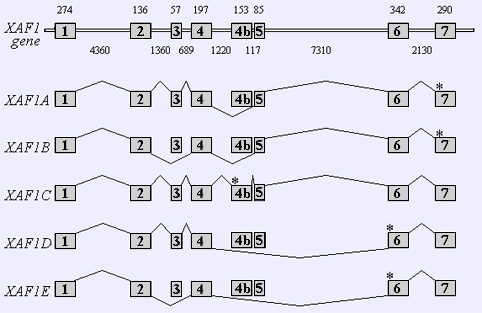
Schematic diagram of the XAF1 gene comprising 8 exons (in grey) and transcript variants. The sizes in base pairs (bp) of exons (above) and introns (below) are shown. (*) indicates the positions of the stop codons.
Description
The XAF1 gene exists as a single copy in the human genome; it contains 8 exons and was predicted to span over approximately 18 kb of the genomic DNA.
Transcription
Five isoforms of XAF1 cDNA have been identified and are expressed in a cell and tissue type specific-manner:
The original XAF1, also called XAF1(A) (CDS: 906nt)
The XAF1(B) isoform (CDS: 849nt); lacks exon 3
The XAF1(C) isoform (CDS: 495nt); contains exon 4b and a new stop codon
The XAF1(D) isoform (CDS: 426nt); lacks exons 4b and 5 (new stop codon in exon 6)
The XAF1(E) isoform (CDS: 369nt); lacks exons 3, 4b and 5 (new stop codon in exon 6)
With Northern blot analysis, at least four distinct transcripts sizes have been identified in Homo sapiens (3.9 kb, 4.5 kb, 6.0 kb and 7.0 kb). How these mRNA species relate to isoform variants is not known.
The original XAF1, also called XAF1(A) (CDS: 906nt)
The XAF1(B) isoform (CDS: 849nt); lacks exon 3
The XAF1(C) isoform (CDS: 495nt); contains exon 4b and a new stop codon
The XAF1(D) isoform (CDS: 426nt); lacks exons 4b and 5 (new stop codon in exon 6)
The XAF1(E) isoform (CDS: 369nt); lacks exons 3, 4b and 5 (new stop codon in exon 6)
With Northern blot analysis, at least four distinct transcripts sizes have been identified in Homo sapiens (3.9 kb, 4.5 kb, 6.0 kb and 7.0 kb). How these mRNA species relate to isoform variants is not known.
Pseudogene
Not known
Proteins
Description
The full length XAF1 protein consists of 301 amino acids corresponding to a molecular weight of 33.411 kDa. The protein contains seven zinc fingers domains. The XAF1(B) isoform is predicted to lack the third N-terminal zinc finger of the previously described XAF1. The XAF1(C) is predicted to contain the first five amino-terminal zinc finger domains of the previously described XAF1 and also a unique 24 aa carboxy terminus. There is no evidence for XAF1 isoforms (C), (D) and (E) expression at the protein level.
Expression
Normal tissue: ubiquitous and differential expression in normal tissues; highest in heart and ovary and lowest in brain and testis at mRNA levels. The XAF1 protein also displays differential protein expression profile within normal cell or tissue development including placenta and motoneurons.
Cancer: as opposed to normal cells, XAF1 is found either low or undetectable in tumor cell lines at both mRNA and protein levels. Expression varies also widely among different tumor cell lines. High levels of XAF1 protein were found in glioblastoma cells (SF-539) and ovarian cells (OVCAR-5). Detectable levels were found also in various gastric and colon cancer cell lines and also myeloma cells (U266).
Cancer: as opposed to normal cells, XAF1 is found either low or undetectable in tumor cell lines at both mRNA and protein levels. Expression varies also widely among different tumor cell lines. High levels of XAF1 protein were found in glioblastoma cells (SF-539) and ovarian cells (OVCAR-5). Detectable levels were found also in various gastric and colon cancer cell lines and also myeloma cells (U266).
Localisation
Nuclear and cytoplasmic distribution
Function
Tumor suppressor gene: loss of heterozygosity (LOH) found in 12 of 33 (36%) human primary colorectal carcinomas. The absence or reduced expression of XAF1 in cancer cell lines by genetic or epigenetic modifications have suggested a possible role in the suppression of development and/or progression of malignancy.
IAP antagonist: XAF1 exerts a proapoptotic effect by directly interacting with BIRC4/XIAP and antagonizing its anticaspase activity. XAF1 enhances XIAP E3 ligase activity towards BIRC5/Survivin through a complex and mediates Survivin down-regulation.
Interferon (IFN)-stimulated gene (ISG): XAF1 is an important mediator of IFN-induced sensitization to TNF-related apoptosis-inducing ligand (TRAIL) in cancer.
Increasing expression of XAF1 sensitizes cells to apoptosis-induced by various stimuli including etoposide, 5-FU, TRAIL, anti-Fas Ab, TNFalpha, UV, H2O2, gamma-irradiation.
IAP antagonist: XAF1 exerts a proapoptotic effect by directly interacting with BIRC4/XIAP and antagonizing its anticaspase activity. XAF1 enhances XIAP E3 ligase activity towards BIRC5/Survivin through a complex and mediates Survivin down-regulation.
Interferon (IFN)-stimulated gene (ISG): XAF1 is an important mediator of IFN-induced sensitization to TNF-related apoptosis-inducing ligand (TRAIL) in cancer.
Increasing expression of XAF1 sensitizes cells to apoptosis-induced by various stimuli including etoposide, 5-FU, TRAIL, anti-Fas Ab, TNFalpha, UV, H2O2, gamma-irradiation.
Homology
XAF1 shares high amino acid similarity with the zinc finger domains of FLN29 and TRAF6.
Mutations
Note
Include genetic and epigenetic modification
Germinal
Not known
Somatic
No somatic mutations in tumor cell lines examined. LOH described in colon tumors.
Epigenetics
Aberrant promoter hypermethylation in the 5 proximal region (from +3nt to -234 nt) in a variety of gastric, colon, bladder, kidney and prostate cancer cell lines and tumors.
Implicated in
Entity name
Colorectal cancer, gastric cancer, urogenital cancer
Oncogenesis
XAF1 is proposed to be a tumor suppressor gene. Correlation of reduction in XAF1 expression with stage and grade within gastric and colorectal tumors demonstrating that the loss of XAF1 contributes to tumorigenesis.
Article Bibliography
| Pubmed ID | Last Year | Title | Authors |
|---|---|---|---|
| 17613533 | 2007 | Degradation of survivin by the X-linked inhibitor of apoptosis (XIAP)-XAF1 complex. | Arora V et al |
| 14612497 | 2003 | Hypermethylation of XIAP-associated factor 1, a putative tumor suppressor gene from the 17p13.2 locus, in human gastric adenocarcinomas. | Byun DS et al |
| 17570219 | 2007 | Frequent alteration of XAF1 in human colorectal cancers: implication for tumor cell resistance to apoptotic stresses. | Chung SK et al |
| 16353137 | 2006 | Switch to full-length of XAF1 mRNA expression in prostate cancer cells by the DNA methylation inhibitor. | Fang X et al |
| 11087668 | 2000 | Expression and genetic analysis of XIAP-associated factor 1 (XAF1) in cancer cell lines. | Fong WG et al |
| 17449173 | 2007 | Gene expression and promoter methylation of the XIAP-associated Factor 1 in renal cell carcinomas: correlations with pathology and outcome. | Kempkensteffen C et al |
| 12029096 | 2002 | Identification of X-linked inhibitor of apoptosis-associated factor-1 as an interferon-stimulated gene that augments TRAIL Apo2L-induced apoptosis. | Leaman DW et al |
| 16909101 | 2006 | Promoter CpG hypermethylation and downregulation of XAF1 expression in human urogenital malignancies: implication for attenuated p53 response to apoptotic stresses. | Lee MG et al |
| 11175744 | 2001 | Identification of XAF1 as an antagonist of XIAP anti-Caspase activity. | Liston P et al |
| 15667552 | 2005 | Low expression of XIAP-associated factor 1 in human colorectal cancers. | Ma TL et al |
| 15610524 | 2004 | XAF1 expression is significantly reduced in human melanoma. | Ng KC et al |
| 15084658 | 2004 | Motoneuron resistance to apoptotic cell death in vivo correlates with the ratio between X-linked inhibitor of apoptosis proteins (XIAPs) and its inhibitor, XIAP-associated factor 1. | Perrelet D et al |
| 17621877 | 2007 | The role of XAF1 in cancer. | Plenchette S et al |
| 17008933 | 2007 | Potent antitumor efficacy of XAF1 delivered by conditionally replicative adenovirus vector via caspase-independent apoptosis. | Qi R et al |
| 18093313 | 2007 | Adjuvant whole abdominal intensity modulated radiotherapy (IMRT) for high risk stage FIGO III patients with ovarian cancer (OVAR-IMRT-01) - Pilot trial of a phase I/II study: study protocol. | Rochet N et al |
| 16530516 | 2006 | All-trans retinoic acid induces XAF1 expression through an interferon regulatory factor-1 element in colon cancer. | Wang J et al |
| 16432762 | 2006 | Xaf1 can cooperate with TNFalpha in the induction of apoptosis, independently of interaction with XIAP. | Xia Y et al |
| 14583479 | 2003 | Coexistence of high levels of apoptotic signaling and inhibitor of apoptosis proteins in human tumor cells: implication for cancer specific therapy. | Yang L et al |
| 16343440 | 2006 | Identification of a novel splice variant of X-linked inhibitor of apoptosis-associated factor 1. | Yin W et al |
| 17087954 | 2006 | Correlation between the single-site CpG methylation and expression silencing of the XAF1 gene in human gastric and colon cancers. | Zou B et al |
Other Information
Locus ID:
NCBI: 54739
MIM: 606717
HGNC: 30932
Ensembl: ENSG00000132530
Variants:
dbSNP: 54739
ClinVar: 54739
TCGA: ENSG00000132530
COSMIC: XAF1
RNA/Proteins
Expression (GTEx)
Pathways
Protein levels (Protein atlas)
References
| Pubmed ID | Year | Title | Citations |
|---|---|---|---|
| 38095639 | 2024 | XAF1 promotes colorectal cancer metastasis via VCP-RNF114-JUP axis. | 1 |
| 38520543 | 2024 | XAF1 overexpression inhibits the malignant progression and cisplatin resistance of NSCLC by activating endoplasmic reticulum stress. | 0 |
| 38095639 | 2024 | XAF1 promotes colorectal cancer metastasis via VCP-RNF114-JUP axis. | 1 |
| 38520543 | 2024 | XAF1 overexpression inhibits the malignant progression and cisplatin resistance of NSCLC by activating endoplasmic reticulum stress. | 0 |
| 35430604 | 2022 | XAF1 destabilizes estrogen receptor α through the assembly of a BRCA1-mediated destruction complex and promotes estrogen-induced apoptosis. | 2 |
| 36132546 | 2022 | IRF9 and XAF1 as Diagnostic Markers of Primary Sjogren Syndrome. | 1 |
| 35430604 | 2022 | XAF1 destabilizes estrogen receptor α through the assembly of a BRCA1-mediated destruction complex and promotes estrogen-induced apoptosis. | 2 |
| 36132546 | 2022 | IRF9 and XAF1 as Diagnostic Markers of Primary Sjogren Syndrome. | 1 |
| 34134965 | 2021 | [Effect of stable overexpression of XAF1 gene on biological characteristics of ovarian cancer A2780 cells]. | 0 |
| 34134965 | 2021 | [Effect of stable overexpression of XAF1 gene on biological characteristics of ovarian cancer A2780 cells]. | 0 |
| 30551877 | 2019 | YY1 negatively regulates the XAF1 gene expression in prostate cancer. | 8 |
| 31081052 | 2019 | TGF-β1 protects colon tumor cells from apoptosis through XAF1 suppression. | 12 |
| 31575897 | 2019 | Paradoxical epigenetic regulation of XAF1 mediates plasticity towards adaptive resistance evolution in MGMT-methylated glioblastoma. | 7 |
| 30551877 | 2019 | YY1 negatively regulates the XAF1 gene expression in prostate cancer. | 8 |
| 31081052 | 2019 | TGF-β1 protects colon tumor cells from apoptosis through XAF1 suppression. | 12 |
Citation
Stéphanie Plenchette ; Wai Gin Fong ; Robert G Korneluk
XAF1 (XIAP associated factor-1)
Atlas Genet Cytogenet Oncol Haematol. 2008-01-01
Online version: http://atlasgeneticsoncology.org/gene/44095/xaf1
