BIRC5 (baculoviral IAP repeat containing 5)
2019-01-01 Paola Cristina Branco , Paula Christine Jimenez , Joao Agostinho Machado-Neto, PhD , Letícia Veras Costa-Lotufo AffiliationAbstract
BIRC5, also known as survivin, has been implicated in cell cycle progression and apoptosis avoidance. BIRC5 is highly expressed in embryonic tissues, however very low or absent in adult tissues. BIRC5 overexpression has been frequently associated to cancer development, a poor prognosis and chemoresistance. Besides that, different BIRC5 isoforms has been characterized and related to better or worse chemotherapy responses depending on the isoform and the cancer type. So far, many efforts have been conducted in order to deplete BIRC5 in cancer cells, including gene therapy, pharmacological and nanotechnological approaches. In this review, we will discuss the role of BIRC5 in cancer cell biology and its clinical significance, demonstrating its DNA\/RNA and protein aspects, also its relevance for diagnosis and prognosis, and advances as a target for the treatment of different cancer types.
DNA/RNA
Description
Transcription
Proteins
Description
Structurally, members of the IAPs are characterized by the presence of at least one BIR (Baculovirus IAP repeat) domain, which contains nearly 80 amino acid residues and carries Zn2+ in the center. Such domain is a highly conserved sequence that mediates protein-protein interactions, an essential feature for their anti-apoptotic function. Within the eight human IAPs recognized ( NAIP [BIRC1], BIRC2 [cIAP1], BIRC3 [cIAP2], XIAP [BIRC4], survivin [BIRC5], BIRC6 [bruce], BIRC7 [livin] and BIRC8 [ILP-2]) there may be between one and three BIR domains, typically arranged in their N-terminal portion (Budhidarmo and Day, 2015; Lopez and Meier, 2010).
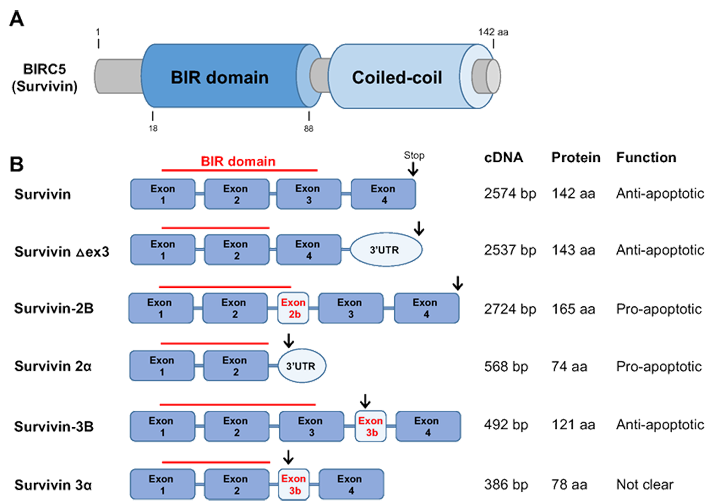
BIRC5 (survivin), the smallest among the IAPs (16.5 kDa), was discovered in 1997 (Ambrosini et al., 1997), is 142 amino acids (aa) long and has a single BIR domain (Peery et al., 2017). This protein is presented as a stable loop-shaped homodimer, formed by interactions of the N-terminal region through a predominantly hydrophobic interface (Chantalat et al., 2000; Verdecia et al., 2000). Furthermore, on the C-terminal portion, survivin carries an alpha-helix CC (coiled coil) domain, its unique structure (Chantalat et al., 2000; Coumar et al., 2013) which convenes the ability to associate to microtubules and a range of other proteins involved, mainly, in the process of mitosis, and further allowing for translocation among the different cellular compartments, such as mitochondria, cytoplasm and nucleus (Rodel et al., 2012) (Figure 1).
Since BIRC5 is connected to a diverse network of biochemical processes and therefore has remarkable multifunctionality, its modulation in cancer therapy continues to be extensively explored. Several survivin inhibitors have been identified by in vitro and in silico methods, such as antisense oligonucleotides, siRNA, dominant-negative mutants, peptidomimetic molecules and other small inhibitory molecules, and even as anticancer vaccine (Fenstermaker et al., 2016; Sarvagalla et al., 2016).
Expression
However, BIRC5 is expressed in cells that undergo malignant transformation, being overexpressed in numerous tumors (Altieri, 2001; LaCasse et al., 2008). Recent studies evidenced that transcriptional activation is not the only cause for BIRC5 overexpression, but also post-transcriptional regulation, specially coordinated by many alternative polyadenylation (APA) sites. For instance, in ovarian cancer, aberrant APA leads to shortening of the 3-UTR region, enabling escape from negative regulation of miRNAs and causing up-regulation of BIRC5 (He et al., 2016).
Clinically, overexpression of BIRC5 has been correlated with a poor prognosis of cancer, resistance to apoptosis induced by chemotherapy, decreased survival of patients and greater chances of relapse (Islam et al., 2000; Rodel et al., 2012).
Localisation
Function
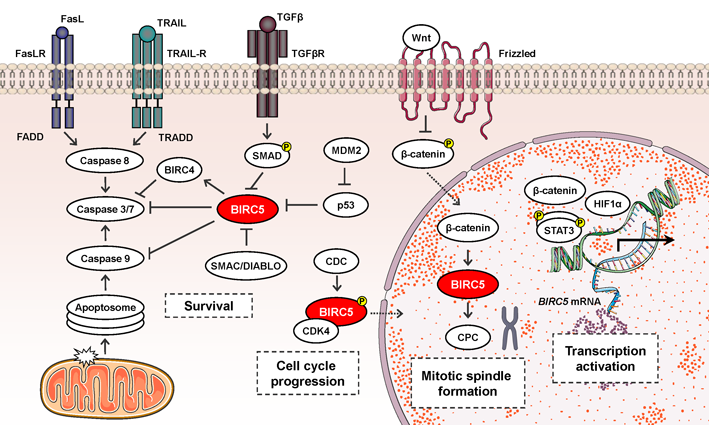
Interaction of BIRC5 with CDK4 has been associated with progression of the cell cycle. In mitosis, BIRC5 plays a key role in integrating the transient chromosome complex (CPC), along with INCENP, CDCA8 (borealin) and AURKB, which controls the formation and stabilization of the mitotic spindle (Altieri, 2013; Coumar et al., 2013). Activation of Wnt signaling induces β-catenin ( CTNNB1) and BIRC5 nuclear translocation, which contributes in mitotic spindle formation, further regulating CPC, β-catenin, STAT3 and HIF1A (Figure 2). BIRC5 also appears to be involved in the cellular response to stress through the interaction with various chaperones, such as AIP, HSPD1 (HSP60) and HSP90AA1 (HSP90) (Altieri, 2013; Fortugno et al., 2003). Moreover, BIRC5 also partakes in the process of autophagy (Wang et al., 2011) and in DNA repair among several tumor cell lines (Jiang et al., 2009).
BIRC5 has also been shown to induce cell motility, metastasis and increased colonization capacity by AKT-mediated upregulation of the α5 integrin pathway in a melanoma model (McKenzie et al., 2013). Additionally, BIRC5 plays an important role in angiogenesis, contributing to endothelial cell proliferation and migration, which was then linked to increased β-catenin protein levels that consequently promotes an elevated expression of BIRC5 and VEGF (Fernandez et al., 2014). BIRC5 is also directly involved in enhancing anoikis resistance through miR-141/KLF12/Sp1/survivin axis. It is a consensus that anoikis resistance is crucial for establishing a metastatic niche and consequently promoting cancer progression and dissemination (Mak et al., 2017).
Dissimilar functions have been attributed to the different isoforms of BIRC5. Survivin-2α and survivin-2B portray a proapoptotic activity profile, whereas Survivin-ΔEx3 and Survivin-3B show prominent antiapoptotic activity, with similar activities to those of survivin itself. These distinct variants can predict aggressiveness of cancer phenotype, thus contributing to prognosis (Caldas et al., 2005).
BIRC5 can be released from tumor cells in exosomes (Khan et al., 2011). This information provided new insights into biomarkers for determination of early diagnosis and also to predict prognosis. In this context, the splice variant survivin-2B, in breast cancer, was shown to be expressed mostly in primary tumors and exclusively in early stage disease. Conversely, Survivin-ΔEx3 variant was most commonly expressed in late stages of breast cancer (Khan et al., 2014). Survivin-2B has been further reported to promote cell death in some cancer cells by promoting autophagy followed by cell death induced by accumulation and stabilization of IKBKB (IKKB) in the nucleus (Shi et al., 2014).
Homology
Table 1. Comparative identity of human BIRC5 with other species
| % Identity for: Homo sapiens BIRC5 | Symbol | Protein | DNA |
| vs. P. troglodytes | BIRC5 | 98.3 | 98.8 |
| vs. M. mulatta | BIRC5 | 97.9 | 97.9 |
| vs. C. lupus | BIRC5 | 90.8 | 90.1 |
| vs. B. taurus | BIRC5 | 90.1 | 90.1 |
| vs. M. musculus | Birc5 | 83.6 | 82.6 |
| vs. R. norvegicus | Birc5 | 83.0 | 81.3 |
| vs. G. gallus | BIRC5 | 60.6 | 65.7 |
| vs. X. tropicalis | birc5.2 | 57.8 | 64.2 |
| vs. D. rerio | Birc5a | 54.3 | 58.0 |
(Source: http://www.ncbi.nlm.nih.gov/homologene)
Mutations
Somatic
Implicated in
BIRC5 expression was also associated to radioresistance: ionization of glioblastoma cell lines promoted BIRC5 upregulation, which mediated dedifferentiation to a stem-like phenotype and, consequently, induced a radioresistant phenotype (Dahan et al., 2014).
Treatment of glioma cells with the survivin inhibitor YM155 overcomes resistance to TRAIL-induced apoptosis, by downregulating MCL1 and BIRC5 (Premkumar et al., 2013). In glioblastoma cell lines, YM155 treatment reduced BIRC5 expression, and induced apoptosis and DNA fragmentation (Lai et al., 2012). Similar results were reported by Jane and colleagues (Jane et al., 2013), where YM155 downregulated BIRC5 and MCL1 expression and inhibited cell growth in malignant human glioma cells. Interestingly, in resistant glioma cell lines attributed to EGFR activation, YM155 alone did not present any significant effects, however in combination with ABT-373, a BH3-only mimetic that targets the prosurvival members of the BCL2 family, a synergic effect mediated by caspase activation was observed (Jane et al., 2013).
Depletion of BIRC5 levels mediated by parthenolide treatment induced apoptosis and cell cycle arrest in glioblastoma cell lines (Tang et al., 2015). Cucurbitacin-I, another natural product, induced cell death in malignant glioma cells, while promoting G2/M accumulation, depletion of p-STAT3, p-STAT5, p-JAK1 and p- JAK2 levels, and downregulation of AURKA, AURKB and BIRC5 (Premkumar et al., 2015).
Medulloblastoma also presents elevated level of BIRC5 expression, as observed for other brain cancers. Similarly, antagonists of BIRC5 impaired proliferation and survival of both murine and human medulloblastoma cells (Brun et al., 2015).
High BIRC5 expression was associated to advanced stages and sporadic tumors in patients aged greater than 12 months (Islam et al., 2000), which negatively impacted clinical outcomes (Azuhata et al., 2001). In addition, BIRC5/p53 and BIRC5/FAS ratios have been implicated in neuroblastoma prognosis (Sandler et al., 2002; Tajiri et al., 2001). In neuroblastoma and oligodendroglioma cell lines, BIRC5 silencing reduced cell viability while further inducing mitotic catastrophe and cell death by caspase-dependent and -independent pathways (Shankar et al., 2001).
Estrogen positive breast cancer subtypes have been connected to increased BIRC5 regulation, which was reverted by treatment with the natural compound myricetin, enhancing apoptosis (Jiao and Zhang, 2016). In triple negative breast cancer, chemoresistance and metastasis were associated to elevated DEPTOR protein expression that, in turn, induced a higher expression of BIRC5, both in vitro and in vivo (Parvani et al., 2015). Survivin and survivin-ΔEx3 were overexpressed and associated to chemoresistance in non-responder samples using ex vivo organotypic cultures of primary human breast tumors (Faversani et al., 2014). Using shRNA targeting BIRC5 splice variants isoforms, Zheng and colleagues (Zheng et al., 2011) demonstrated that apoptosis rates were improved considerably by survivin depletion, but survivin-ϚEx3 isoform silencing only moderately inhibited cell survival and growth in a breast cancer model.
In breast cancer cells, combined therapy using panobinostat with gemcitabine markedly diminished BIRC5 expression (Budman et al., 2012). Similarly, SMAC mimetics (BV6, Birinapant) and BH3-mimetics (ABT-737/263) combined with paclitaxel treatment demonstrated positive results regarding BIRC5 downregulation (Panayotopoulou et al., 2017).
Chemoresistance was also related to the extracellular LGALS1 (galectin-1) expression that, moreover, contributes to cancer progression and doxorubicin resistance in triple negative breast cancer. It must be stated, herein, that galectin-1 expression is mediated by STAT3 activation, which is a transcription factor that culminates in BIRC5 upregulation, corroborating the role of BIRC5 in chemoresistance in breast cancer cells (Nam et al., 2017). The function for STAT3 in BIRC5 upregulation in breast cancer cells was also confirmed by Wang and colleagues (Wang et al., 2015), who demonstrated that MIR204 inhibits STAT3 activation and BIRC5 expression.
BIRC5 also participates on the invasive phenotype by regulating the expression of the vascular endothelial growth factor-C ( VEGFC) at both protein and mRNA levels, which culminates in a raised metastasis rate in breast cancer (Cai et al., 2012). In agreement, elevated BIRC5 expression was associated with poor prognostic in stage II/III breast cancer patients (Hamy et al., 2016). The authors proposed that BIRC5 expression might be theranostic, and suggest that high BIRC5-expressing breast cancer patients would be randomized to receive BIRC5 targeting drugs (Hamy et al., 2016).
A recent study that evaluate the transcriptome of primary breast cancer patients, demonstrated that, along with NEK2 and TOP2A, BIRC5 gene was amplified in obese breast cancer patients, reinforcing that this gene may be druggable for this population (Nuncia-Cantarero et al., 2018). One factor that may explain such observation is the synthesis of visfatin, an adipokine secreted by adipocytes, macrophages and inflamed endothelial tissue, which was found to be increased in obese and breast cancer patients, while exerting a protective effect on BIRC5, raising its levels and, thus, contributing to tumor progression (Gholinejad et al., 2017).
In breast cancer cell lines, including triple negative phenotype and tamoxifen-resistant cells, YM155, a BIRC5 inhibitor, as previously mentioned, reduces cell viability, with IC50 values in the low nanomolar range, and induced autophagy (Cheng et al., 2015).
In breast cancer cell lines, ABT-263 (navitoclax), a BCL2 family protein inhibitor, promoted a negative modulation of BIRC5 levels in MDA-MB-231, but not in MCF-7, which was associated with a higher sensitivity to the drug (Lee et al., 2018).
Elevated expression of BIRC5 was also correlated with levels of CD133+, which is associated to chemoresistance to 5-fluorouracil, in colon cancer cells. The elevated expression of BIRC5 induced by activation of the CXCL12/ CXCR4 signaling pathway in cells exposed to radiation may be a crucial factor for the acquisition of chemoresistance in this cancer type (Wang et al., 2017a). However, no association was found between expression of BIRC5 and invasion, lymph node metastasis, nor histologic differentiation (Li et al., 2017). Survivin depletion by the EpCAM-aptamer-guided BIRC5 RNAi enhanced colorectal cancer stem cells sensitivity to 5-FU and oxaliplatin, further inducing apoptosis, reducing tumor growth and improving the overall survival in a colorectal cancer xenograft model (AlShamaileh et al., 2017).
The use of natural products was also implicated in reduction of BIRC5 levels, such as tanshinone I, an active compound from traditional Chinese herbal medicine (Lu et al., 2016), and the Pinus roxburghii essential oil (Sajid et al., 2018). Additionally, treatment with tamoxifen β-estradiol or a combination of these two agents promoted decreased BIRC5 levels and impaired cell migration in colorectal cancer cells (Ou et al., 2017). In colon cancer cells, dimethoxy curcumin inhibited cell growth, increased apoptosis, reduced cell migration, downregulated BIRC5 expression and enhanced CDH1 (E-cadherin) in vitro and in vivo (Chen et al., 2016).
Treatment failure in colorectal cancer was previously associated to the presence of stem cells bearing a KRAS mutation, which, then, become resistant to chemotherapy. Treatment with Omega-3 fatty acid DHA promoted a reduction of cell viability, with caspase-3 activation mediated by a decrease in transcript and protein levels of BIRC5 and, moreover, an increase in MIR16-1 expression levels, suggesting that BIRC5 and microRNA-16-1 to be promising molecular targets of DHA (Sam et al., 2018).
BIRC5 knockdown using shRNA promoted an elevated sensitivity to radiation and chemotherapy using 5-FU, demonstrating that the modulation of BIRC5 levels may be an important adjuvant therapy for gastric cancer patients (Shen et al., 2012). In agreement, BIRC5 silencing mediated by siRNA increased apoptosis rates, inhibited cell proliferation in a cisplatin-resistant cell line (Li et al., 2014) and impaired cell migration in gastric cancer cells (Li et al., 2015).
Other signaling pathways seem to converge to the induction of BIRC5 expression in renal cell carcinoma. For instance, combined treatment between the histone deacetylase (HDAC) inhibitor OBP-801 and the phosphatidylinositol 3-kinase (PI3K) inhibitor LY294002 synergistically inhibited cell growth and induced apoptosis in renal cell carcinoma through BIRC5 downregulation (Yamada et al., 2013).
In acute myeloid leukemia, BIRC5 overexpression is involved in drug resistance of leukemia stem cells, regulated by the ERK/MSK/Sp1/MYC axis (Zhang et al., 2015b). Interestingly, BIRC5 depletion, by siRNA, reduced cell proliferation, induced apoptosis, and synergistically enhanced cytotoxicity of etoposide in acute myeloid leukemia cells (Karami et al., 2013). Other molecular signaling that has been involved in acute myeloid leukemia resistance is the expression of MUC1 (MUC1-C), an oncoprotein critical for the onset of tumorigenesis, which is overexpressed in acute myeloid leukemia blasts and leukemia stem cells. It has been demonstrated that targeting MUC1-C reduced BIRC5 levels and increased sensitivity to cytarabine, indicating that BIRC5 is involved in multiple signaling pathways required for survival in leukemia cells (Stroopinsky et al., 2018).
Acute lymphoblastic leukemia (ALL) patients also presented elevated levels of BIRC5 and VEGF, especially prior to treatment with an association of idarubicin, cytosine arabinoside and etoposide. Nevertheless, those levels decreased after treatment (Yang et al., 2013). In children diagnosed with acute lymphoblastic leukemia, BIRC5 expression was higher compared to healthy donors. The same group of patients was monitored during the entire treatment period and those who went in to complete remission of the disease presented decreased levels of BIRC5, compared to diagnosis sample. In contrast, BIRC5 protein levels were elevated in non-survived ALL patients (Yahya et al., 2012). In acute lymphoblastic leukemia primary samples and cell lines, treatment with YM155 exhibited elevated cytotoxicity by induction of DNA damage, leading to phosphorylation of CHEK2 and H2AFX and promoting suppression of BIRC5 expression (Chang et al., 2015).
It is well accepted that leukemia stem cells contribute to a reduced treatment efficacy and also to chemoresistance. The natural product curcumin decreased BIRC5 levels in leukemia stem cell-like KG1a in a combined treatment with busulfan, which may overcome such chemoresistant of leukemia stem cells (Weng et al., 2015).
Furthermore, Li and colleagues (Li et al., 2018) observed an association between the presence of C allele of BIRC5 polymorphism rs9904341, but not of rs8073069, and an increased risk of acute leukemia development in a cohort including 182 childhood acute leukemia patients and 200 controls.
Recently, BIRC5 was identified as a target of MIR195, a microRNA that induced apoptosis and senescence in NSCLC cells (Yu et al., 2018). A combined therapy using the natural product resveratrol and the epidermal growth factor receptor (EGFR) inhibitor erlotinib promoted an increase in cell death mediated by BIRC5 depletion in NSCLC cells (Nie et al., 2015). Similarly, depletion of BIRC5 induced by treatment with YM155 increased the sensitivity of such cells to radiation (Hu et al., 2015). Treatment with the natural product fisetin also increased sensitivity to cisplatin in cisplatin-resistant NSCLC cells by modulation of MAPK/BIRC5/Caspase axis (Zhuo et al., 2015).
Lung cancer stem cells were more sensitive to FL118, a BIRC5 inhibitor, than cisplatin. Additionally, FL118 downregulated cancer stem cell related markers, which may improve drug-sensitivity in this kind of tumor cells (Wang et al., 2017c).
BIRC5 expression was positive in 40% of lymph node biopsy of diffuse large B-cell lymphoma patients. Such observation correlated with unfavorable factors for therapy response and predicted shorter survival outcomes (Markovic et al., 2012). A meta-analysis, including 17 studies and 1,352 diffuse large B-cell lymphoma patients, found positive BIRC5 expression to be associated with advanced clinical stages and reduced overall survival (Zhang et al., 2015c).
The combinatory use of bendamustine and rituximab associated with BIRC5 inhibitor, YM155, presented potentiating effects on induction of cell death by triggering DNA damage and cell cycle arrest in lymphoma cells, and, moreover, reduced tumor size and metastatic capacity in diffuse large B-cell lymphoma xenograft murine models (Kaneko et al., 2014). A combined treatment of rituximab and YM155 was shown to reduce tumor growth more effectively than monotherapy (Kita et al., 2012). In B and T cell lymphoma cells, BIRC5 abrogation using the non-toxic tellurium compound, AS101, has overcome chemoresistance, sensitizing these cells to paclitaxel (Danoch et al., 2015). BIRC5 expression presented anti-apoptotic functions and is regulated by NF-κB and PI3K/AKT signaling pathways in nasal NK/T-cell lymphoma cells (Sun et al., 2015).
In melanoma cells, BIRC5 was associated to enhanced AKT and MAPK signaling dependent migration and invasion, as well as to the upregulation of ITGA5 (α5 integrin) (McKenzie et al., 2010). BIRC5 silencing through RNA interference promoted cell cycle arrest and reduced cell proliferation and metastasis in vivo and in vitro in melanoma models. Moreover, as observed for other tumor types, BIRC5 inhibition led to increased sensitivity to chemotherapy in melanoma cells (Kedinger et al., 2013). In another study, a proposed strategy to overcome chemoresistance and to promote melanoma cell death was the combination of vemurafenib and Nutlin-3, whose synergism was responsible for BIRC5 depletion and apoptosis induction (Ji et al., 2013).
Pharmacological suppression of BIRC5 expression, using YM155, increased apoptosis induction and tumor regression in melanoma xenograft models. In the same study, combined treatment of YM155 and docetaxel presented potentiating effects in induction of apoptosis compared to monotherapy, corroborating the notion that targeting BIRC5 may be an interesting approach in melanoma management (Yamanaka et al., 2011). Similar results were obtained using natural compounds extracted from plants that target BIRC5 through β-catenin and STAT3 suppression (Habibie et al., 2014).
Another alternative approach for targeting BIRC5 was the generation of recombinant fusion proteins containing the TAT protein transduction domain and either wild-type survivin (TAT-Surv-WT) or a dominant- negative mutant (TAT-Surv-T34A). The mutant promoted in vitro cell death through apoptosis and DNA fragmentation in melanoma cells. In vivo injections of such mutant in melanoma xenograft mice increased apoptosis, induced aberrant nuclei formation and impaired tumor growth (Yan et al., 2006).
BIRC5 mRNA was detected in 98% of samples from metastatic melanoma patients. High BIRC5 mRNA levels were significantly associated with poor overall survival (Takeuchi et al., 2005).
The association of nuclear and cytoplasmic BIRC5 expression and prognosis remains controversial in ovarian cancer. The evaluation of BIRC5 expression in patients treated with taxane and platinum agents concluded that, in this treatment regimen, higher nuclear BIRC5 expression was associated with reduced risk of disease recurrence and death (Felisiak-Golabek et al., 2011). By contrast, another study reported that nuclear BIRC5 was significantly associated with chemoresistance to taxane-based chemotherapy, predicting poor progression-free survival (Du et al., 2015). Immunohistochemistry analysis revealed that BIRC5 expression presented a positive correlation with FIGO stage in epithelial ovarian cancer, benign epithelial ovarian tumor tissue and borderline ovarian tumor tissues (Ju et al., 2016).
BIRC5 splices variants were also correlated to the development of ovarian cancer and resistance to chemotherapy. Taxane-resistant ovarian cancer cells expressed higher BIRC5 mRNA levels than their taxane-sensitive counterparts. Survivin-2B expression was significantly higher in taxane-resistant cells, when compared to sensitive cells (Vivas-Mejia et al., 2011).
YM155 treatment induced BIRC5 downregulation, cell growth inhibition, cell cycle arrest, reactive oxygen species formation and apoptosis, and enhanced docetaxel efficacy in ovarian cancer cell lines (Hou et al., 2018). In agreement, in ovarian cancer cells, BIRC5 knockdown enhanced cisplatin sensitivity in resistant cancer cells, inducing apoptosis and inhibiting the invasive process through downregulation of MMP2 (Jiang et al., 2013).
In a cohort including 157 prostate cancer patients and 145 controls, genetic polymorphisms c.-31G>C (rs9904341), c.454G>A (rs2071214), and c. *148T>C (rs1042489) of BIRC5 were associated with risk for prostate cancer development (Karimian et al., 2018).
Treatment with BIRC5 inhibitor (YM155) inhibited cell growth, cell migration and invasion in prostate cancer cells (Xu et al., 2015). Overexpression of miR-494 (a microRNA targeting BIRC5) and/or BIRC5 silencing using shRNA attenuated cell growth in vitro and in vivo (Zhu et al., 2016). Moreover, treatment of prostate cancer cells with a selective inhibitor of nuclear export, KPT-330, inhibited proliferation and promoted apoptosis of tumor cells, by increasing protein degradation of exportin XPO1, BIRC5 and CCND1, further leading to cell cycle arrest and apoptosis (Gravina et al., 2015). Natural products, such as the triterpenoid pristimerin, demonstrated that BIRC5 levels may modulate therapeutic responses, once BIRC5-overexpressing prostate cancer cells became resistant to pristimerin (Liu et al., 2014).
Article Bibliography
| Pubmed ID | Last Year | Title | Authors |
|---|---|---|---|
| 9422522 | 1998 | Developmentally regulated expression of the novel cancer anti-apoptosis gene survivin in human and mouse differentiation. | Adida C et al |
| 28724889 | 2017 | Aptamer-mediated survivin RNAi enables 5-fluorouracil to eliminate colorectal cancer stem cells. | AlShamaileh H et al |
| 22410464 | 2013 | Targeting survivin in cancer. | Altieri DC et al |
| 9256286 | 1997 | A novel anti-apoptosis gene, survivin, expressed in cancer and lymphoma. | Ambrosini G et al |
| 27712979 | 2016 | Novel polyacrylate-based cationic nanoparticles for survivin siRNA delivery combined with mitoxantrone for treatment of breast cancer. | Arami S et al |
| 27162247 | 2017 | Synthesis and characterization of Fe(3)O(4)-PEG-LAC-chitosan-PEI nanoparticle as a survivin siRNA delivery system. | Arami S et al |
| 21738816 | 2011 | The proliferation markers Ki-67/MIB-1, phosphohistone H3, and survivin may contribute in the identification of aggressive ovarian carcinomas. | Aune G et al |
| 11733907 | 2001 | The inhibitor of apoptosis protein survivin is associated with high-risk behavior of neuroblastoma. | Azuhata T et al |
| 28413637 | 2017 | Correlation of survivin and B-cell lymphoma 2 expression with pathological malignancy and anti-apoptotic properties of glial cell tumors. | Bae IS et al |
| 26405584 | 2015 | Survivin-targeted immunotherapy drives robust polyfunctional T cell generation and differentiation in advanced ovarian cancer patients. | Berinstein NL et al |
| 27853365 | 2016 | Gene-silencing effects of anti-survivin siRNA delivered by RGDV-functionalized nanodiamond carrier in the breast carcinoma cell line MCF-7. | Bi Y et al |
| 25241898 | 2015 | Survivin as a therapeutic target in Sonic hedgehog-driven medulloblastoma. | Brun SN et al |
| 25542341 | 2015 | IAPs: Modular regulators of cell signalling. | Budhidarmo R et al |
| 29956779 | 2018 | Effect of survivin downregulation by simvastatin on the growth and invasion of salivary adenoid cystic carcinoma. | Cai WY et al |
| 22607367 | 2012 | Survivin regulates the expression of VEGF-C in lymphatic metastasis of breast cancer. | Cai X et al |
| 15688031 | 2005 | Survivin splice variants regulate the balance between proliferation and cell death. | Caldas H et al |
| 29434780 | 2018 | Berbamine induces SMMC-7721 cell apoptosis via upregulating p53, downregulating survivin expression and activating mitochondria signaling pathway. | Cao Y et al |
| 25808836 | 2015 | Targeting Survivin Inhibits Renal Cell Carcinoma Progression and Enhances the Activity of Temsirolimus. | Carew JS et al |
| 29694611 | 2018 | Evaluation of survivin immunoexpression in the differentiation of high- and low-grade breast ductal carcinoma in situ. | Chade MC et al |
| 25895498 | 2015 | YM155 potently kills acute lymphoblastic leukemia cells through activation of the DNA damage pathway. | Chang BH et al |
| 10949039 | 2000 | Crystal structure of human survivin reveals a bow tie-shaped dimer with two unusual alpha-helical extensions. | Chantalat L et al |
| 27614381 | 2016 | Dimethoxy Curcumin Induces Apoptosis by Suppressing Survivin and Inhibits Invasion by Enhancing E-Cadherin in Colon Cancer Cells. | Chen D et al |
| 21793333 | 2010 | Cortactin, fascin and survivin expression associated with clinicopathological parameters in brain gliosarcoma. | Chen JH et al |
| 27764228 | 2016 | Survivin Overexpression Is Associated with Aggressive Clinicopathological Features in Cervical Carcinoma: A Meta-Analysis. | Cheng KY et al |
| 22773958 | 2012 | Suppression of survivin promoter activity by YM155 involves disruption of Sp1-DNA interaction in the survivin core promoter. | Cheng Q et al |
| 25220225 | 2015 | YM155 down-regulates survivin and XIAP, modulates autophagy and induces autophagy-dependent DNA damage in breast cancer cells. | Cheng SM et al |
| 28698863 | 2017 | Evaluation of the Expression of the Inhibitor of Apoptosis Protein Family and Human Telomerase Reverse Transcriptase in Patients With Advanced Colorectal Adenoma. | Choi JY et al |
| 30249893 | 2018 | Survivin expression as an independent predictor of overall survival in pancreatic adenocarcinoma. | Contis J et al |
| 23453862 | 2013 | Treat cancers by targeting survivin: just a dream or future reality? | Coumar MS et al |
| 25429620 | 2014 | Ionizing radiations sustain glioblastoma cell dedifferentiation to a stem-like phenotype through survivin: possible involvement in radioresistance. | Dahan P et al |
| 25563370 | 2015 | Overexpression of Survivin mutant Thr34Ala induces apoptosis and inhibits gastric cancer growth. | Dang SC et al |
| 25351768 | 2015 | Sensitizing B- and T- cell Lymphoma Cells to Paclitaxel/Abraxane-Induced Death by AS101 via Inhibition of the VLA-4-IL10-Survivin Axis. | Danoch H et al |
| 25577253 | 2015 | Prognostic significance of pretreatment VEGF, survivin, and Smac/DIABLO serum levels in patients with serous ovarian carcinoma. | Dobrzycka B et al |
| 26198101 | 2015 | Overexpression of Class III β-tubulin, Sox2, and nuclear Survivin is predictive of taxane resistance in patients with stage III ovarian epithelial cancer. | Du J et al |
| 27090386 | 2016 | Survivin protein expression is involved in the progression of non-small cell lung cancer in Asians: a meta-analysis. | Duan L et al |
| 27330887 | 2016 | Evaluation of survivin expression in prostate specimens of patients with prostate adenocarcinoma and benign prostate hyperplasia underwent transurethral resection of the prostate or prostatectomy. | Eslami M et al |
| 28386373 | 2017 | Mechanism of progestin resistance in endometrial precancer/cancer through Nrf2-survivin pathway. | Fan R et al |
| 24886669 | 2014 | Survivin family proteins as novel molecular determinants of doxorubicin resistance in organotypic human breast tumors. | Faversani A et al |
| 22075440 | 2011 | Nuclear survivin expression is a positive prognostic factor in taxane-platinum-treated ovarian cancer patients. | Felisiak-Golabek A et al |
| 29540489 | 2018 | Survivin Monoclonal Antibodies Detect Survivin Cell Surface Expression and Inhibit Tumor Growth In Vivo. | Fenstermaker RA et al |
| 25204429 | 2014 | Survivin expression promotes VEGF-induced tumor angiogenesis via PI3K/Akt enhanced β-catenin/Tcf-Lef dependent transcription. | Fernández JG et al |
| 15660660 | 2005 | Proliferation, apoptosis, and survivin expression in a spectrum of melanocytic nevi. | Florell SR et al |
| 14614132 | 2003 | Regulation of survivin function by Hsp90. | Fortugno P et al |
| 27340370 | 2016 | Survivin: a unique target for tumor therapy. | Garg H et al |
| 28442350 | 2017 | Extracellular NAMPT/Visfatin induces proliferation through ERK1/2 and AKT and inhibits apoptosis in breast cancer cells. | Gholinejad Z et al |
| 26620414 | 2015 | KPT-330, a potent and selective exportin-1 (XPO-1) inhibitor, shows antitumor effects modulating the expression of cyclin D1 and survivin [corrected] in prostate cancer models. | Gravina GL et al |
| 20651737 | 2010 | IAPs: from caspase inhibitors to modulators of NF-kappaB, inflammation and cancer. | Gyrd-Hansen M et al |
| 24946930 | 2014 | Survivin suppression through STAT3/β-catenin is essential for resveratrol-induced melanoma apoptosis. | Habibie et al |
| 27592112 | 2016 | BIRC5 (survivin): a pejorative prognostic marker in stage II/III breast cancer with no response to neoadjuvant chemotherapy. | Hamy AS et al |
| 27174320 | 2016 | Aberrant Alternative Polyadenylation is Responsible for Survivin Up-regulation in Ovarian Cancer. | He XJ et al |
| 29636860 | 2018 | YM155 enhances docetaxel efficacy in ovarian cancer. | Hou LJ et al |
| 26418254 | 2015 | The mechanism of radiosensitization by YM155, a novel small molecule inhibitor of survivin expression, is associated with DNA damage repair. | Hu S et al |
| 26982182 | 2016 | Periostin Contributes to Cisplatin Resistance in Human Non-Small Cell Lung Cancer A549 Cells via Activation of Stat3 and Akt and Upregulation of Survivin. | Hu W et al |
| 15746049 | 2005 | A potent immunogenic general cancer vaccine that targets survivin, an inhibitor of apoptosis proteins. | Idenoue S et al |
| 10698506 | 2000 | High expression of Survivin, mapped to 17q25, is significantly associated with poor prognostic factors and promotes cell survival in human neuroblastoma. | Islam A et al |
| 23325792 | 2013 | YM-155 potentiates the effect of ABT-737 in malignant human glioma cells via survivin and Mcl-1 downregulation in an EGFR-dependent context. | Jane EP et al |
| 23812671 | 2013 | Vemurafenib synergizes with nutlin-3 to deplete survivin and suppresses melanoma viability and tumor growth. | Ji Z et al |
| 19331153 | 2009 | Survivin may enhance DNA double-strand break repair capability by up-regulating Ku70 in human KB cells. | Jiang G et al |
| 23229441 | 2013 | Knockdown of survivin contributes to antitumor activity in cisplatin-resistant ovarian cancer cells. | Jiang L et al |
| 27122002 | 2016 | Myricetin suppresses p21-activated kinase 1 in human breast cancer MCF-7 cells through downstream signaling of the β-catenin pathway. | Jiao D et al |
| 29719390 | 2018 | Smart polymeric nanoparticles with pH-responsive and PEG-detachable properties for co-delivering paclitaxel and survivin siRNA to enhance antitumor outcomes. | Jin M et al |
| 27249597 | 2016 | Expression and clinical implication of Beclin1, HMGB1, p62, survivin, BRCA1 and ERCC1 in epithelial ovarian tumor tissues. | Ju LL et al |
| 24486595 | 2014 | Combination of YM155, a survivin suppressant, with bendamustine and rituximab: a new combination therapy to treat relapsed/refractory diffuse large B-cell lymphoma. | Kaneko N et al |
| 24460358 | 2013 | siRNA-mediated silencing of survivin inhibits proliferation and enhances etoposide chemosensitivity in acute myeloid leukemia cells. | Karami H et al |
| 30034311 | 2018 | Survivin polymorphisms and susceptibility to prostate cancer: A genetic association study and an in silico analysis. | Karimian M et al |
| 23835136 | 2013 | Sticky siRNAs targeting survivin and cyclin B1 exert an antitumoral effect on melanoma subcutaneous xenografts and lung metastases. | Kedinger V et al |
| 24620748 | 2014 | Early diagnostic value of survivin and its alternative splice variants in breast cancer. | Khan S et al |
| 20717727 | 2011 | Survivin is released from cancer cells via exosomes. | Khan S et al |
| 25480498 | 2015 | Serum survivin and vascular endothelial growth factor in extranodal NK/T-cell lymphoma, nasal type: implications for a potential new prognostic indicator. | Kim SJ et al |
| 22787117 | 2012 | Sepantronium bromide (YM155) enhances response of human B-cell non-Hodgkin lymphoma to rituximab. | Kita A et al |
| 27941677 | 2016 | The Enrichment of Survivin in Exosomes from Breast Cancer Cells Treated with Paclitaxel Promotes Cell Survival and Chemoresistance. | Kreger BT et al |
| 18931692 | 2008 | IAP-targeted therapies for cancer. | LaCasse EC et al |
| 22770110 | 2012 | Novel survivin inhibitor YM155 elicits cytotoxicity in glioblastoma cell lines with normal or deficiency DNA-dependent protein kinase activity. | Lai PC et al |
| 28947240 | 2018 | Human breast cancer cells display different sensitivities to ABT-263 based on the level of survivin. | Lee EY et al |
| 9859993 | 1998 | Control of apoptosis and mitotic spindle checkpoint by survivin. | Li F et al |
| 23244104 | 2012 | Expression of survivin and caspase 3 in oral squamous cell carcinoma and peritumoral tissue. | Li SX et al |
| 27989099 | 2017 | Clinicopathologic Significance of Survivin Expression in Relation to CD133 Expression in Surgically Resected Stage II or III Colorectal Cancer. | Li W et al |
| 29456699 | 2018 | Correlation between survivin polymorphism and acute leukemia of children. | Li WX et al |
| 25973061 | 2015 | Downregulation of survivin inhibits proliferation and migration of human gastric carcinoma cells. | Li Y et al |
| 25177958 | 2014 | Inhibitory effect of survivin-targeting small interfering RNA on gastric cancer cells. | Li YH et al |
| 23029106 | 2012 | A novel small molecule FL118 that selectively inhibits survivin, Mcl-1, XIAP and cIAP2 in a p53-independent manner, shows superior antitumor activity. | Ling X et al |
| 30285798 | 2018 | An ABCG2 non-substrate anticancer agent FL118 targets drug-resistant cancer stem-like cells and overcomes treatment resistance of human pancreatic cancer. | Ling X et al |
| 28076475 | 2016 | EXPRESSION OF E-CADHERIN AND WNT PATHWAY PROTEINS BETACATENIN, APC, TCF-4 AND SURVIVIN IN GASTRIC ADENOCARCINOMA: CLINICAL AND PATHOLOGICAL IMPLICATION. | Lins RR et al |
| 28384094 | 2017 | Nuclear survivin promoted by acetylation is associated with the aggressive phenotype of oral squamous cell carcinoma. | Liu S et al |
| 27994498 | 2016 | Association between survivin genetic polymorphisms and epidermal growth factor receptor mutation in non-small-cell lung cancer. | Liu TC et al |
| 25175770 | 2014 | Ubiquitin-proteasomal degradation of antiapoptotic survivin facilitates induction of apoptosis in prostate cancer cells by pristimerin. | Liu YB et al |
| 20888210 | 2010 | To fight or die - inhibitor of apoptosis proteins at the crossroad of innate immunity and death. | Lopez J et al |
| 26893558 | 2016 | Efficient inhibition of ovarian cancer by degradable nanoparticle-delivered survivin T34A gene. | Luo L et al |
| 27489375 | 2017 | Clinicopathological and prognostic significance of survivin expression in renal cancer patients: a meta-analysis. | Ma C et al |
| 28095864 | 2017 | MicroRNA-141 enhances anoikis resistance in metastatic progression of ovarian cancer through targeting KLF12/Sp1/survivin axis. | Mak CS et al |
| 22528517 | 2012 | Survivin expression in patients with newly diagnosed nodal diffuse large B cell lymphoma (DLBCL). | Markovic O et al |
| 23640047 | 2013 | Survivin promotion of melanoma metastasis requires upregulation of α5 integrin. | McKenzie JA et al |
| 27378628 | 2016 | Low Merlin expression and high Survivin labeling index are indicators for poor prognosis in patients with malignant pleural mesothelioma. | Meerang M et al |
| 17804712 | 2007 | YM155, a novel small-molecule survivin suppressant, induces regression of established human hormone-refractory prostate tumor xenografts. | Nakahara T et al |
| 28415760 | 2017 | Binding of galectin-1 to integrin β1 potentiates drug resistance by promoting survivin expression in breast cancer cells. | Nam K et al |
| 25895606 | 2015 | Synergistic Induction of Erlotinib-Mediated Apoptosis by Resveratrol in Human Non-Small-Cell Lung Cancer Cells by Down-Regulating Survivin and Up-Regulating PUMA. | Nie P et al |
| 21160138 | 2011 | Quantitative detection of serum survivin and its relationship with prognostic factors in ovarian cancer. | No JH et al |
| 29330624 | 2018 | Functional transcriptomic annotation and protein-protein interaction network analysis identify NEK2, BIRC5, and TOP2A as potential targets in obese patients with luminal A breast cancer. | Nuncia-Cantarero M et al |
| 28849238 | 2017 | Endocrine therapy inhibits proliferation and migration, promotes apoptosis and suppresses survivin protein expression in colorectal cancer cells. | Ou QJ et al |
| 28187446 | 2017 | Targeting of apoptotic pathways by SMAC or BH3 mimetics distinctly sensitizes paclitaxel-resistant triple negative breast cancer cells. | Panayotopoulou EG et al |
| 25810016 | 2015 | Deptor enhances triple-negative breast cancer metastasis and chemoresistance through coupling to survivin expression. | Parvani JG et al |
| 21472129 | 2011 | Survivin isoforms and clinicopathological characteristics in colorectal adenocarcinomas using real-time qPCR. | Pavlidou A et al |
| 28577912 | 2017 | Targeting survivin for therapeutic discovery: past, present, and future promises. | Peery RC et al |
| 25482928 | 2015 | Cucurbitacin-I inhibits Aurora kinase A, Aurora kinase B and survivin, induces defects in cell cycle progression and promotes ABT-737-induced cell death in a caspase-independent manner in malignant human glioma cells. | Premkumar DR et al |
| 22680927 | 2012 | Survivin as a prognostic/predictive marker and molecular target in cancer therapy. | Rödel F et al |
| 17916908 | 2008 | Survivin repression by p53, Rb and E2F2 in normal human melanocytes. | Raj D et al |
| 24440709 | 2014 | Survivin and YM155: how faithful is the liaison? | Rauch A et al |
| 25678789 | 2015 | Competitive inhibition of survivin using a cell-permeable recombinant protein induces cancer-specific apoptosis in colon cancer model. | Roy K et al |
| 16621243 | 2006 | Structural, functional and therapeutic biology of survivin. | Sah NK et al |
| 29743861 | 2018 | Pinus Roxburghii essential oil anticancer activity and chemical composition evaluation. | Sajid A et al |
| 25657335 | 2015 | Multifunctional Polymeric Micelles Co-loaded with Anti-Survivin siRNA and Paclitaxel Overcome Drug Resistance in an Animal Model of Ovarian Cancer. | Salzano G et al |
| 29619114 | 2018 | Omega-3 fatty acid DHA modulates p53, survivin, and microRNA-16-1 expression in KRAS-mutant colorectal cancer stem-like cells. | Sam MR et al |
| 11877677 | 2002 | The survivin:Fas ratio is predictive of recurrent disease in neuroblastoma. | Sandler A et al |
| 25946974 | 2015 | Nicotinamide phosphorybosiltransferase overexpression in thyroid malignancies and its correlation with tumor stage and with survivin/survivin DEx3 expression. | Sawicka-Gutaj N et al |
| 23812937 | 2013 | Cytoplasmic localization of wild-type survivin is associated with constitutive activation of the PI3K/Akt signaling pathway and represents a favorable prognostic factor in patients with acute myeloid leukemia. | Serrano-López J et al |
| 11677271 | 2001 | Survivin inhibition induces human neural tumor cell death through caspase-independent and -dependent pathways. | Shankar SL et al |
| 22261621 | 2012 | Survivin knockdown enhances gastric cancer cell sensitivity to radiation and chemotherapy in vitro and in nude mice. | Shen X et al |
| 24556686 | 2014 | Survivin-2B promotes autophagy by accumulating IKK alpha in the nucleus of selenite-treated NB4 cells. | Shi K et al |
| 24294379 | 2013 | Immunohistochemical expression of nuclear and cytoplasmic survivin in gastrointestinal carcinoma. | Shintani M et al |
| 12660240 | 2003 | Direct interaction between survivin and Smac/DIABLO is essential for the anti-apoptotic activity of survivin during taxol-induced apoptosis. | Song Z et al |
| 17616652 | 2007 | Nuclear and cytoplasmic survivin: molecular mechanism, prognostic, and therapeutic potential. | Stauber RH et al |
| 23536723 | 2013 | Suppression of survivin induced by a BCR-ABL/JAK2/STAT3 pathway sensitizes imatinib-resistant CML cells to different cytotoxic drugs. | Stella S et al |
| 29761849 | 2018 | MUC1-C drives myeloid leukaemogenesis and resistance to treatment by a survivin-mediated mechanism. | Stroopinsky D et al |
| 25760809 | 2015 | LMP-1 induces survivin expression to inhibit cell apoptosis through the NF-κB and PI3K/Akt signaling pathways in nasal NK/T-cell lymphoma. | Sun L et al |
| 27729789 | 2016 | Chitosan-based nanoparticles for survivin targeted siRNA delivery in breast tumor therapy and preventing its metastasis. | Sun P et al |
| 11295291 | 2001 | Quick quantitative analysis of gene dosages associated with prognosis in neuroblastoma. | Tajiri T et al |
| 15986442 | 2005 | Survivin expression by metastatic melanoma predicts poor disease outcome in patients receiving adjuvant polyvalent vaccine. | Takeuchi H et al |
| 25858470 | 2015 | Induction of survivin inhibition, G₂/M cell cycle arrest and autophagic on cell death in human malignant glioblastoma cells. | Tang TK et al |
| 23267699 | 2012 | Survivin selective inhibitor YM155 induce apoptosis in SK-NEP-1 Wilms tumor cells. | Tao YF et al |
| 21063391 | 2011 | Application of phi29 motor pRNA for targeted therapeutic delivery of siRNA silencing metallothionein-IIA and survivin in ovarian cancers. | Tarapore P et al |
| 17545596 | 2007 | Melanocyte expression of survivin promotes development and metastasis of UV-induced melanoma in HGF-transgenic mice. | Thomas J et al |
| 29917189 | 2018 | Expressions and correlation analysis of HIF-1α, survivin and VEGF in patients with hepatocarcinoma. | Tian QG et al |
| 28845553 | 2017 | Survivin: A novel marker and potential therapeutic target for human angiosarcoma. | Tsuneki M et al |
| 10876248 | 2000 | Structure of the human anti-apoptotic protein survivin reveals a dimeric arrangement. | Verdecia MA et al |
| 21512144 | 2011 | Silencing survivin splice variant 2B leads to antitumor activity in taxane--resistant ovarian cancer. | Vivas-Mejia PE et al |
| 27798120 | 2017 | Activation of CXCL12/CXCR4 renders colorectal cancer cells less sensitive to radiotherapy via up-regulating the expression of survivin. | Wang D et al |
| 28260087 | 2017 | Knockdown of PARP6 or survivin promotes cell apoptosis and inhibits cell invasion of colorectal adenocarcinoma cells. | Wang H et al |
| 28861158 | 2017 | FL118, a novel survivin inhibitor, wins the battle against drug-resistant and metastatic lung cancers through inhibition of cancer stem cell-like properties. | Wang J et al |
| 26639243 | 2016 | Clinical significance of survivin and vascular endothelial growth factor mRNA detection in the peripheral whole blood of breast cancer patients. | Wang S et al |
| 26191195 | 2015 | MicroRNA-204 targets JAK2 in breast cancer and induces cell apoptosis through the STAT3/BCl-2/survivin pathway. | Wang X et al |
| 26557682 | 2015 | Curcumin Enhanced Busulfan-Induced Apoptosis through Downregulating the Expression of Survivin in Leukemia Stem-Like KG1a Cells. | Weng G et al |
| 25787895 | 2015 | Survivin and PSMA Loaded Dendritic Cell Vaccine for the Treatment of Prostate Cancer. | Xi HB et al |
| 26103574 | 2015 | Dual inhibition of survivin and MAOA synergistically impairs growth of PTEN-negative prostate cancer. | Xu S et al |
| 23113120 | 2012 | Serum Survivin and TP53 Gene Expression in Children with Acute Lymphoblastic Leukemia. | Yahya RS et al |
| 23900601 | 2013 | A novel HDAC inhibitor OBP-801 and a PI3K inhibitor LY294002 synergistically induce apoptosis via the suppression of survivin and XIAP in renal cell carcinoma. | Yamada T et al |
| 21737502 | 2011 | Antitumor activity of YM155, a selective small-molecule survivin suppressant, alone and in combination with docetaxel in human malignant melanoma models. | Yamanaka K et al |
| 16702945 | 2006 | Induction of melanoma cell apoptosis and inhibition of tumor growth using a cell-permeable Survivin antagonist. | Yan H et al |
| 28435150 | 2017 | YM155 Down-Regulates Survivin and Induces P53 Up-Regulated Modulator of Apoptosis (PUMA)-Dependent in Oral Squamous Cell Carcinoma Cells. | Yan X et al |
| 27173182 | 2016 | Effects of monomethoxypolyethylene glycol-chitosan nanoparticle-mediated dual silencing of livin and survivin genes in prostate cancer PC-3M cells. | Yang AQ et al |
| 27446274 | 2016 | Effects of survivin on FVADT chemotherapy for refractory multiple myeloma. | Yang H et al |
| 23251288 | 2013 | Analysis of the expression levels of survivin and VEGF in patients with acute lymphoblastic leukemia. | Yang M et al |
| 29201172 | 2017 | Construction of a novel vector expressing Survivin-shRNA and fusion suicide gene yCDglyTK and its application in inhibiting proliferation and migration of colon cancer cells. | Ye L et al |
| 29545751 | 2018 | A Novel Hydroxamate-Based Compound WMJ-J-09 Causes Head and Neck Squamous Cell Carcinoma Cell Death via LKB1-AMPK-p38MAPK-p63-Survivin Cascade. | Yen CS et al |
| 29416000 | 2018 | miR-195 targets cyclin D3 and survivin to modulate the tumorigenesis of non-small cell lung cancer. | Yu X et al |
| 25120804 | 2014 | Bortezomib-based chemotherapy regimens can improve response in newly diagnosed multiple myeloma patients with bcl-2 and survivin overexpression. | Zeng W et al |
| 24337012 | 2014 | Survivin gene expression increases gastric cancer cell lymphatic metastasis by upregulating vascular endothelial growth factor-C expression levels. | Zhang J et al |
| 26018732 | 2015 | Dual induction of apoptotic and autophagic cell death by targeting survivin in head neck squamous cell carcinoma. | Zhang L et al |
| 25890196 | 2015 | Sp1 and c-Myc modulate drug resistance of leukemia stem cells by regulating survivin expression through the ERK-MSK MAPK signaling pathway. | Zhang Y et al |
| 26356696 | 2015 | Prognostic and Clinicopathological Value of Survivin in Diffuse Large B-cell Lymphoma: A Meta-Analysis. | Zhang Y et al |
| 26899500 | 2016 | Cancer stem cells and chemoresistance: The smartest survives the raid. | Zhao J et al |
| 22466440 | 2011 | Levels of effectiveness of gene therapies targeting survivin and its splice variants in human breast cancer cells. | Zheng WY et al |
| 28321124 | 2017 | Combined inhibition of β-catenin and Bcr-Abl synergistically targets tyrosine kinase inhibitor-resistant blast crisis chronic myeloid leukemia blasts and progenitors in vitro and in vivo. | Zhou H et al |
| 30261114 | 2018 | High nuclear Survivin expression as a poor prognostic marker in pancreatic ductal adenocarcinoma. | Zhou L et al |
| 26718651 | 2016 | Targeting survivin using a combination of miR‑494 and survivin shRNA has synergistic effects on the suppression of prostate cancer growth. | Zhu J et al |
| 26692948 | 2015 | Fisetin, a dietary bioflavonoid, reverses acquired Cisplatin-resistance of lung adenocarcinoma cells through MAPK/Survivin/Caspase pathway. | Zhuo W et al |
| 23070005 | 2012 | The inhibitor of apoptosis (IAP) proteins are critical regulators of signaling pathways and targets for anti-cancer therapy. | de Almagro MC et al |
| 28654818 | 2017 | High-Throughput Screening of Myxoid Liposarcoma Cell Lines: Survivin Is Essential for Tumor Growth. | de Graaff MA et al |
Other Information
Locus ID:
NCBI: 332
MIM: 603352
HGNC: 593
Ensembl: ENSG00000089685
Variants:
dbSNP: 332
ClinVar: 332
TCGA: ENSG00000089685
COSMIC: BIRC5
RNA/Proteins
Expression (GTEx)
Pathways
Protein levels (Protein atlas)
References
| Pubmed ID | Year | Title | Citations |
|---|---|---|---|
| 37355887 | 2024 | Long non-coding RNA FGD5 antisense RNA 1 targets Baculovirus inhibitor 5 via microRNA-497-5p to alleviate calcific aortic valve disease. | 0 |
| 37864584 | 2024 | Impact of Survivin rs9904341 and rs17878467 Polymorphisms On Risk of Preeclampsia in Iran. | 0 |
| 38111129 | 2024 | Post-transcriptional regulation of BIRC5/survivin expression and induction of apoptosis in breast cancer cells by tristetraprolin. | 0 |
| 38164179 | 2024 | TRAF4 regulates ubiquitination-modulated survivin turnover and confers radioresistance. | 0 |
| 38216925 | 2024 | Downregulation of PTPRT elevates the expression of survivin and promotes the proliferation, migration, and invasion of lung adenocarcinoma. | 0 |
| 38876304 | 2024 | USP36 inhibits apoptosis by deubiquitinating cIAP1 and survivin in colorectal cancer cells. | 0 |
| 37355887 | 2024 | Long non-coding RNA FGD5 antisense RNA 1 targets Baculovirus inhibitor 5 via microRNA-497-5p to alleviate calcific aortic valve disease. | 0 |
| 37864584 | 2024 | Impact of Survivin rs9904341 and rs17878467 Polymorphisms On Risk of Preeclampsia in Iran. | 0 |
| 38111129 | 2024 | Post-transcriptional regulation of BIRC5/survivin expression and induction of apoptosis in breast cancer cells by tristetraprolin. | 0 |
| 38164179 | 2024 | TRAF4 regulates ubiquitination-modulated survivin turnover and confers radioresistance. | 0 |
| 38216925 | 2024 | Downregulation of PTPRT elevates the expression of survivin and promotes the proliferation, migration, and invasion of lung adenocarcinoma. | 0 |
| 38876304 | 2024 | USP36 inhibits apoptosis by deubiquitinating cIAP1 and survivin in colorectal cancer cells. | 0 |
| 36336629 | 2023 | Longitudinal associations of serum survivin with the severity and prognosis of community-acquired pneumonia patients. | 1 |
| 36581205 | 2023 | Oncogenic RAS promotes MYC protein stability by upregulating the expression of the inhibitor of apoptosis protein family member Survivin. | 5 |
| 37164127 | 2023 | The analysis of Survivin promoter (-31G/C) gene variation in oral squamous cell carcinoma risk and prognosis. | 2 |
Citation
Paola Cristina Branco ; Paula Christine Jimenez ; Joao Agostinho Machado-Neto, PhD ; Letícia Veras Costa-Lotufo
BIRC5 (baculoviral IAP repeat containing 5)
Atlas Genet Cytogenet Oncol Haematol. 2019-01-01
Online version: http://atlasgeneticsoncology.org/gene/797/birc5-(baculoviral-iap-repeat-containing-5)
