Diaphyseal medullary stenosis with malignant fibrous histiocytoma (DMS-MFH)
1999-12-01 John A. Martignetti AffiliationMount Sinai School of Medicine, Departments of Human Genetics, Pediatrics, 1425 Madison Ave, Box 1498, New York, NY 10029, USA
Identity
Name
Diaphyseal medullary stenosis with malignant fibrous histiocytoma (DMS-MFH)
Alias
Bone dysplasia with medullary fibrosarcoma , Bone dysplasia with malignant fibrous histiocytoma , Hereditary bone dysplasia with malignant change
Note
DMS-MFH is an hereditary bone dysplasia \/ cancer syndrome
Inheritance
autosomal dominant; rare hereditary cancer syndrome with only four families identified worldwide; etiology unknown
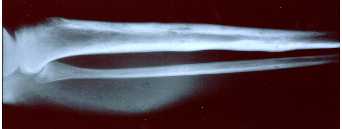
Photograph A: Lateral X-ray view of the left tibia and fibula of an 18 year old male with DMS-MFH and MFH. Note the extensive diaphyseal cortical thickening, areas of resultant medullary stenosis, endosteal irregularities, overall permeative pattern in the medullary cavity, and metaphyseal striations.
Omim
112250
Mesh
C536169
Orphanet
85182 Diaphyseal medullary stenosis - bone malignancy
Umls
C1300202;C1862177
Clinics
Note
radiologic evidence of bone dysplasia not evident in childhood; X-ray findings become apparent during adolescence
Phenotype and clinics
- bone dysplasia (100%)
- cortical growth abnormalities: diaphyseal medullary stenosis with overlying endosteal cortical thickening and scalloping, metaphyseal striations, scattered sclerotic areas symmetrically affecting the long bones; bilateral mandibular radiolucent and sclerotic lesions
- bone infarctions
- pathologic fractures: subsequent poor healing or non-union
- progressive wasting or bowing of the lower extremities
- bone pain
- pre-senile cataracts (25%)
- bone malignant fibrous histiocytoma (MFH) (35%)
- diagnosis: X-ray skeletal findings are unique; however, there may be some radiologic overlap with other diaphyseal dysplasias including Camurati-Engelman and Kenny-Caffey diseases and radiation osteitis; no hematologic or urinary markers of disease have been identified; 201Thallium chloride radionucleotide scans may offer discrimination between areas of increased metabolic bone activity found in DMS-MFH patients and malignant change.
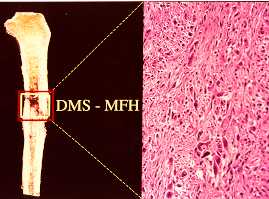
Photograph B: Tibia and MFH of patient shown in Photograph A. The MFH tumor was associated with the infarcted area in the proximal tibia. Hematoxylin and eosin preparation shows removed MFH tumor from infarcted area with typical storiform arrangement of spindle cells throughout the view.
Neoplastic risk
thirteen cases of osseous MFH; thirty-five per cent of DMS-MFH patients develop MFH; the age distribution has been from the second to fifth decades; no sex predilection; in its sporadic form, MFH represents approximately 6% of all bone cancers and is the most frequently occurring adult soft-tissue sarcoma
Treatment
no known treatment for the dysplasia; the tumors are highly aggressive treated with surgical ablation and the same chemotherapeutic regimens as osteosarcoma it is believed that preoperative chemotherapy improves surgical outcome
Evolution
the disease becomes radiologically apparent only in adolescence: however, retrospectively, clinical signs and symptoms may be evident in childhood; these include unexplained bone pain and pathologic fractures; in some, crippling pain and weakness of the lower extremities ensues following the sixth decade; malignancy occurs most frequently between the second to fifth decades and is particularly aggressive; only two long-term survivors, greater than five years, are known.; pre-senile cataracts have been noted as early as in the third decade
Other Findings
Note
collagen fibrils from the endosteal surface of bones appear frayed and unraveled (npublished results); chemical crosslink analysis of bone biopsy samples reveal altered hydroxylysylpyridinolin (HP) \/ lysylpyridinoline (LP) ratios (unpublished results)
Genes involved and Proteins
Article Bibliography
| Pubmed ID | Last Year | Title | Authors |
|---|---|---|---|
| 4713573 | 1973 | Hereditary bone dysplasia with sarcomatous degeneration. Study of a family. | Arnold WH et al |
| 3745248 | 1986 | Hereditary bone dysplasia with malignant change. Report of three families. | Hardcastle P et al |
| 10612808 | 2000 | Malignant fibrous histiocytoma: inherited and sporadic forms have loss of heterozygosity at chromosome bands 9p21-22-evidence for a common genetic defect. | Martignetti JA et al |
| 8781110 | 1996 | Diaphyseal medullary stenosis (sclerosis) with bone malignancy (malignant fibrous histiocytoma): Hardcastle syndrome. | Norton KI et al |
External Links
Citation
John A. Martignetti
Diaphyseal medullary stenosis with malignant fibrous histiocytoma (DMS-MFH)
Atlas Genet Cytogenet Oncol Haematol. 1999-12-01
Online version: http://atlasgeneticsoncology.org/cancer-prone-disease/10056/diaphyseal-medullary-stenosis-with-malignant-fibrous-histiocytoma-(dms-mfh)
