Bone: Osteosarcoma
2002-09-01 Anne-Marie Capodano Affiliation1.Laboratoire de Cytogénétique Oncologique, Hôpital de la Timone, 264 rue Saint Pierre, 13005 Marseille, France
Summary
Note
Osteosarcoma is a malignant neoplasm of bone. It is among the most common non hematologic primary malignant tumors of bone in both children and adults. The conventional type arises in the intramedullary cavity of the bone and represents 75 % of all osteosarcomas.These tumors penetrate and destroy the cortex of the bone and extend into surrounding soft tissues. In conventional intramedullary osteosarcoma , the predominant histologic pattern may be osteoblastic, fibroblastic, chondroblastic, giant cell rich, malignant fibrous histiocytoma like or partially telangiectatic.
Clinics and Pathology
Epidemiology
The age of presentation of osteosarcoma occurs chiefly in two groups : 10 25 years of age, and more than 60 years of age. Osteosarcoma may arise as a de novo lesion or develop secondarily to a known premalignant lesion such as Paget disease, osteogenesis imperfecta, bone lesion, chronic osteomyelitis, fibrous dysplasia, giant cell tumor, osteoblastoma, or to a process such as radiation therapy. Several chemical agents such as beryllium oxyde were shown to be inducers of osteosarcoma.
Some cases of osteosarcoma appear to be familial : in particular children with familial bilateral retinoblastoma have a incidence of osteosarcoma several hundred times that of an age-matched general population. This appears to represent both a genetic predisposition to de novo neoplasia and an increased susceptibility to radiation-induced sarcoma.
Patients with hereditary diseases such as Rothmund-Thomson syndrome, Bloom syndrome, and Li-Fraumeni syndrome were found to have increased risk of having osteosarcoma develop.
Some cases of osteosarcoma appear to be familial : in particular children with familial bilateral retinoblastoma have a incidence of osteosarcoma several hundred times that of an age-matched general population. This appears to represent both a genetic predisposition to de novo neoplasia and an increased susceptibility to radiation-induced sarcoma.
Patients with hereditary diseases such as Rothmund-Thomson syndrome, Bloom syndrome, and Li-Fraumeni syndrome were found to have increased risk of having osteosarcoma develop.
Clinics
Approximately 85 % of patients with de novo osteosarcoma present before 20 years of age. More than 60 % are in their second decade of life. Males are affected more often than females. Conventional osteosarcoma shows a marked predilection for the metaphyseal regions of the long bones. The distal femur accounts for one third of all cases, followed by proximal tibia, and the proximal humerus.
The most common presenting complaint is pain, usually from 1 to 8 months duration. Pathologic fractures are uncommon occuring in less than 5 % of patients.
The classic radiographic finding is a large infiltrating metaphyseal lesion that arises in medullar bone and erodes through the cortex to from a large soft tissue mass. Osteosarcomas appear most often with a mixed lytic and sclerotic appearance.
The most common presenting complaint is pain, usually from 1 to 8 months duration. Pathologic fractures are uncommon occuring in less than 5 % of patients.
The classic radiographic finding is a large infiltrating metaphyseal lesion that arises in medullar bone and erodes through the cortex to from a large soft tissue mass. Osteosarcomas appear most often with a mixed lytic and sclerotic appearance.
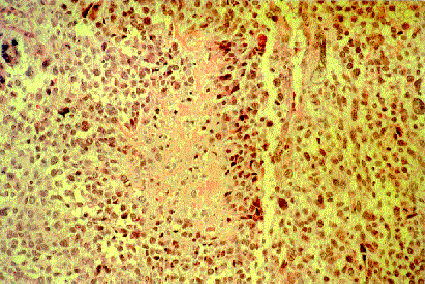
Microscopic features : osteoblastic osteosarcoma with atypical cells elaborating immature osteoid.
Pathology
Osteosarcoma is composed of proliferating spindle-shaped cells that directly produce osteoid or immature bone (fig 1).
Approximately 75 % of osteosarcomas arise in the intramedullary cavity and are referred to as "classical" or "conventional" osteosarcoma (fig 2). "Conventional" osteosarcomas can be divided into histological subtypes according to their predominant stromal differentiation : fibroblastic, telangiectatic and giant-cell rich.
Others types of osteosarcomas are :
Cortex-associated osteosarcomas Low grade (central) osteosarcomas Osteoblastoma-like osteosarcomas Disease-associated osteosarcomas Multicentric osteosarcomas Post-irradiation osteosarcomas Osteosarcoma of the gnathic bones.
Most osteosarcomas are easily recognized based on their hight-grade obviously anaplastic cells and uniquivocal osteoid production. The neoplastic cells in high grade conventional osteosarcomas have marked nuclear pleiomorphism, conspicious chromatin abnormalities, prominent nucleoli and many mitotic figures some of which are atypical. In the fibrosarcomatous pattern of osteosarcoma, the stroma is composed of spindle cells. Osteosarcomas may contain large areas that resemble malignant fibrous histiocytoma.
Approximately 75 % of osteosarcomas arise in the intramedullary cavity and are referred to as "classical" or "conventional" osteosarcoma (fig 2). "Conventional" osteosarcomas can be divided into histological subtypes according to their predominant stromal differentiation : fibroblastic, telangiectatic and giant-cell rich.
Others types of osteosarcomas are :
Most osteosarcomas are easily recognized based on their hight-grade obviously anaplastic cells and uniquivocal osteoid production. The neoplastic cells in high grade conventional osteosarcomas have marked nuclear pleiomorphism, conspicious chromatin abnormalities, prominent nucleoli and many mitotic figures some of which are atypical. In the fibrosarcomatous pattern of osteosarcoma, the stroma is composed of spindle cells. Osteosarcomas may contain large areas that resemble malignant fibrous histiocytoma.
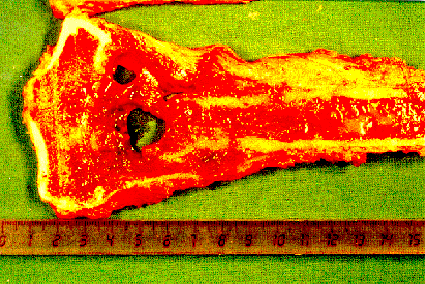
Macroscopy aspect of an osteosarcoma : hemorragic and destructive tumor of the metaphysis of the right tibia. Bilateral rupture of cortical and invasion of epiphyseal plate.
Treatment
Osteosarcoma is a chemosensitive tumor specially to high-dose methotrexate. The usual therapy is 8 to 12 weeks pre-operative chemotherapy, followed by conservative surgery or amputation, then by post-operative chemotherapy adapted to the histological response to pre-operative chemotherapy. But, 30 to 40 % of patients have a bad histological response to pre-operative treatment and a worse long term prognosis.
Prognosis
Molecular events associated with disease aggressiveness and chemotherapy response may serve as prognostic factors.
Age, localisation, tumoral mass, initial metastatic disease are prognostic factors. The most important predictor of outcome at diagnosis is the presence or absence of metastases. The most reliable prognostic factor is the histological response to pre-operative chemotherapy. Elevated expression of P-glycoprotein in immunochemistry was associated with a decreased probability of event-free survival. The expression of HER2/neu may be a predictor of chemotherapy response and prognosis in osteosarcoma. For some authors, it is correlated with a poor survival rate.
At present, RB gene LOH (loss of heterozygosity) appears as an early predictive feature for primary osteosarcomas, indicating a possible unfavourable outcome whereas its absence is correlated with a favourable prognostic.
Age, localisation, tumoral mass, initial metastatic disease are prognostic factors. The most important predictor of outcome at diagnosis is the presence or absence of metastases. The most reliable prognostic factor is the histological response to pre-operative chemotherapy. Elevated expression of P-glycoprotein in immunochemistry was associated with a decreased probability of event-free survival. The expression of HER2/neu may be a predictor of chemotherapy response and prognosis in osteosarcoma. For some authors, it is correlated with a poor survival rate.
At present, RB gene LOH (loss of heterozygosity) appears as an early predictive feature for primary osteosarcomas, indicating a possible unfavourable outcome whereas its absence is correlated with a favourable prognostic.
Cytogenetics
Cytogenetics morphological
The majority of osteosarcomas are characterized by complex chromosomal abnormalities with pronounced cell-to-cell variation or heterogeneity. A high frequency of aneuploidy and numerous structural abnormalities has been described.
High-grade tumors were seen to be hyperdiploïd whereas low-grade tumors were seen to be diploïd.
Nevertheless some authors studied the association between the degree of aneuploidy and prognosis and response to chemotherapy. They reported that patients whose tumors showed a non diploid DNA content had a longer event-free survival after surgical resection and chemotherapy than did those with diploid tumors. The most commonly identified numeric chromosomal abnormalities were gain of chromosome 1 and loss of chromosomes 9, 10, 13 and 17. The chromosomal breakpoints most commonly involved in structural rearrangements include 1p11-13, 1q11-12, 1q21-22, 11p14-15, 14p11-13, 15p11-13, 17 p and 19q13.
High-grade tumors were seen to be hyperdiploïd whereas low-grade tumors were seen to be diploïd.
Nevertheless some authors studied the association between the degree of aneuploidy and prognosis and response to chemotherapy. They reported that patients whose tumors showed a non diploid DNA content had a longer event-free survival after surgical resection and chemotherapy than did those with diploid tumors. The most commonly identified numeric chromosomal abnormalities were gain of chromosome 1 and loss of chromosomes 9, 10, 13 and 17. The chromosomal breakpoints most commonly involved in structural rearrangements include 1p11-13, 1q11-12, 1q21-22, 11p14-15, 14p11-13, 15p11-13, 17 p and 19q13.
Cytogenetics molecular
Many studies were reported in osteosarcomas with comparative genomic hybridization (CGH). DNA sequence copy number increases have been identified on the regions 1q21, 3q26, 6p, 8q, 12q12-13, 14q24-qter, 17p11-12, Xp11.2-21 and Xq12.
The most interesting of these abnormalities are copy number increase at 8q, 1q and 17p. Patients with copy number increases at 8 q have a shorter survival, whereas patients with a copy number increase at 1q21 showed a shorter survival. Amplicon, 17p was identified as in conventional cytogenetic and in CGH.
Ring chromosomes, double minutes and homogeneously staining region are seen in some osteosarcomas. They signify the presence of gene amplification. Ring chromosomes frequently observed in paraosteal osteosarcomas, low-grade tumor, are associated with amplification of DNA at chromosome 12q13-15 in CGH technique. This region contains MDM2 and CDK4 genes.
The most interesting of these abnormalities are copy number increase at 8q, 1q and 17p. Patients with copy number increases at 8 q have a shorter survival, whereas patients with a copy number increase at 1q21 showed a shorter survival. Amplicon, 17p was identified as in conventional cytogenetic and in CGH.
Ring chromosomes, double minutes and homogeneously staining region are seen in some osteosarcomas. They signify the presence of gene amplification. Ring chromosomes frequently observed in paraosteal osteosarcomas, low-grade tumor, are associated with amplification of DNA at chromosome 12q13-15 in CGH technique. This region contains MDM2 and CDK4 genes.
Genes Involved and Proteins
Note
A number of important genes have been identified, including various tumor suppressor genes, oncogenes and genes coding for growth factors. Inactivation of both P53 and RB pathways appears to be a central event in the genesis of osteosarcoma.
Gene name
RB1 (retinoblastoma)
Location
13q14.2
Note
Alterations in the RB gene pathway :
Note
Note
Note
Note
Note
Gene name
TP53 (Tumour protein p53 (Li-Fraumeni syndrome))
Location
17p13.1
Note
Alterations in the P53 pathway :
Inactivation of the p53 pathway is central event in many tumors including osteosarcoma. The p53 gene is located on chromosome 17p13, chromosomal region frequently altered in cytogenetic analysis. Abnormalities of p53 were identified in 50 % of cases. p53 mutations are more often missense type. Alterations of p53 observed in osteosarcoma can be allelic loss (7580 %) or gene rearrangements (10-20 %) or point mutations (20-30 %). In patients with the Li-Fraumeni syndrome who have a germline mutation of p53 they are a high risk of osteosarcoma. And in 3 % of patients with sporadic osteosarcoma, germline mutations in p53 are identified.
Some genes are involved in the regulation of p53 and abnormalities of these are detected in cases of osteosarcoma. The MDM2 gene located on chromosome 12q13 encodes a protein that negatively modulates p53 function by binding the p53 protein. MDM2 is amplified in 5-10 % of osteosarcomas. Another important protein is the p14 product of the INK4 gene. The p14 protein exerts a protective effect on p53. For some authors either or two singular events : INK4A deletion or 12q13 amplification can inactivate two separate pathways of cell cycle control. But direct genetic alteration of both p53 and RB do not co-exist with either INK4A deletion or 12q13 amplification. So, three pathways of cell are possible to induction of an osteosarcoma.
Inactivation of the p53 pathway is central event in many tumors including osteosarcoma. The p53 gene is located on chromosome 17p13, chromosomal region frequently altered in cytogenetic analysis. Abnormalities of p53 were identified in 50 % of cases. p53 mutations are more often missense type. Alterations of p53 observed in osteosarcoma can be allelic loss (7580 %) or gene rearrangements (10-20 %) or point mutations (20-30 %). In patients with the Li-Fraumeni syndrome who have a germline mutation of p53 they are a high risk of osteosarcoma. And in 3 % of patients with sporadic osteosarcoma, germline mutations in p53 are identified.
Some genes are involved in the regulation of p53 and abnormalities of these are detected in cases of osteosarcoma.
Gene name
DCC (deleted in colorectal carcinoma)
Location
18q21.2
Note
Others suppressor genes than RB and p53 can exist in osteosarcomas LOH have been describe on chromosomal region 3q26 and 18q22. On 18q22, is located DCC gene (deleted in colon cancer). Abnormalities of these region are seen in Paget¹s disease where osteosarcoma risk is increased.
Note
Article Bibliography
| Pubmed ID | Last Year | Title | Authors |
|---|---|---|---|
| 10502725 | 1999 | Alteration of pRb/p16/cdk4 regulation in human osteosarcoma. | Benassi MS et al |
| 9140456 | 1997 | Cytogenetic findings in 73 osteosarcoma specimens and a review of the literature. | Bridge JA et al |
| 8636759 | 1996 | Loss of heterozygosity of the RB gene is a poor prognostic factor in patients with osteosarcoma. | Feugeas O et al |
| 11953594 | 2002 | Etiology of osteosarcoma. | Fuchs B et al |
| 10561353 | 1999 | Expression of HER2/erbB-2 correlates with survival in osteosarcoma. | Gorlick R et al |
| 9685858 | 1998 | Association of loss of heterozygosity at the p53 locus with chemoresistance in osteosarcomas. | Goto A et al |
| 11241308 | 2001 | Loss of p16(INK4a) expression correlates with decreased survival in pediatric osteosarcomas. | Maitra A et al |
| 8344751 | 1993 | Cytogenetic findings in 33 osteosarcomas. | Mertens F et al |
| 11257102 | 2001 | The Rb/E2F pathway and cancer. | Nevins JR et al |
| 11950895 | 2002 | Cytogenetics and molecular biology of osteosarcoma. | Ragland BD et al |
| 2259385 | 1990 | Germ-line transmission of a mutated p53 gene in a cancer-prone family with Li-Fraumeni syndrome. | Srivastava S et al |
| 11173637 | 1997 | Allelic Losses from Chromosome 17 in Human Osteosarcomas. | Sztán M et al |
| 9935200 | 1999 | CDK4 gene amplification in osteosarcoma: reciprocal relationship with INK4A gene alterations and mapping of 12q13 amplicons. | Wei G et al |
| 10399948 | 1999 | Characterization of the 17p amplicon in human sarcomas: microsatellite marker analysis. | Wolf M et al |
Citation
Anne-Marie Capodano
Bone: Osteosarcoma
Atlas Genet Cytogenet Oncol Haematol. 2002-09-01
Online version: http://atlasgeneticsoncology.org/solid-tumor/5043/bone-osteosarcoma
