Thyroid: Papillary carcinoma/Adenocarcinoma
2000-08-01 Marco A Pierotti Affiliation1.Istituto Nazionale dei Tumori, Dept. of Experimental Oncology, Via Venezian, 1 20133 Milan, Italy
Classification
Note
Cytogenetics
Cytogenetics morphological
seventy cases of papillary thyroid carcinomas (PTCs) have been reviewed, 51 of them displaying a normal karyotype (73%). In 10 cases non recurrent structural or numerical changes were observed. In particular, 9 cases showed recurrent structural changes including: inv10(q11.2q21.2) in 5 tumors, a t(10;17)(q11.2;q23) in two cases, and a der(1) in the last two tumors
Genes Involved and Proteins
Note
Gene name
RET (REarranged during Transfection)
Location
10q11.21
Protein description
the RET proto-oncogene codes for the tyrosine kinase receptor of GDNF (Glial cell Derived Neurotrophic Factor) and Neurturin (NTN); activation of RET by GDNF or NTN has been shown to require one of two accessory proteins, GDNFRa and GDNFRb.
Germinal mutations
germline mutations of proto-RET result in human diseases including familial medullary thyroid carcinoma MTC, multiple endocrine neoplasia type 2A and 2B (MEN2A and MEN2B) and Hirschsprung¼s disease
Somatic mutations
RET is expressed in the thyroid by normal C cells and their pathologic counterpart, medullary thyroid carcinoma (MTC); moreover, RET expression can be detected in normal adrenal medulla and pheochromocytomas
Gene name
CCDC6 (coiled-coil domain containing 6)
Location
10q21.2
Gene name
AKAP10 (A-kinase anchoring protein 10)
Location
17p11.2
Gene name
NCOA4 (Nuclear Receptor Coactivator 4)
Location
10q11.23
Gene name
NTRK1 (neurotrophic receptor tyrosine kinase 1)
Location
1q23.1
Dna rna description
the NTRK1 proto-oncogene encodes the high affinity receptor for Nerve Growth Factor (NGF)
Protein description
NTRK1 is primarily expressed in the nervous system
Germinal mutations
mice carrying a germline mutation that eliminates NTRK1 show severe sensory and sympathetic neuropathies, including the loss of neurons of the dorsal root ganglia associated with nociceptive functions, and most die within one month of birth; interestingly, point mutations leading to the inactivation of the NTRK1 receptor, have been identified in patient with CIPA (Congenital Insensitivity to Pain with Anhidrosis), an autosomal-recessive disorder characterized by absence of reaction to noxious stimuli; thus NGF signalling via NTRK1 appears essential for the development and maintenance of both the peripheral and central nervous systems
Gene name
TPM3 (tropomyosin 3)
Location
1q21.3
Gene name
TPR (Translocated promoter region)
Location
1q31.1
Gene name
TFG (TRK-fused gene)
Location
3q12.2
Result of the chromosomal anomaly
Note
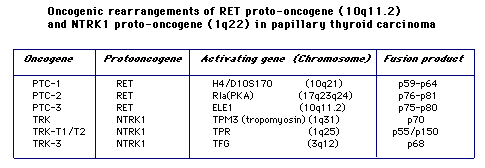
the RET/PTC1 oncogene, represents the first example of oncogene activation in solid tumors due to an acquired chromosomal abnormality
Description
RET/PTC1 is a chimeric transforming sequence generated by the fusion of the TK domain of RET to the 5 terminal sequence of the gene H4/D10S170; both partners in the fusion have been localized to chromosome 10q and their fusion is the molecular event consequent to a paracentromeric inversion of chromosome 10q, inv 10 (q11.2 q21.2)
Oncogenesis
H4/D10S170 has been shown to display a coiled-coil sequence which confers to the oncoprotein the ability to form dimers, resulting in a constitutive activation of the TK function
To be Noted
Note
in fact Ret/ptcs oncoproteins and in some cases Trk oncoproteins were demonstrated to bind and activate PLCg, an SH2-containing enzyme catalyzing the hydrolisis of phosphatydilinositol biphospate to inositol trophoshate and diacyl glicerol, and Shc, an adaptor protein belonging to the Ras pathway; the relocalization in the cytoplasm of RET and NTRK1 enzymatic activity could allow their interaction with unusual substrata, perhaps modifying their functional properties
Article Bibliography
| Pubmed ID | Last Year | Title | Authors |
|---|---|---|---|
| 16946010 | 2007 | RET/PTC rearrangements and BRAF mutations in thyroid tumorigenesis. | Ciampi R et al |
Citation
Marco A Pierotti
Thyroid: Papillary carcinoma/Adenocarcinoma
Atlas Genet Cytogenet Oncol Haematol. 2000-08-01
Online version: http://atlasgeneticsoncology.org/solid-tumor/5053/thyroid-papillary-carcinoma-adenocarcinoma
