Soft Tissues: Well-differentiated liposarcoma
2013-02-01 Andreas F Mavrogenis , Panayiotis J Papagelopoulos Affiliation1.First Department of Orthopaedics, Athens University Medical School, ATTIKON University Hospital, Athens, Greece
Summary
Note
Clinics and Pathology
Epidemiology
Clinics
Well-differentiated liposarcomas are most commonly found in the extremities and the retroperitoneum, and, less often, in the head and neck area. The tumors usually arise from deep-seated, well-vascularized structures, and rarely from submucosal or subcutaneous fat. Patients usually note a deep seated, slow growing mass in their soft tissue. Only when the tumor is very large do symptoms of pain or functional disturbances occur. Retroperitoneal tumors may present with signs of weight loss and abdominal pain, or mass effect to the kidney or ureter leading to kidney failure.
Imaging
- Radiography: May show a faint soft tissue mass or swelling; areas of calcification or bony erosion may be related to dedifferentiation or higher tumor grade. Chest radiography and computed tomography may be used as screening for pulmonary metastases.
- Sonography: Ultrasonography shows a well-circumscribed uniformly hyperechoic mass.
- Computed tomography: Usually shows a lobulated, well-circumscribed mass with multiple septations and variable contrast enhancement. Computed tomography is superior to MR imaging in detailing cortical bone erosion and tumor mineralization.
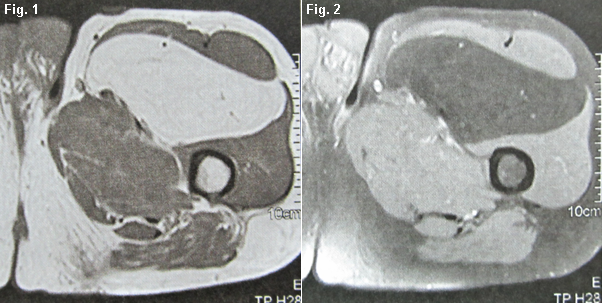
- MR imaging: Well-differentiated liposarcomas have well-defined and mostly lobulated margins. The tumors are encapsulated and composed of mainly fat with septa or nodules. Their signal intensity is intermediate between subcutaneous fat and muscle; well-differentiated liposarcomas are hyperintense on T2-weighted images, and they demonstrate faint enhancement or no enhancement after the intravenous administration of contrast material, and linear septations. Diffuse enhancement is usually observed following gadolinium administration. There may be incomplete fat suppression because of the nature and amount of lipids.
- Scintigraphy: An early-phase bone scan may show a marked increase of radioisotopic uptake.
Pathology
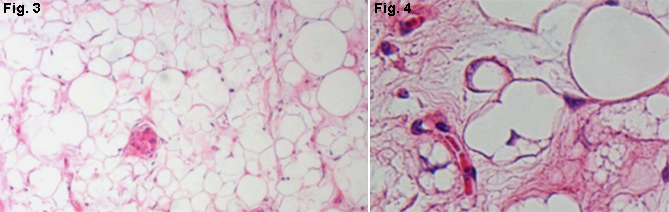
Microscopically: Light microscopy typically shows mature adipocytic cells, atypical stromal cells and limited number of scattered lipoblasts. Four sybtypes have been distinguished:
- Adipocytic or Lipoma-like: the most common form; it is composed of a relatively mature adipocytic proliferation in which, in contrast to benign lipoma, significant variation in cell size, focal adipocytic nuclear atypia and hyperchromasia, and scattered hyperchromatic as well as multinucleate stromal cells are often identified (see figure 3 and 4).
- Sclerosing: the second in frequency, most often seen in retroperitoneal or paratesticular lesions. It is characterized by the presence of scattered bizarre stromal cells, marked nuclear hyperchromasia and rare multivacuolated lipoblasts set in an extensive fibrillary collagenous stroma. Occasionally, the fibrous component may represent the majority of the neoplasm.
- Inflammatory: rare variant, most often seen in the retroperitoneum. A chronic inflammatory infiltrate predominates to the extent that the adipocytic nature of the neoplasm can be obscured.
- Spindle cell: it is composed of a fairly bland neural-like spindle cell proliferation set in a fibrous and/or myxoid stroma, and an atypical lipomatous component which usually includes lipoblasts.
Interpretative difficulties arise when atypical lipomatous tumors contain fibrous or myxoid areas whose cellularity and mitotic rate are higher than in the typical tumors but lower than in the typical dedifferentiated component of dedifferentiated liposarcoma. Many studies pointed out that the cut-off portion of myxoid and fibrous areas with higher mitotic rate and cellularity is uncertain. This portion has been regarded 1 cm (up to 3 cm in large tumors) and considered as a sign of low-grade dedifferentiation from the very beginning.
Similarity to large deep-seated lipomas is also a diagnostic problem. Several authors proposed a positivity in over-expression of MDM2, HMGA2 and CDK4 as a reliable hallmark to distinguish between these two entities, and genetic differences between low and higher grade liposarcomas. Others reported that CDK4 in ALT/WD liposarcomas is expressed inconsistently and is associated with adverse prognosis compared to the MDM2/CDK4 genotype.
Differential diagnosis: Lipoma; lipoblastoma; hibernoma; neurofibroma. Cytogenetics may be of value when diagnosing lipomatous tumors because different tumor types have different more or less specific chromosomal abnormalities.
Cytogenetics
Genes
Recently, immunostaining of cdk4 and mdm2 proteins has been recognized as a valuable method for the differentiation of benign lipoma from well-differentiated liposarcoma. Furthermore, ki-67 expression is associated with progression of soft tissue sarcomas.
Treatment
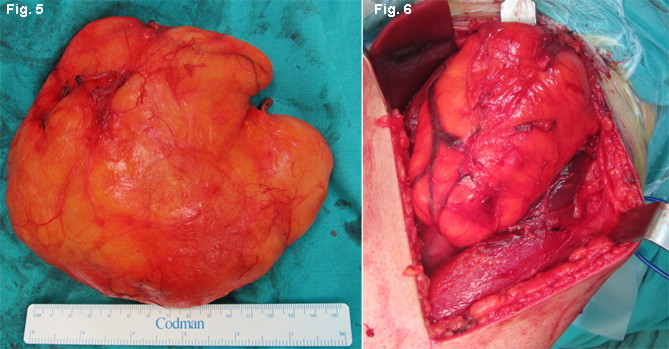
Given the favorable outcome with wide surgical excision alone, regardless of the histologic type of the tumor, some authors believe that adjuvant radiation therapy is unjustified. However, in patients with large high-grade liposarcomas may benefit from multimodality treatment with chemotherapy and radiation. Radiation therapy may be a valuable adjunct to surgery, especially if other than wide margins of resection. The use of chemotherapy in liposarcomas remains experimental. The grade of well-differentiated liposarcomas provides no incremental information over other histological subtypes in terms of response to therapy.
Prognosis
Article Bibliography
| Pubmed ID | Last Year | Title | Authors |
|---|---|---|---|
| 15593324 | 2005 | Deep-seated, well differentiated lipomatous tumors of the chest wall and extremities: the role of cytogenetics in classification and prognostication. | Bassett MD et al |
| 10982304 | 2000 | Liposarcoma: new entities and evolving concepts. | Dei Tos AP et al |
| 17197914 | 2007 | Atypical lipomatous tumor, its variants, and its combined forms: a study of 61 cases, with a minimum follow-up of 10 years. | Evans HL et al |
| 15154619 | 2004 | Well-differentiated liposarcoma associated with benign lipoma. | Hatano H et al |
| 19737942 | 2009 | Clinical and biological significance of CDK4 amplification in well-differentiated and dedifferentiated liposarcomas. | Italiano A et al |
| 14699038 | 2004 | Atypical lipomatous tumor/well-differentiated liposarcoma of the extremity and trunk wall: importance of histological subtype with treatment recommendations. | Kooby DA et al |
| 11757865 | 2001 | Well-differentiated liposarcoma (atypical lipomatous tumors). | Laurino L et al |
| 7942636 | 1994 | Well-differentiated liposarcoma. The Mayo Clinic experience with 58 cases. | Lucas DR et al |
| 22146207 | 2011 | Atypical lipomatous tumors/well-differentiated liposarcomas: clinical outcome of 67 patients. | Mavrogenis AF et al |
| 17954275 | 2007 | Pairwise comparison of genomic imbalances between primary and recurrent well differentiated liposarcomas. | Micci F et al |
| 11964652 | 2002 | Atypical lipomatous masses of the extremities: outcome of surgical treatment. | Rozental TD et al |
| 16173997 | 2005 | Clinical outcomes of deep atypical lipomas (well-differentiated lipoma-like liposarcomas) of the extremities. | Sommerville SM et al |
| 12792777 | 2003 | Ring chromosomes and low-grade gene amplification in an atypical lipomatous tumor with minimal nuclear atypia. | Storlazzi CT et al |
| 20495536 | 2010 | Can MDM2 analytical tests performed on core needle biopsy be relied upon to diagnose well-differentiated liposarcoma? | Weaver J et al |
Citation
Andreas F Mavrogenis ; Panayiotis J Papagelopoulos
Soft Tissues: Well-differentiated liposarcoma
Atlas Genet Cytogenet Oncol Haematol. 2013-02-01
Online version: http://atlasgeneticsoncology.org/solid-tumor/5167/soft-tissues-well-differentiated-liposarcoma
