11q23 rearrangements (KMT2A) in leukaemia
2003-08-01 Jean-Loup Huret Affiliation1.Genetics, Dept Medical Information, University of Poitiers, CHU Poitiers Hospital, F-86021 Poitiers France
Clinics and Pathology
Disease
de novo and therapy related leukaemias; acute myeloid leukaemia (AML) and acute lymphocytic leukaemia (ALL) grossly represent half cases each; myelodysplasia (MDS) in the remaining 5%; biphenotypic leukaemia at times (likely to be more frequent with more investigations); 11q23 rearrangements in treatment related leukaemias (5-10% of 11q23 cases) are found mainly following a treatment with anti-topoisomerase II, or an intercalating topoisomerase II inhibitor, but also after alkylating agents treatment and/or radiotherapy; the prior cancer is variable.
Phenotype stem cell origin
AML: M5a in half cases, M4 (20%), M1 or M5b (10% each), M2 (5%); ALL: B-cell mostly, L1 or L2, CD19+ in 60% of B-ALL cases, CD10+ 35%; T-ALL in rare cases (
Epidemiology
25% are infant (
Clinics
organomegaly; frequent CNS involvement (5%); high WBC (> 50 X 109/l in 40%).
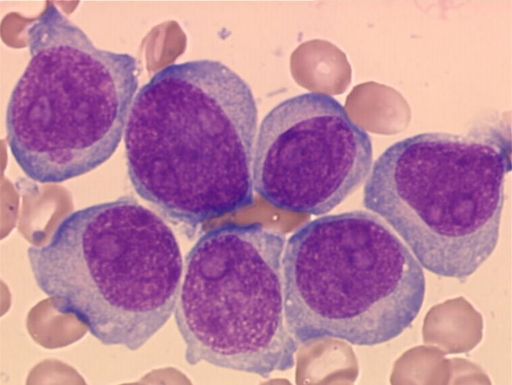
Molecular studies have identified a human homologue of the drosophila trithorax gene (designed HRX or MLL). MLL is a developmental regulator and is structurally altered in leukemia associated translocations that show an abnormality at band 11q23. The MLL gene on 11q23 is involved in a number of translocations with different partner chromosomes. The most common translocations observed in childhood AML are the t(9;11)(p21;q23) and the t(11;19)(q23;p13.1); other translocations of 11q23 involve at least 30 different partners chromosomes. Molecular studies have shown that MLL is rearranged more frequently than is revealed by conventional cytogenetic studies. A partial tandem duplication of MLL gene has also been reported in the majority of adult patients whose leukemic blast cells have a +11 and in some with normal karyotype. There is a strong association between AML M5/M4 and deletion and translocations involving 11q23. Sometimes cases of 11q23 M5B and M4, and occasionally M2 or M1 also show MLL rearrangement. Two clinical subgroups of patients have a high frequency of 11q23 aberration and M5 subtypes: one is AML in infants with MLL rearrangement in about 50% of cases; the other group is "secondary leukemia" (sAML) potentially after treatment with DNA topoisomerase II inhibitors. In general the translocations in these leukemia are the same as those occurring in "de novo" leukemia i.e. t(9;11), t(11;19) - Text and iconography Courtesy Georges Flandrin 2001.
Prognosis
very poor in general; variable according to the translocation, the phenotype, the age , and whether the leukaemia is de novo or treatment related.
Cytogenetics
Cytogenetics morphological
Additional anomalies
+X and i(7q) in the t(4;11); +8, +19, +21 in the t(6;11); +8 and +19 in the t(9;11); inv(11) in the t(10;11); +X, +6 and +8 in the 19p13.3; +8 in the 19p13.1
Genes Involved and Proteins
Gene name
KMT2A (myeloid/lymphoid or mixed lineage leukemia)
Location
11q23.3
Dna rna description
21 exons, spanning over 100 kb; 13-15 kb mRNA; coding sequence: 11.9 kb.
Protein description
431 kDa; contains two DNA binding motifs (a AT hook, and Zinc fingers), a DNA methyl transferase motif, a bromodomain; transcriptional regulatory factor; nuclear localisation; wide expression; homology with trithorax (drosophila).
Gene name
variable gene, from a variable chromosome partner (see above)
Dna rna description
these genes appear to have, in most cases, no apparent homology to each other; for DNA and protein description of each, refer to their gene entry.
Result of the Chromosomal Anomaly
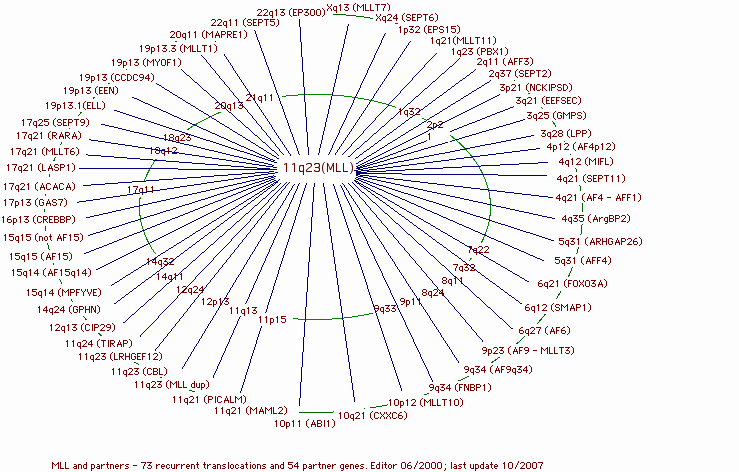
MLL and partners - Editor, 06/2000, last update 09/2001. We implore researchers not to discover further MLL partners: there is no more room.
Description
5 MLL- 3 partner; highly variable breakpoints on the partnerN-term AT hook and DNA methyltransferase from MLL fused to (little or most of) the partner C-term part; the reciprocal ( partner-MLL) may or may not be expressed.
Article Bibliography
| Pubmed ID | Last Year | Title | Authors |
|---|---|---|---|
| 2177642 | 1990 | Implication of prior treatment with drug combinations including inhibitors of topoisomerase II in therapy-related monocytic leukemia with a 9;11 translocation. | Albain KS et al |
| 9479491 | 1998 | Cloning and characterization of three human forkhead genes that comprise an FKHR-like gene subfamily. | Anderson MJ et al |
| 7542910 | 1995 | Molecular basis of 11q23 rearrangements in hematopoietic malignant proliferations. | Bernard OA et al |
| 10908648 | 2000 | The human GRAF gene is fused to MLL in a unique t(5;11)(q31;q23) and both alleles are disrupted in three cases of myelodysplastic syndrome/acute myeloid leukemia with a deletion 5q. | Borkhardt A et al |
| 9885982 | 1999 | MLL is involved in a t(2;11)(p21;q23) in a patient with acute myeloblastic leukemia. | Fleischman EW et al |
| 9593286 | 1998 | Ten novel 11q23 chromosomal partner sites. European 11q23 Workshop participants. | Harrison CJ et al |
| 10980622 | 2000 | AF15q14, a novel partner gene fused to the MLL gene in an acute myeloid leukaemia with a t(11;15)(q23;q14). | Hayette S et al |
| 8426468 | 1993 | Cytogenetic heterogeneity in t(11;19) acute leukemia: clinical, hematological and cytogenetic analyses of 48 patients--updated published cases and 16 new observations. | Huret JL et al |
| 9389684 | 1997 | Adenoviral E1A-associated protein p300 is involved in acute myeloid leukemia with t(11;22)(q23;q13). | Ida K et al |
| 2674563 | 1989 | Characteristics of trisomy 11 in childhood acute leukemia with review of the literature. | Ingram L et al |
| 9593288 | 1998 | Derivative chromosomes of 11q23-translocations in hematologic malignancies. European 11q23 Workshop participants. | Johansson B et al |
| 3496135 | 1987 | Acute leukemia with chromosome translocation (4;11): 7 new patients and analysis of 71 cases. | Lampert F et al |
| 9593284 | 1998 | The t(10;11)(p12;q23) translocation in acute leukaemia: a cytogenetic and clinical study of 20 patients. European 11q23 Workshop participants. | Lillington DM et al |
| 9593282 | 1998 | The t(6;11)(q27;q23) translocation in acute leukemia: a laboratory and clinical study of 30 cases. EU Concerted Action 11q23 Workshop participants. | Martineau M et al |
| 9600980 | 1998 | t(11;22)(q23;q11.2) In acute myeloid leukemia of infant twins fuses MLL with hCDCrel, a cell division cycle gene in the genomic region of deletion in DiGeorge and velocardiofacial syndromes. | Megonigal MD et al |
| 9593285 | 1998 | The translocations, t(11;19)(q23;p13.1) and t(11;19)(q23;p13.3): a cytogenetic and clinical profile of 53 patients. European 11q23 Workshop participants. | Moorman AV et al |
| 8161808 | 1994 | Childhood acute lymphoblastic leukemia with the t(4;11)(q21;q23): an update. | Pui CH et al |
| 1991161 | 1991 | Clinical characteristics and treatment outcome of childhood acute lymphoblastic leukemia with the t(4;11)(q21;q23): a collaborative study of 40 cases. | Pui CH et al |
| 9226152 | 1997 | All patients with the T(11;16)(q23;p13.3) that involves MLL and CBP have treatment-related hematologic disorders. | Rowley JD et al |
| 8558942 | 1996 | 11q23 rearrangements in acute leukemia. | Rubnitz JE et al |
| 7837391 | 1995 | Self-fusion of the ALL1 gene. A new genetic mechanism for acute leukemia. | Schichman SA et al |
| 9593290 | 1998 | Secondary acute leukemia and myelodysplastic syndrome with 11q23 abnormalities. EU Concerted Action 11q23 Workshop. | Secker-Walker LM et al |
| 9593283 | 1998 | Hematological malignancies with t(9;11)(p21-22;q23)--a laboratory and clinical study of 125 cases. European 11q23 Workshop participants. | Swansbury GJ et al |
| 10588740 | 1999 | AF5q31, a newly identified AF4-related gene, is fused to MLL in infant acute lymphoblastic leukemia with ins(5;11)(q31;q13q23). | Taki T et al |
| 9694699 | 1998 | ABI-1, a human homolog to mouse Abl-interactor 1, fuses the MLL gene in acute myeloid leukemia with t(10;11)(p11.2;q23). | Taki T et al |
| 8977038 | 1996 | Chromosome abnormalities in leukaemia: the 11q23 paradigm. | Young BD et al |
Citation
Jean-Loup Huret
11q23 rearrangements (KMT2A) in leukaemia
Atlas Genet Cytogenet Oncol Haematol. 2003-08-01
Online version: http://atlasgeneticsoncology.org/haematological/1030/11q23-rearrangements-(kmt2a)-in-leukaemia
Historical Card
2001-01-01 11q23 rearrangements (KMT2A) in leukaemia by Jean-Loup Huret Affiliation
Genetics, Dept Medical Information, University of Poitiers, CHU Poitiers Hospital, F-86021 Poitiers France
1998-08-01 11q23 rearrangements (KMT2A) in leukaemia by Jean-Loup Huret Affiliation
Genetics, Dept Medical Information, University of Poitiers, CHU Poitiers Hospital, F-86021 Poitiers France
